
Why Do I Feel Numb? Causes, Warning Signs, and First Steps
You're sitting on the couch after a normal day. Someone you love is talking, maybe even sharing good news, and you know how you're supposed to react. You nod, you say the right thing, but inside there's almost nothing. Not sadness, exactly. Not joy either. Just flat.
If you've been asking yourself 'Why do I feel numb?', that mismatch between what you know you care about and what you can feel is often the part that worries people most.
Table of Contents
Why Feeling Numb Is More Common Than You Think - You Don't Need a Diagnosis to Take This Seriously
What Emotional Numbness Actually Feels Like - Everyday Ways It Shows Up
When Depression and Anxiety Flatten Your Feelings - Patterns That Fit a Mood Explanation
Dissociation and the Body's Shutdown Response - What to Track for Two Weeks
Medication, Burnout, and Chronic Stress as Causes - Timing Is the Clue to Bring to Your Prescriber
When to Get Professional Help and What to Expect - Warning Signs That Raise the Urgency
Why Feeling Numb Is More Common Than You Think
Feeling numb usually means something has turned down your emotional volume. It isn't a character flaw, and it isn't usually one standalone condition on its own. Think of it more like a symptom, a signal that can come from mood, stress, trauma, medication, exhaustion, or a medical issue, and different causes call for different next steps.
That's where people get stuck. Two people can both say "I feel nothing" and mean very different things. One person has lost interest and pleasure along with their energy. Another feels detached, almost outside their body. A third feels muted since a medication change. If you treat all three the same way, you can miss what's happening.
You Don't Need a Diagnosis to Take This Seriously
You don't have to wait until numbness becomes a crisis, and you don't need a label before you're allowed to notice it. A more useful starting point is curiosity about the pattern.
When did it start: Was there a stressor, loss, illness, or medication change nearby?
What travels with it: Low mood, anxiety, poor sleep, unreality, or memory gaps each point in a different direction.
What it costs you: If work, relationships, or basic self-care are getting harder, that's relevant information.
Numbness isn't proof that you don't care. Often it's proof that your system has been carrying more than it can process comfortably.
Sorting the pattern first keeps you from jumping to the easiest explanation, like assuming you're lazy, cold, or broken. Those explanations feel familiar to a lot of people, but they rarely help you decide what to do next.
What Emotional Numbness Actually Feels Like
Emotional numbness is a reduced ability to feel both positive and negative emotions. That's the detail people miss. It's not just feeling sad, and it's not the same as feeling calm. Calm still leaves you present and responsive. You can laugh, get annoyed, feel moved, or settle again. Numbness blurs all of that.
A useful analogy is a radio turned down so far that you can tell something is playing, but you can't make out the song. The static gets quieter too. Good news arrives and you register it intellectually. Something painful happens and you think, I should be crying, but the tears don't come.

Everyday Ways It Shows Up
For one person, it's sitting across from friends at dinner and performing interest while feeling oddly far away. For another, it's getting through meetings, texts, and errands on autopilot, then realizing the whole day feels thin in memory.
Flat reactions: A promotion, a kind message, or time with people you love lands with a muted thud.
Difficulty crying or getting angry: Emotions that used to move through you feel blocked or distant.
Loss of pull toward favorite things: Music, food, sex, hobbies, or plans stop registering as appealing.
Going through the motions: You're functioning on the outside, but internally you feel like you're watching from a distance.
Blankness when asked how you feel: "Fine," "nothing," or "I don't know" may be the only words available.
It can be constant, or it can come and go. Some people feel blank for an afternoon during intense stress. Others notice weeks of emptiness where even small pleasures barely register. The length, timing, and company it keeps are what help you sort out the cause.
When Depression and Anxiety Flatten Your Feelings
Depression and anxiety are common reasons emotional responsiveness drops. Depression can involve diminished interest or pleasure, low energy, impaired concentration, sleep or appetite changes, and a reduced ability to experience emotion. Anxiety and prolonged stress can work differently. After being on alert for a long time, your system may produce a protective shutdown, leaving you detached, flat, or unable to access feelings.
The scale helps explain why clinicians ask about mood early. The World Health Organization fact sheet on mental disorders notes that 322 million people were living with depression in 2023, including 43 million children and adolescents, while 470 million people were living with an anxiety disorder in that same year. Those numbers don't mean everyone with depression or anxiety feels numb. They also don't mean numbness automatically equals a diagnosis. They show that the conditions linked to flattened emotion are widespread, so the pattern deserves a careful look.
Patterns That Fit a Mood Explanation
Ask what else changed alongside the numbness. Depression becomes more plausible when flatness sits next to persistent low mood, hopelessness, loss of pleasure, or major sleep and appetite shifts. Anxiety fits more when numbness follows prolonged worry, panic, or overload, especially if you swing between feeling keyed up and feeling shut down.
Clinical literature also shows numbness can linger as other symptoms shift. In a survey summarized in a review of emotional blunting in depression, severe blunting was reported by nearly three-quarters of 752 people with depression in the acute phase and one-quarter of those in remission. In plain terms, your mood can improve somewhat while emotional responsiveness still lags behind. That isn't unusual, and it doesn't mean you're doing recovery wrong.
A useful question: If the numbness lifts, even briefly, during rest, connection, or a lower-stress day, note that. Fluctuation tells you something about what your system responds to.
Duration matters too. A flat evening after bad news is different from numbness that lasts for weeks and starts interfering with relationships or work.
Dissociation and the Body's Shutdown Response
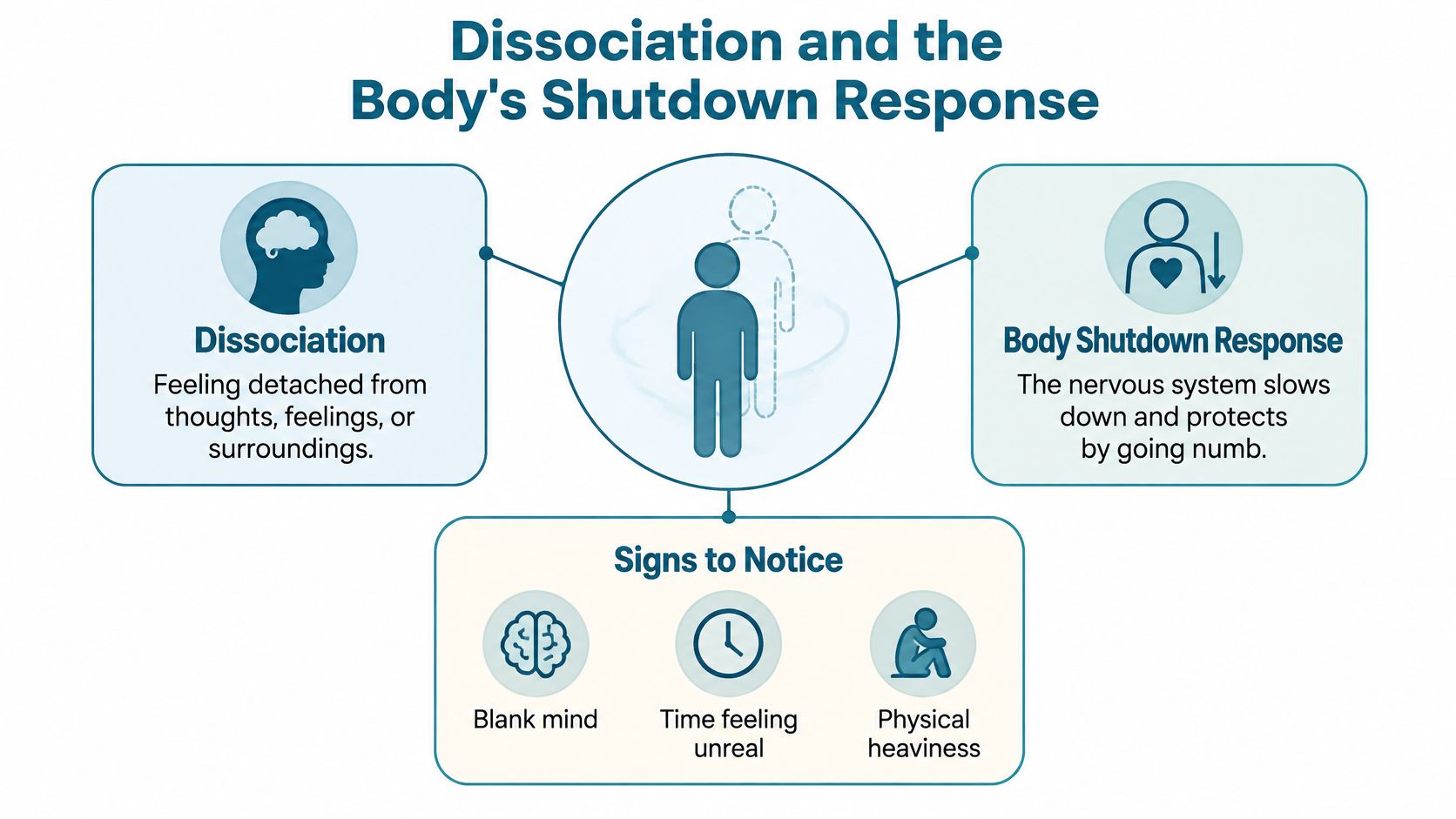
Dissociation is a different mechanism. Instead of emotions feeling lower, you may feel detached from your emotions, memories, surroundings, body, or sense of self. People describe feeling behind glass, unreal, spaced out, or like they're observing life rather than living it. NHS trauma guidance describes dissociation as "shutting off" and losing awareness of what's happening around you in its resource on supporting people after traumatic events.
That shutdown can be protective. When stress feels overwhelming, attention narrows toward threat or pulls away from ordinary emotional processing. The result may be blankness, heaviness, time loss, or gaps in memory. It differs from ordinary calm because presence drops. You might miss part of a conversation, feel disconnected from your hands, or struggle to know what you're feeling at all.
Trauma is one important context, though not the only one. A systematic review and meta-analysis of the dissociative subtype of PTSD estimated that this subtype affected 38.1% of people with PTSD across included samples, with estimates varying by method. You shouldn't use a percentage to diagnose yourself. The point is simpler. For some people, disconnection is a trauma-related protective response, not a failure to care.
What to Track for Two Weeks
A brief log can make episodes easier to explain to a clinician and easier for you to understand.
Trigger and timing: Arguments, trauma reminders, panic, exhaustion, cannabis or alcohol, or no clear trigger.
Duration and body signs: Minutes or hours, heaviness, blank mind, unreality, or reduced awareness.
Sleep and grounding response: How you slept, and whether sensory grounding helped you come back.
During an episode, orient yourself to the room. Name colors, sounds, textures, and where your feet are. Slow your exhale, eat and hydrate regularly, and stabilize sleep where you can. If awareness is impaired, don't drive. The U.S. Department of Veterans Affairs page on DSM-5 criteria for PTSD is a reminder that post-traumatic symptoms are assessed across several domains, not from numbness alone.
Medication, Burnout, and Chronic Stress as Causes
It's easy to assume numbness says something fixed about your personality. You're just not an emotional person. You're too logical. You don't try hard enough. Medication effects and burnout complicate that story, and they're often overlooked.
Antidepressants can reduce overwhelming distress while also muting positive and negative emotions. That experience is often called emotional blunting, and it can reflect residual depression, medication effects, or both. A systematic review of apathy associated with antidepressant drugs reported one study finding blunting in 46% of 669 people receiving antidepressant monotherapy, while noting rates vary by drug, sample, and measurement method.
Timing Is the Clue to Bring to Your Prescriber
Map the sequence instead of guessing. Did numbness exist before treatment, or did it appear or intensify after starting or increasing a dose? Note motivation, pleasure, empathy, sexual interest, and daily functioning alongside the date of any change. Those notes give your prescriber something concrete to work with.
Don't stop an antidepressant abruptly because you feel flat. Discuss dose, timing, alternatives, and whether depression itself still needs treatment. That conversation isn't complaining. Loss of emotional range affects relationships and quality of life, so it belongs in treatment planning.
Burnout pattern: Prolonged overload leaves you detached and depleted, and rest doesn't restore you the way it used to.
Chronic stress pattern: You may mistake muted feelings for finally being stable, when you're running on empty.
ADHD and overwhelm: For adults with ADHD, anxiety, or substance-use concerns, shutdown after sustained demand can be misread as indifference or poor motivation.
If end-of-day depletion is familiar, our perspective on feeling tired after work and what it can signal may help you separate ordinary tiredness from a deeper pattern of overload.
How to Tell Which Cause Fits Your Pattern
The same phrase, “I feel nothing,” can describe different experiences. You might feel detached from your body or surroundings, notice little pleasure or motivation, or struggle to identify what you feel. The details around the numbness help distinguish these patterns.
Pattern You Notice | Possible Explanation | Reasonable Next Step |
|---|---|---|
Unreality, feeling outside your body, or gaps in memory | Dissociation | Note when episodes happen and discuss them with a clinician |
Less pleasure, hopelessness, or changes in sleep or appetite | Depression | Consider an evaluation, especially if these changes persist |
Numbness began after starting or increasing medication | Medication effect, residual depression, or both | Share the timeline with your prescriber; don't stop medication suddenly |
Feeling flat after ongoing demands, poor sleep, or dread | Burnout or chronic stress | Look at workload, rest, sleep, and available support |
Bodily tension without a clear name for the feeling | Difficulty identifying emotions, or overwhelm | Notice sensations and try naming emotions in small steps |
Sudden physical numbness with weakness, confusion, speech trouble, severe headache, or facial drooping | Possible medical emergency | Seek urgent medical evaluation |
These patterns are clues, not diagnoses, and more than one cause can be present. For example, anxiety and dissociation can occur together, while ongoing stress can make it harder to identify what you feel. If overload seems central, learn more about why you may feel overwhelmed all the time.
A useful question is: “What else is happening when I feel numb, and when does it shift?” The answer can help you choose what to discuss with a professional or prescriber.
When to Get Professional Help and What to Expect
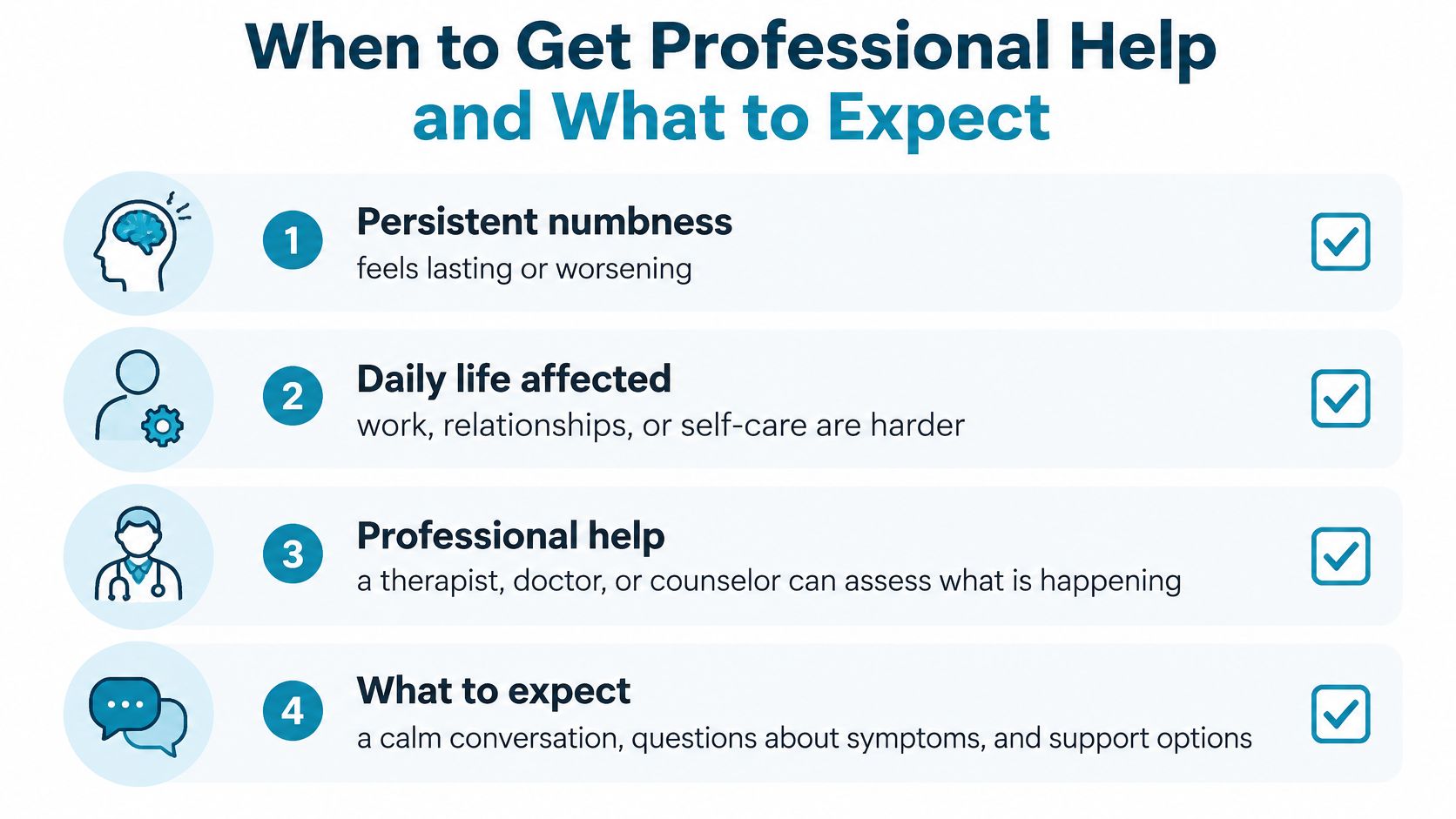
Self-observation is useful, but it has limits. Get a professional evaluation when numbness lasts for weeks, interferes with work or relationships, follows a major stressor, or appears alongside hopelessness or thoughts of self-harm. If safety is at risk, immediate help is appropriate. You don't need to prove it's bad enough first.
Warning Signs That Raise the Urgency
Persistent or worsening numbness: It isn't fluctuating back toward your baseline.
Daily life is shrinking: Work, relationships, concentration, or self-care are harder.
Other symptoms are present: Hopelessness, suicidal thoughts, major sleep or appetite changes, panic, memory gaps, or inability to function.
Physical red flags: Sudden weakness, speech difficulty, confusion, facial drooping, or severe headache needs urgent medical care, not watchful waiting.
Treatment should also be reviewed when it isn't helping. NICE guidance on depression in adults recommends reassessing the treatment plan when depression hasn't responded after four weeks of antidepressant treatment at a therapeutic dose, or after four to six weeks of psychological therapy or combined treatment. Persistent numbness fits that same principle. It's clinical information, not a personal failure.
Therapy itself doesn't require a polished explanation. Clients do not need a diagnosis or a perfectly clear reason for being in therapy to get started. They also do not need to know exactly what they want to work on before starting therapy, because part of therapy is figuring that out together. A first conversation may cover timing, mood, stress, relationships, sleep, substance use, medication, and safety. Therapy complements medical evaluation and medication management rather than replacing them, and high-functioning people seek that kind of sorting too, as discussed in our page about finding a therapist for high achievers.
First Steps to Take Now and Your Next Move
Start smaller than solving your whole emotional life. This week, keep a simple log. Note when numbness shows up, how long it lasts, how you slept, what stress or substances were involved, and what else you notice in your body. You're not collecting perfect data. You're looking for a pattern you can describe.
When detachment hits, try grounding before you analyze. Look around and name what you see, feel your feet on the floor, hold something cold or textured, and breathe with a slower exhale. If medication may be involved, bring your timeline to one conversation with your prescriber or doctor. If numbness is new, physical, or paired with neurological symptoms, get medical care urgently.
The short video below offers another way to think through mental-health habits while you consider your next step.
Understanding numbness is a reasonable goal on its own. You don't have to arrive with the right words or a finished theory about yourself. Nick begins therapy by getting to know your personality, relationships, values, and the way you make sense of your life. His guiding idea from his own therapy experience is that people need to feel understood enough to grow.
If you'd like a place to sort this through in person in Washington, D.C., or virtually in D.C. and Virginia, consider scheduling an initial consultation with Nick Donahue, LICSW. Bring whatever you have, even if it's mostly "I feel numb and I don't know why," and we can start there together.
Comments