
Dealing with Relationship Jealousy: A Clear Plan To Move Through It
Your partner's phone lights up with a familiar name. Or they've been quiet all evening, but they've somehow had time to like a post. Before you've decided what happened, you're rereading messages, comparing yourself with someone else, or drafting a question that's really an accusation.
Learning how to deal with relationship jealousy starts with separating the feeling from what you do next. Jealousy is a sequence you can interrupt, not proof of betrayal or a permanent flaw in your character. Settle the immediate reaction, identify what you know, and decide whether you need to make a request, negotiate a boundary, or address a safety problem.
Table of Contents
A Plan for the Next Jealous Moment - Record the sequence without building a case - Delay the urge before making a request - Make the request, then evaluate what happened
Why Jealousy Changes From One Relationship to the Next - Relationship conditions matter
When Checking Crosses a Safety Line - Digital checking isn't a reliable trust repair - When the perceived rival isn't in the room
Words That Ask for One Specific Thing - Requests about replies and friendships - Requests about online contact and older fears
Common Questions About Relationship Jealousy - Is feeling jealous a sign that something is wrong with me? - Can jealousy fade on its own? - Does ADHD make jealousy stronger?
Choosing Individual Work or a Shared Conversation - When individual work is the better starting place - When the work belongs between you
A Plan for the Next Jealous Moment
You don't need to solve the relationship while your chest is tight and your thumb is hovering over your partner's profile. Start by making enough room to choose your next action. If there are threats, coercive monitoring, stalking, or violence, skip communication practice and prioritize the safety guidance below.
The practical sequence is to record what happened, separate observation from prediction, delay the urge, make a specific request, and review the result. A study available through PubMed Central found that lower trust was associated with greater cognitive and behavioral jealousy, supporting attention to both the thoughts you have and the actions you take. This isn't a tested guarantee that a particular coping routine will resolve jealousy.
Record the sequence without building a case
For one to two weeks, keep a brief note of the trigger, your automatic interpretation, emotional intensity, urge, and what you did. Use your phone's Notes app or a notebook, whichever you'll open. The purpose is to recognize your own sequence, not assemble a dossier on your partner.
Say you notice your partner has commented on an ex's photo. Your note might look like this:
Trigger: I saw a friendly comment under an ex's photo.
Interpretation: They're reconnecting and I'm about to be replaced.
Intensity: Rate the feeling from 0 to 100.
Urge: Search older posts, inspect followers, and ask a loaded question.
Behavior: Put the phone away, or record that you kept checking.
Keep the entry short enough that it doesn't become another form of rumination. You're looking for useful patterns, such as whether uncertainty after an argument feels different from uncertainty on an otherwise connected day.
Next, divide the note into observable facts and threat predictions. A comment is observable. Your partner's intention, or what you imagine will happen next, may not be.
This isn't an instruction to dismiss evidence. If your partner broke an agreement, write down the agreement and the behavior that violated it. If you don't know what the behavior means, leave that space open rather than filling it with either the worst explanation or forced optimism.
Delay the urge before making a request
Give yourself 20 to 30 minutes without checking, interrogating, or asking for reassurance. During that pause, press your feet into the floor, notice the room around you, and breathe gently with an unforced, slower exhale. Don't spend the interval composing a prosecution in your head.
For a fast-moving ADHD brain, the pause needs to be visible. Put a reminder on your lock screen, start a timer, or leave the phone somewhere that requires standing up to retrieve it. These supports make the intended response easier to access when remembering it is difficult.
The next gate is emotional readiness. Use below about 40 out of 100 as a practical cue to reconsider the conversation, not as a medically validated cutoff; a study of emotion regulation and jealousy available through PubMed Central examined how emotional suppression related to jealousy-associated guarding behaviors, rather than establishing a universal threshold for talking.
Ask whether you can hear an answer you don't expect without immediately arguing against it. If you can't, postpone the discussion and choose a clear time to return.
Practical rule: You can take your feeling seriously without treating its explanation as established fact.
Name the fear under the reaction. It may be abandonment, humiliation, or the thought that you're not enough. Then choose something that doesn't follow the urge: write a balanced alternative explanation, soothe yourself, or postpone a message rather than sending it.
You're not trying to suppress the feeling. You're allowing it to be present without making it responsible for your behavior.
Make the request, then evaluate what happened
When you're ready, describe an observation and ask for something concrete. Your partner should be able to understand what you're requesting without first defending their entire character. You'll find examples of that language below.
Later, consider whether the exchange helped you understand each other or merely relieved anxiety until the next trigger. A useful response may still feel uncomfortable. You might accept an answer, tolerate some uncertainty, and choose not to investigate further.
Five-step response when jealousy spikes
Step | What you do | Timing | It worked if |
|---|---|---|---|
Log the spike | Trigger, interpretation, intensity 0–100, urge, behavior | 1–2 weeks of notes | You can see the pattern without acting on it |
Separate fact from prediction | Write only what you could show someone else | A few minutes | The story is labeled as a story |
Delay the urge | No checking, interrogation, or reassurance-seeking; breathe or ground | 20–30 minutes | The urge peaks and starts to fall |
Make one request | One observation and one specific ask, no accusation | When intensity is lower | The partner can answer without defending a character attack |
Review the result | Did this build trust or only cut anxiety? | Later the same day | Checks drop and requests get clearer |
Watch for some common misses. Validation means acknowledging that someone hurts, not agreeing that their fear is accurate. Asking for consideration is different from demanding certainty that no partner can provide, and talking at an intensity of 80 out of 100 is unlikely to produce a careful conversation.
Phone searches and repeated reassurance can give immediate relief while strengthening the habit of responding to uncertainty by checking. If you keep mentally reopening the same question, understanding how anxiety contributes to overthinking can help you recognize when reflection has stopped being useful.
Progress means fewer checks, shorter periods of rumination, and clearer requests. It doesn't require never feeling jealous again.
Why Jealousy Changes From One Relationship to the Next
Feeling jealous doesn't make you possessive by nature, and it doesn't establish that your partner has lied. Romantic jealousy is a complex emotion prompted by a real or perceived threat to a relationship. A 2017 systematic review in Terapia Psicológica examined 230 international studies and grouped contributing influences into personal, interpersonal, and sociocultural factors rather than identifying a single cause.
Those categories include your self-esteem and attachment patterns, the quality of the relationship, and the social environment around it. Your history matters, but it isn't the whole explanation.
Relationship conditions matter
A longitudinal study published in Personal Relationships followed 891 young, unmarried adults over five years and examined 1,507 romantic relationships, finding that 28.2% of the variance in cognitive jealousy reflected stable differences between individuals, while 39.8% reflected differences between relationships.
These figures describe variation in jealous thoughts within that study. They don't divide your personal jealousy into percentages or tell you who's responsible for a particular conflict.
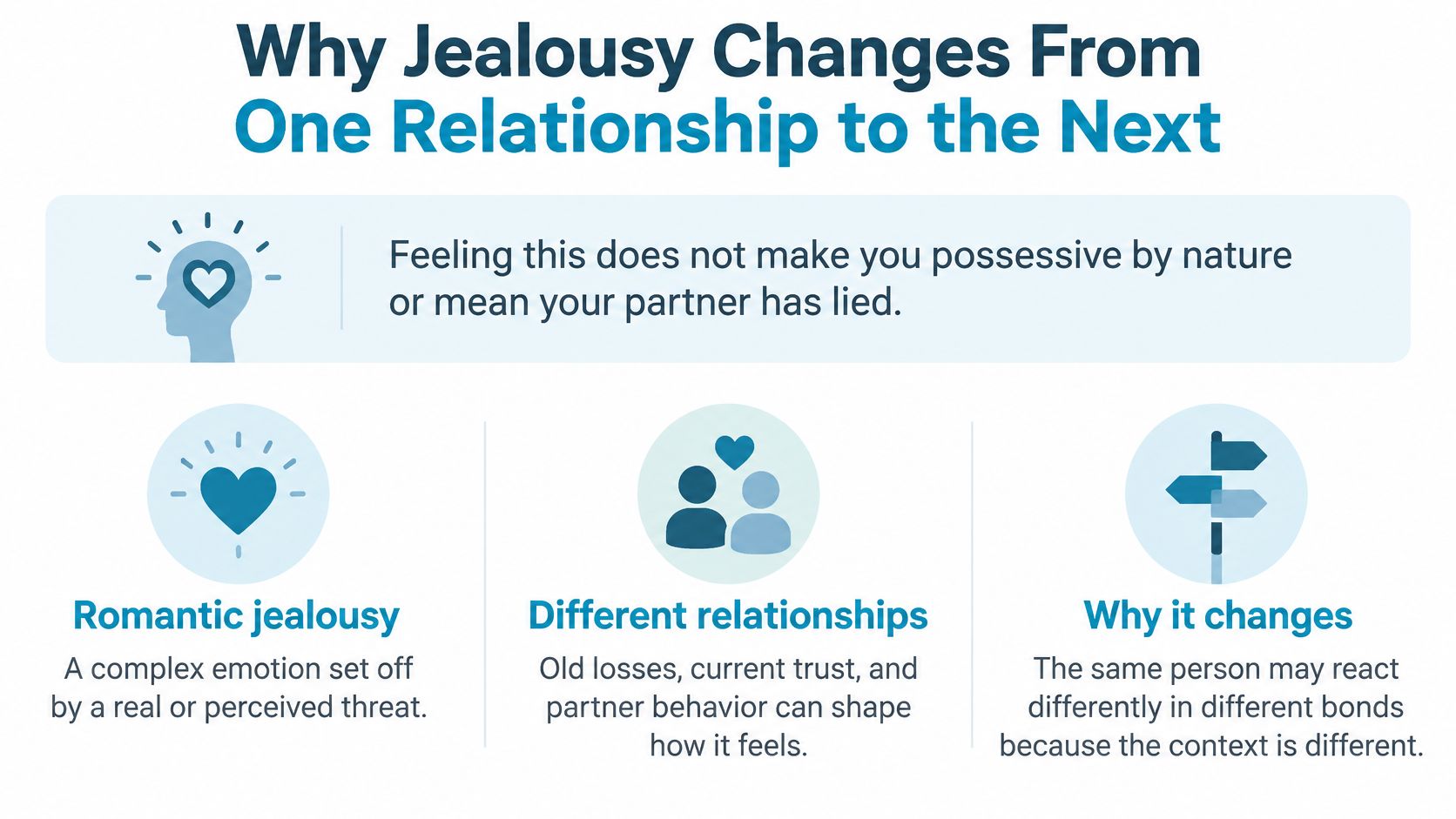
The practical implication is that the same person may feel relatively steady with clear agreements and much more unsettled when communication is inconsistent or an injury hasn't been repaired. That doesn't automatically make either partner the problem. It means the conditions between you deserve examination.
A 2025 study indexed by APA PsycNet, involving 1,466 participants from the United States, United Kingdom, and Netherlands, associated higher jealousy with higher perceived partner value but lower trust. Wanting someone and feeling unsure about them can coexist.
Replace the character verdict with a relationship question: What conditions make this fear easier or harder to carry?
Before deciding that you're a jealous person, list what's happening:
Unclear boundaries: You haven't agreed on what contact with an ex means.
Inconsistent connection: Expectations about replies or plans keep changing.
Damaged trust: A real breach remains unresolved.
Older fear: The present situation resembles an earlier loss.
Understanding these distinctions is part of breaking recurring relationship patterns, rather than assuming every partnership will feel the same.
When Checking Crosses a Safety Line
Before treating jealousy as an emotion-management problem, ask whether both people still have freedom to make choices. A sharing arrangement isn't voluntary if refusing it leads to punishment.
Use these questions to sort what's happening:
Evidence: Is the concern based on observable behavior or an ambiguous online cue?
Consent: Is sharing access, plans, or location freely agreed to and reversible?
Freedom: Can either person say no without intimidation, retaliation, or another interrogation?
These questions apply to phones, passwords, location sharing, and group chats. Sharing a location for a trip can be a convenience. Being required to account for every stop, or being afraid to turn sharing off, is different.
Digital checking isn't a reliable trust repair
A Université de Montréal account of a 2025 longitudinal study reports that, among 322 young adults, social-media-induced jealousy predicted more electronic surveillance and lower relationship satisfaction one year later, while surveillance itself wasn't directly associated with lower satisfaction. That distinction points toward the jealousy process, not the mere existence of a like, as something worth addressing.
It doesn't establish that monitoring is harmless or that checking restores trust. Nor does every glance at a public profile constitute abuse. Look at consent, pressure, and consequences, not just whether someone opened an app.
Fear, agreed transparency, or a safety problem
What is happening | What it is | Do this | Do not do this |
|---|---|---|---|
A spike from a like, a delay, or a story in your head | Emotion and interpretation | Pause 20–30 minutes, log fact versus prediction, make one request later | Interrogate at the peak or treat the feeling as proof |
You both want a shared rule about exes, trips, or replies | Negotiated boundary | Make it specific, mutual, and reversible | Invent a blanket ban based on gender or platform |
Occasional agreed sharing of plans or location | Consensual transparency | Either person can stop it without payback | Turn a choice into an expectation you can't refuse |
Jealousy toward a celebrity, influencer, character, or comment thread | Symbolic threat unless behavior breaks an agreement | Name the behavior that matters | Demand every account be unfollowed |
Password, message, or location demands, stalking, threats, or punishment for saying no | Safety and control | Safety planning and specialized help | Couples scripts, more reassurance, or treating it as love |
When the perceived rival isn't in the room
A partner's attachment to a celebrity, fictional character, or influencer may feel threatening without providing evidence of disloyalty. An ex in a comment thread may activate the same fear. Symbolic threat concerns what someone represents to you; behavioral threat concerns what your partner does.
Secrecy, broken agreements, and sustained emotional withdrawal deserve attention. But a blanket unfollow order avoids the harder conversation about what online intimacy means to each of you.
Ask which specific behavior violates a shared agreement, and what boundary would address that behavior without trying to eliminate every uncomfortable feeling. Negotiate expectations about private messages, public comments, ex-partner contact, and fandom rather than relying on gender rules.
If accusations come with intimidation, repeated interrogations, stalking, retaliation after a refusal, or coerced access, stop treating this as communication practice. Seek specialized domestic-violence support and consider a safer device if yours may be monitored; don't confront someone about monitoring if doing so could increase danger. If you're the person using control, stop the behavior and seek individual professional help rather than asking your partner to accommodate it.
Words That Ask for One Specific Thing
Use a script only when you're settled enough to listen and the situation allows either person to decline. The sequence is settle, test your interpretation against evidence, and then name a concern without turning it into a charge.
A study of 477 undergraduates available through PubMed Central found that attachment anxiety predicted jealousy and that self-differentiation partly mediated the association. In everyday language, self-differentiation means staying connected while keeping your own friends, routines, and values.
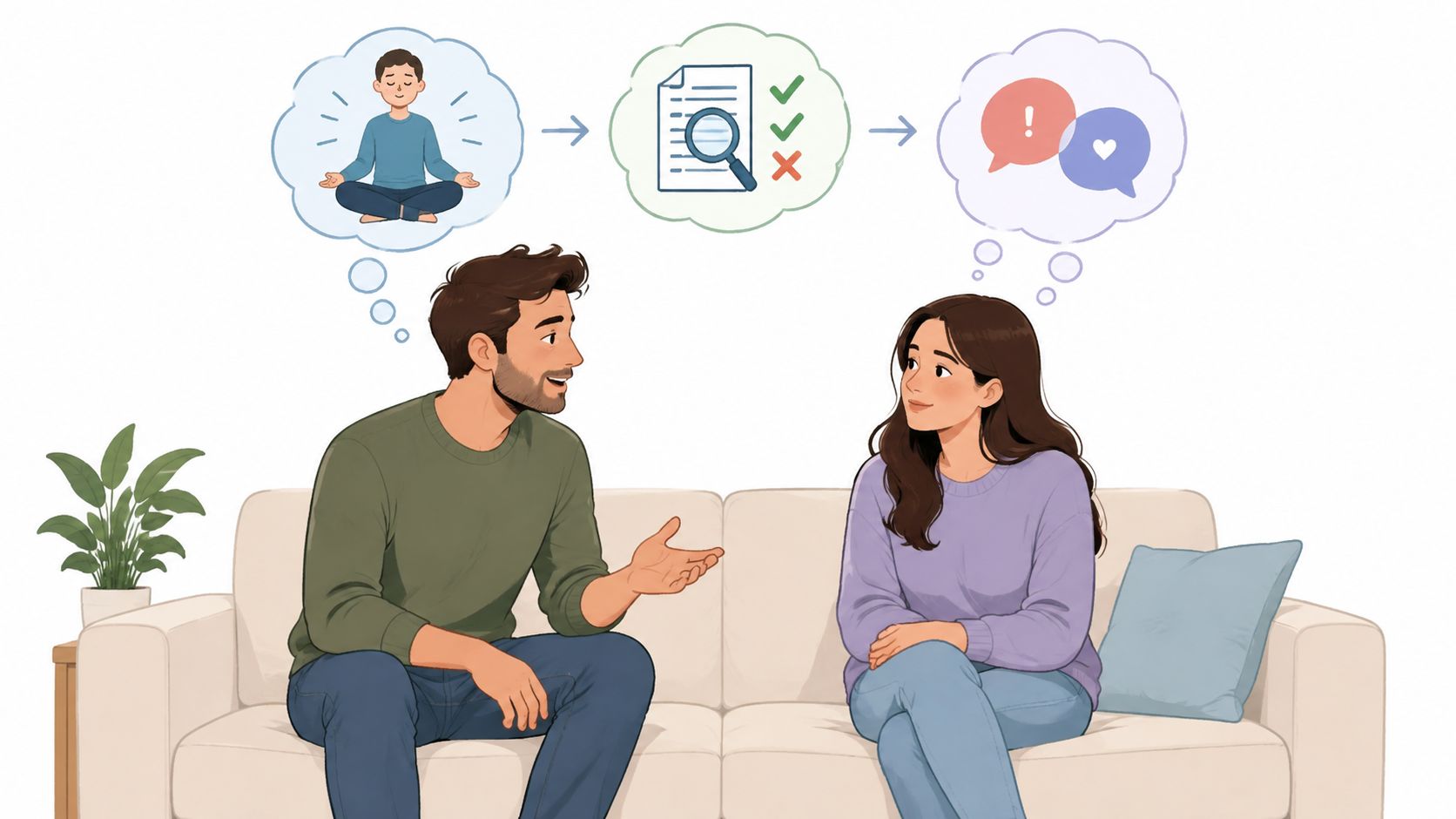
Requests about replies and friendships
A late reply: Use this when the issue is uncertainty about availability, not an entitlement to your partner's entire evening.
Try: I noticed I spun a story when you went quiet after nine. I don't need your whole evening. A text that you're heads-down until ten would help.
Instead of: If you loved me, you'd answer. Prove I matter.
The useful request concerns a manageable communication habit. Your partner can suggest a different arrangement rather than having to prove their love through constant availability.
A friendship: Use this when you need an agreement about a particular situation, such as travel.
Try: I get tight when plans with Sam stay vague. I'm not asking you to drop the friendship. I'm asking us to agree on what overnight trips look like.
Instead of: Choose between Sam and me.
The conversation can address sleeping arrangements, advance notice, and what each person considers reasonable. It shouldn't require either person to surrender all independent friendships.
Requests about online contact and older fears
Social media: Use this when checking has replaced a direct conversation about contact with an ex.
Try: A comment thread pulled me into checking. I want to stop policing your likes. Can we agree on what a private conversation with an ex looks like?
Instead of: Open your phone and explain every person you follow.
An old wound: Use this when you recognize that tonight's event has connected with a deeper fear.
Try: This feels bigger than tonight. I'm scared of being left, and I want to say that instead of cross-examining you. Could you sit with me while I explain what came up?
Instead of: Promise you'll never leave, and tell me again until I believe it.
A request gives your partner something understandable to respond to. A test makes them guess what would finally count as enough.
Treat these statements as openings, not cures. Your partner may need time, may disagree with the proposed arrangement, or may offer another way to address the concern.
Repeated reassurance can reduce distress without changing the pattern between you. Keep your own routines and connections active while assessing whether agreements are being kept. If the only request you can imagine is surveillance, a threat, or coerced access, stop the script and address the behavior as a safety problem.
Common Questions About Relationship Jealousy
Is feeling jealous a sign that something is wrong with me?
Jealousy is a common, complex response to a perceived threat to a bond, not a diagnosis or a character verdict. Feeling it doesn't prove betrayal, and it doesn't mean you're destined to act possessively. What deserves attention is how you interpret the feeling, how you behave, and whether the relationship gives you reasonable grounds for concern.
Can jealousy fade on its own?
It can soften as trust develops or circumstances become clearer, but waiting isn't always enough. If the same interaction keeps repeating, another reassuring conversation may offer only temporary relief. Consider whether both people follow through on agreements and whether you're becoming more able to tolerate ordinary uncertainty, rather than judging progress only by how reassured you feel tonight.
Does ADHD make jealousy stronger?
None of the studies cited here directly tests the relationship between ADHD and jealousy, so an ADHD-specific link shouldn't be treated as established fact. ADHD is a neurodevelopmental condition that can affect executive functioning, emotional regulation, and impulse control, although people's experiences differ substantially. Clinically, a visible reminder, an accessible note template, or a timer may fit those difficulties better than just telling yourself to be less reactive.
Safety comes first: If your question is about control, coercion, or fear of saying no, use the safety criteria rather than trying to become better at reassuring a partner.
Choosing Individual Work or a Shared Conversation
Start with the part of the situation you can assess safely, not with a verdict about who needs fixing. You don't have to settle whether anxiety, ADHD, old hurt, or the relationship itself explains everything before asking for support.
When individual work is the better starting place
If your partner is mostly steady but you lose evenings to rumination, impulsive messages, or shame, individual work offers somewhere to examine the sequence without turning your partner into its manager. That can be especially useful when uncertainty quickly becomes self-criticism or fear of abandonment.
For relationships and dating, therapy offers a place to slow down, understand what's happening, and begin responding differently, sometimes by first understanding yourself. Our sessions start with what's been happening in your life, get curious about patterns, and work out together what moving forward looks like.
Where to start with jealousy
Situation | Start here | The work | Not the first move |
|---|---|---|---|
Your mind runs ahead, your partner is mostly steady, shame or ADHD urgency is loud | Individual therapy | Map triggers, slow urges, build a kinder account of yourself | Asking your partner to reassure you out of a pattern |
Both of you want agreements you can live with and either can decline | A planned talk or couples work | Specific boundaries on contact, privacy, and repair | A rule written at peak intensity |
You can't tell anxiety, ADHD, and the relationship apart yet | An individual consultation | Learn the pattern before inviting someone else into it | Diagnosing yourself from a checklist |
Threats, stalking, password demands, or punishment for a no | Safety planning and specialized support | Protection and a way out of coercion | Communication homework as if this were insecurity |
When the work belongs between you
If both people want clearer agreements and neither is punished for honesty, a planned conversation or couples work can help define expectations. That work requires room for disagreement, including the possibility that you want different kinds of relationships. Better wording can't resolve every incompatibility.
When ADHD affects relationships, we work to understand how it shows up in your life and build practical strategies that work with your brain, not against it. That includes emotional and interpersonal patterns, not just reminders or organizational tools.
Nick Donahue, LICSW, works with adults and teens in Washington, DC and Virginia on ADHD, anxiety, and relationship patterns. You don't need a diagnosis to ask whether therapy might help, and you don't have to arrive knowing exactly what the problem is.
If you only needed something to try tonight, keep the short note and choose the next action you can take without violating anyone's boundaries. If being honest or saying no puts you at risk, prioritize protection over a better conversation.
Nick Donahue LICSW offers individual therapy for teens and adults who want to understand ADHD, anxiety, and relationship difficulties with less shame and more practical support. If jealousy keeps pulling you into checking, overthinking, or conflict, visit Nick Donahue LICSW to learn about ADHD-informed therapy in Washington, DC and virtual therapy across DC and Virginia.
Comments