
Anxiety Therapy: Approaches and How to Start
The U.S. Centers for Disease Control and Prevention reported that 12% of U.S. adults, about one in eight, regularly felt worry, nervousness, or anxiety in 2024. If you're searching for anxiety therapy in Washington, DC, the practical question isn't how to make anxiety disappear. It's which kind of support can help you respond differently when worry starts making decisions for you.
Anxiety therapy approaches a D.C. searcher can compare
Anxiety therapy in D.C. is structured conversation and practice aimed at the loop between anxious thoughts, the body's alarm, and avoidance. It isn't a promise that you'll never feel anxious. These approaches overlap in real-world care, and mild worry doesn't automatically call for a full treatment protocol.
Approach | Often a fit when | What sessions emphasize | Evidence note |
|---|---|---|---|
Cognitive behavioral therapy | Worry, avoidance, and functional impairment are clear | Thoughts, body cues, behavior, and gradual approach to avoided situations | Strongest long-term support in the 2024 review; figures in the research section |
Third-wave CBT including ACT | Overthinking runs decisions even when the person knows the worry is excessive | Relationship with thoughts, values-based action, and willingness to feel discomfort | Moderate-certainty evidence in the 2024 review; figures in the research section |
Applied relaxation | Physical alarm is the main problem | Practiced calming during anxiety-provoking situations, not only at rest | Recommended by NICE as a high-intensity option; effect discussed in the research section |
Interpersonal therapy | Anxiety shows up in dating, conflict, or reassurance cycles | Relationship patterns and new responses in real conversations | Not among the approaches compared in the 2024 review; evidence for general anxiety is less direct |
Mindfulness-based approaches | Attention sticks to threat and the body feels constantly on | Present-moment attention and less automatic reaction to sensations | Often combined with CBT or ACT rather than used alone |
Cognitive behavioral therapy (CBT) helps make the anxiety pattern visible and gives you a chance to test a different response. A therapist might help you notice how predicting a mistake changes your body, delays sending an email, and increases the urge to avoid a conversation. For adults with generalized anxiety disorder, NICE's high-intensity CBT benchmark is typically 12–15 weekly, one-hour sessions. That's a guideline, not a fixed requirement.
Third-wave CBT, including Acceptance and Commitment Therapy (ACT), focuses less on winning an argument with every worried thought and more on changing how much that thought controls your actions. You might learn to notice “I'll get this wrong” without waiting for complete certainty before taking a step that matters to you.
Applied relaxation trains you to settle physical arousal in situations that trigger anxiety, not only in a quiet room. Interpersonal therapy pays attention to how worry enters relationships, such as repeated reassurance seeking or conflict that never quite resolves. Mindfulness-based work can help you notice a sensation or thought without immediately treating it as evidence of danger.
A useful first question is what you most want to change: your decisions, avoidance, physical alarm, or relationships. The answer can help you and a therapist decide where to begin.
Table of Contents
How Worry and Avoidance Keep Each Other Going - Four connected parts of the loop
What Research Shows Therapy Can Change - What a standardized difference can and can't tell you
A Realistic Course of Anxiety Treatment - What a therapy session can include
Anxiety at Work, in Relationships, and With ADHD - When ADHD and anxiety overlap
How to Reach Adequate Care in DC - A checklist for choosing care
How Worry and Avoidance Keep Each Other Going
On a weekday morning, you're drafting an email to a manager. You reread it for forty minutes because one sentence might sound careless. Your shoulders tighten, you imagine being criticized, and you postpone sending it. When the deadline gets close, you send a shorter version, feel a brief drop in tension, and then worry about how it came across.
That temporary relief matters. The NICE guide to treatment for generalized anxiety disorder explains that avoidance can reinforce future avoidance, while gradually approaching feared situations can help people learn that outcomes may be less likely, more manageable, or more tolerable than expected. The same pattern can show up in overthinking, work or school stress, relationship anxiety, and life transitions.
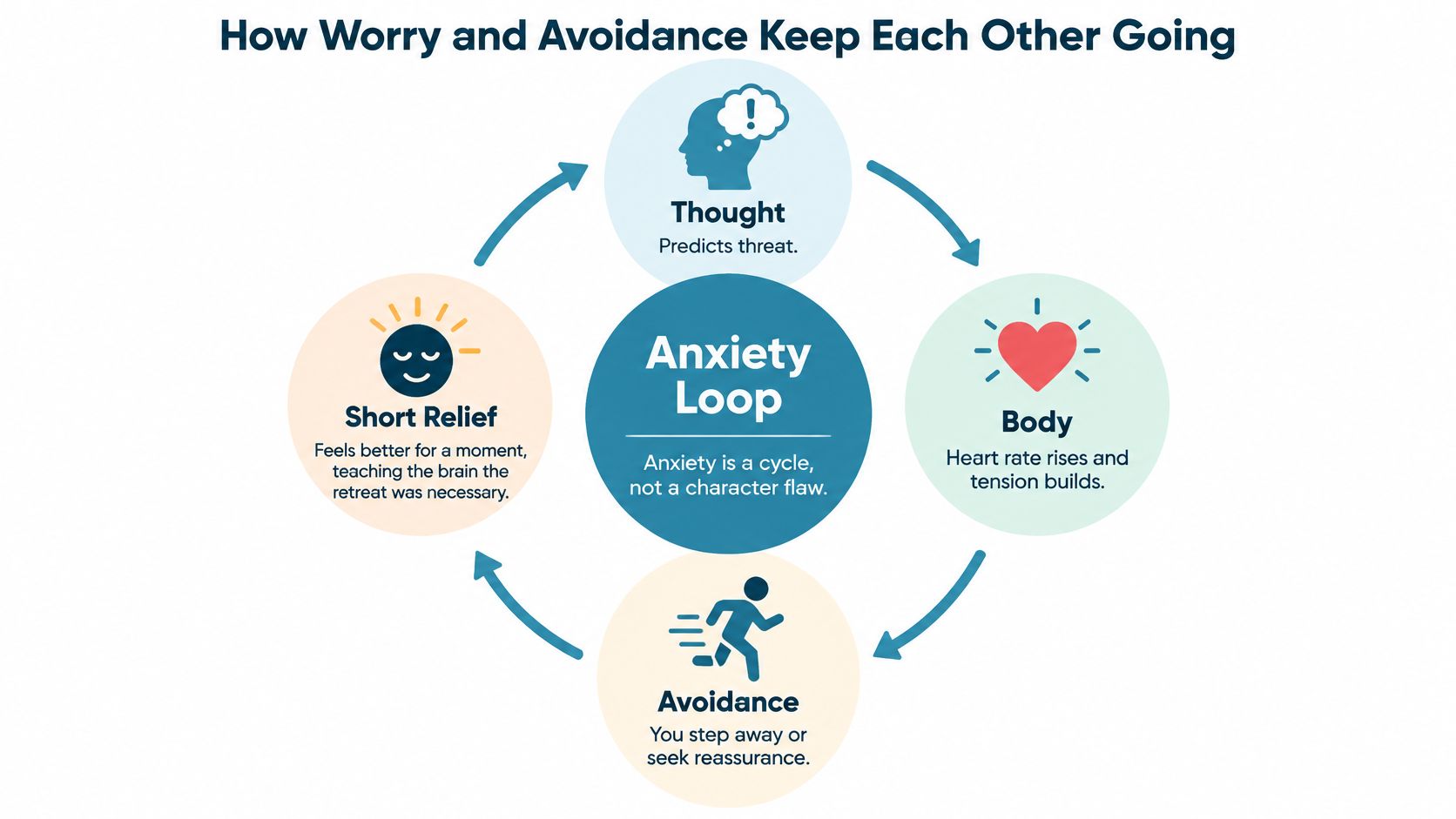
Four connected parts of the loop
Thoughts: “They'll think I'm incompetent,” or “If I don't check, something bad will happen.”
Emotions: Fear, dread, embarrassment, or frustration can rise as the prediction feels more convincing.
Bodily sensations: Your heart may race, your jaw may clench, or your stomach may tighten.
Behavior: You delay, cancel, overprepare, seek reassurance, or avoid the situation altogether.
Overthinking can look productive because it involves effort: comparing options, rehearsing, reviewing, and planning. But it can function as avoidance when the task is facing uncertainty. You might research every possible outcome of a conversation while avoiding the conversation itself.
That's not a character flaw. Avoidance is hard to drop because it can bring short-term relief. Therapy isn't about pushing yourself through exposure with no preparation; it's about supported approach, at a pace that allows you to try a different response and learn from it.
Progress doesn't have to mean feeling calm all the time. It can mean sending the email without another round of checking, tolerating a question you can't answer yet, or returning to an activity that matters.
Functional signs of change may include less reassurance seeking, clearer communication, greater tolerance of uncertainty, and resuming valued activities at work, school, or in relationships. If feeling overwhelmed is part of the picture, this guide to feeling overwhelmed all the time offers another way to think about what may be getting in the way.
A therapist's formulation is a shared map of what keeps your anxiety going: what tends to trigger it, what happens in your thoughts and body, how you respond, and what might help loosen the pattern.
What Research Shows Therapy Can Change
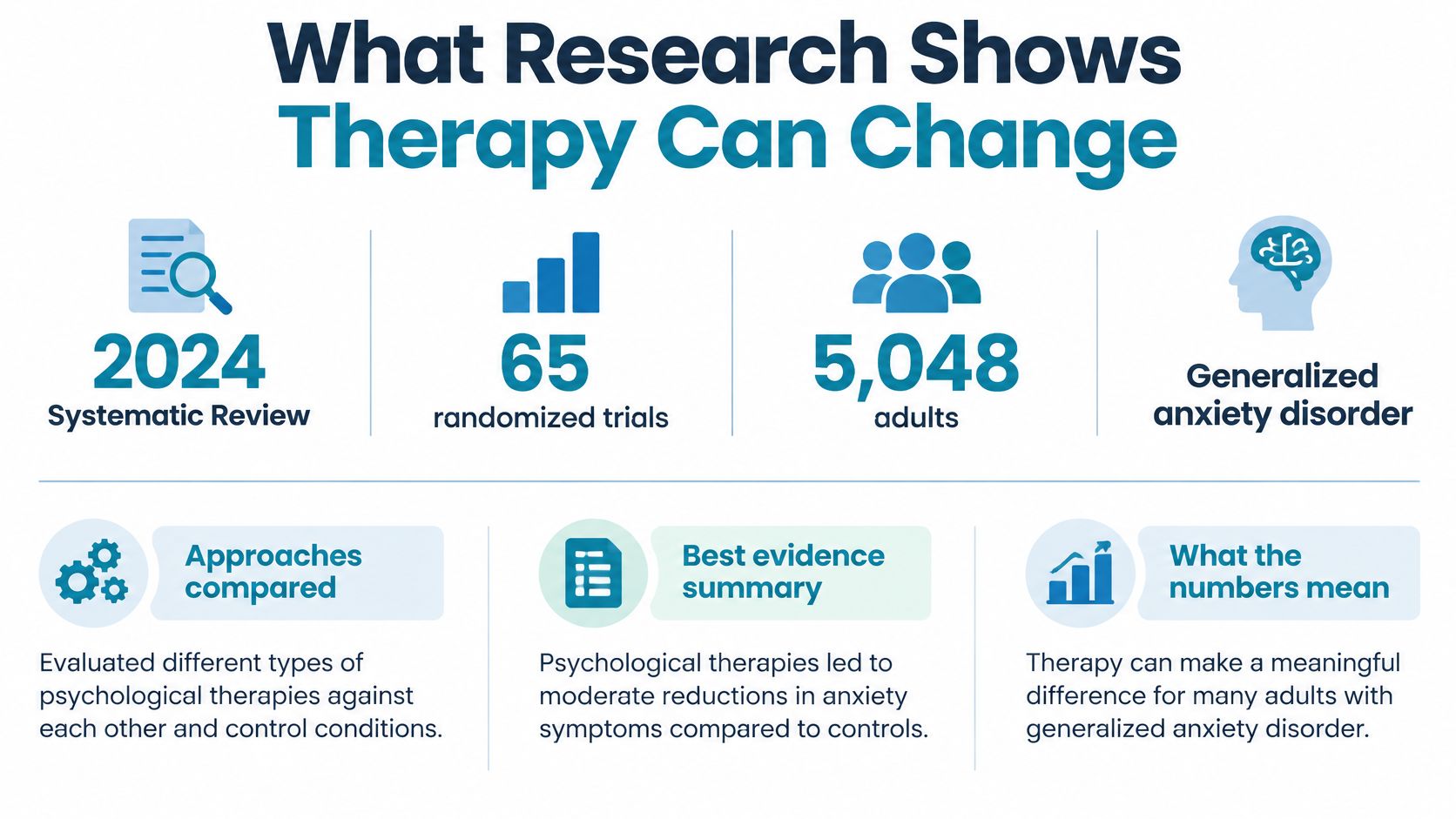
A 2024 systematic review and network meta-analysis in JAMA Psychiatry examined 65 randomized clinical trials involving 5,048 adults with generalized anxiety disorder. Compared with usual treatment, the standardized mean difference was -0.76 for third-wave CBT, -0.74 for conventional CBT, and -0.59 for relaxation therapy. The negative values indicate greater symptom reduction than the comparison condition.
The review rated evidence for CBT and third-wave CBT as moderate certainty. When researchers excluded studies with a high risk of bias, both still performed better than usual treatment. CBT was the only approach in this analysis associated with long-term effectiveness. At follow-up three to 12 months after treatment, the difference for CBT versus usual treatment was -0.60.
These estimates describe average differences between groups. They do not predict exactly what will happen for one person.
What a standardized difference can and can't tell you
A standardized difference expresses how far apart groups' outcomes were relative to the variation among participants. In everyday terms, adults receiving these psychological interventions improved more on average than adults receiving the comparison condition. Within that average sits a wide range: some people improve substantially, some modestly, and some not at all.
The numbers also have limits. They do not establish that every therapy approach works equally well, that a particular client will respond, or that improvement will follow a set schedule. The findings apply to adults with generalized anxiety disorder in the studies examined, which means they carry less certainty for someone whose worry is tangled up with ADHD, relationship conflict, or a specific phobia rather than a GAD diagnosis.
That gap between group averages and one person's life is where fit matters. A therapy that works on average can still miss if it never addresses the loop running your anxiety, whether that is overthinking dressed up as problem-solving or avoidance that shrinks your week. Evidence-informed work starts by identifying the pattern that keeps your anxiety going, then tests a different response in real situations and adjusts based on what happens. I look for a therapist who treats the research as a starting point rather than a script.
A Realistic Course of Anxiety Treatment
For adults with generalized anxiety disorder, NICE recommends stepped care. That means beginning with lower-intensity support when it's clinically appropriate, then considering high-intensity therapy when symptoms cause marked impairment or don't improve. The NICE recommendations for GAD name CBT and applied relaxation as high-intensity options and describe CBT delivered by a trained practitioner using protocols supported by clinical-trial manuals.
NICE gives 12–15 weekly, one-hour CBT sessions as a typical course. It also allows fewer sessions if someone recovers sooner and additional treatment when clinically needed. Think of that range as a benchmark for a coherent plan, not a timer that determines when you should be finished.
What a therapy session can include
In a 60-minute individual session, you might review what's happened since your last meeting, look at the pattern you're working on, and practice one response. The session could include examining a prediction, rehearsing a conversation, trying a relaxation exercise, or planning a manageable approach to something you've been avoiding.
The practice between sessions matters too. It might be sending one message without repeatedly editing it, noticing a reassurance urge before acting on it, or taking a small step toward a situation you've been putting off. The point isn't to add homework for its own sake; it's to find out whether a useful idea holds up in daily life.
A practical checkpoint: Ask whether the plan is changing what you do outside the session, not only how clearly you can describe the problem.
A treatment plan should include regular review of symptoms, daily functioning, skills practice, and whether the approach needs to change. Weekly meetings are common at the start. As skills become usable and anxiety takes up less room in daily life, sessions may be spaced farther apart.
Change the plan if practice between sessions keeps stalling, if the work never addresses avoidance, or if ADHD, a relationship crisis, or another concern is driving the anxiety more than the current approach accounts for. Psychotherapy also doesn't replace medical evaluation when panic, depression, sleep problems, substance use, or physical symptoms call for a prescriber's input.
After a few weeks, ask yourself: Is worry still making the decisions, or is there one situation I can approach differently? The answer can guide a conversation with your therapist about continuing, adjusting the work, or involving another kind of care.
Anxiety at Work, in Relationships, and With ADHD
You're working on a report but can't start until you're certain it won't contain mistakes. The fear of getting it wrong turns into a delay, and then you stay late trying to undo the delay. That can be anxiety, an executive-functioning difficulty, or both. It's a useful reason to look at the pattern rather than label yourself lazy.
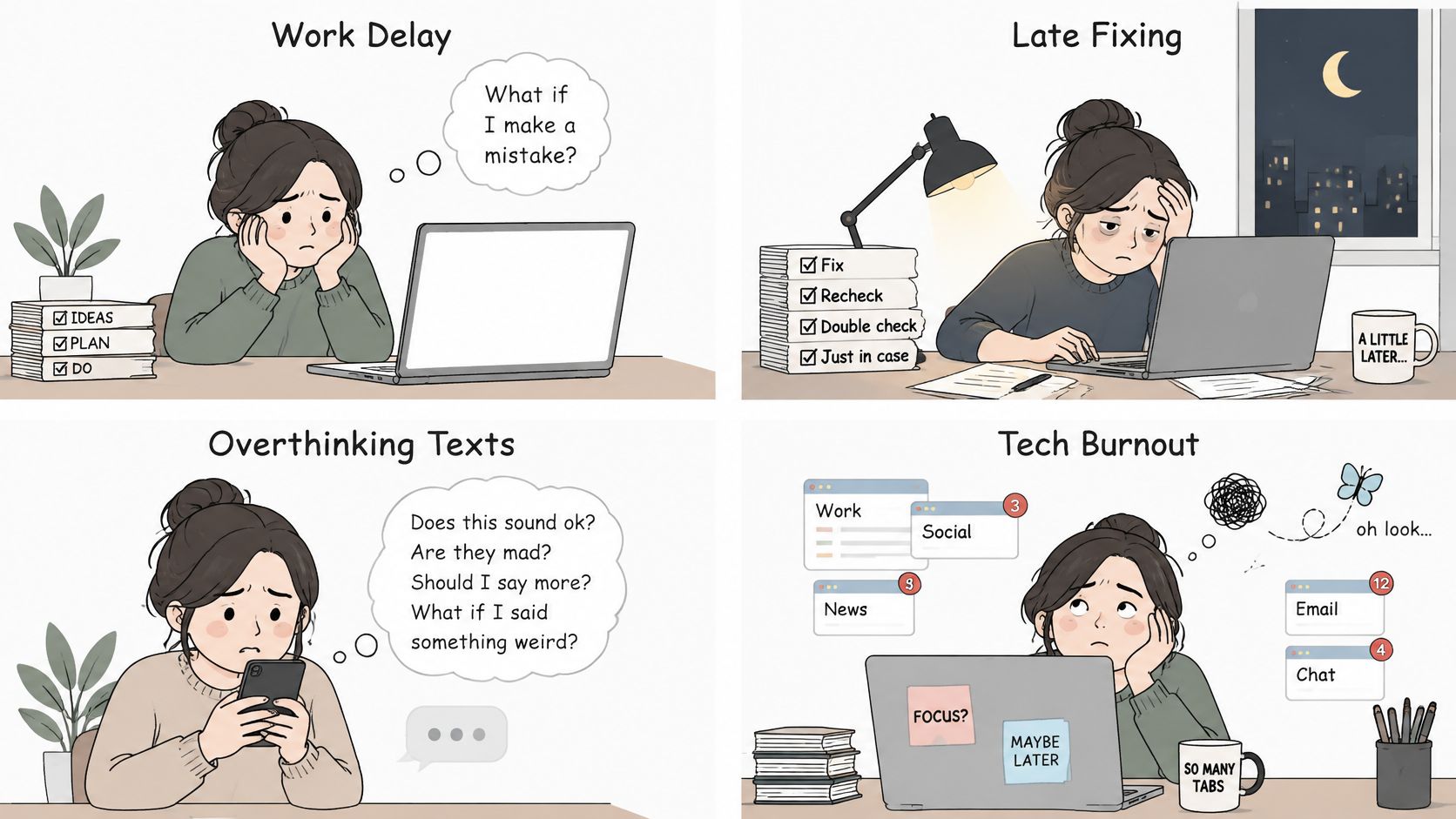
Dating can bring a different version of the same loop. A delayed reply feels like rejection, you ask for reassurance, and the same argument returns later. Therapy can help you notice when anxiety takes over the interpretation, then explore the relationship need or fear underneath it. People looking at the connection between ADHD and dating may also find this article on ADHD and relationship problems relevant.
When ADHD and anxiety overlap
ADHD is a neurodevelopmental condition that can affect organization, follow-through, emotional regulation, relationships, and daily functioning. In 2023, an estimated 15.5 million U.S. adults, or 6.0% of the adult population, reported a current ADHD diagnosis, according to a CDC report on adult ADHD. The report found that 55.9% were diagnosed during adulthood.
That matters if you did well in school or weren't assessed as a child but struggle now with work demands, time, follow-through, or relationships. Missed details, time blindness, and emotional spikes can be mistaken for moral failure, feeding shame and anxiety. Anxiety-related avoidance can also look like ADHD-related procrastination. Therapy can make room for both: the executive demands themselves and the fear, self-criticism, or dread attached to them.
In a technology-heavy job, a person might jump between notifications, avoid a difficult task, then work late trying to catch up. A useful therapy focus isn't only a better calendar. It might be noticing the moment avoidance takes over, trying a smaller approach to the task, and understanding what the fear of getting it wrong means to that person.
School stress, identity, and friendships can affect teens in their own ways. The American Academy of Child and Adolescent Psychiatry's ADHD resource center identifies cognitive-behavioral therapy and behavioral-management techniques as having the strongest evidence among young people with ADHD. It describes behavioral therapies as structured talk therapies that help young people and parents unlearn problematic behaviors and build coping strategies. That's a summary of one approach, not a prescription for every adolescent; parent involvement can be useful when it fits the teen's needs.
An ADHD diagnosis doesn't explain every difficulty, and a list of worries isn't a diagnosis. Notice which pattern is costing you the week: task avoidance, relationship anxiety, emotional overwhelm, or some combination. Then bring that specific pattern into a first conversation.
How to Reach Adequate Care in DC
Finding a therapist is only part of the decision. The National Institute of Mental Health's anxiety statistics show that 19.1% of U.S. adults experienced an anxiety disorder in the past year and 31.1% at some point in their lives. The NIMH also reports that 42.2% of adults with an anxiety disorder received some form of treatment or service during a 12-month period. Of those receiving treatment, 33.8% received minimally adequate treatment, equivalent to 14.3% of all adults with an anxiety disorder in that analysis.
Those figures make a practical point: getting into care doesn't automatically mean the care is adequate. Look for a plan that addresses the patterns affecting your daily life and gives you a way to review whether the work is helping.
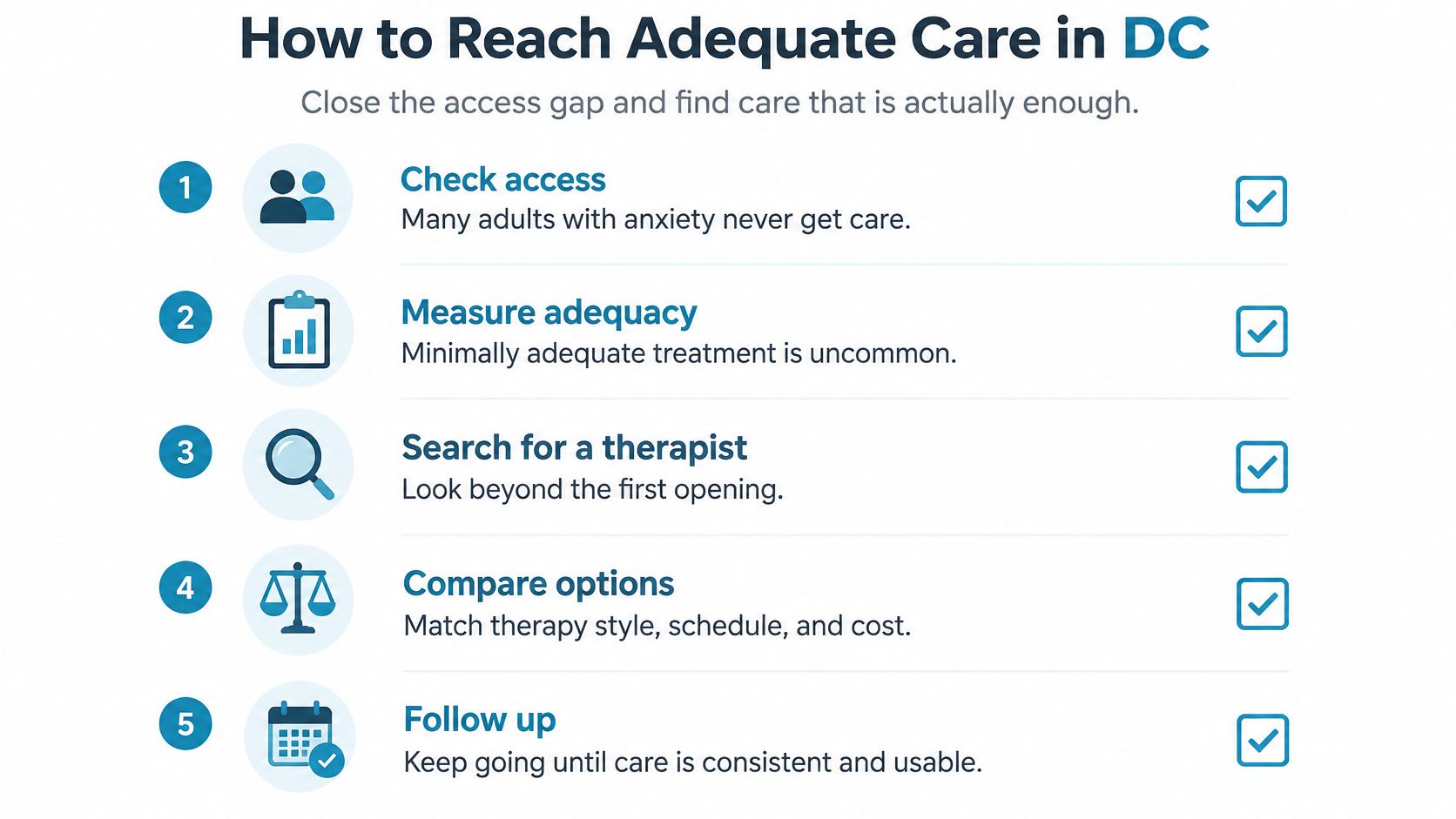
A checklist for choosing care
Name the impact. Look at sleep, work, school, relationships, or substance use, not only how worried you feel. Specific examples make it easier to explain what you want help with.
Choose a workable format. In-person therapy in Washington, D.C., may suit you if being in the room matters. Virtual therapy across D.C. and Virginia may be more practical if commuting or scheduling gets in the way.
Ask what the work will target. Is the focus avoidance, overthinking, physical alarm, relationship patterns, ADHD-related difficulties, or a mix? A therapist should be able to explain how that focus connects to your concerns.
Ask how you'll review progress. Find out what you'll practice between sessions and how you'll decide whether to adjust the approach. A plan that never leaves the office may not help with the moments you're trying to handle differently.
Clarify qualifications and other care. Ask about licensure, such as an LICSW, and whether a medical or psychiatric evaluation might belong alongside therapy.
A consultation can help if you don't know the goal yet. Before booking, ask about fees, sliding-scale options, and whether the practice bills insurance or works out of network. Check those details directly rather than assuming a particular coverage arrangement.
Be cautious if a therapist only listens without helping you build a plan, if the work never addresses what you avoid, or if anyone promises that anxiety will be gone. If you're in crisis, experiencing severe depression, or concerned about substance-related risk, seek urgent or medical care rather than waiting for a routine weekly opening.
Before a first call, jot down what's been hardest lately, what you've stopped doing or keep putting off, and what you want to be different. You don't need a polished explanation. A few concrete examples are enough to start the conversation.
Start With a Conversation That Fits
For anxiety, therapy is about developing a different relationship with it so it no longer gets to make all the decisions, not eliminating it completely. That distinction matters: the aim is to make room for choices that anxiety has been crowding out, without expecting every anxious thought or sensation to disappear.
Nick Donahue, LICSW, works with teens and adults in Washington, D.C., including people navigating anxiety alongside ADHD, relationship challenges, or a life transition. Sessions begin by getting to know your personality, relationships, and values, then slowing down enough to understand what the anxiety is doing. You don't need a clear diagnosis or a perfect agenda to begin.
In-person therapy is offered at two Dupont Circle locations: Connecticut Ave on Wednesdays and Fridays, and P Street on Mondays and Thursdays. You can schedule either a free consultation or an initial therapy session online, whichever feels like the better fit. If you're still sorting out what kind of support you want, this reflection on finding a therapist for high achievers may help you think through what you're looking for.
Nick Donahue LICSW offers individual therapy for teens and adults in Washington, D.C., with virtual sessions for clients across D.C. and Virginia. If anxiety or overthinking is narrowing your choices, visit Nick Donahue LICSW to schedule a free consultation or an initial session.
Comments