
A Therapist for High Achievers: What A Real Fit Looks Like
15 randomized controlled trials involving 912 participants found medium-to-large improvements in perfectionism-focused treatment targets, which is why a therapist for high achievers should focus on the cost of success, not talk you out of ambition. The job is to tell the difference between drive, perfectionism, ADHD compensation, and burnout, then treat each one differently.
You can look accomplished on paper and still feel like your life runs on threat response. The inbox is under control, the deadlines get met, and your calendar looks impressive, but rest feels suspicious, mistakes feel expensive, and the work only feels safe when it's urgent.
That combination is common enough that it can start to feel normal. It isn't normal if your body never gets to stand down, your relationships keep getting the leftovers, or your self-respect depends on another clean quarter, another promotion, another flawless semester.
Table of Contents
The High Achiever Whose Success Is Starting to Cost Them - Four patterns that often overlap
What Drives High-Achiever Distress - Healthy ambition is effort with authorship - A quick decision framework
Perfectionism and Imposter Syndrome as Overlapping Patterns - What a therapist listens for - What treatment looks like in practice
When the Performance Itself Is ADHD Compensation - The compensation loop - What therapy targets
Burnout When Leaving the Job Is Not an Option - What useful therapy does here
Therapy Approaches That Fit High-Achiever Patterns - What each approach looks like in the room
The High Achiever Whose Success Is Starting to Cost Them
A lot of high achievers arrive in therapy after months or years of telling themselves they're just tired. They're not falling apart in the obvious way. They're still delivering, still answering messages, still keeping the machine running. What's changed is the price.
I hear versions of the same story often: the person who rewrites an email five times, the professional who can't relax until every detail is checked, the student who gets excellent grades but melts down after one wrong answer, the manager who keeps up appearances while sleeping badly and snapping at everyone at home. The outside story is competence. The inside story is vigilance.
Four patterns that often overlap
Healthy ambition is values-guided. You care about doing good work, and the effort feels chosen. Perfectionism is different, because the rules get rigid and the stakes feel moral. One ordinary mistake can feel like proof that you're unsafe, exposed, or unacceptable.
ADHD compensation looks different again. A person may look disciplined from the outside, but the discipline is propped up by urgency, fear, or last-minute rescue work. Burnout is the slow collapse of the system that's been overused for too long. None of those patterns mean the person should want less from life.
Practical rule: if your success costs sleep, ease, relationships, or the ability to stop thinking about work, the problem isn't ambition alone.
A thoughtful therapist for high achievers earns their keep here. Not by lowering your standards across the board, but by figuring out what the standards are doing to you. If you're in Washington, DC or Virginia and want help sorting that out, therapy can be a place to think clearly without having to perform competence for one more hour.
What Drives High-Achiever Distress
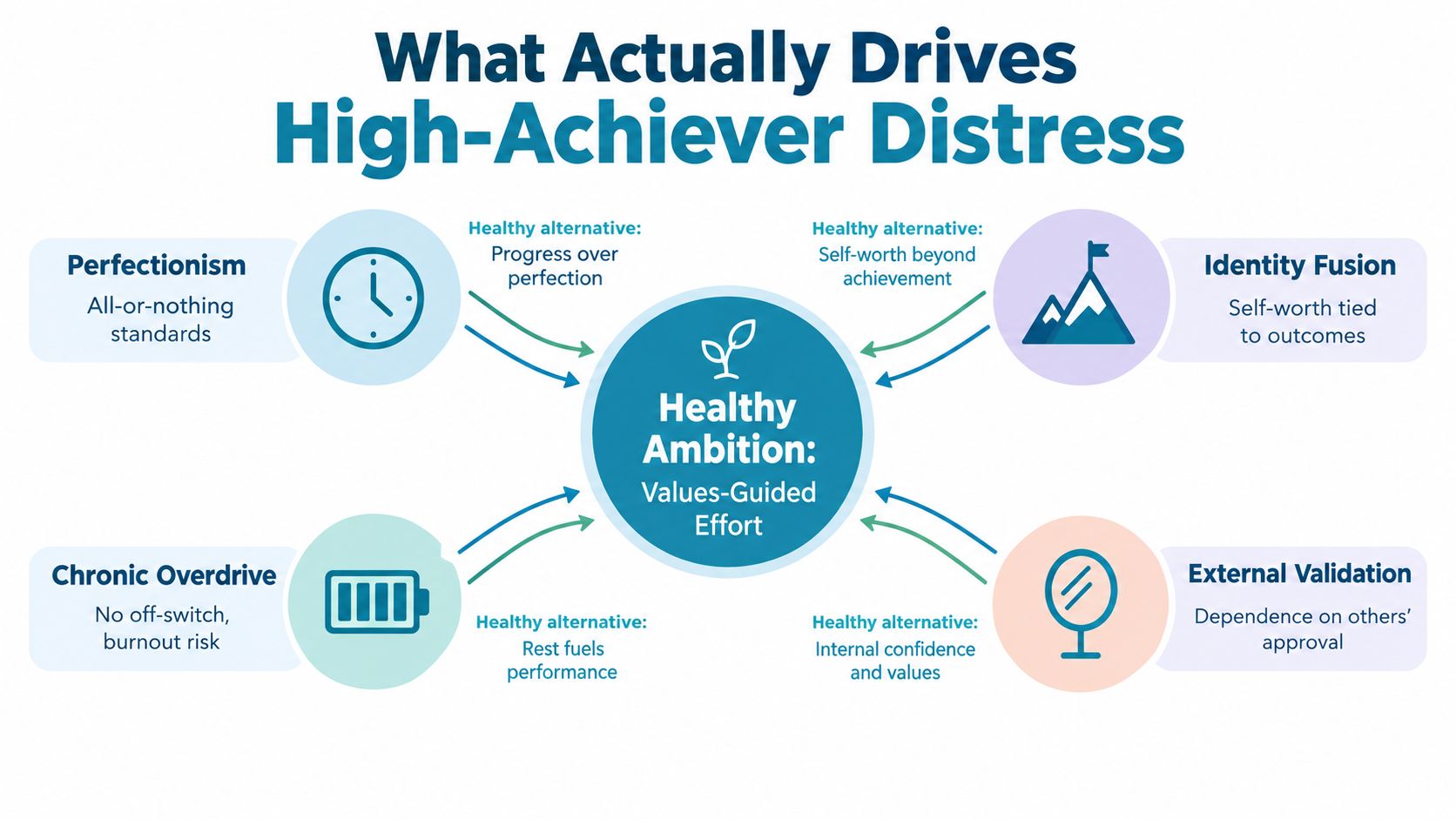
Healthy ambition is effort with authorship
Healthy ambition starts with choice. You decide what matters, you act on it, and you can stop without treating rest like a character flaw. The work can be demanding, but it does not keep your nervous system on alert all the time.
Distress begins when effort stops feeling chosen and starts functioning like an identity test. Perfectionism, imposter-style doubt, ADHD compensation, and burnout can all look like high output from the outside while the internal cost keeps climbing.
A quick decision framework
Ask whether the effort is chosen or compulsory. If you can rest without guilt, ambition is probably still serving you. If rest feels like laziness, the rules may have hardened.
Notice what happens when you make a normal mistake. A brief correction points in one direction. Rumination, hiding, and overchecking point in another.
Track whether urgency is holding your life together. If everything works only when there is pressure, your system may be compensating for executive-function problems. If this sounds like your baseline, it may help to look at why you feel overwhelmed all the time before assuming the problem is motivation.
Look at what the success costs. If performance stays intact but sleep, patience, intimacy, or health are sliding, burnout deserves attention.
The point is not to label yourself. It is to notice which lever is stuck. A clinician can then help you work on the right problem instead of handing you generic advice about balance that never touches the engine underneath.
Perfectionism and Imposter Syndrome as Overlapping Patterns
Perfectionism-focused CBT gives you a real treatment target, not a moral lecture. A synthesis of 15 randomized controlled trials involving 912 participants found medium-to-large improvements in personal standards (Hedges' g = 0.57), concern over mistakes (g = 0.89), and clinical perfectionism (g = 0.87). Those findings matter because concern over mistakes can drive avoidance, overchecking, procrastination, and chronic rumination even when performance stays strong. The problem is not high standards on its own, it is rigid self-worth rules.
What a therapist listens for
A perfectionistic client often sounds successful and exhausted at the same time. Ordinary errors feel humiliating. Unfinished work feels intolerable. Rest gets postponed until the next milestone, and even then it rarely feels deserved.
Imposter feelings fit into that pattern. They do not require obvious incompetence. They often show up in people who are objectively capable but cannot internalize success, so each win only resets the bar higher. The result is more effort, less satisfaction, and a growing inability to disengage.
If the standard is so high that no ordinary human can meet it consistently, therapy is not there to make you less ambitious. It is there to make the standard livable.
What treatment looks like in practice
Good therapy tests the prediction, not just the feeling. A therapist may ask you to send an email after one review instead of four, or finish a project before every possible tweak is made. Graded behavioral experiments, flexible standards, and exposure to completion without excessive checking are the tools here.
The same review reported reductions in depression, anxiety, and eating-disorder symptoms, although that does not mean every client will improve in the same way. Progress is best tracked with repeated symptom and functioning measures, not achievement alone, because high output can hide exhaustion.
When the Performance Itself Is ADHD Compensation
A client can look unusually capable and still be spending a lot of energy just to keep from falling apart. The achievement is real. So is the hidden cost. When success depends on constant compensation, the question is no longer whether the person is high achieving, it is whether the performance is covering an attention problem.
Adult ADHD often shows up that way. A person builds systems around missed details, time blindness, and the drag of switching tasks, then uses pressure, overpreparation, or late-night effort to keep everything from slipping. The structure works until it starts breaking down.
The 2023 U.S. national survey estimated that 15.5 million adults, 6.0% of the adult population, had a current ADHD diagnosis, and 55.9% were diagnosed at age 18 or older. CDC data on adult ADHD diagnosis shows how common adult diagnosis is, and why late recognition should not be treated as unusual. A lot of high achievers reach adult life before anyone names what is driving the strain.
The compensation loop
The loop is familiar. Executive-function weaknesses lead to missed deadlines, disorganization, or trouble finishing larger projects. Those setbacks create shame. Shame pushes the person into anxious overcontrol, and the overcontrol often becomes long hours, crisis-mode work, or perfectionism. If concentration itself is the sticking point, it helps to look at why you can't concentrate on work rather than treating it as a discipline failure.
That pattern can make someone look highly productive while they are barely coping. The work gets done, but sleep gets shorter, stress stays high, and burnout risk rises. NIMH describes adult ADHD as a persistent pattern of inattention and/or hyperactivity-impulsivity that interferes in at least two settings, and adults may struggle with procrastination, poor time management, disorganization, and trouble completing large projects. NIMH's adult ADHD guide gives the clinical frame that separates this from ordinary distraction.
What therapy targets
Treatment has to be concrete. External calendars and reminders. Task decomposition. Implementation intentions. Time estimates that do not assume fantasy-level focus. Scheduled transitions. Post-task review.
It also means challenging global conclusions like “I'm lazy” or “I only work under pressure.” Those statements usually reflect shame, not fact. If the pattern sounds familiar and performance has become a way to compensate for attention problems, a medical or psychiatric evaluation can help with diagnostic clarification and medication assessment. Therapy still matters when medication access is uneven. The CDC's treatment data note that 71.5% of stimulant users reported difficulty filling a prescription due to unavailability in the prior year. CDC medication access data
Burnout When Leaving the Job Is Not an Option
Burnout gets oversimplified a lot. The WHO defines it as an occupational phenomenon tied to chronic workplace stress that hasn't been successfully managed, and it shows up as exhaustion, mental distance or cynicism toward work, and reduced professional efficacy. That is different from depression, anxiety, or ADHD overload, even when the symptoms overlap in real life. WHO burnout definition
Some people cannot just quit. They need the paycheck, the health insurance, the visa stability, the family structure, or the bridge to the next role. Therapy has to stay realistic in those situations. The goal is not escape fantasy, it is reducing harm while the person stays in the job.
What useful therapy does here
A good therapist starts with workload triage. What has to get done, what can wait, and what should be delegated or dropped. Then comes the harder part, deciding what to say at work without oversharing. You can ask for clarity, better sequencing, or fewer simultaneous demands without naming a diagnosis.
Sleep, substance use, and recovery habits need a straight look too. Burnout does not improve if evenings disappear into scrolling, alcohol, or cannabis that blunts stress for a while and leaves the next day worse. The point is not moral purity, it is noticing what protects recovery and what erodes it. See why rest needs to be planned, not earned.
The picture is bigger than one exhausted person failing at self-care. PwC's 2025 Gen Z paradox survey found 45% of Gen Z respondents felt overwhelmed at least weekly, and the same survey also reported higher rates among fully remote and hybrid workers. High performance can sit right next to serious impairment. Someone can keep producing while their health, relationships, and recovery get steadily worse.
If you are trying to keep a demanding job intact, therapy for burnout in DC and Virginia can focus on restoring choice inside the constraints you have, not pretending the constraints do not exist.
Therapy Approaches That Fit High-Achiever Patterns
A good fit usually means therapy that changes behavior, not just insight. Acceptance and Commitment Therapy (ACT) works well when the problem is getting stuck in fear-based rules, because it helps people notice what matters and act from values instead of from avoidance. Cognitive behavioral therapy (CBT) fits when rigid thoughts, checking, procrastination, and self-criticism are driving the cycle. Interpersonal work matters when achievement is tangled up with conflict, approval-seeking, or isolation.
What each approach looks like in the room
ACT is often about making room for discomfort without letting it run the day. The therapist helps you name the value underneath the pressure, then take steps that match it. That can be especially useful when the goal isn't less ambition, but more freedom around how ambition gets expressed.
CBT is more concrete. It tests beliefs, builds experiments, and measures what happens when you behave differently. If your brain keeps saying, “If I'm not on top of everything, this will collapse,” CBT gives you a structured way to challenge that prediction without pretending the fear is silly.
Interpersonal work pays attention to how you ask for help, how you handle disappointment, and what your relationships have been absorbing while you've been performing. A lot of high achievers are skilled at output and underpracticed at honesty. Therapy has to address both.

You don't need therapy that turns into productivity coaching with nicer language. You need someone who can talk about emotional regulation, shame, avoidance, relationships, and the body's cost of overdrive. If medication might also be relevant, a therapist should be comfortable coordinating care or recommending evaluation rather than pretending psychotherapy has to do everything.
The goal is not one perfect method. It's the combination that helps you stop confusing pressure with purpose.
How to Evaluate Fit With a Therapist for High Achievers
An initial consultation should tell you whether the therapist understands achievement as a clinical variable, not just a personality trait. They should ask what success costs you, not only what you've accomplished. They should also know adult ADHD well enough to distinguish attention problems from burnout, anxiety, and perfectionism.
A strong therapist will ask about sleep, relationships, how you react to ordinary mistakes, and whether your standards are flexible or punitive. A weak fit often shows up fast. If the therapist dismisses ambition, praises your functioning without asking what it costs, or treats therapy like a life-optimization service, keep looking.
Here are useful questions to ask:
How do you measure progress? You want someone who looks beyond work output and pays attention to functioning, distress, and recovery.
What do you do when a client looks successful but feels miserable? That answer tells you whether they can work with hidden distress.
How do you differentiate perfectionism from healthy standards? A good clinician should answer this plainly.
How do you approach adult ADHD if the person is compensated and high performing? That's a real clinical question, not a trick one.
How do you handle therapy when the client can't reduce workload right away? Good care should adapt to real-world constraints.
Nick Donahue LICSW is one option for adults and teens who want a therapist in Washington, DC or virtually in Virginia, with attention to ADHD, anxiety, relationships, and life transitions. That kind of fit matters because the work is usually less about being “fixed” and more about being accurately understood.
Pattern | What to Ask About | Helpful Therapy Features |
|---|---|---|
Perfectionism | “How do you work with mistakes, overchecking, and rigid standards?” | Behavioral experiments, exposure to imperfection, flexible standards |
ADHD compensation | “How do you assess adults who look successful but are chronically overextended?” | Executive-function supports, planning systems, emotional regulation work |
Burnout | “How do you treat burnout when I can't just leave my job?” | Workload triage, values-based decisions, sleep and recovery planning |
Approval-driven overwork | “How do you work with people-pleasing and fear of disappointing others?” | Interpersonal work, boundary practice, communication rehearsal |
A Grounded Next Step Without the Sales Pitch
The first conversation doesn't need to be dramatic. It should cover what's been getting expensive, what you want to change, whether the therapist works in person in Washington, DC or virtually across DC and Virginia, and whether the pace feels honest. You're not signing up for a personality makeover. You're checking whether the work is worth your time.
A simple first-contact checklist can help:
Name the main problem clearly. Is it perfectionism, ADHD compensation, burnout, or some mix of the three?
Ask how progress will be tracked. If the answer is only “how you feel,” keep asking.
Notice whether the therapist gets the cost of success. That's often the difference between a generic provider and the right fit.
If you're ready to talk with someone who won't confuse your capability for wellbeing, reach out and ask about therapy that takes high achievement seriously without making it the whole story. Good therapy should help you keep what matters, lose what's harming you, and make the next step feel a little more deliberate.
Comments