
Culture of Joy: What It Means and How to Build One
You're already doing the thing that makes this topic hard. A person scrolls past gratitude prompts, mindfulness tips, and bright quotes, then looks up from the screen and still feels tense, overstimulated, numb, or oddly guilty for not feeling better. The problem is usually not a lack of effort. It's that joy gets treated like a private mood, when a real culture of joy is closer to a living environment, shaped by relationships, expectations, safety, and the room people have to breathe.
Table of Contents
When Trying to Be Happy Just Makes Things Worse - Why the usual advice lands badly
What a Culture of Joy Actually Means - Joy as a social pattern, not a mood hack - How positive emotions build capacity
The Building Blocks That Make Joy Possible - Five conditions that make joy more likely - Why the structure matters more than the vibe
How Culture of Joy Shows Up Around the World - Joy can be collective, not just personal - Wellbeing can include responsibilities and joy at once
Why Joy Advice Backfires When You Are Burnt Out - Whose joy is being measured - Why positivity can feel like another job
Practical Steps to Build a Culture of Joy This Week - Notice, name, nurture - Small experiments that change conditions
When Trying to Be Happy Just Makes Things Worse
A person with anxiety opens another article about “choosing happiness.” A parent who is burned out hears that a better mindset will help. Someone with ADHD reads a list of simple habits and feels worse, not better, because the list sounds easy only to people who aren't already depleted.
That reaction makes sense. When a person is already carrying stress, advice can start to sound like a moral test. If joy is framed as something anyone can summon on demand, then struggle feels like failure instead of evidence that the environment needs changing.
Why the usual advice lands badly
A lot of popular joy advice assumes there's enough time, safety, energy, and support to practice it. Many people don't have that. They have deadlines, caregiving, shame, financial pressure, sensory overload, or a nervous system that stays on alert long after the workday ends.
Practical rule: if an approach makes someone feel more defective, it's probably asking for a feeling before it has changed the conditions that support that feeling.
A culture of joy starts from a different question. Instead of asking, “How does someone force positivity?” it asks, “What kinds of places, relationships, and routines make joy possible often enough that it becomes part of daily life?”
What a Culture of Joy Actually Means
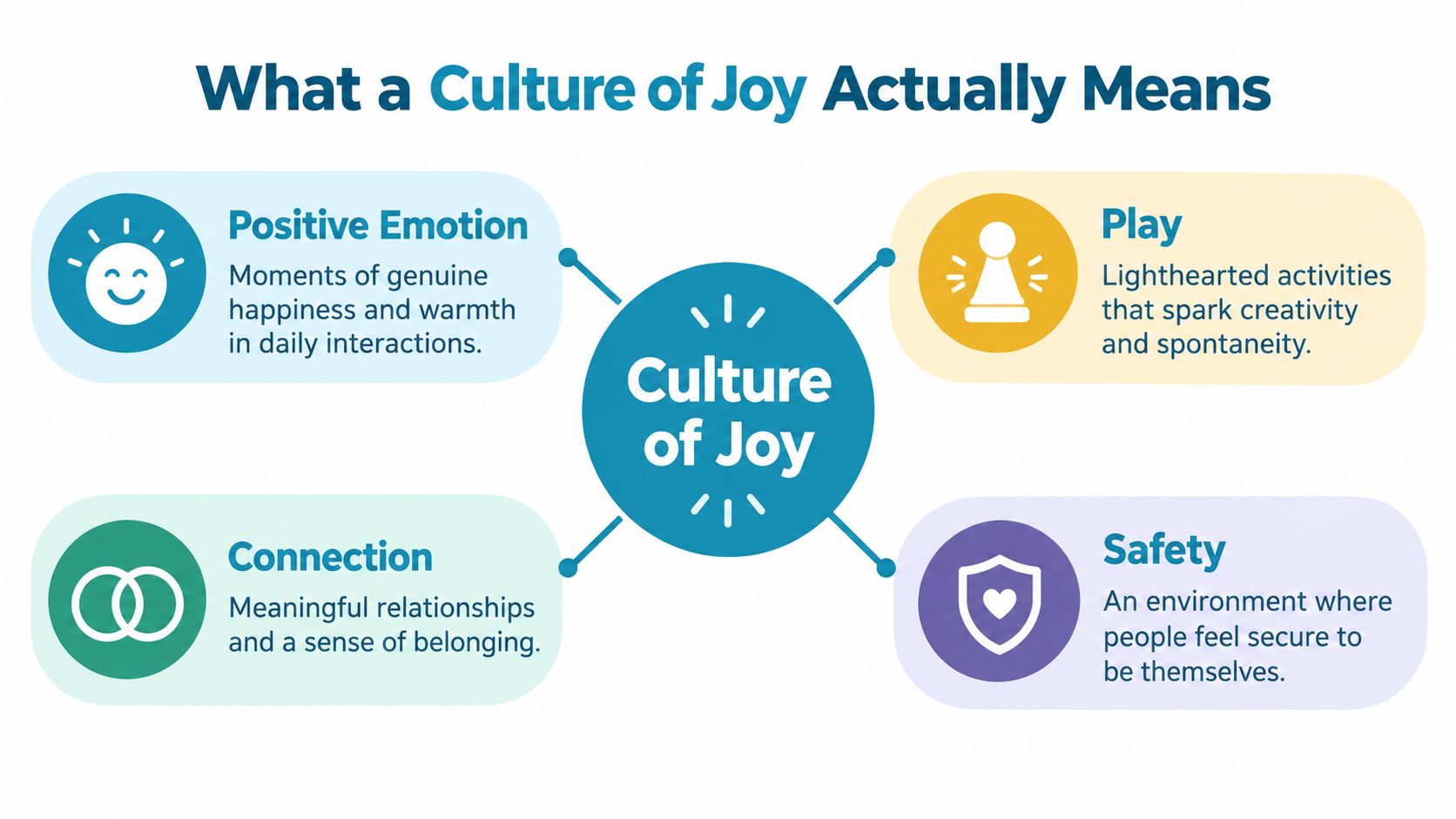
A culture of joy is not constant cheerfulness. It is a shared environment that makes room for positive emotion, play, connection, and recovery. Joy can appear in a warm conversation, a meeting that includes laughter, a calmer family routine, or a small return of energy after a hard stretch. It does not ask people to pretend everything is fine.
Joy as a social pattern, not a mood hack
Comparative cross-cultural research makes that distinction clearer. A 2016 analysis of the World Values Survey analysis of happiness across cultures grouped societies into “cultures of joy,” “cultures of honor,” and “cultures of achievement”, and placed cultures of joy especially in Latin America and Catholic Europe. In that research, 41% of respondents in Latin America described themselves as “very happy”, compared with 21% in cultures of honor, 32% in cultures of achievement, and 24% in Catholic Europe.
The same analysis also found that these cultures differed in more than mood. Religion was considered “very important” by 22% in cultures of joy, compared with 57% in cultures of honor and 17% in cultures of achievement. Views on strong political leaders also varied, with 72% of respondents in cultures of joy saying it would be bad or very bad to have a strong leader who did not need to follow parliament or elections. That pattern points to shared values, social trust, and a preference for bounded power, not just individual optimism.
How positive emotions build capacity
Fredrickson's broaden-and-build theory adds the psychological piece. Joy briefly widens the range of thoughts and actions that feel available, which can make room for play, creativity, social contact, and exploration. Repeated moments like that can help build physical, cognitive, social, and psychological resources over time University of Michigan overview.
That matters for people whose attention has narrowed under anxiety, ADHD shame, or burnout. Joy is not a command to smile harder. It is a sign that the surrounding conditions are giving the nervous system enough safety to open up again.
The Building Blocks That Make Joy Possible
A workplace can ask for cheer and still feel joyless if the basics are missing. The same is true in families and communities. If there is no room to choose, no one feels seen, and recovery is treated like laziness, people usually end up performing happiness instead of feeling it.
Five conditions that make joy more likely
Workplace research from the Mayo Clinic repeatedly points to meaning and purpose, recognition, camaraderie, autonomy, and resilience or well-being as recurring contributors to joy Mayo Clinic review. A.T. Kearney's Joy@Work research found a “joy gap” between what workers expected and what they experienced at work, and that gap widened during the COVID-19 era A.T. Kearney Joy@Work report.
Condition | What it looks like | Quick self-check |
|---|---|---|
Meaning and purpose | The work or relationship feels worth doing | Can this person explain why it matters? |
Recognition | Specific effort gets noticed | Does anyone name what was done well? |
Camaraderie | People feel they belong with others | Is there any genuine peer warmth here? |
Autonomy | There's some room to choose how work gets done | Can the person decide anything about timing or method? |
Recovery | Rest is treated as legitimate, not lazy | Is there real permission to pause and reset? |
Why the structure matters more than the vibe
The gap between expectation and experience is the point. In the 2018 survey, nearly 90% of respondents expected a substantial degree of joy at work, but only 37% said that matched their actual experience, a 53-percentage-point gap. In the same 2018 survey, the message was clear, people were hoping for far more joy than their workplaces were delivering.
When Kearney repeated the survey in 2021, the gap had widened to 61%. The pattern is hard to miss. A workplace can sound positive and still leave people drained if they have no control over their time, no clear appreciation, and no recovery built into the rhythm of the day.
That is especially familiar for people living with anxiety, ADHD, or burnout. A nervous system under strain does not respond well to slogans. It responds to conditions that lower pressure, reduce confusion, and make it easier to re-enter connection without forcing it. A culture of joy is built less like a mood board and more like a room where the light works, the chair is sturdy, and people are allowed to sit down.
Useful test: if joy disappears whenever a manager, parent, or workload changes, the issue may be structure, not attitude.
For a practical place to start thinking about relational and therapeutic patterns, a neutral overview of therapy-informed support can be helpful, such as the resources at Nick Donahue LICSW.
How Culture of Joy Shows Up Around the World
A culture of joy does not take the same shape everywhere. In some communities, joy is public and shared, folded into daily rituals. In others, it is treated like a private project, something a person is expected to manage alone.
Joy can be collective, not just personal
Research on cultural differences in joy shows that Asian International participants drew less on personal identity and more on collective dimensions than Asian American and White participants full article on cultural differences in joy. That finding matters because joy is not always a solo feeling. It can live in family meals, worship, group ritual, or shared celebration.
The same article helps explain why individual-first advice can feel off-target. If belonging, family responsibility, or community expectation shapes daily life, joy may come through shared meaning rather than private mood management. For someone with anxiety, ADHD, or burnout, that difference matters. A nervous system under strain rarely responds well to pressure to “just feel better” alone.
Wellbeing can include responsibilities and joy at once
The 2025 Aspen Institute youth wellbeing report found that young people from Latinx, American Indian/Alaska Native, and Black communities often defined wellbeing through balance among school, work, family, friends, financial responsibilities, emotional health, healing, and joy. That framing matters because it rejects the false split between real life and joy. For many people, joy sits beside duty, grief, and repair.
Culture shapes where joy can grow. Family expectations can create belonging, or crowd it out when they leave no room for choice. Religious values can offer meaning, or become pressure to perform happiness. Community responsibility can steady someone, or fill every corner with obligation. Each of these conditions changes whether joy feels available, shared, and safe enough to keep returning to.
Why Joy Advice Backfires When You Are Burnt Out
A lot of joy advice assumes people have spare time, spare energy, and a stable enough life to treat self-improvement like a hobby. For anyone living with anxiety, ADHD-related shame, caregiving demands, money stress, discrimination, or plain exhaustion, that assumption can feel disconnected from reality.
Whose joy is being measured
A 2025 global study of the Big Joy Project found that a seven-day set of small daily actions improved reported wellbeing, positive emotions, stress, health, and sleep. The study also showed how narrow the participant pool was. About 17,600 people took part, and 71% were from the U.S., Canada, and Great Britain, 84% were female, 74% were white, and 94% were college educated Big Joy Project study.
Those figures do not cancel the findings. They do point to a reach problem. If the sample is mostly educated, white, and drawn from a few countries, the evidence may miss people whose daily lives are shaped by disability, racism, economic strain, or caregiving overload.
Why positivity can feel like another job
The same study's interviews with BIPOC and sexual- and gender-minority young adults suggest that joy may depend on detaching from productivity culture and reclaiming time, space, and identity. That is a different task from adding one more self-help assignment. A person cannot optimize their way out of an unsafe schedule or an exhausting environment.
For many therapy clients, the more useful question is not, “How can joy be squeezed in?” It is, “What is blocking access to joy, and what would need to change so a small moment of ease can land?” That question fits anxiety, overthinking, and tech-related burnout far better than a command to be more grateful.
A grounded reframe: joy-building is not the same as joy-performance. One changes conditions. The other adds pressure.

Practical Steps to Build a Culture of Joy This Week
The smallest useful move is usually not a huge life overhaul. It's a repeatable loop that lets a good moment matter enough to happen again. That's where the broaden-and-build idea becomes practical.
Notice, name, nurture
First, notice a moment of vitality. It can be a laugh, a relieved exhale, a shared glance, or a brief sense of ease after a hard task. Then name what opened up. The language can stay simple: “That felt good,” “That was easier than expected,” or “That worked because the load was shared.”
Finally, nurture it. Repeat the setup, protect the conditions, or invite another person into the moment. If a conversation felt good because nobody interrupted, that structure matters. If a walking meeting lowered tension, repeat the format instead of assuming the mood will somehow recreate itself.
Small experiments that change conditions
A few low-friction tests can help:
Clarify purpose: Ask what part of the work, caregiving, or relationship matters. A clearer reason often changes how the same task feels.
Use specific appreciation: Replace vague praise with one concrete observation. "That email calmed the room" lands differently than "good job."
Negotiate bounded autonomy: Choose one part of a routine that can be adjusted, such as timing, sequence, or location.
Create a connection ritual: A short check-in, shared playlist, or end-of-day message can build camaraderie without becoming a performance.
Protect recovery: Treat sleep, silence, a walk, or a screen break as part of the work, not as a reward after everything is finished.
These are not tricks for manufacturing cheerfulness. They are ways to make room for positive experience inside real limits.
For readers wanting deeper support around attention, anxiety, or burnout, a service overview is available at Nick Donahue LICSW services.
Questions People Ask About Building a Culture of Joy
A parent may be trying to stay steady, a manager may be pushing through burnout, and a student may be dealing with anxiety while everyone else says, “just stay positive.” A culture of joy is not that kind of advice. It protects connection, recovery, and shared meaning even when life is hard.
Is a culture of joy the same as toxic positivity? No. Toxic positivity denies pain. A culture of joy leaves room for grief, stress, and uncertainty, while still making space for support and connection.
Can joy exist while someone still feels anxious or depressed? Yes. As covered earlier, Fredrickson's broaden-and-build theory shows that repeated positive moments can build durable resources over time. Joy does not cancel difficult emotions. It can sit beside them.
What if joy feels inaccessible right now? Start with conditions, not mood. Reduce one source of friction, add one supportive relationship, or repeat one low-effort moment that reliably feels less heavy. Small changes in the setting can matter more than forcing a better attitude.
Where does therapy fit? Therapy can help sort out whether the barrier is anxiety, shame, burnout, relationship strain, or an environment that never allows recovery. A helpful FAQ page can also clarify what support may look like. The aim is not forced happiness, it is a more workable life.
Comments