
ADHD Relationship Problems: Why They Happen and What Works
A partner forgets to confirm an appointment. A text goes unanswered while the other person is absorbed in a task. By the time the mistake comes to light, the argument isn't about the appointment or the text anymore. One person feels abandoned and overburdened, while the other feels accused, ashamed, and cornered.
These are common ADHD relationship problems, but “forgetfulness causes fights” doesn't explain the whole pattern. Attention gaps may start the disagreement, yet emotional dysregulation, shame, impulsive communication, and unequal invisible labor often determine how far it goes. Understanding that deeper pathway helps couples replace moral judgments with practical accountability.
Table of Contents
The Moment Everything Starts to Fray - The injury beneath the event - How the first minute gives the pattern away
Why Arguments Explode Over Small Things - The rejection alarm - Intent doesn't cancel impact
The Hidden Trap of the Manager Partner - Support isn't the same as supervision - Fair doesn't always mean identical
How to Repair After a Conflict Spirals - Pause without abandoning - Name the feeling and own one part - Make one repair request - Reconnect through action
When Couples Therapy Actually Helps ADHD - Why the treatment target matters - Individual therapy still affects the relationship
The Moment Everything Starts to Fray
The evening begins with an ordinary plan. One partner is supposed to call the dentist, pick up groceries, and meet the other at home before dinner. The partner with ADHD intends to do all three. Then an email arrives, a work task becomes absorbing, and the internal sense of time disappears. The appointment isn't confirmed. The groceries aren't bought. A later text goes unread.
When the other partner walks through the door, the first question is direct: “What happened?” The ADHD partner hears disappointment before hearing information and responds defensively. The other partner sees defensiveness as proof that the missed tasks don't matter. Within minutes, both people are arguing about character instead of circumstances.

The injury beneath the event
The practical failure matters. A missed commitment can create real inconvenience, financial stress, or an unfair distribution of work. ADHD doesn't erase responsibility, and the partner carrying the extra load shouldn't have to pretend that repeated disruption is harmless.
The trouble begins when both people translate the event into a personal verdict:
The non-ADHD partner may conclude: “If this mattered, it would have happened.”
The ADHD partner may conclude: “Nothing I do will ever be enough.”
Both partners may then act from those conclusions: one pursues harder, while the other withdraws or attacks.
Research on adult ADHD links the condition with shorter and more discordant relationships, lower relationship satisfaction, and greater difficulty resolving conflict. Longitudinal findings also reported that adults diagnosed with ADHD during childhood were approximately three times more likely to divorce than comparison-group adults, while research involving older adults found lifetime singlehood or a history of divorce was about three times higher among adults with ADHD than among adults without ADHD (review of adult ADHD and romantic relationships). These are population-level risks, not predictions about an individual couple.
How the first minute gives the pattern away
The early warning sign isn't always shouting. It may be a sudden change in tone, an explanation that becomes frantic, a partner repeating the same complaint, or one person leaving the room without agreeing to return. Standard communication advice often fails here because “use active listening” doesn't regulate a nervous system already flooded by shame or anger.
A more useful question is: What happened immediately before the escalation? Was there a missed task, a perceived criticism, an abrupt interruption, or an overloaded environment? Naming the trigger doesn't settle who is right. It gives both partners a workable point of intervention before the original problem becomes evidence that the relationship itself is unsafe.
Practical rule: Treat the missed commitment as a problem to solve, not as a verdict on either partner's love or character.
Why Arguments Explode Over Small Things
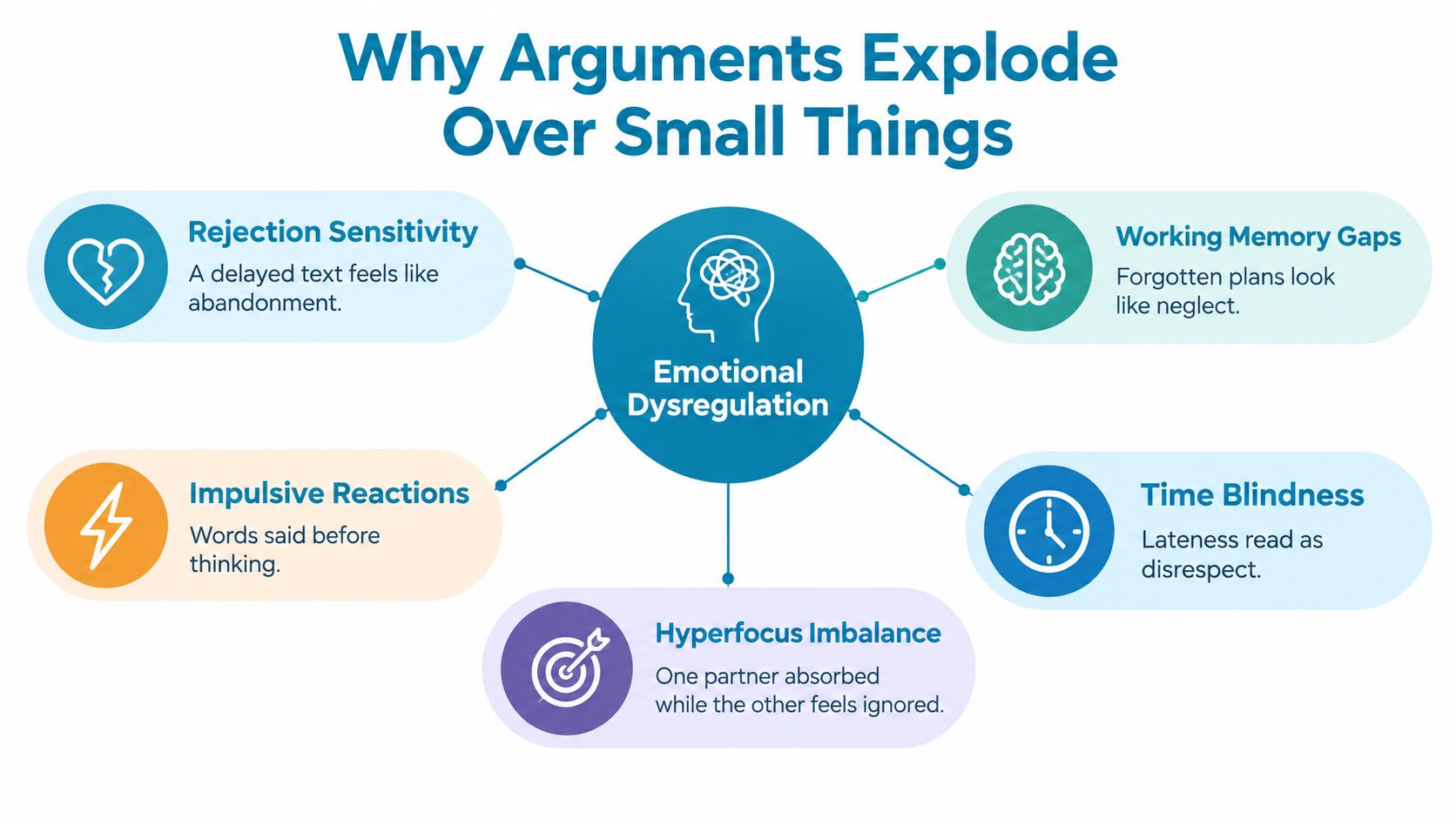
A fight about dishes often is not about dishes. One partner asks a simple question. The other hears accusation, failure, and the familiar sting of letting someone down again. By the time both people are arguing about tone, the original issue is gone.
That mismatch between event and reaction is common in ADHD relationships. The visible trigger may be lateness, a forgotten bill, or a task that still is not finished. Underneath, the nervous system is reacting to something bigger: frustration, shame, and the fear that one mistake now proves a much harsher story about character or commitment.
Emotional dysregulation sits near the center of that chain reaction. It means the brain has trouble slowing the rise of emotion, bringing down the intensity, or shifting out of it once activated. The feeling itself is real. The first interpretation often is not fully accurate. A neutral reminder can register as criticism. A request for follow-through can feel like personal rejection.
The rejection alarm
Rejection Sensitive Dysphoria, often called RSD, is a common shorthand for intense distress around perceived criticism or rejection. It is not a formal diagnosis, so it should not carry more weight than it can hold. Still, it names a pattern many adults with ADHD know well: feedback lands like danger, and the body reacts before reflective thinking catches up.
In practice, it can happen fast. One partner says, “The rent transfer still needs to be completed.” The other does not hear a logistics problem. They hear, “You are unreliable, and I cannot trust you.” Defensiveness follows. Then the first partner, now feeling ignored or shut out, pushes harder. What began as a practical issue turns into a threat response on both sides.
That is why standard communication advice often falls flat here. A couple can know all the right words and still miss the moment when the ADHD partner's rejection alarm turns a repairable problem into a fight about worth, loyalty, or safety in the relationship. Duke University research summary on ADHD's relationship impact notes that ADHD symptoms are associated with poorer romantic relationship quality. In the room with couples, the mechanism often looks less like simple forgetfulness and more like a support mismatch colliding with a threat-sensitive nervous system.
Intent doesn't cancel impact
Understanding the mechanism helps. It does not erase harm.
ADHD can explain why a reaction comes out fast, sharp, or bigger than the moment seems to warrant. It does not make hurtful words harmless. A flooded partner still has to learn how to pause, step away respectfully, and come back at an agreed time. Without that skill, every practical problem becomes emotionally expensive.
The same principle applies to the other partner. The burden of missed responsibilities is real, even when ADHD is part of the picture. Naming the pattern accurately helps couples work on the right problem. It keeps them from turning every conflict into a moral verdict, and it keeps serious safety concerns in their proper category.
If either partner feels physically unsafe, intimidation, threats, coercive control, or violence must be treated as a safety issue, not as a communication problem. Neurobiology may clarify what is happening. It never asks anyone to tolerate abuse.
The Hidden Trap of the Manager Partner
Tuesday night, one person is answering the school email, comparing repair shops, checking whether the bill got paid, and reminding their partner about the form due tomorrow. The other person may not be doing nothing. They may be overwhelmed, ashamed, or intending to get to it later. But inside the relationship, the split becomes painfully clear. One adult is carrying the remembering.
That is the manager-partner trap. It usually starts as an attempt to keep life from falling apart. Then the role hardens. One partner becomes the person who notices, tracks, prompts, follows up, and absorbs the fallout when something is missed. The other partner starts receiving guidance in the tone of a coworker under review or a teenager being chased. Desire drops fast in that setup. So does goodwill.
This is often a support mismatch, not a simple lack of caring. A 2025 study of social support needs in adults with ADHD found that greater emotional dysregulation, hyperactivity, and inattention were associated with greater desired social support among adults with ADHD, while romantic partners did not necessarily meet that support adequately. In practice, that means the ADHD partner may need help with planning, follow-through, calming down, and reassurance all at once. Their partner may try to provide all of it, then burn out.
Support isn't the same as supervision
A helpful support system reduces friction for both people. Supervision shifts the mental load onto one person.
The difference shows up in invisible labor. The visible task is “book the car service.” The hidden work is noticing the sticker date, researching options, checking times, comparing cost, scheduling, putting it on the calendar, remembering the day before, and making sure it happened. Couples fight about the missed appointment, but the deeper injury usually comes from who had to hold the whole chain in their head.
I often tell couples to sort tasks by ownership, not intention. Good intentions do not run a household.
Three questions help:
What needs redesign? The task may need autopay, a shared calendar, a written checklist, or a simpler sequence.
Who owns the support system? The person responsible for the task should usually set up the reminder, alarm, note, or app that helps them complete it.
What happens if it gets missed? The consequence should be addressed without turning the other partner into the permanent backup brain.
A shared calendar can help. It does not repair resentment on its own. If one partner still has to enter every item, remind repeatedly, and check completion, the app has just digitized the same old dynamic.
Fair doesn't always mean identical
Fair division of labor is rarely fifty-fifty in the literal sense. It is a negotiated split that accounts for capacity, preference, reliability, and the total mental load, including planning and follow-through.
Couples need honesty. One person may be better at meals, the other at laundry or finances. In some relationships, gender expectations distort that negotiation. In others, both partners have ADHD, and neither can reliably hold the administrative structure without outside supports. Vague promises to “try harder” usually fail. Named ownership works better.
A workable boundary: “Support means helping the system function. It doesn't mean one partner becomes responsible for another adult's entire life.”
How to Repair After a Conflict Spirals
Repair starts after the nervous system has come down, not at the peak of the argument. A couple that tries to solve logistics while one partner is flooded will usually produce more explanations, more defensiveness, and another injury.
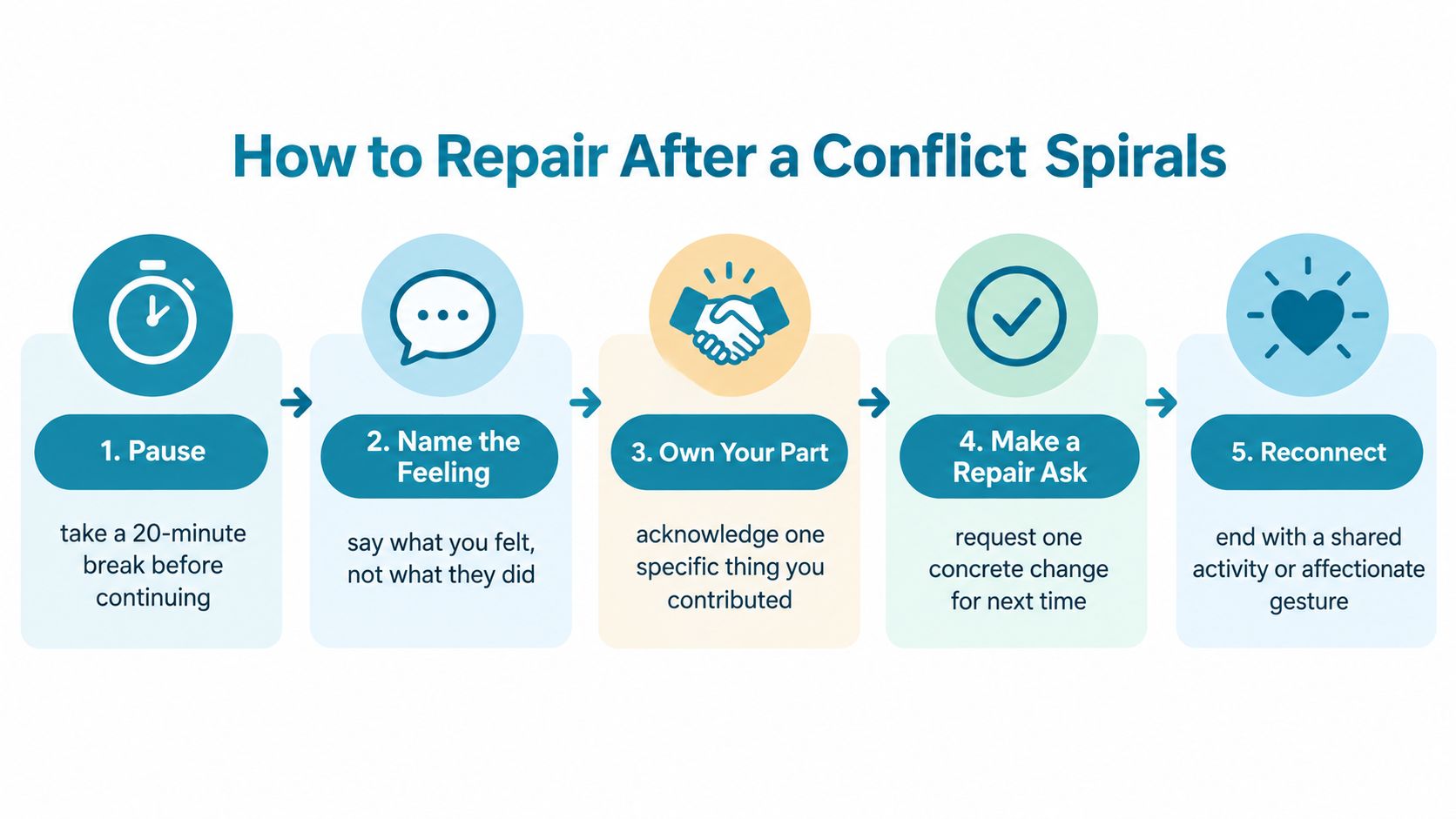
The following sequence is deliberately concrete. It doesn't replace accountability. It creates enough stability for accountability to be heard.
Pause without abandoning
The partner who needs space should state the pause clearly and give a return point: “The conversation is getting too intense. A break will help. The discussion will resume after both people have settled.” Walking away without explanation can activate abandonment fears, while insisting on immediate resolution can intensify flooding.
The pause should include regulation rather than rumination. A short walk, water, slower breathing, reduced sensory input, or a quiet room can help. The person who is more activated shouldn't use the break to compose a stronger case against the other partner.
Name the feeling and own one part
When the conversation resumes, each person describes an internal experience rather than presenting a prosecution. “I felt alone and overloaded when the appointment wasn't handled” is more useful than “You never care.” The ADHD partner might say, “I felt ashamed and attacked, then I responded in a way that made the situation worse.”
A complete apology names the impact and the behavior. “I missed the commitment, became defensive, and left the other partner carrying the consequence. That hurt and wasn't fair” is stronger than “Sorry you took it that way.”
Make one repair request
The request should be observable and limited. “Next time, the responsible partner will put the appointment in the shared calendar immediately and send confirmation after booking” gives the couple something to test. “Be more considerate” doesn't tell either person what to do differently.
Couples who want additional guidance on relationship patterns can review the educational resources at Nick Donahue's therapy blog, while remembering that online information isn't a substitute for individualized care.
Reconnect through action
Repair isn't complete when the explanation ends. A shared meal, a brief walk, a hand squeeze, or sitting together without discussing the problem can signal that the relationship has survived the rupture. Affection should never be forced, but reconnection gives both nervous systems evidence that conflict and connection can coexist.
When Couples Therapy Actually Helps ADHD
Generic communication training often assumes that both partners can pause, remember the conversation, regulate emotion, and apply a new script under pressure. ADHD can disrupt each of those steps. A couple may understand reflective listening perfectly in a calm office and still lose access to it during a fast-moving argument.
Effective therapy therefore needs more than neutral communication rules. The clinician should assess attention, impulsivity, emotional regulation, shame, follow-through, conflict style, co-occurring anxiety or substance use, and the distribution of household labor. The therapist should also distinguish ADHD-related impairment from incompatibility, coercion, and emotional abuse.
Why the treatment target matters
Acceptance and Commitment Therapy can help a person notice painful thoughts and feelings without allowing them to dictate behavior. In practice, that may mean identifying the thought “This criticism proves failure,” making room for the shame, and choosing a values-based response such as pausing or repairing.
Interpersonal Therapy focuses on relationship roles, communication patterns, transitions, and unresolved conflict. It can help couples examine how a missed commitment changes the balance of responsibility, rather than treating the argument as an isolated communication error.
Mindfulness-based approaches may also help when the couple needs greater self-understanding and better awareness of emotional escalation. The model matters less than whether the therapist can translate it into concrete, brain-aligned practice.
Individual therapy still affects the relationship
Couples therapy isn't always the first or only step. The partner with ADHD may need individual work on emotional regulation, shame, impulsive responses, executive functioning, or treatment decisions. The other partner may need support for resentment, burnout, grief, boundaries, and the difference between compassion and self-erasure.
The research base remains limited. A 2025 systematic review identified only eight studies and emphasized the need for research involving both partners in the same relationship, particularly outside North America (systematic review of ADHD and intimate relationships). That limitation is one reason treatment should remain individualized rather than promising that a single script will work for every couple.
For adults seeking individual support with ADHD, anxiety, overthinking, emotional regulation, and relationship patterns, Nick Donahue LICSW PLLC describes therapy using ACT, Interpersonal Therapy, Humanistic, and mindfulness-based approaches. Couples can also seek a clinician who provides dedicated relationship therapy and understands ADHD in both partners.
A useful test for fit: After an initial conversation, each partner should be able to explain what the therapist believes is maintaining the cycle and what specific behavior will be practiced next.
Moving From Survival to Connection
The assumption that ADHD relationship problems are caused by carelessness is too simple to guide treatment. The evidence points to a more complicated interaction among attention, emotional dysregulation, impulsive communication, shame, conflict, and unmet support needs. That complexity doesn't remove responsibility. It shows where responsibility needs to be applied.
A workable relationship usually requires three shifts:
From memory to systems: Externalize important commitments instead of relying on one partner's working memory.
From supervision to ownership: Share support while keeping responsibility visible and adult-to-adult.
From escalation to repair: Interrupt the nervous-system surge, then address both the practical failure and the emotional injury.
The risks associated with ADHD are real, but they aren't destiny. Couples can build satisfying relationships when they stop treating every symptom as a moral message and stop treating every painful reaction as an excuse. Progress may look less dramatic than a complete personality change. It may look like a calendar entry made immediately, a pause taken before an insult, or an apology that finally addresses the burden left behind.
Shame often tells the ADHD partner to hide and the other partner to control. Neither response creates intimacy. A more durable path combines compassion with clear limits, practical supports with independent ownership, and professional care when home strategies aren't enough.
Couples who want to understand an individual therapist's background and approach can review Nick Donahue's professional information and compare it with other ADHD-informed options. The next step can be a consultation, a shared conversation about one recurring conflict, or an appointment with a clinician who can assess both the relationship pattern and each person's needs.
If missed commitments, explosive arguments, or the manager-partner dynamic are eroding trust, schedule an ADHD-informed therapy consultation and bring one recent conflict to discuss. A specific example gives a clinician enough detail to identify the cycle, clarify each person's responsibility, and build a repair plan that fits the couple's actual life.
Published via the Outrank app
Comments