
Can't Concentrate on Work?
You open the laptop, the deadline is real, and the work still won't start. Messages keep stacking up, the tab count grows, and the task that should take ten minutes somehow feels impossible. When people say “can't concentrate on work”, the problem is usually not a broken character, it's a mismatch between attention, task design, and the environment around the task.
That's the frame that tends to hold up in therapy. For many adults, especially people with ADHD, anxiety, or poor sleep, concentration doesn't improve by trying harder. It improves when the conditions for focus get redesigned, the way an office chair gets adjusted or a meeting agenda gets tightened. Nick Donahue LICSW's about page reflects that same practical, conversation-based approach to ADHD and anxiety work, and the logic applies here too, focus is something people can engineer, not just force.
Table of Contents
When You Can't Concentrate on Work, the Problem Is Usually Design
The Three Real Reasons Concentration Breaks Down - A quick way to sort the pattern - Attention regulation is not the same as motivation - Sleep and anxiety can masquerade as concentration problems - Environment fit is usually underestimated
Turn 'Work on the Report' Into a Real Starting Plan - Build the plan before the work starts - Before and after, stripped down - What usually goes wrong
Run Small Experiments on Your Work Environment - Run one change at a time - Use accommodations as tests, not admissions
Measure Concentration Like a Working Adult, Not a Mood - Track what actually changes - Keep the review simple
Troubleshooting When Nothing Seems to Stick - Watch for the bigger pattern
When You Can't Concentrate on Work, the Problem Is Usually Design
A report is due, the inbox keeps pinging, and every time someone returns to the document, the brain feels like it is starting from zero. That looks like laziness from the outside. In practice, it usually means the person, the task, and the environment are out of sync.
Willpower is a poor fix for a problem that repeats all day. ADHD often shows up as trouble starting, staying with a task, switching back after interruption, or finishing multistep work, even when the work matters. The CDC notes that about 15.5 million U.S. adults, or 6.0% of the adult population, reported a current ADHD diagnosis in 2023, and about half were diagnosed at age 18 or older, which helps explain why work settings often reveal attention problems that school never made obvious. Adult ADHD symptoms are also estimated to affect 2% to 5% of adults worldwide CDC.
Sleep problems and anxiety can muddy the picture further. A person who is running on bad sleep or spending half the day in threat-monitoring mode may describe that as “unfocused,” but the actual issue is load, not effort. Workplace engagement matters too, because attention problems do not happen in a vacuum, they show up in systems where involvement is already strained.
Practical rule: If focus keeps falling apart in the same place, with the same task, at the same time of day, treat that as a design clue, not a character flaw.
That is the frame I use in therapy, and it matches how adults change between sessions. Nick Donahue LICSW's about page reflects that same practical, conversation-based approach to ADHD and anxiety work.
The better question is simpler: which condition is breaking concentration, attention regulation, sleep and anxiety, or environment fit? Once you ask that, you can run experiments instead of chasing shame. That fits real work, where people have interruptions, deadlines, and only a limited amount of patience for advice that assumes perfect self-control.
The business side points the same way. Gallup reported that global employee engagement was 20% in 2025, with 16% actively disengaged, and the U.S. at 31% engaged in the same year Gallup. That does not mean every concentration problem is disengagement. It does show that attention at work is shaped by the larger system around the work, not just by effort.
The Three Real Reasons Concentration Breaks Down
Treating every concentration problem the same way is where advice starts to fail. A noisy office, a racing mind, and ADHD-style task paralysis can all feel like “I can't focus,” but they call for different fixes. Sorting the pattern first saves time and reduces trial-and-error.
A quick way to sort the pattern
If this is happening | Likely driver | Where to start in this guide |
|---|---|---|
The task starts fine, then falls apart after interruptions | Attention regulation | Turn vague work into an if-then plan |
The brain feels foggy, wired, or exhausted before the task even begins | Sleep or anxiety load | Check sleep quality and stress signals first |
Focus improves in some settings but collapses in open offices or meeting-heavy days | Environment fit | Run small work-environment experiments |
That table is not a diagnosis. It is a sorting tool. People often have more than one driver at once, which is why concentration advice can feel contradictory.
Attention regulation is not the same as motivation
Interest is usually intact. What breaks down is ignition and re-entry after interruptions. Someone may care a lot about a report and still stall on the first sentence, drift after a Slack notification, or lose the thread when a coworker interrupts. The CDC summary cited above describes adult ADHD as a persistent pattern of inattention, hyperactivity, and impulsivity that affects work, relationships, and daily life.
Sleep and anxiety can masquerade as concentration problems
A tired brain skips steps. An anxious brain keeps checking for danger. In both cases, working memory gets crowded out, and the person starts calling it a focus issue. That is why sleep quality, night wakings, and morning functioning matter, not just total hours asleep.
Environment fit is usually underestimated
A 2025 qualitative review of adults with ADHD found that some people concentrated better in stimulating, novel, physically active, or fast-paced environments. A 2025 survey found that many employed adults with ADHD rated flexible hours, remote or hybrid work, and noise control as most helpful, while rigid structures and open offices were least effective SAGE review. That cuts against generic focus advice, and for good reason. Some brains do better with more stimulation, as long as it is the right kind.
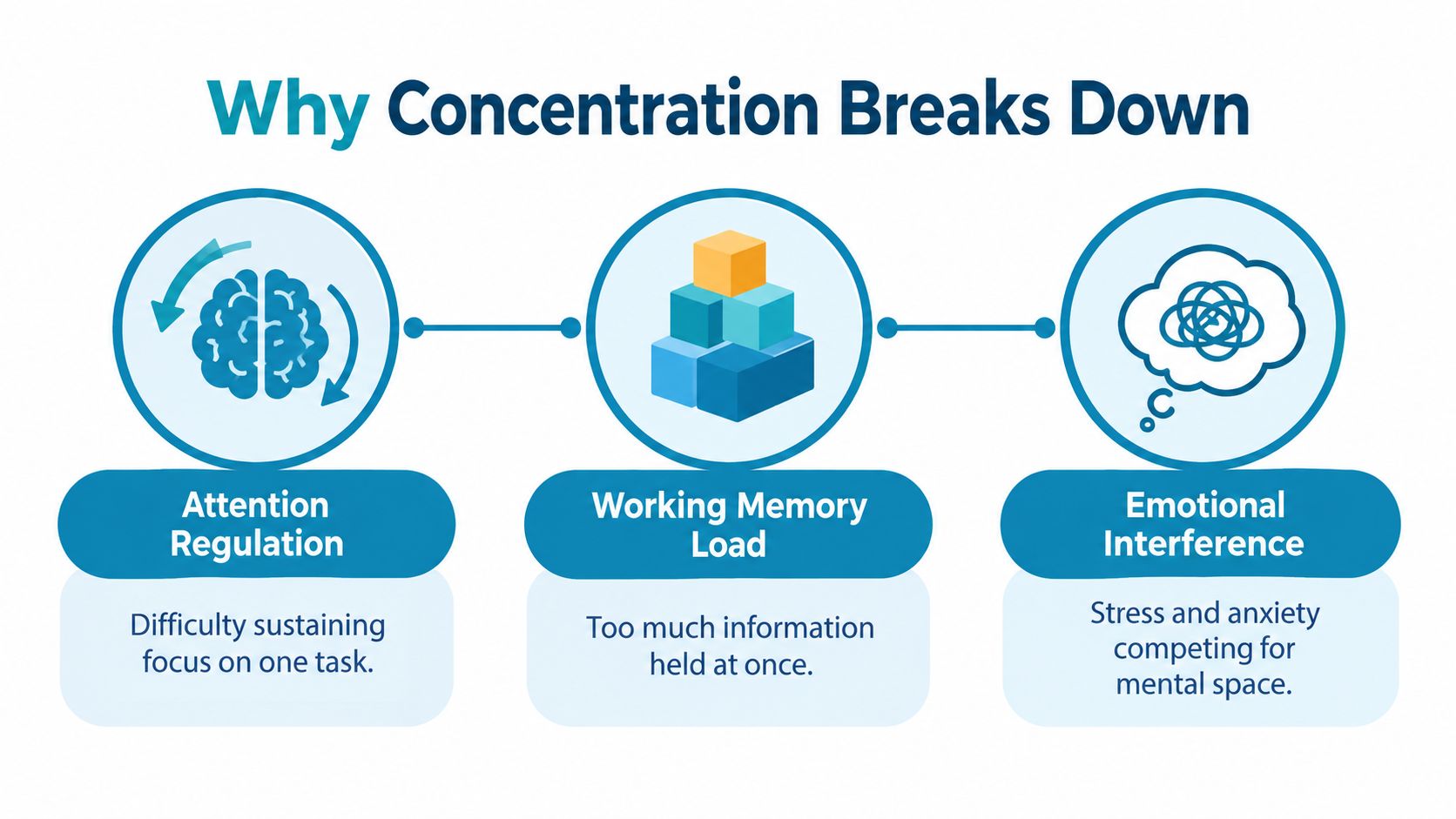
The drivers stack. A person can have an attention-regulation issue, a sleep problem, and a poor-fit workspace at the same time. Fixing only one layer may help a little, but it rarely holds.
Turn 'Work on the Report' Into a Real Starting Plan
Vague intentions invite avoidance. “Work on the report” is too broad for a brain that already struggles with task initiation, especially if the task is boring, unclear, or easy to interrupt. A better starting point is an implementation intention, which means converting the plan into a specific if-then cue and a tiny first action.
Build the plan before the work starts
Use this format:
If it is 9:00 a.m. and the laptop opens, then messaging apps close, the report opens, and one named paragraph gets written for 10 minutes.
That structure matters because the cue is observable, the action is immediate, and the duration is short enough to survive resistance. The Konstanz meta-analysis of 642 independent tests found implementation intentions improved cognitive, emotional, and behavioral outcomes, with concentration effects in the medium range and attention outcomes sometimes large Konstanz meta-analysis.
Practical rule: Don't write a plan that sounds impressive. Write one that still works when the brain is mildly annoyed.
Before and after, stripped down
Before, the task is, “Finish the report.”After, the task is, “If the calendar hits 9:00 and the laptop opens, then shut Slack, open the document, and draft the first paragraph for 10 minutes.”
A second example works for people who get pulled into email all day:
If email opens before the report starts, then the inbox gets closed, one sentence gets added to the report, and a five-minute timer begins.
The recovery rule matters just as much as the start rule. If an email, text, or unrelated tab interrupts the work, write that distraction on a capture list, return to the document, and restart the timer. That keeps interruption from turning into a full task collapse.
What usually goes wrong
Ambiguous triggers: “When I have time” never lands on a real moment.
Oversized actions: “Finish the project” is not a first step.
No recovery rule: One interruption becomes an hour.
A more useful rehearsal is physical, not mental. Place the cue in the actual environment, open the document, close the apps, and practice the first 10 minutes where the work happens, not in a motivational mood somewhere else. The point is to make starting more automatic than stalling.

Run Small Experiments on Your Work Environment
Environment is the most underused lever in concentration work, and the right setup is rarely found by guessing. Treat each change as a test with one variable, not a personality verdict. If you want a fuller look at this practical, attention-first approach, see the blog at Nick Donahue LICSW.
Run one change at a time
The goal is simple. Change one part of the work setup, keep the rest steady, and watch what happens to attention, stress, and output.
Quiet vs lightly stimulating setting: Try one day with headphones and low background noise, then one day with café noise or a busier room. Track minutes on task and how often the mind drifts.
Async vs meeting-heavy mornings: Protect one morning from live meetings for one to three workdays, then compare it with a normal meeting-heavy morning. Notice how quickly the first task starts.
Written instructions vs verbal handoffs: Ask for one task in writing, or write your own instructions immediately after a verbal conversation. Track rework and clarification loops.
Movement breaks: Set a timer for every 45 to 60 minutes, stand up, walk, stretch, or reset the body briefly. Notice whether the next work block starts faster.
Notification and tab limits: Close all but the active tab and mute nonessential alerts for one to three workdays. Count context switches, not just annoyance.
Use accommodations as tests, not admissions
Adults with ADHD often do not need more discipline. They need a different operating setup. That can mean flexible hours, hybrid work, or a quieter space, and it can also mean dropping the idea that an open office is automatically more professional because it is louder and harder to think in.
Keep the log plain. Write the date, the setup, the task, and one sentence about focus quality. If a change helps for two days and then stops helping, that still gives you useful data. The environment may be helping, while the task itself still needs more structure.
Nick Donahue LICSW's services page is one example of therapy that works with ADHD, anxiety, and related concentration problems through structured, practical support. The larger point is simpler: the right accommodation should look like a design choice, not a confession.
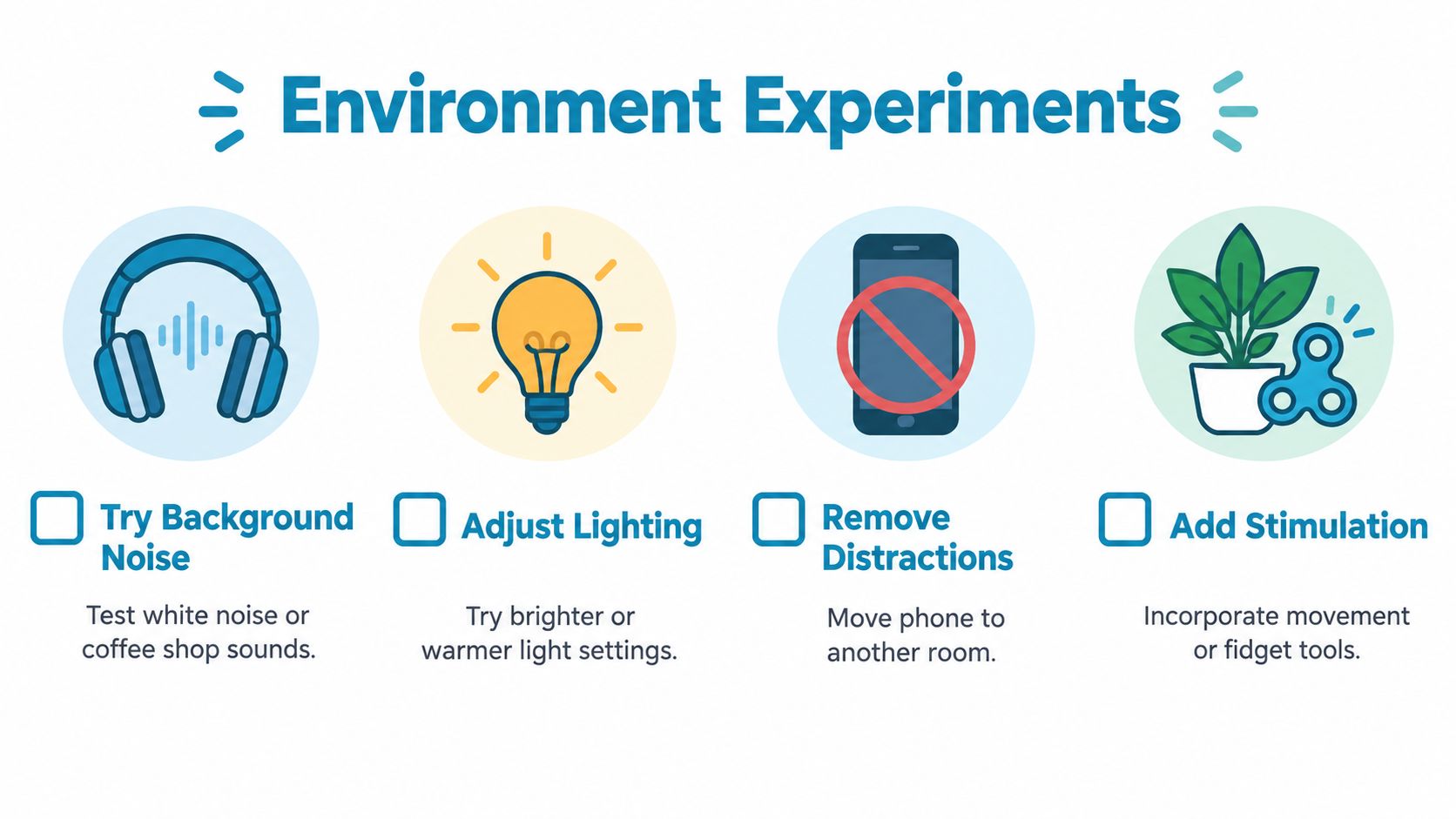
The work environment does not need to be perfect. It needs to be less hostile to the kind of attention the person has.
Measure Concentration Like a Working Adult, Not a Mood
A focus check based on vibes is unreliable. Someone can feel busy all day and still produce very little. Someone else can feel distracted and still finish the work that matters.
Track the work instead.
Track what actually changes
Use three numbers for five working days:
Minutes on the target task
Number of context switches
Completed work units, such as paragraphs, tickets, emails, or reviewed documents
Those three numbers beat a mood check because hyperfocus can feel productive while producing little. A single notebook page or a plain spreadsheet is enough. No dashboard, no productivity theater.
Keep the tracking light enough that you will use it. Record the numbers in under a minute per block. If the tracking becomes another avoidance ritual, it is too much.
Subjective focus can mislead, especially for people who swing between hyperfocus and shutdown. Objective tracking shows whether the if-then plan and the environment change are buying more time on task, fewer interruptions, or more finished work units.
Keep the review simple
At the end of each day, ask which setup produced more target-task minutes, fewer switches, or more completed units. Keep the winner and drop the loser. That is how a focus system improves, by trimming what does not work.
Troubleshooting When Nothing Seems to Stick
Sometimes the problem is a bad afternoon. Sometimes it's a bad week. Sometimes it's a longer pattern that deserves more than another productivity tweak. Sorting those cases clearly keeps people from blaming themselves for a system problem that needs a different intervention.
Watch for the bigger pattern
Persistent anxiety, racing thoughts, sleep disruption, growing use of cannabis or other substances to shut the brain off, burnout from high-demand work, and emotional blowups around tasks that used to be manageable all point to something deeper than a focus glitch. A sleep audit makes sense when poor sleep is frequent. An anxiety screen makes sense when the mind keeps scanning for danger. A substance-use check-in makes sense when cannabis or other substances start functioning like a nightly off-switch.
When concentration problems come bundled with disorganization, procrastination, and emotional dysregulation, structured CBT for adult ADHD is a stronger next step than generic productivity advice. The better-evidenced route uses a repeatable workflow, identify the recurring failure, record the trigger, thought, emotion, and behavior, break the task into smaller visible steps, use external reminders and one prioritized task list, practice in real work, and review weekly Wiley review. The point is not to “try harder,” it's to identify what keeps breaking the system.
Asking for help is not a productivity hack. It is the design fix when the personal system is the bottleneck.
A persistent pattern can also justify an evaluation for adult ADHD, especially when the person has long-standing trouble initiating, sustaining, or restarting work across settings. If the problem has been there for years, the work environment may be exposing it rather than causing it.
Your One-Page Concentration Reset
Concentration is a design problem, not a willpower problem. Pick one driver, write one if-then plan, make one environment change, and track minutes, switches, and completed work for five days. If the numbers improve, keep the change. If they don't, change the setup, not the person.
Start today with four moves, close messaging apps before the first task, define one trigger and one action, schedule one movement break, and turn off one nonessential notification. If the same problem keeps showing up across days or months, professional support can help turn the experiment into a real plan, and therapy that uses ACT, mindfulness, and ADHD-aware strategy can be a useful place to do that work with someone who understands how attention behaves.
Comments