
Why Do I Feel Overwhelmed All the Time!?!
The inbox is open, three messages need an answer, laundry is waiting, and a small decision about dinner somehow feels impossible. Nothing looks catastrophic from the outside. The person is still attending meetings, replying to texts, and showing up for family, yet internally every demand feels urgent and the mind keeps jumping ahead to the next problem.
That experience often prompts the search, “Why do I feel overwhelmed all the time?” The answer usually isn't a character flaw or a simple failure to organize. Constant overwhelm can develop when chronic stress, poor recovery, anxiety, executive-function strain, and emotional dysregulation keep reinforcing one another.
Table of Contents
What Constant Overwhelm Actually Feels Like - The hidden accumulation
The Stress, Sleep, and Anxiety Loop - Why the overlap matters
How Overwhelm Shows Up in Your Body and Mind - Translating the experience
Why Productivity Advice Often Misses the Point - The cycle behind the backlog - Externalize rather than intensify
When Overwhelm Is an ADHD Pattern Rather Than a Workload Problem - Clues that change the question
Practical Steps That Actually Reduce the Load - In the next 24 hours - Over the next week - At the structural level
When Self-Help Stops Working and Support Makes Sense - Signs that a fuller assessment is needed
What Constant Overwhelm Actually Feels Like
A person can look highly functional while privately feeling close to collapse. They may submit the report, pick up the children, answer the polite “How are you?” and then sit in the car for several minutes because entering the house means facing another list of unfinished tasks.
The internal experience is less about one large emergency than about no psychological room between demands. A message from work stays active while a family concern, financial uncertainty, health worry, or unfinished errand competes for attention. Even pleasant plans can feel like obligations when the nervous system is already carrying too much.
The American Psychological Association's 2023 Stress in America data offers useful context. Among 3,185 U.S. adults, 33% said their stress was completely overwhelming on most days, while 24% rated typical stress at 8 to 10 on a 10-point scale, compared with 19% in 2019. Those figures don't describe people who have all stopped functioning. They include people who may still be meeting responsibilities while feeling overloaded inside.
The hidden accumulation
Several background concerns can remain active at once. In the same survey, respondents identified the future of the country, violence and crime, national debt, mass shootings, social divisiveness, and health care as significant stressors. The point isn't that every person experiences each concern in the same way. It's that the mind may be responding to a stack of unresolved uncertainty, not one isolated task.
A useful reframe: Feeling overwhelmed doesn't prove that someone is weak, lazy, or incapable. It may show that the current demands have exceeded available recovery and mental capacity.
Someone who keeps saying “nothing is technically wrong” may be overlooking the total load. Outward competence can coexist with exhaustion, irritability, avoidance, indecision, and a persistent sense of falling behind. That pattern deserves attention rather than moral judgment, and a frequently asked questions resource can help clarify when everyday stress has become something more persistent.
The Stress, Sleep, and Anxiety Loop
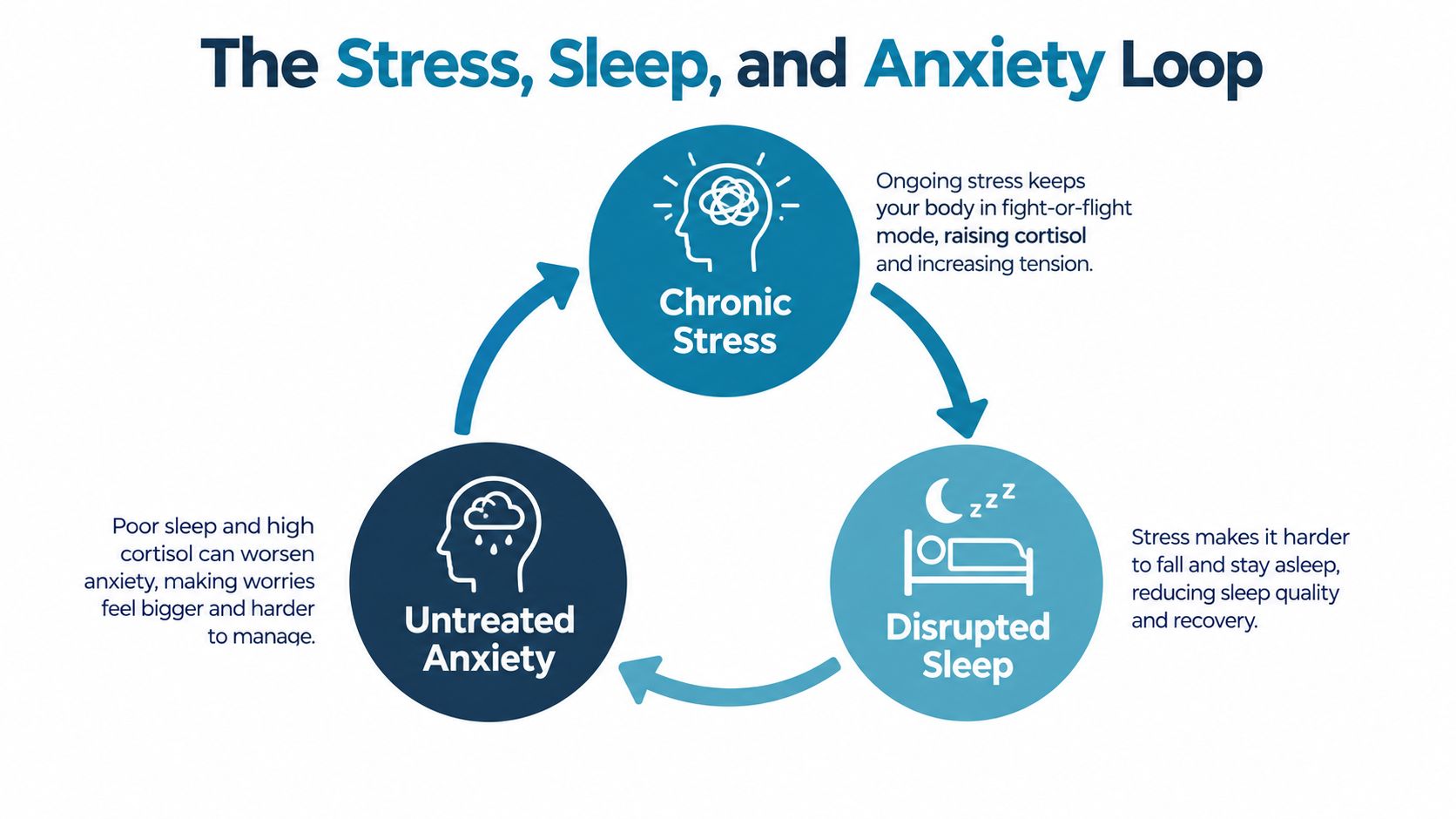
Constant overwhelm often runs on a loop rather than a single cause. Chronic stress makes it harder to settle at night, disrupted sleep reduces attention and emotional regulation, and anxiety fills the resulting mental space with predictions about what could go wrong.
The CDC's sleep indicator definitions report that 35% of U.S. adults had insufficient sleep in 2020, defined as averaging fewer than seven hours in a 24-hour period. More recent CDC data found that 30.5% averaged less than seven hours in 2024. Insufficient sleep is associated with higher risks of anxiety and depression, as well as physical conditions including obesity, diabetes, hypertension, heart disease, and stroke.
An anxious mind rarely rests just because the body is in bed. It may rehearse conversations, anticipate failure, scan for threats, or keep reopening decisions that seemed settled earlier. Short sleep then makes ordinary demands feel larger, while worry makes restorative sleep harder to reach.
Why the overlap matters
The scale of anxiety helps explain why this pattern shouldn't be dismissed as poor discipline. The World Health Organization estimated that 470 million people were living with an anxiety disorder in 2023, making anxiety disorders the most common mental disorders worldwide, while only about 27.6% of people needing treatment received it. Anxiety can bring racing thoughts, excessive anticipation, muscle tension, difficulty concentrating, and trouble deciding what deserves attention first.
The APA survey also reported that 37% of adults had a diagnosed mental health condition in 2023, compared with 32% in 2019. Anxiety disorders were reported by 24%, and depression by 23%, according to the APA survey data. These figures don't diagnose any individual reader, but they show why persistent overwhelm can coexist with a seemingly ordinary life.
A practical next step is to observe the loop without trying to solve everything at once. A mental health blog with practical guidance may offer ideas, but persistent sleep disruption, escalating worry, or declining function calls for a more individualized assessment.
How Overwhelm Shows Up in Your Body and Mind
Overwhelm is easier to address once its parts have names. A person may notice a tight jaw, raised shoulders, shallow breathing, a clenched stomach, or a body that stays braced even during quiet moments. The mind may race through possible problems while struggling to complete the one task directly in front of it.
Common experiences include:
Racing thoughts: Several possible futures appear at once, each demanding preparation.
Excessive anticipation: The mind rehearses what might happen instead of responding to what is happening.
Priority confusion: Every item feels equally urgent, so choosing becomes exhausting.
Concentration problems: Attention slips away before a paragraph, conversation, or instruction is complete.
Muscle tension: The body remains prepared for action, even when no immediate danger is present.
These aren't merely signs of having a crowded calendar. Chronic stress can affect working memory, attention shifting, inhibition, and cognitive flexibility, the functions needed to hold a plan in mind, resist distractions, change direction, and decide what can wait. Reviews of this research connect chronic stress with subjective problems in concentration, memory, and decision-making, along with poorer performance on working-memory and attentional-shifting tasks, as described in this research review on chronic stress and cognition.
Translating the experience
“I can't keep up” is emotionally accurate but not always precise enough to guide action. A more useful description might be: working memory is full, attention keeps shifting, and ordinary tasks are being processed as urgent threats.
That distinction matters because pushing harder can intensify the problem. When inhibition and flexibility are strained, adding more reminders, more tabs, or a more ambitious schedule may create another layer of stimulation rather than relief.
When the brain treats every open loop as urgent, the first intervention is often reduction, not motivation.
The body also provides information. Irritability, shutdown, restlessness, headaches, disrupted appetite, or difficulty transitioning between activities can all signal that demands are exceeding available regulation. These sensations don't establish a diagnosis, but they indicate that the person needs a clearer assessment of stress, sleep, anxiety, health, and workload.
Why Productivity Advice Often Misses the Point
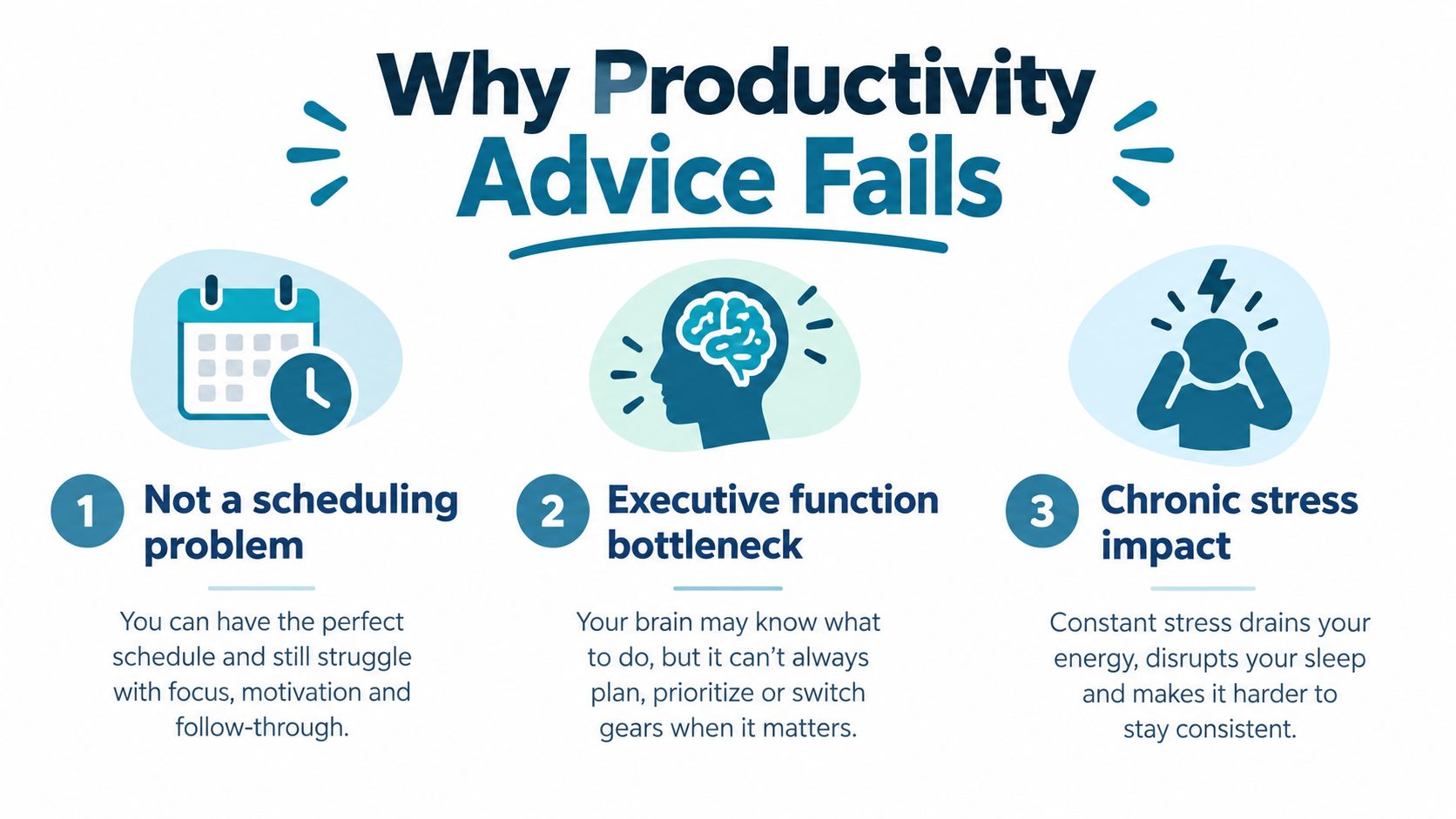
Standard productivity advice assumes that the person has enough cognitive capacity to use it. Time-blocking, batching, and prioritizing can help when the main issue is an unstructured day. They work less well when stress has already impaired the mental functions required to choose, sequence, inhibit, and begin.
Every unfinished item can stay mentally active. The brain keeps checking the appointment, the email, the bill, the conversation, and the project, even while the person is trying to focus elsewhere. That creates an executive-function bottleneck, not merely a scheduling gap.
The cycle behind the backlog
Chronic stress can reduce cognitive control. Reduced control contributes to missed tasks, indecision, avoidance, and unfinished commitments. The accumulating backlog then produces more stress, which further reduces the ability to organize.
This is why a person can understand exactly what needs to happen and still remain unable to start. Knowledge isn't the same as access to working memory, inhibition, emotional regulation, and flexible attention at the moment action is required.
Externalize rather than intensify
The more useful approach is to move information out of the brain and reduce simultaneous demands:
Use one visible capture list. Keep tasks in one place rather than scattered across messages, notes, and memory.
Choose one to three priority actions. A short list creates a realistic decision boundary for the day.
Define the next physical step. “Work on taxes” is vague. “Open the tax folder and find the income statement” gives the brain a starting point.
Use timed work intervals. A bounded period can feel safer than an undefined demand to work until everything is done.
Schedule actual recovery. A pause without notifications, scrolling, or new decisions allows the system to come down.
The objective isn't to extract more effort from an exhausted person. It's to reduce the information the brain must actively maintain. A smaller system may look less ambitious, but it often makes action more available.
When Overwhelm Is an ADHD Pattern Rather Than a Workload Problem
ADHD-related overwhelm can look like poor planning from the outside, but the internal mechanism may involve attention regulation, working memory, inhibition, and emotional intensity. A task can be objectively manageable and still trigger frustration, shame, urgency, or avoidance so quickly that beginning becomes difficult.
A systematic review of adult ADHD studies found greater emotion-regulation difficulties in comparison groups, with reported effect sizes ranging from d = 0.31 to 2.27, as reported in this systematic review of emotion dysregulation in adult ADHD. Emotional dysregulation was also associated with ADHD symptom severity and executive-function problems. A 2025 review described emotional dysregulation in roughly 34% to 70% of adults with ADHD, while a separate 2025 study linked it with symptom severity and executive-function deficits, particularly among women with ADHD, according to the review and study on ADHD emotional dysregulation.
Clues that change the question
The useful question isn't “Is the workload objectively too large?” It is “What happens between noticing the task and being able to begin or return to it?”
ADHD-linked overwhelm becomes more plausible when the pattern is longstanding and appears across settings. Relevant clues can include:
Early history: Similar difficulty with organization, lateness, forgetfulness, or unfinished work appeared during childhood or school.
Attention inconsistency: Focus varies sharply with interest, urgency, novelty, or external structure.
Interruption sensitivity: A small interruption makes returning to the original task unusually difficult.
Emotional acceleration: Frustration, shame, anger, or panic rises faster than the situation seems to warrant.
Recovery difficulty: The person needs a long time to regain momentum after a stressful interaction or change of plan.
Repeated capability gaps: Strong performance in some situations coexists with chronic failure to manage routine demands.
Sleep loss can amplify this vulnerability. A meta-analysis of 79 publications found that sleep loss impaired executive-function components including working memory, inhibitory control, and cognitive flexibility, with significant effects on reaction time and accuracy, as summarized in the ADHD and sleep research.
Overwhelm doesn't prove ADHD, and a checklist can't replace assessment. Evaluation becomes worth considering when difficulties affect work, school, relationships, or daily care, especially alongside impulsivity, chronic lateness, emotional reactivity, or inconsistent attention.
Practical Steps That Actually Reduce the Load
The most useful plan is small enough to use during overwhelm. It should reduce immediate stimulation, protect recovery, and address the demands that keep replenishing stress instead of adding a new self-improvement project.
In the next 24 hours
Start with the body and environment. Protect a consistent wake time, close unnecessary tabs, silence nonessential notifications, and lower visual clutter around the next task. Choose one five-minute physical action, such as opening the document, placing the dishes by the sink, or writing the first sentence.
The five-minute limit isn't a promise to finish. It lowers the emotional threshold for starting and gives working memory a narrower target. If momentum develops, continue. If it doesn't, the action still provides information about what made the task difficult.
Over the next week
Use a simple structure rather than a perfect routine:
Capture everything once: Keep one visible list for tasks and worries.
Select up to three priorities: Allow the rest to remain secondary without treating them as failures.
Work in bounded intervals: Stop before exhaustion turns into avoidance.
Create a recovery ritual: Take a quiet walk, shower, stretch, or sit without adding more digital input.
Track sleep briefly: Note sleep timing and duration so patterns become observable rather than guessed.
At the structural level
Personal coping can't fully compensate for harmful conditions. A Deloitte global Gen Z and millennial survey described about nine in ten respondents as feeling stressed or anxious at least sometimes, while 58% of Gen Z and 54% of millennials reported regular digital fatigue; the same Deloitte mental health research identified long hours and lack of recognition as leading work stressors.
That evidence points toward harder questions. Which meetings, notifications, expectations, relationship demands, or financial pressures keep reactivating the stress response? What can be reduced, renegotiated, delegated, or exited? Sometimes the right intervention is a boundary or workload change, not another breathing exercise.
Nick Donahue LICSW offers individual therapy for teens and adults in Washington, D.C., with virtual sessions for clients in D.C. and Virginia, focusing on ADHD, anxiety, emotional regulation, relationships, and life transitions. That is one possible form of support, not a substitute for changing conditions that keep exceeding a person's capacity.
When Self-Help Stops Working and Support Makes Sense
The question “Should this be manageable alone?” often contains more shame than curiosity. A person may keep downloading planning apps, adjusting routines, and promising to try harder while the actual problem remains a mismatch between demands, control, and recovery.
That mismatch can persist even when someone knows what would help. People may need time away and still avoid taking it because of work pressure, guilt, financial concerns, caregiving responsibilities, or fear of falling further behind. The Deloitte findings on stress and missed time off make the point that recovery isn't always available just because someone understands its value.
Signs that a fuller assessment is needed
Professional support makes sense when overwhelm is persistent, interferes with work, school, relationships, sleep, or basic care, or keeps returning despite meaningful changes. It becomes especially important when it occurs with:
Panic symptoms: Sudden surges of fear, intense physical symptoms, or avoidance of ordinary situations.
Depressive symptoms: Loss of interest, hopelessness, persistent low mood, or marked withdrawal.
Increasing substance use: Using cannabis, alcohol, or other substances more often to shut down worry or exhaustion.
Severe sleep disruption: Ongoing difficulty falling asleep, staying asleep, or feeling restored.
Safety concerns: Any thoughts of self-harm require immediate support through local emergency services, a crisis line, or a trusted person who can stay present.
A clinician can assess anxiety, ADHD, depression, sleep disorders, medical contributors, and the effects of chronic stress rather than assuming that every problem is a motivation issue. The assessment may also clarify whether the person needs therapy, medication evaluation, medical care, environmental changes, or several forms of support.

Therapy can provide a place to slow the pattern down without requiring a diagnosis before the first conversation. Approaches such as Acceptance and Commitment Therapy, Interpersonal Therapy, Humanistic therapy, and mindfulness-based work can be combined with practical, brain-aligned strategies for ADHD and emotional regulation. Details about therapy services and formats can help someone decide whether that kind of conversation fits their needs.
Constant overwhelm is a signal, not a verdict. A person doesn't need to earn support by reaching a crisis point. Start by writing down the three demands consuming the most attention, the recovery barrier that keeps them active, and the smallest change another person could help make. Then schedule a consultation with a licensed clinician, trusted medical professional, or local support service to turn that list into a realistic plan.
If overwhelm is interfering with sleep, relationships, work, or daily functioning, contact a licensed mental health professional for an initial consultation. In an immediate safety crisis, contact local emergency services or a crisis resource in the reader's area.
Prepared with the Outrank tool
Comments