
Wake Up Feeling Anxious: A Practical Morning Plan
The popular advice to lower your cortisol misses an important distinction: feeling alarmed when you wake isn't evidence that you have a hormone problem. If you wake up feeling anxious, the more useful question is whether the pattern follows poor sleep, your sleep schedule, a prediction about the day, or some combination of these.
Start by separating the physical feeling from the meaning you give it. Then use a small morning routine and a time-pattern diary to decide what needs attention, rather than adding more wellness tasks to an already difficult morning.
Table of Contents
Why You Wake Up Feeling Anxious - Cortisol contributes to arousal, not the whole explanation - Match the pattern before choosing the fix
What to Do in the First 30 Minutes - Five moves you can do half-awake - When a routine isn't enough
A Two-Week Diary for Your Clock - Record enough to make a decision - Read patterns, not verdicts
When ADHD and Short Sleep Amplify Mornings - Take sleep complaints seriously - Reduce the mental work required to begin
Mistakes That Keep Morning Anxiety Going - Don't turn coping into another performance standard - Keep the plan smaller than the problem
Decide Whether to Handle This or Get Help - Use diagnostic criteria as context, not a waiting period - What therapy can realistically offer
Why You Wake Up Feeling Anxious
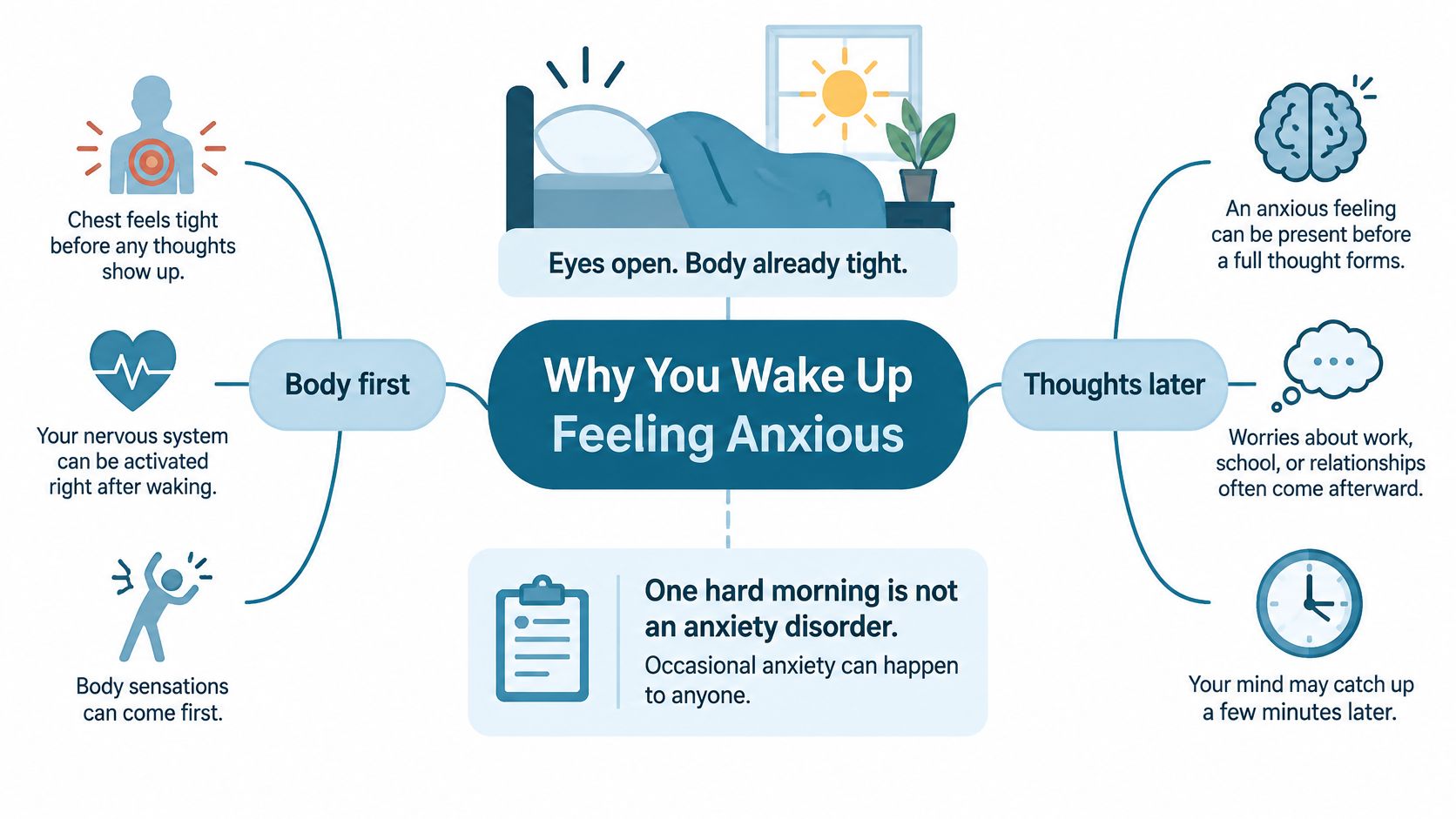
Your eyes open, and your chest is already tight. You haven't formed a complete thought about work, school, or your relationship, but you're bracing anyway. That body-first experience is real, although it doesn't tell you, by itself, what's causing it.
One hard morning is not an anxiety disorder. A normal cortisol rise is not a diagnosis. Morning anxiety describes a pattern, not a single condition with a single explanation.
Cortisol contributes to arousal, not the whole explanation
The cortisol awakening response describes a rise across roughly the first 15 to 45 minutes after awakening, usually followed by a decline across the day; the small study published in Stress and Health found an association with internalizing symptoms, not proof that cortisol causes morning anxiety. Findings across studies are inconsistent, and sleep and waking time complicate the picture.
That distinction matters when you're deciding what to do. An anxious morning isn't a reason to buy cortisol tests or supplements without clinical guidance. Those purchases can turn uncertainty into more checking without clarifying the underlying problem.
The diagram separates the initial body alarm from the thoughts that may follow it.
Match the pattern before choosing the fix
Several experiences can feel almost identical from inside your body. Use the closest match for this week, not as a self-diagnosis, but as a starting hypothesis.
What the morning feels like and what to try first
What you notice | More likely driver | First move |
|---|---|---|
Body alarm in the first 15–45 minutes, before a clear worry | Normal cortisol awakening plus arousal, not a proven hormone disease | Longer exhale for 3–5 minutes; skip cortisol tests and supplements |
Short, broken, or unrefreshing sleep and a hair-trigger first thought | Sleep loss amplifying emotional reactivity | Stabilize wake time and treat sleep as the target, not only the thought |
A specific prediction about work, school, or a relationship as soon as you wake | Anticipatory anxiety | Label it as a prediction and pick one action for the next 30 minutes |
Worse after late nights, shift changes, or fighting your natural sleep time | Circadian misalignment or chronotype mismatch | Fixed wake time, morning light, and a two-week time log |
Early waking plus trouble starting the day when focus and emotions are hard all day | Possible ADHD-linked sleep disruption alongside anxiety | Track sleep separately from worry; don't treat it as laziness |
The body-first row asks you to avoid turning sensation into a hormone diagnosis. The sleep row asks whether you're trying to reason your way out of exhaustion. The prediction row points toward the difference between preparing for a real obligation and repeatedly rehearsing its worst possible outcome.
The schedule row concerns whether your required waking time fits your actual sleep pattern. The ADHD row asks whether starting the day is difficult even when you know what needs doing. These patterns can overlap.
If you keep mentally reviewing the same concern, understanding how anxiety and overthinking interact may help you recognize when planning has become rumination. Before trying to solve the day's problems, give yourself a manageable transition out of bed. Repeated dread that prevents you from getting out the door deserves assessment, not more self-blame.
What to Do in the First 30 Minutes
Use this routine before coffee and before opening your phone when practical. It's a sequence for separating physical activation from threat interpretation, not a test you have to pass by becoming calm.
Keep a notebook beside the bed, or use a paper card if journaling feels like another assignment. You only need enough information to notice a pattern.
Five moves you can do half-awake
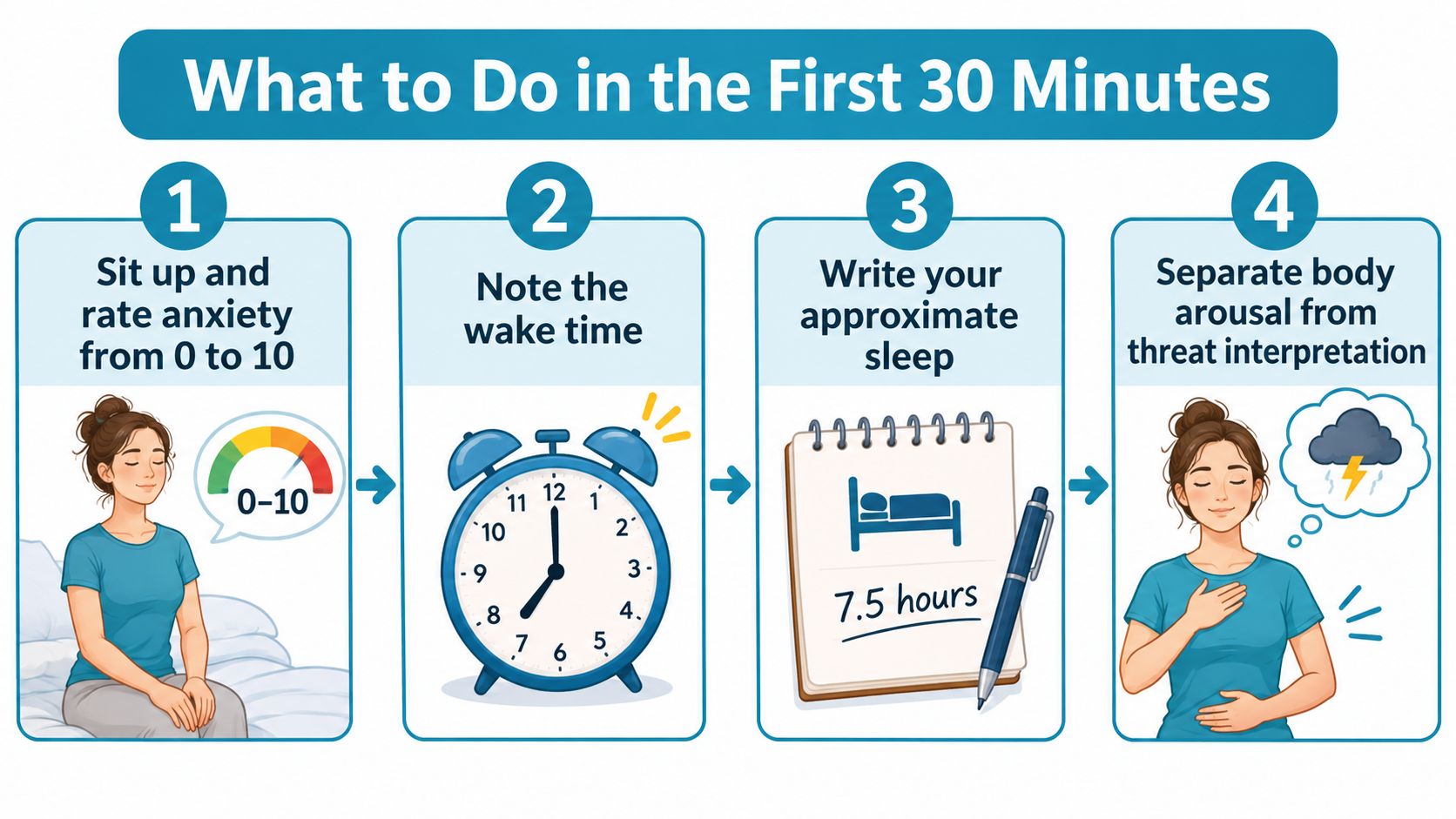
Sit up and record, without debating. Rate your anxiety from 0 to 10, note your wake time and approximate sleep, and write the first anxious sentence. Include the previous day's caffeine, alcohol, or cannabis use. A brief entry is enough; don't begin investigating whether the thought is true.
Breathe slowly and comfortably for 3 to 5 minutes, allowing the exhale to be a little longer than the inhale. Don't force unusually deep breaths or hold your breath. If focusing on breathing makes you more distressed, orient to the room instead: feel your feet against the floor and look at an ordinary object.
Rewrite the thought as a prediction. For example, change The meeting will humiliate me to I'm predicting the meeting will go badly. You're not replacing fear with a positive promise. You're distinguishing an expectation from an event that has happened.
Choose one controllable action for the next 30 minutes. Showering, stepping outside, packing your bag, or taking medication as prescribed all count. Choose an action with a visible finish, not an instruction to get your life together.
Do the action while leaving news and email closed for 20 to 30 minutes, if your responsibilities allow. If you must check for an urgent message, check that channel deliberately and stop. Don't turn an essential check into open-ended scrolling.
This visual gives you a compact reminder of the opening moves.
First 30 minutes after an anxious wake-up
When | Do this | Skip this |
|---|---|---|
0–2 minutes | Rate anxiety 0–10 and write the first thought, wake time, and rough sleep | Arguing with the thought or opening email |
2–7 minutes | Comfortable breathing with a longer exhale for 3–5 minutes | Forceful deep breaths or breath-holding |
7–10 minutes | Label the thought as a prediction, not a fact | Using it as evidence you're in danger |
10–15 minutes | Choose one controllable action for the next 30 minutes | Building the whole day's to-do list |
15–30 minutes | Do that action; delay news and email 20–30 minutes | Scrolling for reassurance |
Treat those windows as a practical arrangement, not a medically validated timetable. The useful distinction is between noticing anxiety and immediately organizing your behavior around it.
You don't have to settle the question of how the whole day will go before you can begin it.
When a routine isn't enough
Treating the first thought as proof that something is wrong can lead to repeated checking, mental reviewing, and reassurance-seeking. A routine helps interrupt that response, but persistent panic or impairment calls for more than a longer self-help list.
Cognitive behavioral therapy, or CBT, addresses anxious interpretations and avoidance; a meta-analysis of adult anxiety trials found approximately 51% remission, while generalized-anxiety findings summarized in the clinical evidence report 51.4% immediately after treatment and 65% at follow-up, with a large benefit over pill placebo. These are group findings, not an individual forecast, and outcomes differ by condition and study.
A Two-Week Diary for Your Clock
Morning-focused advice can miss a basic question: Is waking your most anxious time, or the time you notice it most? Your natural preference for earlier or later sleep, called your chronotype, may help explain the timing.
Coverage from the Association for Psychological Science describes emerging findings that early chronotypes may experience greater anxiety in the morning, while later chronotypes may experience more in the evening. This isn't a rule for every person. Short sleep and a schedule that conflicts with your body clock can also complicate the transition to waking.
Record enough to make a decision
Keep a single log for two weeks, using the fields below. Add a morning anxiety rating, note whether anxiety peaked in the morning or evening, and include nightmares or unusual circumstances. Use rough estimates rather than checking the clock throughout the night.
Two-week morning pattern log
Field to record | What to write | How to read it after 14 days |
|---|---|---|
Sleep window | Bedtime, wake time, hours asleep, awakenings | High anxiety after short or broken nights points to sleep first |
Clock type | Whether dread peaks morning or evening | Morning peaks in early types and evening peaks in late types need different timing fixes |
Substances | Caffeine, alcohol, or cannabis the prior day | Next-morning spikes after use suggest possible rebound, not only worry |
First thought | Work, school, relationship, health, or none | A repeated prediction with decent sleep points to anticipatory worry |
Body flags | Nightmares, panic, or feeling unrested despite time in bed | Persistent flags warrant clinical screening rather than another self-test |
A paper notebook or a simple spreadsheet works. If tracking becomes another way to repeatedly inspect your body for danger, simplify it: make an entry, close the notebook, and continue your morning.
For a teen, a parent can help make recording easier without interrogating the rating. Asking what would make the morning more manageable is more useful than asking why the number hasn't improved.
Read patterns, not verdicts
Compare weekly averages rather than selecting the worst morning as your conclusion. To calculate an average, add the recorded ratings and divide by the number of entries. Also look at whether you completed your planned activity, because functioning can improve before the feeling changes much.
Use the pattern to choose a target:
After short or fragmented nights: Prioritize a sustainable waking schedule, daylight after waking, and evaluation of persistent sleep difficulties rather than adding more thought exercises.
After adequate sleep, with the same feared obligation: Write the concern down for a planned review later, then return to the immediate action. Postponing worry means giving it a place, not pretending the issue doesn't exist.
After late nights or changing shifts: Examine schedule alignment. Social jet lag means your sleep timing shifts between required days and free days; a rigid morning routine won't fully address that mismatch.
Alongside nightmares or substance-related spikes: Bring the pattern to a clinician. The diary identifies an association, not proof of withdrawal, trauma, or a sleep disorder.
Keep existing supports in place while collecting the baseline. Then test one manageable change at a time so you can tell whether it helps.
When ADHD and Short Sleep Amplify Mornings
For adults diagnosed with ADHD later in life, morning dread may come with an old accusation: you should be able to do this by now. But difficulty getting started and feeling unrested deserve examination before they become another judgment about your character.
ADHD is a neurodevelopmental condition, not a measure of effort. Its effects on executive functioning, emotional regulation, and everyday follow-through differ substantially between people.
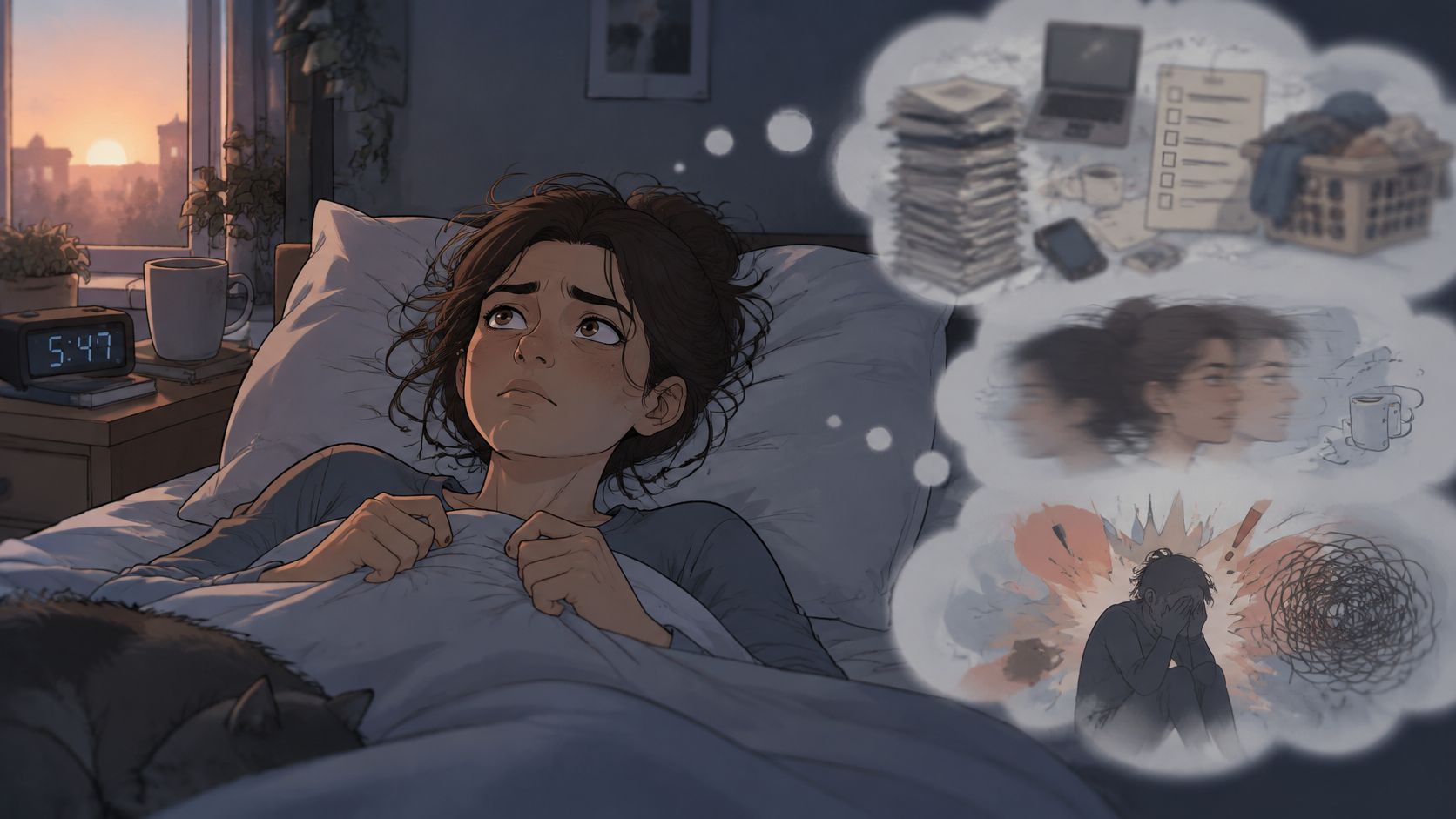
The image below captures the experience of mentally facing the entire day while still in bed.
Take sleep complaints seriously
An analysis of National Comorbidity Survey Replication findings reported rates among adults likely to have ADHD of 10.1% for difficulty initiating sleep, 10.3% for maintaining sleep, 12.6% for early-morning awakening, and 8.6% for not feeling rested despite adequate time in bed, with corresponding odds ratios of 3.8, 3.8, 5.3, and 4.2 compared with adults without likely ADHD.
A separate study of ADHD and sleep difficulties found that 82.6% of participants with ADHD reported sleep problems lasting at least one month, compared with 36.5% of controls. That measure concerned sleep problems generally; it doesn't establish that ADHD caused a particular person's morning anxiety.
The emotional effects of sleep loss also matter. A review of sleep deprivation and emotional regulation describes increased amygdala reactivity and weaker communication between the prefrontal cortex and amygdala. In everyday terms, you may react more strongly to a minor stressor while having less capacity to pause and put it in perspective.
Reduce the mental work required to begin
Say you wake at 5:30 a.m., already rehearsing how you'll be late. You check your phone to make sure nothing has changed, follow another notification, then discover you've used the time you meant to spend getting ready. Anxiety, checking, and difficulty switching tasks are now tangled together.
A long internal routine may be poorly matched to that moment. Try external cues instead:
Move the alarm: Put it far enough away that turning it off requires getting up, provided that's physically accessible.
Write the opening action the night before: Leave a card beside the alarm with something concrete, such as putting on the clothes you've set out.
Make waking predictable: Aim for a consistent, sustainable wake time rather than repeatedly improvising after a bad night. Protect adequate opportunity for sleep rather than using consistency to justify chronic sleep restriction.
The accompanying video offers another format for considering the topic.
If you take a stimulant, ask your prescriber whether medication timing could be relevant to your sleep or morning symptoms. Don't change the dose or schedule on your own. Chronic early waking or unrefreshing sleep also warrants discussion with a clinician who can assess sleep disorders.
If you suspect ADHD, learning about adult ADHD screening and assessment can help you prepare for that conversation. Morning difficulty alone doesn't establish ADHD, and ADHD doesn't explain every hard morning.
Mistakes That Keep Morning Anxiety Going
A useful plan can look ineffective when you measure only whether you felt calm. Less rumination, less avoidance, and getting to the activity you intended are meaningful changes too.
Don't turn coping into another performance standard
Judging a single morning: Compare patterns across your diary instead. An unusually difficult day doesn't establish that the approach failed.
Changing everything at once: Pick a single experiment, such as a steadier wake time or delaying email. Otherwise, you can't tell which change helped or which made the routine harder.
Making breathing compulsory: If you believe the day is unsafe unless you complete the exercise perfectly, breathing has become a condition for acting. Practice flexibility rather than making the ritual more elaborate, with therapeutic support if panic makes that difficult.
Demanding calm from mindfulness: Notice sensations and thoughts without immediately responding to them. Don't use meditation as an exam you fail whenever worry remains.
A college-student mindfulness trial reported improvements in anxiety and sleep quality, but findings from that population don't establish what will work for adults with persistent morning anxiety. The practical question is whether the exercise supports your life, not whether you can perform a particular kind of calm.
Practical rule: A coping tool should give you more flexibility, not another requirement you're afraid to break.
Keep the plan smaller than the problem
Buying a cortisol kit after reading a headline can redirect attention away from the observable pattern. Quitting after a rough day creates a different problem: you never collect enough ordinary mornings to evaluate the change.
Stacking an elaborate routine can also make the first task harder to start, especially when executive functioning is already strained. On a difficult morning, use the action you can complete rather than preserving every step.
If distress remains high despite a workable trial, a clinician should consider anxiety disorders, depression, trauma-related symptoms, medication or substance effects, and sleep disorders. Poor willpower shouldn't be the default explanation.
Decide Whether to Handle This or Get Help
Continuing with a modest routine and diary is reasonable when anxious mornings are occasional, sleep is mostly intact, and your pattern improves after a manageable change. Seek assessment when the distress is frequent, escalating, or interfering with work, school, relationships, or leaving home. You don't need to exhaust every self-help option first.
Use diagnostic criteria as context, not a waiting period
The Merck Manual's summary of DSM-5-TR criteria describes generalized anxiety disorder as excessive worry about multiple activities occurring more days than not for at least six months, difficulty controlling it, and at least three associated symptoms in adults, together with significant distress or impairment. Those symptoms include restlessness, fatigue, difficulty concentrating, irritability, muscle tension, and disturbed sleep.
A clinician must also consider whether substances, medications, or a medical condition better explain the symptoms. That framework is information, not a checklist for diagnosing yourself or a reason to wait until a duration threshold has passed before asking for help.
Get support sooner for panic, hopelessness, or anxiety that repeatedly follows alcohol or cannabis use. New or severe physical symptoms shouldn't automatically be attributed to anxiety. If you feel unable to keep yourself safe, seek immediate emergency support.
What therapy can realistically offer
Therapy for anxiety isn't necessarily about eliminating it. It's about developing a different relationship with anxiety so it no longer gets to make all the decisions.
At our practice, sessions begin with what's been happening in your life. We slow the spiral down, get curious about patterns, and work out what moving forward could look like. A difficult morning might lead to a conversation about avoidance, ADHD-related strain, shame about past mistakes, or a relationship in which you're continually bracing for conflict.
That work goes beyond organizing your morning. An acceptance-based approach can help you act on what matters while discomfort is present; interpersonal work can help you examine the interactions you're anticipating. Mindfulness can support noticing the difference between a sensation, a prediction, and a choice.
Nick's guiding idea, informed by his own therapy experience, is that people need to feel understood enough to grow. You don't need a polished explanation or the right reason to begin that conversation.
You can learn more about anxiety therapy in Washington, DC if you want to understand the process before reaching out. Therapy can sit alongside medical evaluation and medication management when those are needed; it doesn't replace them.
Nick Donahue LICSW offers 60-minute individual therapy for teens and adults, in person in Washington, DC, and virtually for clients in DC and Virginia. If waking anxious is becoming a recurring part of your life, visit Nick Donahue LICSW to learn more or arrange an initial consultation about your concerns and whether the fit feels right.
Comments