
ADHD Screening for Adults: What to Know
You've missed a deadline you cared about, then spent the evening trying to explain why. Maybe your partner has noticed that you lose track of conversations, or you're exhausted by the effort it takes to keep ordinary responsibilities moving. If you're searching for ADHD screening for adults, look for a clinician who can assess longstanding patterns, explain what screening can tell you, and arrange a fuller evaluation when appropriate. The closest appointment isn't necessarily the most useful one.
Table of Contents
Wondering Whether ADHD Explains Your Struggles - Look at the effort behind the appearance - What makes screening worth pursuing
What Adult ADHD Screening Means - How to interpret an ASRS result - Leave with a clear next step
How to Find ADHD Screening Near You in D.C. or Virginia - Access Paths for Adult ADHD Screening - Questions beyond insurance
Why Getting Evaluated Is Harder for Some Adults - Being overlooked isn't proof of a diagnosis - What to ask for after a dismissive experience
What to Bring to Your Screening Appointment - Make your notes concrete - Leave room for uncertainty
What Comes Next After the Screening - Treatment doesn't have to be all or nothing - Make follow-up workable
Practical Questions Adults Ask About ADHD Screening - How much does an evaluation cost? - Why is there a waitlist? - Can my primary-care doctor screen me? - Can I use Virginia telehealth while traveling? - What if the clinician stops at a checklist? - Am I too old to pursue this? - Should I start therapy or seek a diagnosis first?
Wondering Whether ADHD Explains Your Struggles
Considering ADHD can bring relief and skepticism at the same time. You might recognize something familiar in another adult's description, then immediately think about your good grades, demanding job, or ability to concentrate intensely on something interesting. Those questions belong in an assessment, not in an argument you have to settle before making an appointment.
Consider a hypothetical adult who manages deadlines well when a supervisor provides frequent check-ins but struggles after moving into a less structured role. Or someone who keeps work looking organized while household paperwork, appointments, and relationships require exhausting last-minute repairs. Neither example proves ADHD, but both give a clinician more useful information than saying you're distracted.
Look at the effort behind the appearance
An evaluation should consider how you function, not just what others see. Completing a project doesn't tell the whole story if you repeatedly sacrifice sleep, cancel plans, or rely on panic to finish it. Equally, feeling overwhelmed doesn't automatically mean ADHD is the explanation.
If you feel overwhelmed all the time, try separating the experience into concrete problems. Are you losing track of tasks, worrying about doing them incorrectly, avoiding uncomfortable conversations, or feeling too depleted to begin? You don't need to know the cause yet.
You don't have to prove you have ADHD before asking for help understanding your difficulties.
What makes screening worth pursuing
The CDC's explanation of ADHD diagnosis in adults describes a process that combines symptom information with behavioral and developmental history. That's why a legitimate concern can warrant a conversation without guaranteeing a particular diagnosis.
Before reaching out, consider:
Persistence: Is this a recurring pattern rather than an unusually stressful week?
Consequences: What's becoming harder at work, at home, or with other people?
Questions: What would you like to understand beyond whether a label fits?
Seeking screening is a reasonable step toward clarity. If ADHD isn't the answer, understanding what better explains the struggle is still worthwhile.
What Adult ADHD Screening Means
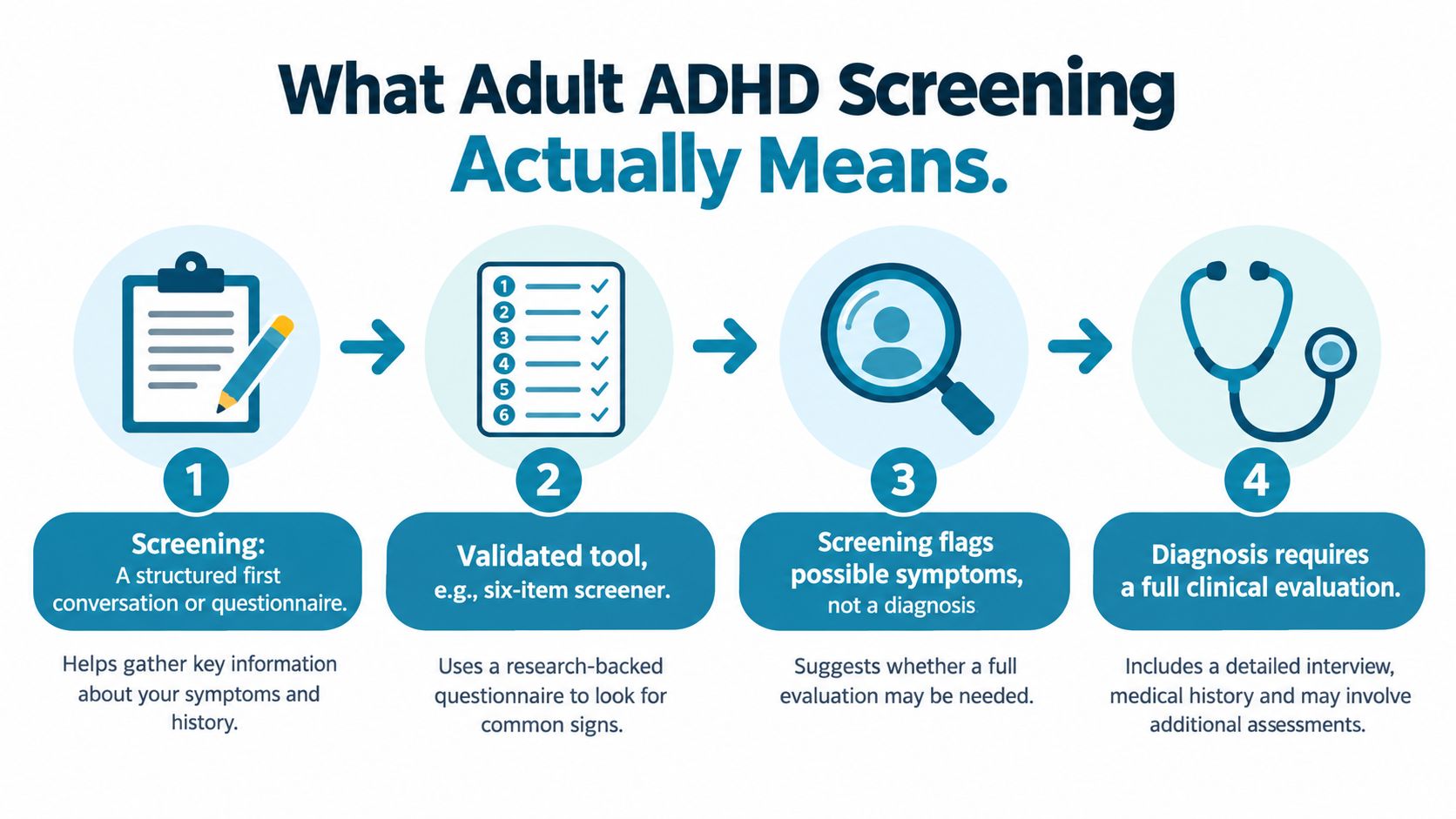
You may leave an appointment with a score and still not know what it means for your next step. Screening is an initial sorting step, not a diagnostic verdict. It usually involves a structured conversation, a questionnaire, or both, to help determine whether a full assessment would be useful. Before booking, ask whether the appointment is for screening or intended to establish a diagnosis. The distinction can affect what you leave with and who you need to see next.
One commonly used tool is the Adult ADHD Self-Report Scale, or ASRS. Its brief screener asks about recognizable patterns, but a clinician needs to understand how those answers relate to your day-to-day life.
The steps from questionnaire to clinical diagnosis are shown below.
How to interpret an ASRS result
In the initial ASRS validation study, the six-item screener showed 68.7% sensitivity and 99.5% specificity against clinician-based classifications in a sample of 154 adults. These results support the tool's use in screening. They do not tell you the personal probability that you have ADHD.
A positive result can help prioritize further assessment. A negative one does not reliably rule ADHD out. If the result seems at odds with persistent difficulties, describe the reminders, external structure, or compensating habits you depend on. Don't change your answers to obtain a preferred result.
Leave with a clear next step
A useful screening appointment should clarify what happens after the questionnaire. Ask the provider which answers need closer attention, what remains uncertain, and who can complete a diagnostic assessment if one is indicated.
An online quiz or social-media checklist can give you language for an experience, but it cannot provide the history-taking and clinical interpretation of an assessment. It should not be a stand-alone route to medication. Bring the questions it raised, and treat its result as a starting point rather than an established conclusion.
The Clinical Criteria a Real Evaluation Covers
Consider what happens when a deadline, household task, or conversation demands sustained attention. A clinician looks for a persistent pattern across situations, its effects on daily life, and whether ADHD or another explanation best fits. A few difficult days do not establish a diagnosis.
For adults age 17 and older, diagnostic criteria generally require at least five persistent symptoms of inattention and/or hyperactivity-impulsivity. Symptoms must have begun before age 12 and lasted at least six months, according to MedlinePlus's ADHD screening guidance. Meeting a symptom count alone is not enough.
The National Institute of Mental Health's ADHD overview explains that symptoms must occur in two or more settings and interfere with functioning. For example, a clinician may ask about unfinished work projects and missed household responsibilities, or impulsive interruptions and trouble maintaining friendships. Occasional lateness differs from a repeated pattern that puts employment at risk despite efforts to change it.
Childhood history matters, even if ADHD was recognized only in adulthood. Questions may cover school behavior, forgotten assignments, teacher comments, and the support you needed to manage routines. Good grades do not settle the question; structure or help from others may have made school manageable.
A useful assessment question: What happened when you had to manage responsibilities without someone else organizing them?
A full evaluation also considers other explanations. NICE's ADHD assessment recommendations call for clinical and psychosocial assessment, developmental and psychiatric history, relevant observer information, and a mental-state assessment. Rating scales can inform the discussion, but should not determine diagnosis by themselves.
That distinction has practical consequences. The clinician may find that another condition better explains the difficulties, that ADHD occurs alongside it, or that more information is needed.
Anxiety or depression can affect task initiation and follow-through, so the clinician examines whether worry, low mood, or both account for the pattern. Sleep disruption and alcohol or other substance use also warrant discussion. Trauma-related difficulties, learning disabilities, and medical concerns such as thyroid problems may call for further assessment.
Emotional dysregulation, relationship friction, or low motivation alone do not establish ADHD. A careful clinician examines when these problems began, where they occur, and what consequences they have. That helps avoid settling on an explanation while leaving another treatable concern unaddressed.
How to Find ADHD Screening Near You in D.C. or Virginia
Treat near me as a navigation question: who can provide the right service, in a format you can use, with a workable follow-up plan? A convenient location matters, but so do adult-assessment experience, professional scope, fees, and the ability to coordinate care.
In Washington, D.C., you might contact a psychiatrist, psychologist, or licensed clinical social worker. Don't assume that every clinician offering ADHD therapy also provides diagnostic evaluations. Ask what the appointment includes and what documentation or referrals it produces.
Access Paths for Adult ADHD Screening
Path | What to Expect | Best Fit |
|---|---|---|
D.C. in-person care | Ask whether the clinician offers screening, diagnosis, therapy, or medication consultation | You prefer meeting face-to-face |
Virginia telehealth | Confirm Virginia licensure and permission to treat you where you'll physically attend | Travel or scheduling makes office visits difficult |
Primary care | Ask whether your clinician offers initial screening and can arrange further assessment | You want to begin with an established medical relationship |
Specialty ADHD service | Clarify assessment scope, reporting, availability, and total fees | You need a dedicated diagnostic pathway or a more complex assessment |
Questions beyond insurance
Virginia telehealth requires a clinician licensed to provide care in Virginia. Confirm their authorization before booking, and ask what happens if you travel or attend from another jurisdiction. Virtual care can reduce travel demands, but it doesn't remove licensing boundaries.
Use the initial inquiry to establish fit:
Adult experience: How do you assess adults whose main difficulties aren't obvious hyperactivity?
Assessment depth: Do you use a validated screener, obtain collateral history when appropriate, and assess co-occurring conditions?
Practical access: What's the current waitlist, cancellation policy, fee structure, and insurance arrangement?
Continuity: If further evaluation or psychiatric consultation is needed, who helps arrange it?
A specialty service may have a waitlist; a nearer therapist may be available but offer treatment rather than diagnosis. Neither is automatically the wrong choice. Match the service to your immediate need, and verify out-of-network benefits directly with your insurer rather than assuming reimbursement will make care affordable.
Why Getting Evaluated Is Harder for Some Adults
You may seek help for anxiety, burnout, relationship conflict, or substance-use concerns before ADHD comes to mind. Those difficulties deserve attention in their own right. A clinician should also ask whether a longstanding pattern of attention or organization problems has gone unrecognized.
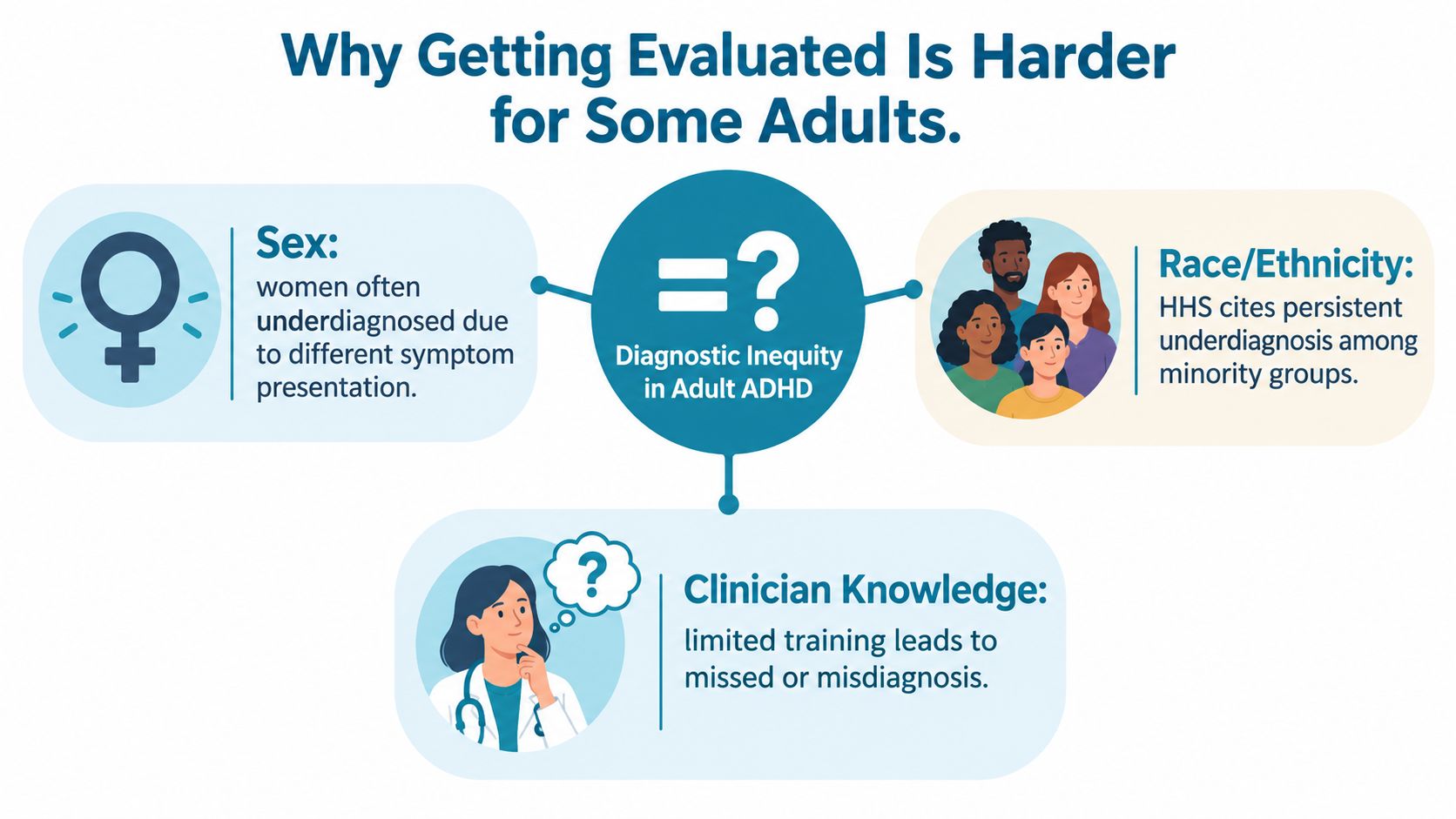
The U.S. Department of Health and Human Services analysis of barriers to adult ADHD diagnosis describes underdiagnosis and disparities related to sex, race, and ethnicity, as well as gaps in clinician knowledge, co-occurring conditions, and fragmented diagnostic pathways. Distance from a clinic is only one part of access.
Being overlooked isn't proof of a diagnosis
Women and adults from underserved groups deserve an assessment that doesn't rely on a stereotyped picture of ADHD. At the same time, feeling dismissed does not establish which condition is present. Both realities matter.
If you can't concentrate on work, ask how the clinician will investigate the problem. Can they consider ADHD, stress, and other explanations without deciding too soon?
Better access means access to careful assessment, not automatic agreement with a suspected diagnosis.
What to ask for after a dismissive experience
A direct, calm question can keep the conversation focused:
Ask for reasoning: What findings support your conclusion, and what might change it?
Request clarification: Did we consider the history behind my current symptoms?
Discuss alternatives: If ADHD doesn't fit, how will we assess and address the difficulties that remain?
A clinician may reasonably conclude that another condition better explains your symptoms. They should be able to explain why and offer a next step. A checklist result or a dismissal without discussion may leave important questions unanswered. In that situation, asking for a fuller assessment or another professional opinion is reasonable.
The goal is a provider who takes your experience seriously and remains open to more than one explanation. Confirmation of your suspicion is less useful than a careful account of what may be causing the difficulty.
What to Bring to Your Screening Appointment
Prepare notes that help you describe your life accurately, not a dossier designed to prove ADHD. A short, usable document is better than an elaborate system you never finish. You can assemble it over a weekend and bring gaps or uncertainties to the appointment.
Oregon's adult ADHD assessment guidance recommends validated tools such as the ASRS at an initial visit while evaluating childhood symptoms, family history, effects at home and work, and co-occurring conditions. It also cautions that brief office observations alone can't provide an accurate diagnosis.
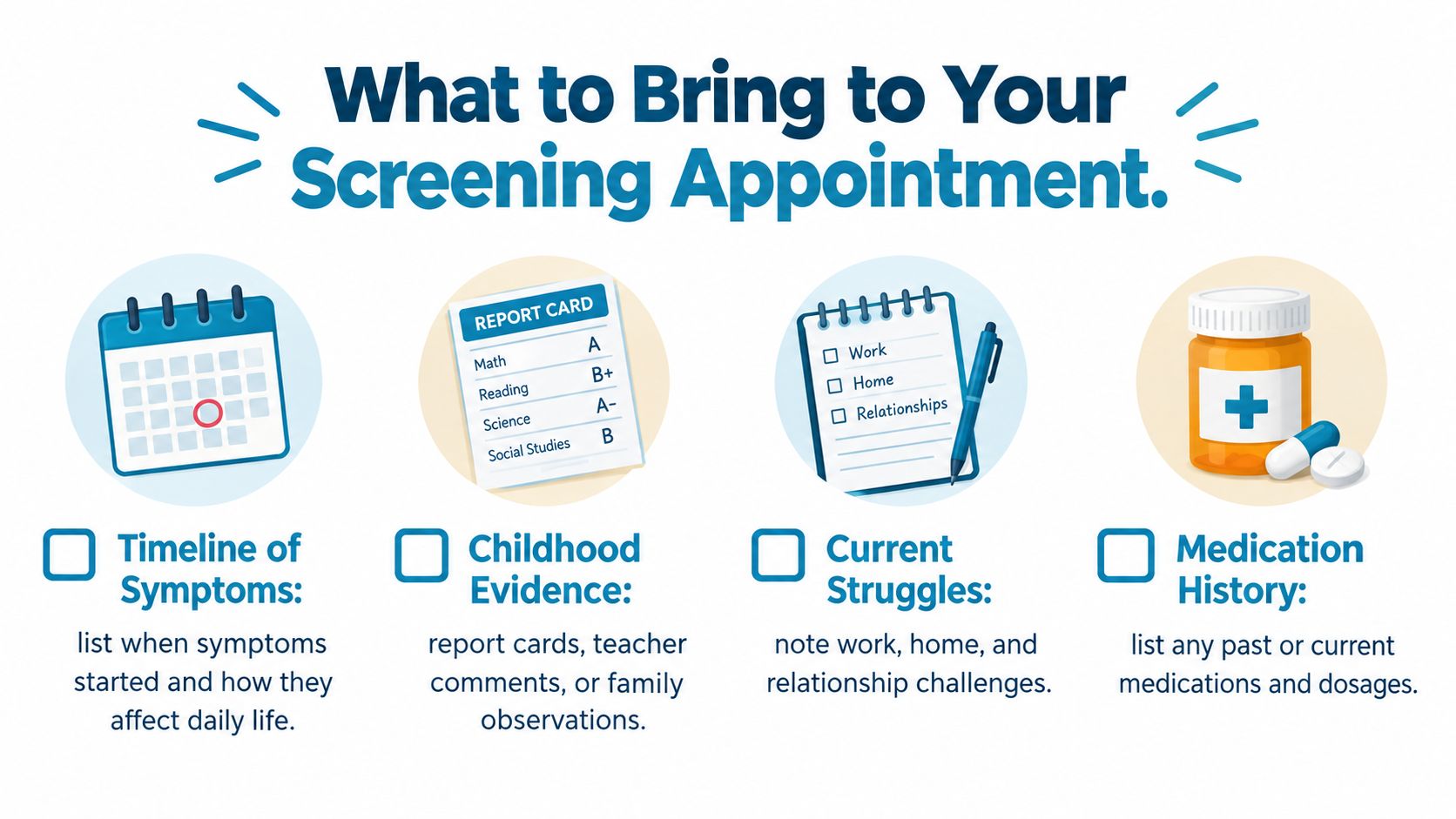
Use the checklist below as a starting point, not an admission requirement.
Make your notes concrete
Symptom timeline: Describe when difficulties first became noticeable, when they became more disruptive, and what changed around those times.
Childhood information: Gather available report cards, teacher comments, or family observations. Ask the clinician how to proceed if records or safe family contacts aren't available.
Current consequences: Note specific work, home, and relationship examples. Include what happened, what you tried, and what it cost you.
Health information: List current and past medications, relevant doses, sleep patterns, mood changes, and alcohol, cannabis, or other substance use.
For example, “I forgot to submit a completed document and needed repeated reminders” offers more detail than “I'm bad at work.” Also note situations where you function well. A balanced account helps the clinician understand context rather than seeing only your worst days.
Leave room for uncertainty
You don't need to arrive with a self-diagnosis framed as fact, social-media screenshots presented as clinical evidence, or an expectation of a specific prescription. You can bring questions about all of those things.
Compiling longstanding difficulties can feel exposing. If shame makes you minimize problems, write down the facts before the appointment. You're describing experiences that deserve attention, not presenting evidence that you've failed at adulthood.
What Comes Next After the Screening
Ask for a clear plan before the appointment ends. That might mean a full diagnostic evaluation, a psychiatric consultation, therapy focused on current difficulties, or coordination among providers. It may also mean more time gathering information before drawing a conclusion.
Different next steps can address different needs.

Treatment doesn't have to be all or nothing
An assessment may identify ADHD alongside anxiety, or suggest that sleep disruption or trauma-related difficulties need closer attention. A clinician may recommend addressing an acute concern, such as significant depression or active substance-use problems, before completing the diagnostic process. Ask what that sequence means and when you'll revisit the unanswered questions.
Therapy can begin with problems you already know you have: avoidance, self-criticism, recurring arguments, or difficulty following through on valued commitments. It doesn't replace medical evaluation or medication management when those are appropriate.
Acceptance and Commitment Therapy, or ACT, can provide a way to examine what matters to you and practice action without waiting for uncomfortable thoughts to disappear. Interpersonal work can explore communication and relationship patterns, while mindfulness-based exercises can offer opportunities to notice reactions before responding. These are possible tools, not a universal prescription or a promise of a particular outcome.
For another format to consider alongside these questions:
Make follow-up workable
Between-session practice should be realistic rather than another arena for perfectionism. You can explore research and reflection on therapy homework and discuss what kind of practice suits you.
Coordination: With your permission, providers can share relevant findings and clarify responsibilities.
Priorities: Agree on the difficulty you most want to address first.
Review: Ask how you'll evaluate whether the plan is useful and when to adjust it.
Practical Questions Adults Ask About ADHD Screening
How much does an evaluation cost?
There isn't a single reliable price to quote. Ask for the total expected fee, including interviews, testing if recommended, written documentation, and follow-up. Verify insurance coverage, out-of-network reimbursement, and cancellation charges before committing.
Why is there a waitlist?
Ask the service rather than assuming the reason. Availability may depend on staffing, assessment scope, and appointment demand. Request a cancellation-list option and ask whether an initial screening or referral elsewhere would be useful while you wait.
Can my primary-care doctor screen me?
Ask whether your doctor offers a validated adult screener and follow-up assessment or referral. Also clarify who would handle diagnosis, treatment planning, and any medication consultation.
Can I use Virginia telehealth while traveling?
Confirm the rules with your clinician before attending from another location. Your physical location during the session matters. Give the office that information when booking, especially if you regularly cross between D.C. and Virginia.
What if the clinician stops at a checklist?
Ask what additional assessment is needed and who can provide it. A score shouldn't be your only explanation for either a diagnosis or a dismissal.
Am I too old to pursue this?
Adult evaluation can be appropriate. The CDC estimated that 15.5 million U.S. adults, or 6.0%, had a current ADHD diagnosis in 2023, with approximately half diagnosed at age 18 or older, based on self-reported diagnosed ADHD rather than all potentially unidentified cases (CDC adult ADHD findings).
Should I start therapy or seek a diagnosis first?
Choose according to your immediate needs. You can seek help with distress and relationship patterns while separately pursuing diagnostic clarity.
If you're looking for ADHD therapy in Washington, D.C., or virtual support while located in Virginia, contact Nick Donahue LICSW PLLC for an initial consultation. Bring your questions about attention, overwhelm, or relationships, even if you don't yet know whether ADHD fits. The conversation can help clarify your therapy needs, fit, and whether a separate diagnostic or medical evaluation would be useful.
Comments