
Homework?: An ADHD-Friendly Guide
The blank screen is already winning. A deadline is close, the assignment says research for homework, and the brain keeps bouncing between “start now” and “figure it out later.” That stuck feeling is not laziness, it is often an executive-function problem, where the task is too large, too vague, or too open-ended to get traction.
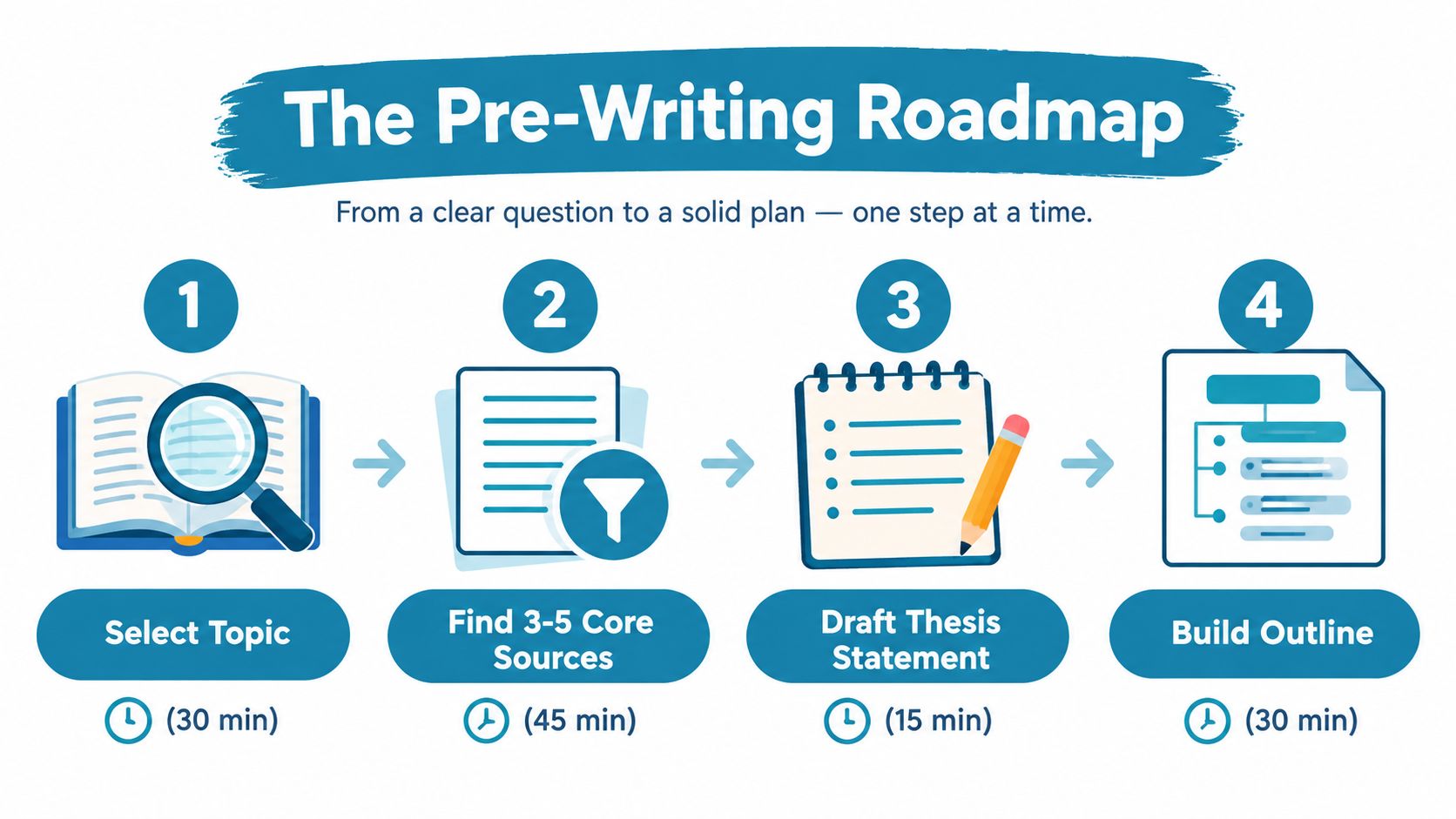
A better start is smaller than most students expect. The job is not to “do the whole paper.” The job is to define one question, gather a few credible leads, test what they say, and turn that into a usable argument. Research workflows work best when they move in stages, starting with the question, then evaluating sources, then synthesizing verified evidence into an answer that fits the assignment as described in this workflow model.
Table of Contents
Breaking Through the Initial Research Paralysis - Turn the assignment into a small set of questions
Finding and Evaluating Sources Without Getting Lost - Use a short, bounded search pass - What to check before a source earns a place
Using AI Tools Without Outsourcing Your Thinking - Keep AI in the low-stakes part of the work - Watch for fabricated citations and lazy copying
Retaining What You Read Through Active Retrieval - Close the source and test memory on purpose - Recall the source, not just the fact
Building Consistency and Managing Homework Momentum - Finish the assignment in visible pieces - Build cues that reduce decision fatigue
Breaking Through the Initial Research Paralysis
Before any searching happens, narrow the assignment. A student facing a broad prompt like “write about climate change” or “research for homework on the civil rights era” can freeze because the task has too many possible paths, and none of them feels obvious.
Turn the assignment into a small set of questions
Write the prompt at the top of the page and split it into 2 to 4 searchable subquestions. A topic like “How does homework affect achievement?” can become questions about which kind of homework matters, how completion connects to performance, and what helps students finish assignments. The goal is to give the brain a shape to follow before the browser opens.
Practical rule: if a question cannot be answered in one sentence, break it apart before searching starts.
A research log helps stop the restart loop. Each line can hold the claim, the source, one piece of evidence, and one limitation. A finished line might read: Claim, later school start times raise attendance. Source, state education dept. report, 2024. Limitation, correlational, one district. That kind of note gives a student something concrete to return to when attention slips or memory gets noisy.
The log also reduces AI confusion. Students who are already overwhelmed can use this FAQ page as a reminder that getting stuck is common, and that a small, visible next step is often enough to restart.
Finding and Evaluating Sources Without Getting Lost
Search results can feel like an open tab graveyard. One article leads to another, then a third, and half an hour disappears with little to show except confusion. A fixed search window keeps the work from becoming a rabbit hole.
Use a short, bounded search pass
Search each subquestion on its own and give that pass a clear stopping point. Gather a few likely sources first, then pause and judge them before looking for more. That limits endless sampling, which matters when attention latches onto one interesting but irrelevant result.
A good next move is to collect a small core set, then compare those sources side by side. For more worked examples of managing school stress without melting down, see the practice blog.
Polished design can mislead. A school logo, neat references, or a .edu domain can look reassuring without proving the information is solid. Students often say they can name suitable sources, but fewer can explain how they know a source is trustworthy, and that gap matters especially in this study of biology students.
What to check before a source earns a place
Use a plain five-question check. Who wrote the piece? Where was it published? Why does it exist? What evidence does it use? Does another credible source say something similar? A source can still be interesting and not be useful for homework.
Two credible sources disagreeing is not a dead end. It is usually a sign that the thesis needs more precision, not less.
That disagreement can strengthen the paper. When one source emphasizes one side and another pushes back, the student can write a more honest argument about uncertainty, context, or competing interpretations. A short research log makes that easier because it records what the source says and what it leaves out.
If the student needs enough evidence without melting down, start with a small core set and compare those sources directly. That usually beats collecting a huge stack of links that never gets checked.
Using AI Tools Without Outsourcing Your Thinking
A student opens an AI tool because starting feels impossible. The blank page is loud, the assignment is vague, and a quick answer looks like relief. That relief can cost the part of the task that was meant to build understanding.
Keep AI in the low-stakes part of the work
Use AI for the parts that lower friction, not the parts that decide the grade. It can suggest search terms, generate subquestions, explain vocabulary, or sketch a rough outline. It should not be the final authority on facts, and citations should never be accepted without checking the original source.
That caution is grounded in how students already use these tools. In a 2025 survey of 1,214 U.S. young people ages 12 to 29, college students' use of AI in some form rose to 92% in 2025 from 66% in 2024, and 88% used generative AI for assessments, while only 36% received institutional support for developing AI skills according to the survey. The gap is clear, students are using the tools faster than schools are teaching the rules.
The practical move is simple. Brainstorm with AI, then verify everything outside the tool. If a citation looks off, find the original source. If a claim sounds polished but vague, treat it as a lead, not an answer.
Watch for fabricated citations and lazy copying
The same survey found that students using AI for literacy often checked outputs because they knew the tool could be wrong, yet some still copied generated material directly into homework. That is the trap. A useful AI interaction should leave the student more informed, not less responsible.
A good check is to ask, “What part of this do I still need to understand without the tool?” If the answer is “almost all of it,” the AI has become a substitute instead of support. For homework, that usually weakens both confidence and originality.
Retaining What You Read Through Active Retrieval
Reading a source twice can feel productive and still leave the material gone five minutes later. That's because recognition is not the same as recall. Highlighting, underlining, and rereading often create the illusion of knowledge without forcing the brain to retrieve anything.
Close the source and test memory on purpose
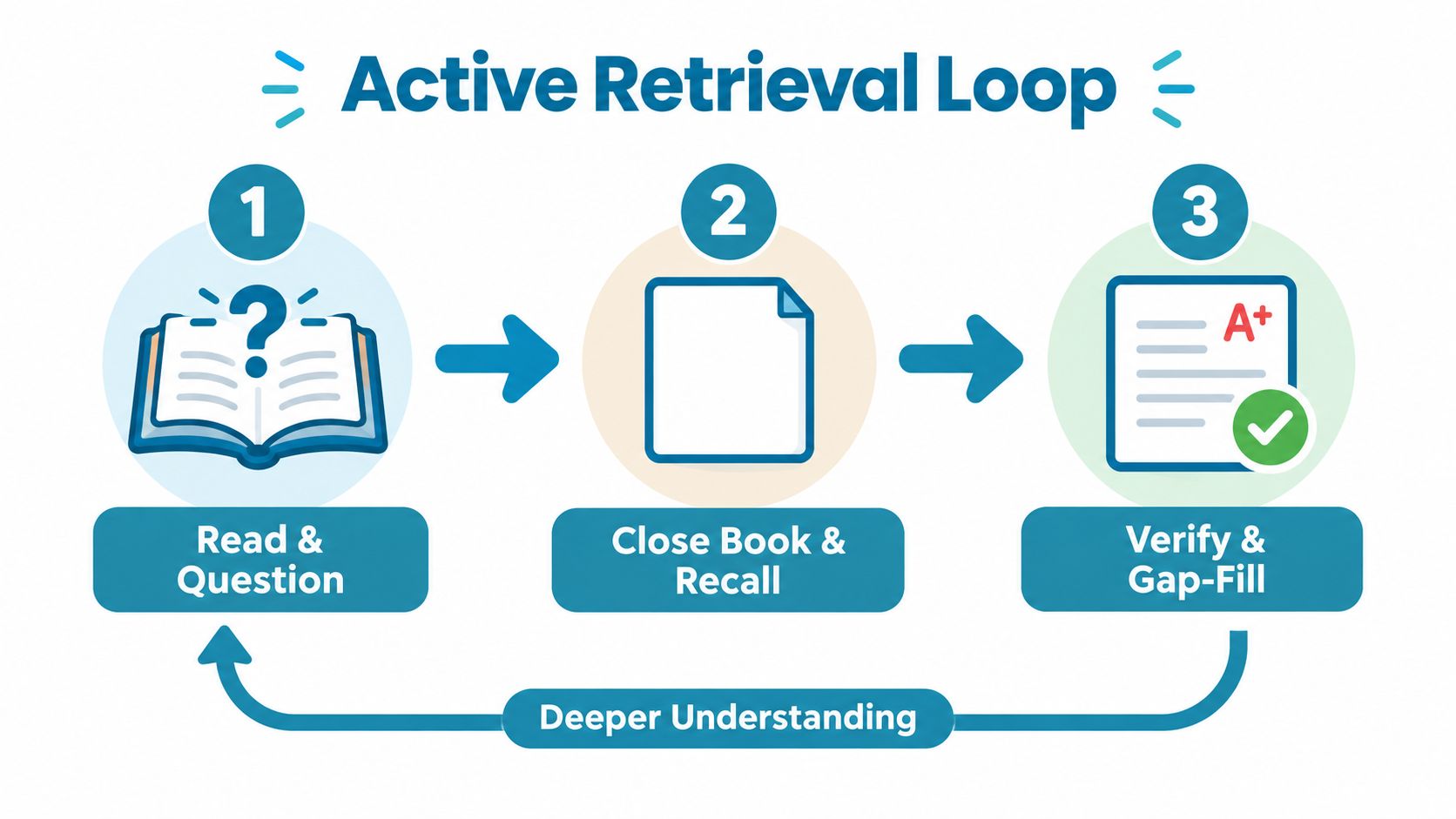
A better pattern is brief, direct, and a little uncomfortable. Read a section, close it, and write or say the main claim from memory. Then reopen the source, check what was missed, and correct the note.
This kind of retrieval practice beats passive review, and spacing it across sessions matters too. A meta-analytic review reported an effect size of g = 0.74 for spaced versus massed retrieval practice in the review. That means the “cram it all tonight” approach is fighting the evidence.
A workable rhythm looks like this, a short same-day recall, another attempt a day or two later, then one final mixed recall session several days after that. The point is not to punish the student with endless quizzing, but to create quick check-ins that make the material stick.
Recall the source, not just the fact
For research-heavy homework, memory should include the author's claim, the evidence supporting it, and one limitation. That way the final paper is built from understanding, not copied wording. It also makes writing faster, because the student is no longer staring at notes that look familiar but refuse to turn into sentences.
If the source can't be remembered without looking, it probably can't be used confidently in the paper yet.
Spacing works best when errors get corrected immediately. Repeating the same missed answer without feedback just rehearses the mistake. Short, repeated retrieval with correction is more mentally efficient than long rereading sessions that feel busy but don't convert into usable knowledge.
Building Consistency and Managing Homework Momentum
The final stretch is where homework often stalls. The sources are collected, the notes exist, and the paper still does not get finished because the remaining steps feel heavy. Consistency carries the work across that gap.
Finish the assignment in visible pieces
Completion matters. In an upper-level genetics course, students completed 79.03% of graded credit assignments compared with 56.99% of non-graded assignments, and homework completion was strongly correlated with academic achievement in the study. Structure changes follow-through, whether or not the assignment feels thrilling.
Students with shaky momentum usually do better with concrete finish-line tasks than with a vague command to work harder. Check whether each source is logged. Confirm that each claim has support. Draft one paragraph at a time. Small actions lower the odds of sliding into busywork.
A simple way to keep moving is to match tasks to energy. On a low-energy day, the goal can be source labeling or quote sorting. On a better day, the task can shift to paragraph drafting or thesis polishing. That flexibility helps students keep momentum without waiting for the right mood to show up first.
Build cues that reduce decision fatigue
Environment matters more than many students expect. One browser window, one document, one next step. When every open tab competes for attention, finishing gets harder. When the next action is obvious, the brain spends less energy deciding where to look.
Map the week on Sunday. Set two 25-minute source-evaluation blocks, one drafting block, and one revision block, then write each block next to the subquestion it serves. That makes the plan easier to follow on a bad day, because the work is already broken into pieces that do not require a fresh decision each time.
Steady completion of required work supports stronger academic outcomes. Occasional heroic bursts can feel dramatic, but they do not replace a repeatable process.
When to Seek Extra Support for Executive Function
Some homework struggles are bigger than strategy. If the same paralysis keeps showing up, especially with shame, racing thoughts, or avoidance that outlasts the deadline, the problem may be less about discipline and more about executive function, anxiety, or attention-related overwhelm.
A better response is not self-criticism. It is support. That can mean talking with a therapist, school counselor, or another qualified professional who can help untangle why starting feels so threatening and build a plan that fits the student's actual brain, not an idealized one.
For teens and adults who keep running into the same wall, Nick Donahue LICSW's services offer a place to work through ADHD, anxiety, overthinking, and school-related stress with more structure and less judgment.
The goal is a repeatable routine that respects low-energy days, allows for small wins, and makes progress feel possible again. If homework has started to feel like proof of inadequacy, that story can change, one manageable step at a time. Reach out today to get support that helps turn stuckness into a clearer, kinder, and more workable plan.
Comments