
Major Change In Life: How to Cope and Decide Well
You're trying to settle into a new job, but the moving boxes are still unpacked. A bill needs attention, someone you care about wants an answer, and you can't remember the last evening that felt ordinary. You may have wanted this change. That doesn't mean you had room for everything it brought with it.
Coping with a major change in life starts with understanding what you're being asked to rebuild. You need more than a positive attitude: you need a realistic picture of the demands, support that fits your circumstances, and a way to make decisions without waiting for complete certainty.
Table of Contents
What Counts as a Major Change in Life - Why several changes can feel bigger than one
Emotional and Practical Pressures by Type of Change - Common pressures by type of major change - When money makes the decision
Emotional Patterns That Make Change Harder - Recognizing what's happening - When distress needs more attention
When ADHD Changes the Equation - Look at the setting, not just the task - Rebuild support without turning it into self-punishment
How to Map Your Changes and Plan the Next Year - Build a plan that includes your limits
Coping With Uncertainty and Isolation - Make support concrete - Give worries somewhere to go
Making Values-Based Decisions When Options Are Limited - Compare imperfect options honestly - A hypothetical job decision
Deciding Whether to Talk It Through With a Therapist - What the conversation can involve - Keeping expectations realistic
What Counts as a Major Change in Life
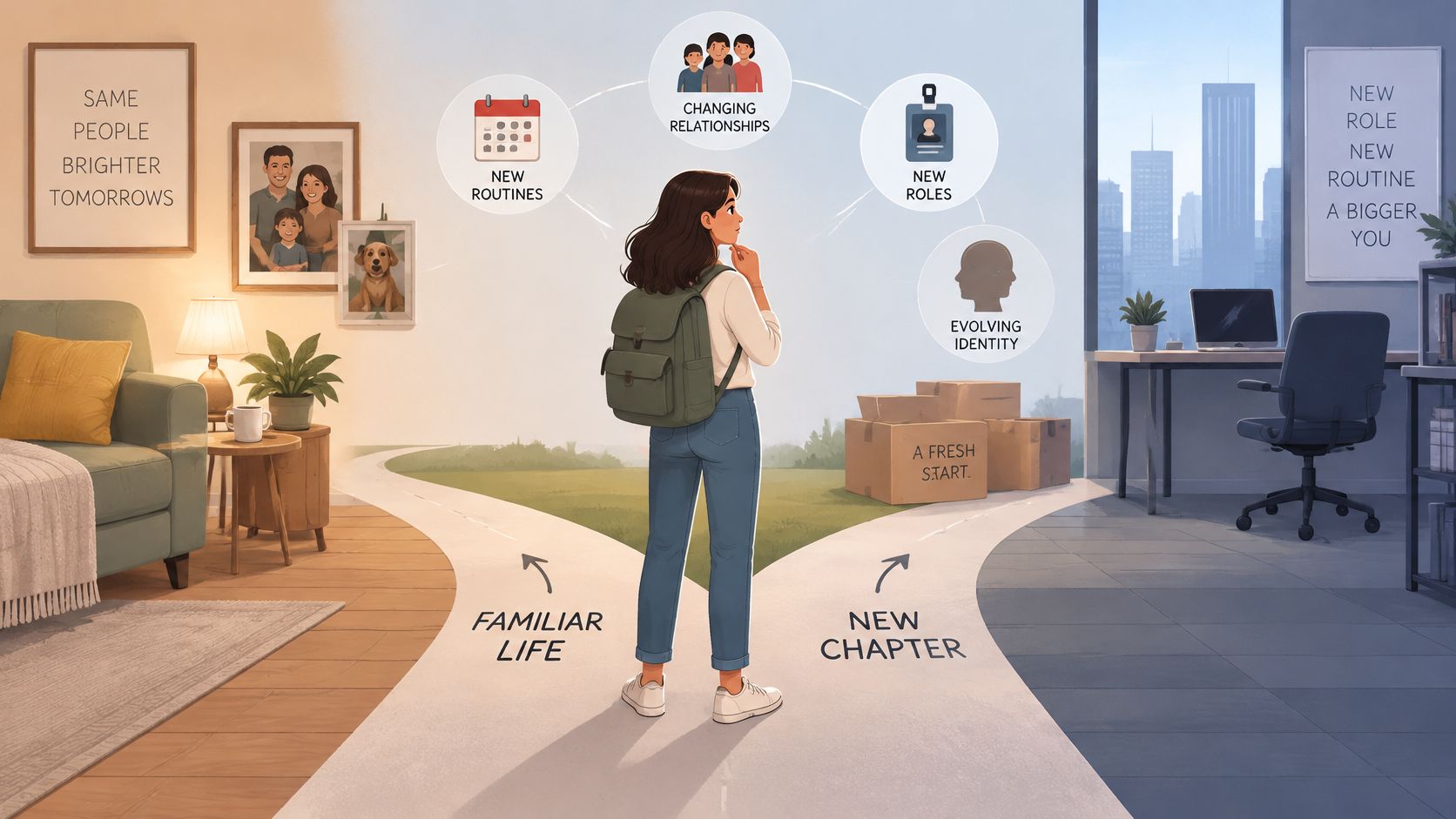
A major change in life is any event that requires sustained readjustment of your routines, roles, relationships, or sense of self, whether you wanted it or not. The defining feature isn't how impressive or upsetting the event sounds. It's how much everyday life you have to reorganize afterward.
Moving to a new city, starting or leaving a job, ending a long relationship, becoming a parent, receiving a serious health diagnosis, retiring, or taking on caregiving can all qualify. So can relocating because your current housing is no longer affordable. A promotion and a breakup may feel very different, but both can require unfamiliar decisions when your usual routines no longer fit.
Why several changes can feel bigger than one
Cumulative load means considering the total work of adapting, not judging each event separately. You might manage a different commute reasonably well, yet struggle when it arrives alongside caregiving responsibilities and a tighter budget.
The classic Holmes–Rahe Social Readjustment Rating Scale, described in Baylor's educational chapter on stressors, assigns Life Change Units to 43 events, considers cumulative changes over roughly one to two years, and historically groups scores of 150–199 as mild crisis, 200–299 as moderate, and 300 or more as major.
The scale is correlational, not a diagnostic instrument. A high score signals greater adjustment demands, not inevitable illness, and it can't determine how a particular person will respond.
Practical rule: Evaluate the amount of daily life you're rebuilding, not whether you think the event should be difficult.
That distinction changes what a useful plan looks like. Rather than asking yourself to cope better with everything, you can identify the pressures, reduce unnecessary demands, and make decisions within the limits you have.
Emotional and Practical Pressures by Type of Change
Different transitions create different kinds of work. Use this comparison as a reference for identifying both what hurts emotionally and what needs practical attention.
Common pressures by type of major change
Type of change | Typical emotional pressure | Typical practical pressure |
|---|---|---|
Moving to a new city or country | Loneliness, loss of familiar places | Housing, new routines, rebuilding support |
Starting a new job or career | Self-doubt, performance anxiety | Learning curve, schedule changes |
Losing a job | Shame, identity disruption | Income gaps, job search, loss of structure |
Ending a long relationship | Grief, rejection, anger | Housing split, finances, household reorganization |
Becoming a parent | Overwhelm, loss of personal time | Sleep disruption, childcare, budget changes |
Taking on caregiving | Guilt, exhaustion | Scheduling, medical logistics, reduced work hours |
Retirement | Loss of role and purpose | Daily structure, income planning |
Serious health diagnosis | Fear, uncertainty | Appointments, treatment decisions, work limits |
Financially forced change | Grief over lost options, anxiety | Cost cutting, relocation, tight decisions |
Real transitions often occupy several rows. Losing a job might also mean relocating and renegotiating responsibilities with a partner. Add those pressures together rather than expecting yourself to respond as though only your employment changed.
These are common patterns, not predictions about your experience. Health, savings, discrimination, previous losses, family responsibilities, and access to help all influence what a change requires. If you're struggling to understand the overall weight of your responsibilities, why you feel overwhelmed all the time offers another way to examine that burden.
When money makes the decision
Financially imposed transitions deserve more than advice about embracing a new chapter. You may be grieving a neighborhood you wanted to stay in, work you valued, or time with family that a longer commute will reduce.
In Cigna Healthcare's 2025 International Health Study, cost of living, uncertainty about the future, and personal finances were the top global stressors, with about two in five respondents worried about them, while 53% said mental-health challenges disrupted daily life.
AXA's 2025 study likewise found that 56% of respondents felt uncertain about the future, as summarized in the same international health study.
The practical starting point is to name the constraint. If rent is unaffordable, staying indefinitely may not be an available option, but location, timing, and moving arrangements might still involve choice. Compare cost-cutting options against a short list of essentials, such as safe housing, necessary care, transportation, and workable contact with people who depend on you.
Emotional Patterns That Make Change Harder
You can understand why a change happened and still have trouble living through it. Emotional responses don't necessarily match your judgment about whether the decision was sensible.
Recognizing what's happening
Grief for your previous life. You accept a job you wanted, then miss easy lunches with former coworkers. Missing what you left doesn't prove you chose badly.
Identity disruption. After retirement, someone asks what you do, and you don't know how to answer. You're adjusting not just your calendar but how you describe yourself.
Rumination. You repeatedly review whether moving was a mistake, imagining increasingly difficult futures without gathering new information. Thinking becomes a loop rather than a way to solve something.
Shame. You compare your private struggle with someone else's outward competence and conclude you should be coping better. You may then hide the very difficulty someone could help with.
Avoidance. You postpone an insurance form because it feels overwhelming. The immediate relief is real, but the approaching deadline makes opening it harder tomorrow.
Rumination can be especially confusing because it feels responsible. You're paying close attention, but you aren't necessarily moving toward a decision. Understanding whether anxiety causes overthinking can help you distinguish useful reflection from repeated attempts to obtain certainty.
Naming the pattern gives you a more specific response than criticizing yourself for having a hard time.
For example, grief may need acknowledgment and conversation. Avoidance may need an easier starting point, such as opening the form with someone beside you rather than demanding that you complete it immediately.
When distress needs more attention
Ordinary adjustment distress often comes in waves and may begin easing over weeks, although there's no universal timetable. You might have an upsetting evening and still experience interest, connection, or relief at other times.
Contact a medical provider or mental health professional promptly if you feel hopeless most days, experience sleep or appetite changes that persist for weeks, increasingly rely on alcohol or other substances, or have thoughts of self-harm. These aren't experiences you need to manage alone or wait to justify.
In the United States, call or text 988 for immediate crisis support. If you're in immediate danger or can't stay safe, seek emergency help.
When ADHD Changes the Equation
A major change can remove supports you didn't realize you depended on. A commute anchored the start of your day, a manager checked in regularly, a partner handled bills, or a familiar kitchen made breakfast almost automatic.
ADHD is a neurodevelopmental condition that can affect executive functioning, the skills involved in starting, sequencing, remembering, and shifting between tasks. It can also affect emotional regulation and relationships, although people's experiences differ substantially. When familiar supports disappear, previously manageable demands may become much harder.
Look at the setting, not just the task
A Simply Psychology account of a 2025 qualitative review involving more than 1,000 adults across the United States, Europe, and Asia describes ADHD impairment that varied by setting, including greater difficulty in routine desk-based work than in active or interest-aligned environments.
The review also identified time management, emotional regulation, academic pressure, stigma, and limited use of accommodations during transitions to independent living. Older adults were rarely represented, leaving less guidance for changes such as retirement and caregiving.
Teens can encounter a similar mismatch when entering high school or college: expectations for independent planning increase before support has been redesigned. Parents can help by agreeing on what responsibility will transfer and what scaffolding will remain, rather than abruptly withdrawing reminders.
Rebuild support without turning it into self-punishment
Make tasks visible. Use a written list that separates the next action from the larger project.
Update reminders. Set prompts for your current location and schedule, not the routine you no longer have.
Add company. Try body doubling, meaning another person works alongside you while you begin.
Protect transitions. Leave buffer time between commitments and explore workplace accommodations through the appropriate channel.
Late recognition of ADHD can also bring shame, grief about missed opportunities, and questions about identity. Those feelings deserve attention beyond finding a better planner.
ADHD doesn't explain every struggle, and a transition doesn't establish a diagnosis. Adult ADHD screening and evaluation can help clarify whether longstanding difficulties warrant assessment. Therapy can support adjustment, but it doesn't replace diagnostic evaluation or medication management.
How to Map Your Changes and Plan the Next Year
Use a paper calendar, a spreadsheet, or Google Calendar, whichever you'll realistically revisit. This is a capacity plan, not a test of how much you can accomplish.
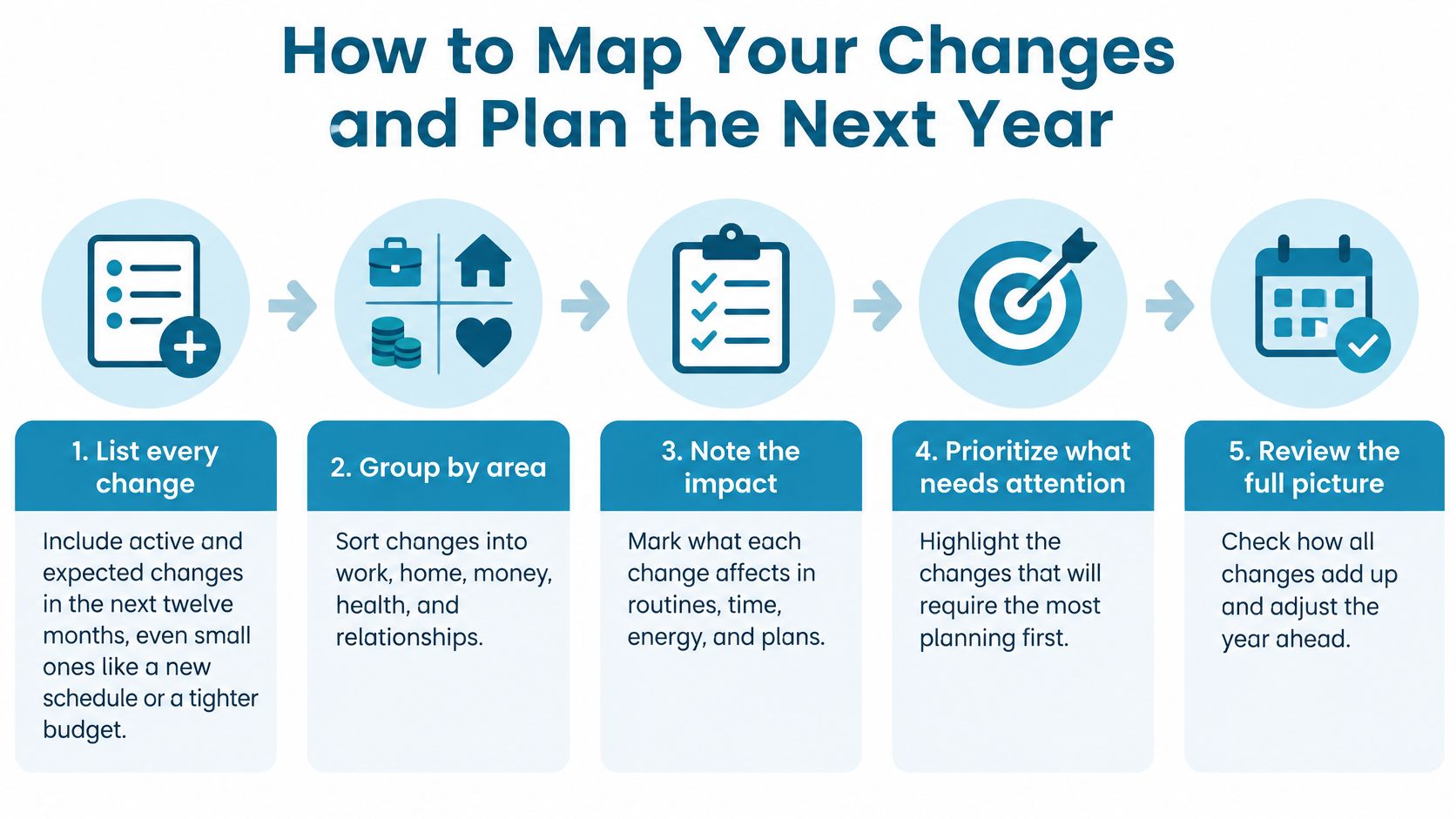
The visual offers a broad overview of what to capture before you make commitments.
Build a plan that includes your limits
List every active or expected change in the next twelve months. Include a new schedule, tighter budget, altered transportation, or changes in household responsibilities, not just headline events. Listing only the move or job change leaves much of the actual work invisible.
Label each change chosen, imposed, or uncertain. This helps distinguish decisions you can prepare for from losses you need to process and possibilities that require contingency plans. Don't assume choosing an event means choosing every consequence.
Place the changes on a twelve-month timeline, grouping them under work, home, money, health, and relationships if that helps. Look for crowded stretches when deadlines, appointments, and transitions overlap, then keep those periods lighter wherever possible. A common mistake is scheduling from available hours without considering available energy.
Circle demands you can simplify, delegate, drop, or delay. Reduce the work around meals, bill payments, paperwork, and unnecessary commitments while protecting sleep and other basic needs; drop or delay at least one avoidable commitment. Trying to overhaul every system at once can become another project you don't have capacity for.
Name three essentials that your plan must protect. These might be necessary health care, rent, and regular contact with an important person, or a dependable daily anchor if your schedule is unsettled. Keep the list short enough to guide trade-offs rather than turning every preference into a requirement.
Choose one small action for the next two weeks, specific enough to begin today. For example, locate the lease and mark its notice requirements, rather than writing “figure out housing.” If you still can't begin, shrink the action until the starting point is clear.
Hold a short monthly check-in to update the timeline, demands, and next action. Notice what has become easier, what remains uncertain, and what needs outside help. Don't treat an outdated plan as a promise you're failing to keep.
Planning check: If your calendar only works when nothing goes wrong, leave more room.
Coping With Uncertainty and Isolation
Support is easier to use when it has a specific shape. You don't need to tell everyone everything, but you do need a way to stay connected that doesn't depend on reaching a breaking point.
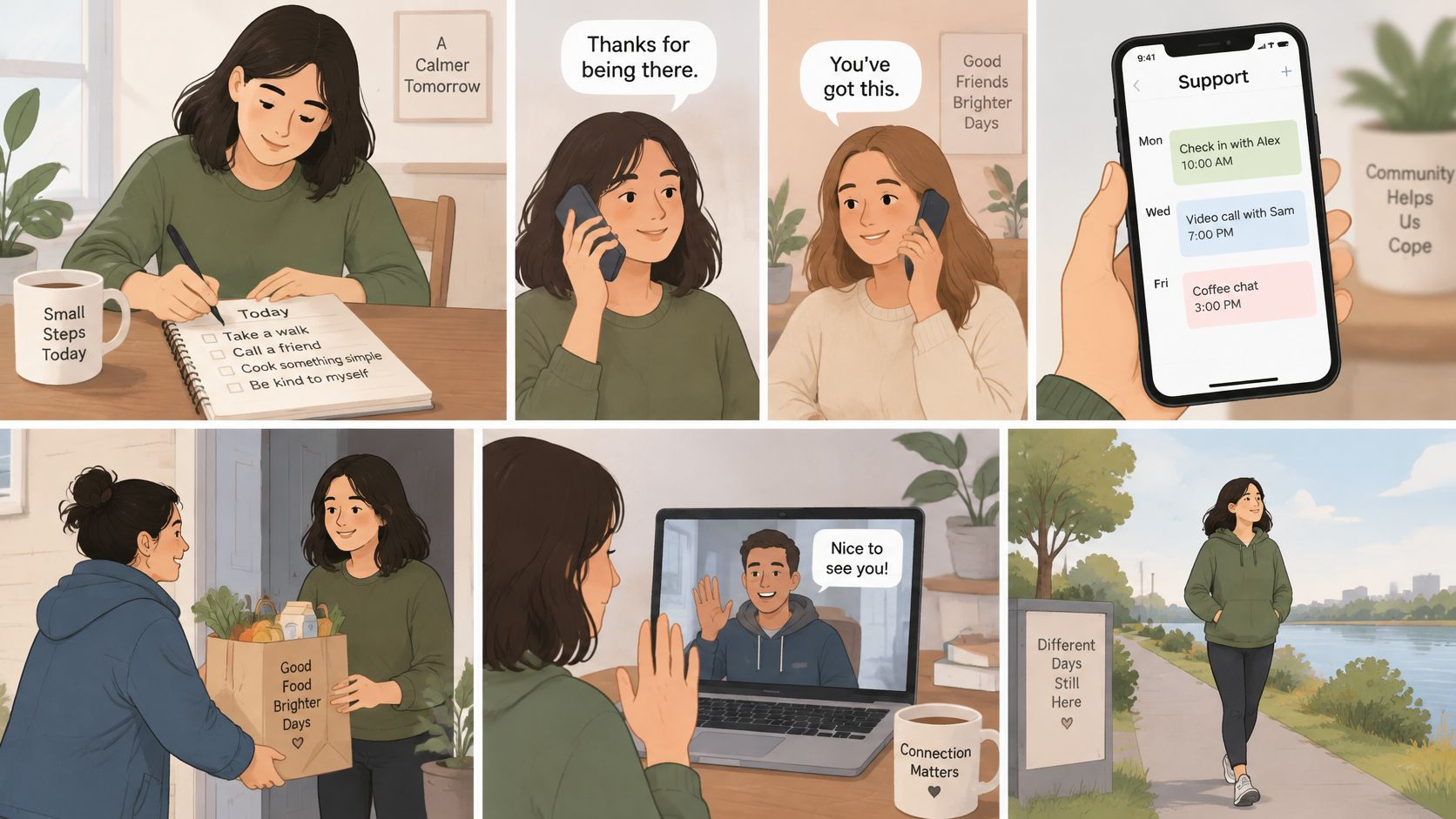
Small forms of contact can fit into a disrupted life.
Make support concrete
Identify two or three reliable people and consider what each can realistically offer. One person may listen well, another may review a form, and someone nearby may be able to provide transportation.
Schedule regular check-ins instead of relying on an open-ended offer to talk sometime. Ask directly for company during a difficult phone call, a ride to an appointment, or help sorting paperwork. Keep at least one routine social activity, even if you shorten it or make it less expensive.
The Global Guidelines for Social Connection evidence brief on major life events describes increased loneliness following major transitions and summarizes evidence associating perceived social support with better coping and quality of life, and lower anxiety and depression.
Repeatedly canceling plans or pulling away from trusted people is useful information, not proof of failure. Ask what would make contact more manageable: a walk instead of dinner, a phone call instead of traveling, or permission not to explain everything.
Give worries somewhere to go
Separate worries into actionable tasks and outcomes you can't control. You can prepare questions for an interview; you can't decide whether the employer will choose you.
For an actionable worry, write the next physical step, such as attaching your résumé to a draft email.
For an uncontrollable outcome, acknowledge the uncertainty and redirect attention to what you're doing now.
Finally, note what got done well enough, including ordinary maintenance, rather than recording only unfinished work.
You can also use a video as a pause in your day rather than another item to complete.
No tactic fits everyone. The aim isn't to eliminate stress, but to make uncertainty more tolerable while keeping enough connection and structure to act.
Making Values-Based Decisions When Options Are Limited
When every option involves loss, searching for the ideal answer can keep you stuck. A values-based approach, informed by Acceptance and Commitment Therapy (ACT), asks what direction you want to move in under the circumstances you face.
Values are ongoing qualities of action, such as steadiness for your family, honesty in your work, or closeness with friends. They aren't goals you finish. You can complete a move; you continue practicing care for the people affected by it.
Compare imperfect options honestly
Write down three values that matter in this season of your life. For each available option, identify what it supports and what it costs, including costs you can't remove through better planning.
Notice whether you're choosing mainly to escape an imagined worst case or to move toward something important. Fear can contain useful information, so don't automatically dismiss it. Ask whether you have a concrete risk to address or are demanding certainty that no option can provide.
A hypothetical job decision
Say you're choosing between relocating for a stable job and staying near family while accepting a shorter contract. Your current values are financial steadiness, family connection, and sustainable work.
Option | What it supports | What it costs |
|---|---|---|
Relocate for the stable job | More predictable income and employment | Everyday family contact and familiar support |
Stay for the shorter contract | Proximity to family and continuity at home | Greater employment uncertainty |
Neither option represents all your values equally. Before deciding, investigate what could reduce the cost: the relocation schedule, realistic travel expenses, the contract's terms, or whether family support is available in a different form.
Set a revisit date, such as ninety days after starting, to review what you've learned and what remains changeable. This isn't a promise that every decision is reversible; a lease or employment commitment may limit your flexibility.
You can make a considered decision while still feeling sad about what it costs.
Clarity sometimes develops after action because experience supplies information that thinking alone can't. The task is to make a workable choice with the information available, not to prove that you'll never regret any part of it.
Deciding Whether to Talk It Through With a Therapist
A major change can strain attention, routines, and emotional regulation all at once. If you feel burned out, disconnected, unsure what to do next, or are adjusting to a change you didn't choose, therapy can offer room to sort through it. You don't need a diagnosis or a “right” reason to start.
What the conversation can involve
Sessions begin with what's been happening in your life. Together, you can notice patterns and consider what moving forward could look like, without assuming there is one correct solution.
The conversation might include emotional regulation, such as recognizing when fear or frustration is shaping your response. It can also help you weigh difficult choices, ask for support, set limits, or adjust responsibilities. A change may bring grief alongside practical demands, even when you chose it.
Therapy can help you make sense of how changing roles affect relationships and routines. Mindfulness-based approaches can help you notice thoughts before reacting to them. ACT may help you take values-guided steps while difficult feelings are still present.
Keeping expectations realistic
Therapy doesn't guarantee a particular outcome, and progress varies. It can be useful to connect conversations to daily pressures, such as an avoided discussion, an overloaded schedule, or a decision with no easy answer. When a change is imposed, the work can focus on the constraints you face and what remains within your control.
If ADHD or anxiety may be affecting your experience, therapy can help you examine the patterns involved. Nick Donahue, LICSW, works with teens and adults on ADHD, anxiety and overthinking, relationships, and life transitions. He provides individual therapy in Washington, D.C., and virtual sessions for clients in D.C. and Virginia. You can learn about the practice at Nick Donahue LICSW and consider whether its approach fits your needs.
Comments