
Does Anxiety Cause Overthinking? What's Really Going On
If answering a worry once were enough, why would the same question return an hour later? Anxiety commonly drives overthinking, though depression, ADHD, perfectionism, and ordinary problem-solving can produce it too. The U.S. Centers for Disease Control and Prevention reported that 12% of U.S. adults regularly experienced feelings of worry, nervousness, or anxiety in 2024; that describes anxious feelings, not repetitive thinking.
Sometimes a recurring thought is asking for information. Often it is asking for a feeling of certainty that information cannot deliver, so the work is tolerating uncertainty and changing what you do with the thought.
Table of Contents
The Short Answer on Anxiety and Overthinking - Related doesn't mean identical
Worry, Rumination and Useful Thinking Compared - Three kinds of repetitive thinking - Look for an observable result
Why Anxious Minds Keep Circling Back - What keeps the pattern going - What the evidence can tell us
Overthinking That Has Other Roots - Different patterns need different questions - Name the experience before judging it
How to Interrupt the Overthinking Cycle - A routine you can adapt - Don't turn the routine into another test
When Overthinking Calls for Professional Support - Notice the effect on daily life - What therapy can involve
The Short Answer on Anxiety and Overthinking
Does anxiety cause overthinking? Often, yes. When you're anxious, you may scan for threats, rehearse difficult conversations, or mentally prepare for things that haven't happened.
But anxiety and overthinking aren't identical. Anxiety can include physical tension, a racing heart, a sense of danger, and avoidance. Overthinking describes a pattern of thought: repeatedly analyzing something after that analysis has stopped helping.
The U.S. Centers for Disease Control and Prevention reported that 12% of U.S. adults, about 1 in 8, regularly experienced feelings of worry, nervousness, or anxiety in 2024. That describes anxiety-related feelings, not an anxiety diagnosis or a measure of repetitive thinking.
Related doesn't mean identical
Say you're preparing for a performance review. You look over your work, write down questions, and decide how to discuss a challenge. That's preparation, even if you're nervous.
Later, you keep imagining your manager's expression and revising an explanation you've already settled on. You're no longer gathering useful information. You're trying to prevent the discomfort of being misunderstood.
A useful distinction: Pay attention to what thinking produces, not just how much thinking you're doing.
Much of the evidence connecting anxiety and rumination is correlational. It shows that they occur together, but it doesn't establish that anxiety always comes first. A more realistic understanding is that anxious feelings can prompt repetitive thinking, and repetitive thinking can intensify anxious feelings.
That distinction matters because arguing with every anxious thought may leave the larger pattern untouched. The useful question isn't only whether a concern is reasonable. It's whether your response helps you handle the situation or keeps you mentally occupied without moving forward.
Worry, Rumination and Useful Thinking Compared
You can think about the same situation in very different ways. Problem-solving works toward a decision or action. Worry anticipates possible future threats. Rumination repeatedly examines an experience, its causes, or what it means about you.
These aren't rigid categories. A concern about tomorrow's meeting can turn into replaying yesterday's mistake, then briefly become useful planning.
Three kinds of repetitive thinking
Reassurance-seeking also belongs in the comparison because it's something people often do in response to these thoughts.
Thinking type | Focus | Typical question | Helpful when | Stuck when |
|---|---|---|---|---|
Problem-solving | A specific decision or task | What is my next step? | It ends in a plan or action | It repeats without new information |
Worry | Possible future threats | What if this goes wrong? | It leads to one concrete preparation step | It generates endless scenarios with no endpoint |
Rumination | Past events, causes and meaning | Why did I say that, and what does it say about me? | It produces a lesson or a repair | It replays the same scene and the same judgments |
Reassurance-seeking | Certainty about a specific worry | Am I okay, and can you confirm it? | Rarely helpful for lasting certainty; a one-time check may settle a practical question | Relief fades fast and the urge returns sooner each time |
Look for an observable result
After an awkward conversation, useful reflection might lead you to apologize for interrupting. Rumination might leave you reviewing your tone, facial expression, and wording without identifying anything else to repair.
Ask whether the thinking has produced:
New information: Something you didn't know before.
A decision: A choice you can act on, even with some doubt.
A next action: A specific preparation, conversation, or repair.
A 2025 study available through PubMed Central compared 76 participants with major depressive disorder or generalized anxiety disorder with 85 controls and found worry frequency averaging 75.66% in the clinical group versus 40.75% among controls. This was a small single study measuring frequency, not a diagnostic test.
You can't use those averages to decide whether you have a disorder. Nor does having frequent thoughts mean every thought needs intervention.
Many people use all these modes. The skill is noticing when you've shifted from engaging with a problem to repeatedly revisiting it. You don't need perfect classification. Recognizing that you've stopped making progress is enough to choose a different response.
Why Anxious Minds Keep Circling Back
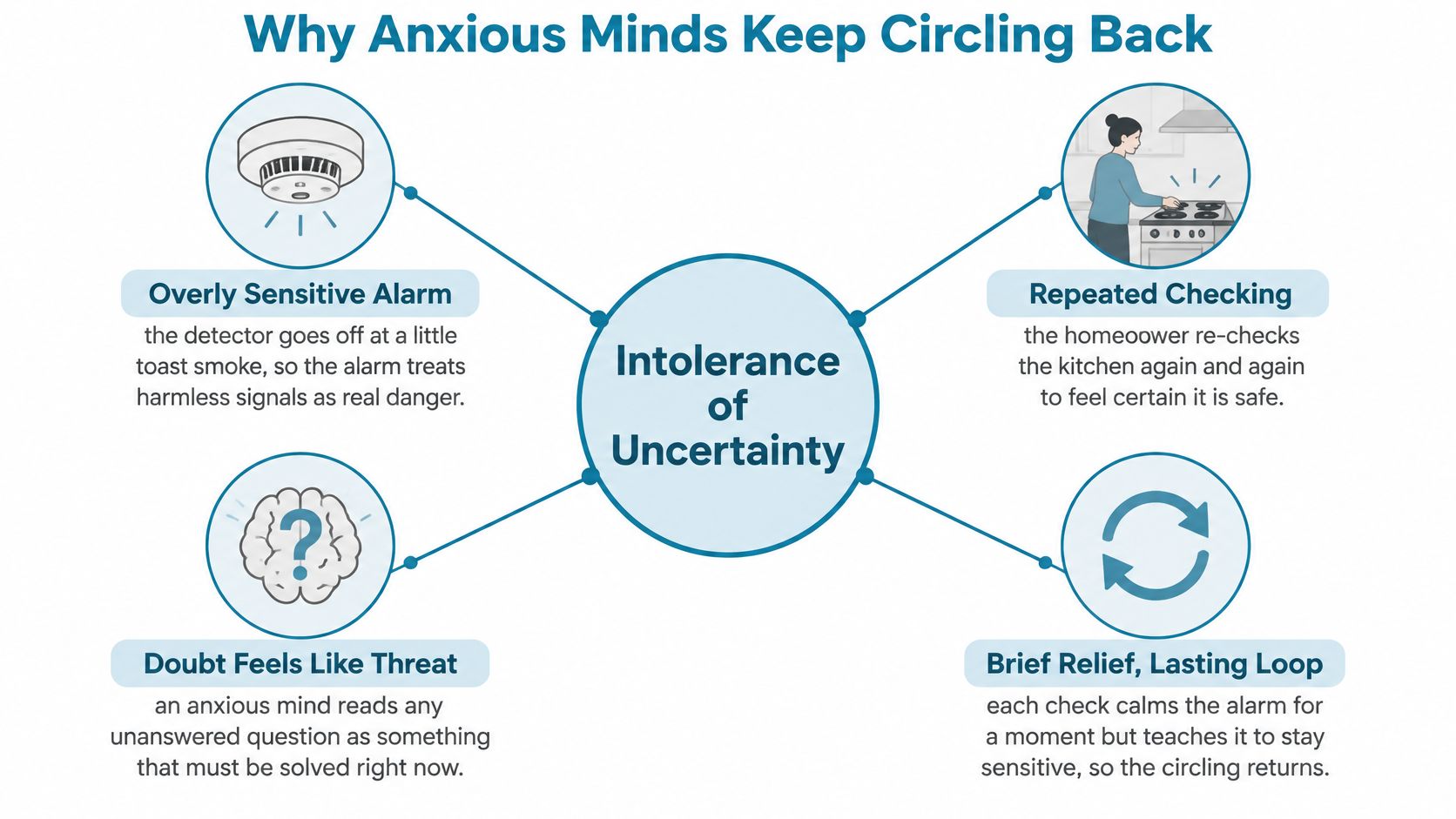
Think of a smoke detector that's sensitive enough to sound over a little toast smoke. You check the kitchen and find no fire, but you keep returning because you can't feel completely sure it's safe.
Fire is possible. The difficulty is treating that possibility as a reason for unlimited checking.
Intolerance of uncertainty means that not knowing feels especially hard to bear. You may understand logically that an unanswered question isn't an emergency while still feeling compelled to settle it immediately.
What keeps the pattern going
Different responses can serve the same purpose:
Rumination: You replay a conversation to determine exactly what someone meant.
Reassurance-seeking: You ask a friend whether they're upset, then ask again with slightly different wording.
Thought suppression: You try to force a concern out of awareness and keep checking whether it's gone.
Experiential avoidance: You skip a social event so you won't have to feel exposed or uncertain.
Each response can offer short-term relief. The problem comes when you start treating relief as proof that the response was necessary.
Say a message remains unanswered for several hours. You wonder whether your friend is busy, then consider whether your last comment offended them. You reread the exchange, search for signs of irritation, and draft another message.
Nothing about your friend's situation has changed. Yet you're increasingly distressed because you've spent that time treating an unknown as a problem requiring immediate resolution.
Overthinking can be a bid for emotional certainty rather than a search for an answer.
What the evidence can tell us
A systematic review and meta-analytic synthesis in Clinical Psychology Review links intolerance of uncertainty with greater use of rumination, reassurance-seeking, avoidance, and thought suppression, while mindfulness and cognitive reappraisal are associated with lower symptoms. Cognitive reappraisal means considering a different interpretation, such as recognizing that a delayed reply doesn't establish rejection.
Mindfulness-based cognitive therapy also has evidence for reducing rumination, with average benefits that can persist after treatment and smaller benefits for anxiety. Average effects don't tell you exactly what will help you personally, and learning these skills isn't the same as making yourself calm on demand.
The practical shift is to stop requiring certainty before you return to living. You can acknowledge that your friend might be upset, leave room for other explanations, and continue with your evening. If a conversation is needed later, you can have it then.
Overthinking That Has Other Roots
Repetitive thinking can sound similar across very different experiences. Someone who feels depressed may keep examining perceived failures; someone with ADHD may mentally cycle through unfinished tasks; someone facing a consequential decision may only need more time.
A meta-analysis published in Clinical Psychology, covering 179 correlational studies and 37 clinical comparison studies, found rumination moderately associated with both anxiety and depression, with people with mood disorders reporting more rumination than people with anxiety disorders. Brooding and emotion-driven rumination had particularly strong associations.
Different patterns need different questions
With depression, thinking may become global and self-critical. Instead of examining a specific setback, you repeatedly revisit what you believe it says about your worth or future.
ADHD is a neurodevelopmental condition that can affect executive functioning, including working memory, attention regulation, and the ability to shift between tasks. Some adults describe repeatedly remembering unfinished responsibilities because they don't trust that they'll remember them later.
ADHD-related open loops: An unfinished task keeps returning because it hasn't been captured somewhere reliable.
Perfectionism: You recheck decisions because an acceptable choice doesn't feel safe enough.
Negative emotional tendencies: A trait sometimes called neuroticism can make distress and negative interpretations more readily available.
Difficulty identifying feelings: You keep analyzing why something happened when you haven't yet recognized that you feel hurt, embarrassed, or disappointed.
These possibilities can overlap. An adult with ADHD might miss a deadline, feel ashamed, and then worry about losing colleagues' respect. That isn't laziness, but ADHD doesn't automatically explain every part of the experience either.
Name the experience before judging it
Emotional competence means recognizing and understanding feelings, not handling every feeling gracefully. Naming disappointment may reveal a need for support; naming embarrassment may help you decide whether a repair is needed.
If these experiences feel tangled together, exploring why you feel overwhelmed all the time can provide another way to understand the pattern. ADHD experiences vary widely, and a thought pattern alone isn't a reliable basis for diagnosis.
This video offers another entry point for reflection.
How to Interrupt the Overthinking Cycle
An interruption isn't a command to stop thinking. It's a deliberate change in what you do while a thought is present.
Start with a manageable situation rather than your most painful concern. You can practice with an email you're overediting or a minor decision you're reopening.
A routine you can adapt
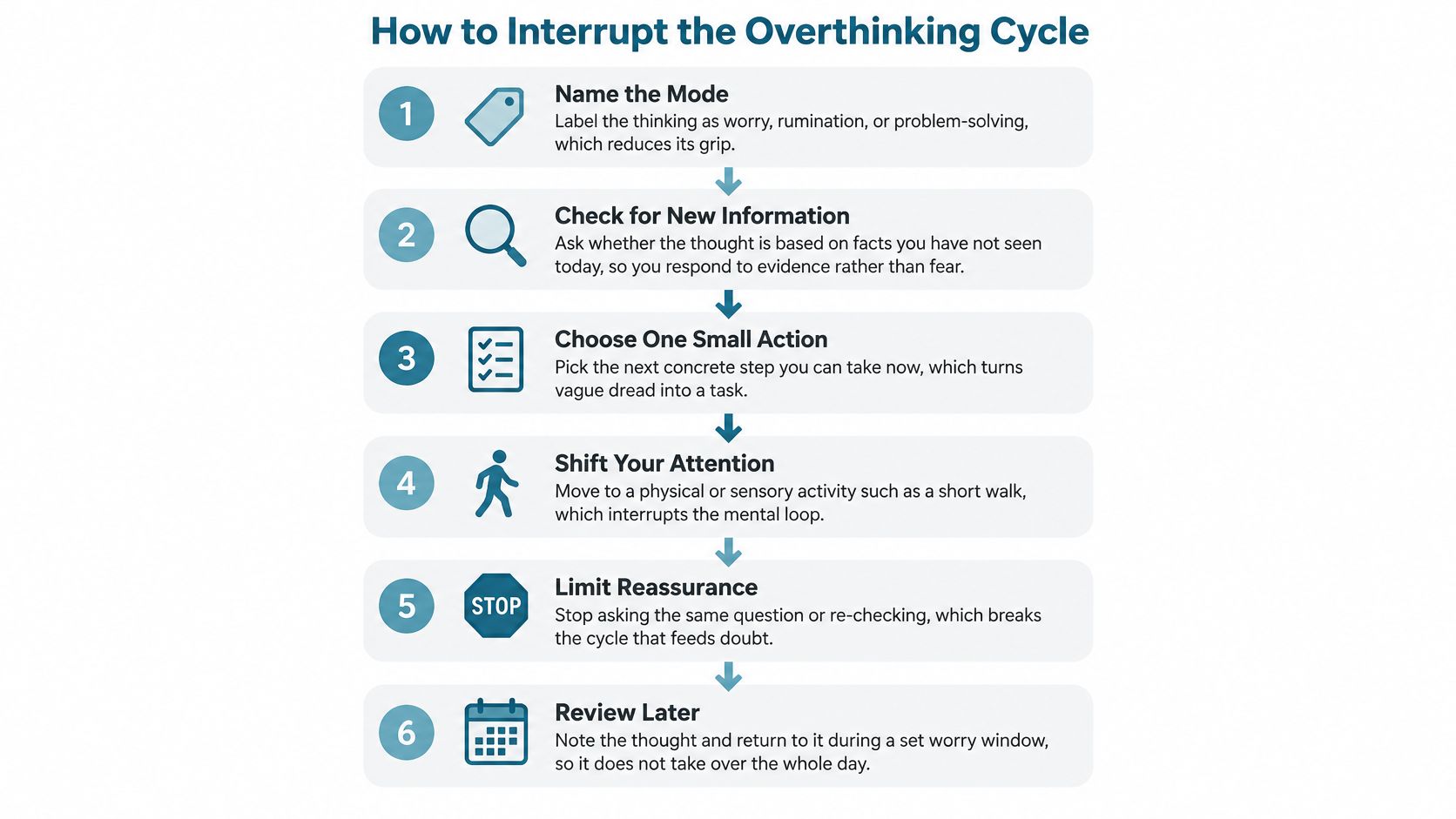
Name the mode. Label what's happening as worry, rumination, or problem-solving. Naming the process can help you observe it instead of automatically following every question it raises. Keep the label neutral, without turning it into another criticism.
Check for new information. Ask whether you've learned anything since you last considered the concern. If you're reviewing the same evidence and reaching the same conclusions, more analysis may not be useful. Write down any actual next step rather than restarting the whole discussion in your head.
Notice the bid for certainty. Ask what would have to happen for this to feel finished. Would you need a guarantee that nobody will misunderstand you or that a choice can't go badly? Recognizing an impossible stopping condition helps you set a practical one.
Take an action or defer on purpose. Send the reasonable draft, put the appointment in your calendar, or ask the relevant factual question. If nothing useful can be done now, write down the concern and choose a brief worry window later. Deferring deliberately gives the thought a place without allowing it to determine your entire day.
Change your body's state. Let your breathing slow comfortably, loosen your shoulders, or walk while noticing your surroundings. If breathing exercises make you more self-conscious, try feeling your feet on the floor instead. Physical grounding gives you something concrete to attend to without requiring the thought to disappear.
Practice defusion. Use the phrase I'm having the thought that before the prediction or judgment. For example, I'm having the thought that making a mistake means I'm incompetent. This ACT skill creates distance between a mental event and a fact you must obey.
Don't turn the routine into another test
Repeated reassurance texts, searching the same question again, and forcing a thought away can become ways of checking whether you're finally safe enough. You don't have to eliminate support or research. Instead, distinguish a useful exchange from repeating it until you feel entirely settled.
Practice aim: Return to something that matters while allowing some discomfort to remain.
For teens, this may mean returning to homework after checking an assignment rather than asking a parent to confirm it repeatedly. Parents can acknowledge the discomfort and support the next action without supplying endless guarantees; emotional regulation for teens involves more than telling a young person to calm down.
These skills need repetition across ordinary situations. A difficult day doesn't establish that they're failing, and partial progress counts: noticing the pattern sooner or sending a draft with some uncertainty is different from never feeling anxious.
When Overthinking Calls for Professional Support
Say you begin spending evenings reviewing work conversations. Eventually, you delay bedtime, avoid speaking in meetings, and ask your partner to evaluate interactions they didn't witness.
The concern isn't that you think a lot. It's that your responses are narrowing your life.

Notice the effect on daily life
Consider professional support when:
Time is disappearing: Repetitive thinking occupies much of your day.
Functioning is affected: Sleep, work, study, or relationships are suffering.
Avoidance is expanding: You increasingly decline opportunities or postpone necessary conversations.
Other symptoms persist: Low mood, distress, or physical symptoms accompany the thinking.
Physical symptoms deserve medical attention rather than an automatic assumption that they're anxiety. A medical clinician can assess possible causes and discuss medication when appropriate. Therapy doesn't replace medical evaluation or medication management.
What therapy can involve
Therapy can begin with an ordinary account of what's been happening. You and your therapist might slow down a recent episode, identify the feeling underneath it, and examine what you did next.
Acceptance and commitment therapy can help you act according to your values without waiting for uncomfortable thoughts to leave. Mindfulness-based work can support attention and awareness, while interpersonal approaches may address relationship patterns, conflict, or fear of disappointing people. The fit depends on the person.
For anxiety, our work isn't about eliminating it completely. It's about developing a different relationship with it so it no longer gets to make all the decisions.
Someone who appears successful may still be struggling privately. If that's familiar, the discussion of a therapist for high achievers may help put words to the experience.
You don't need a diagnosis or a perfectly clear reason to begin. Therapy also doesn't guarantee a particular outcome or fixed timeline; understanding the pattern and practicing new responses takes an individual course.
Try One Interruption This Week
Choose a recurring thought that's familiar but not overwhelming. For a short stretch of ordinary days, make a brief note when it appears: the time, the thinking type, and whether it produced anything new.
Keep the record simple. A line in your phone's Notes app is enough; a detailed transcript can become another way to stay absorbed in the thought.
Make the experiment small
Choose a response: Try naming the mode or postponing the concern to a planned worry window.
Use it consistently: Practice the same response instead of continually searching for a better technique.
Notice behavior: Record whether you returned to a task, tolerated an unanswered message, or made a workable decision.
You're looking for earlier recognition and a different response, not an empty mind. If the pattern persists or is shaping daily life, a consultation can help clarify what might be contributing.
We offer a free 15-20 minute phone or video consultation to answer questions, understand what brings you to therapy, and consider fit. You can schedule either a consultation or an initial therapy session online. Nick Donahue, LICSW, offers in-person sessions in Washington, D.C., and virtual sessions for clients in D.C. and Virginia.
Nick Donahue LICSW offers individual therapy for teens and adults navigating anxiety, overthinking, ADHD, and related challenges. Visit Nick Donahue LICSW to learn more and consider whether a conversation about what's keeping you stuck would be useful.
Comments