
Breaking Relationship Patterns: A Step-by-Step Framework
If you already know why you keep having the same argument, why does knowing so rarely stop it?
Breaking relationship patterns takes more than recognizing a familiar problem. It means identifying the sequence you repeat, choosing a specific point to respond differently, and practicing that response when you're upset, distracted, or afraid. For adults with ADHD, that work may also require practical support for remembering commitments, alongside attention to shame, anxiety, and the meaning each partner gives a missed promise.
You don't have to decide who's the problem before you begin. You do need to get specific about what happens.
Table of Contents
The Five Stages of Changing a Repeating Pattern - The Five Stages at a Glance
Map the Cycle Before You Try to Change It - Write Actions in Order - An Illustrative Episode
Work Out What Is Driving the Cycle - Common Drivers of a Repeating Cycle - When ADHD Creates a Support Gap
Changing the Opening and the Pause in Hard Talks - Make the Opening Answerable - Make the Pause Predictable
Turn One Change Into a Plan You Can Test - Build a Small Experiment - Three Checks on Whether a Change Is Holding
How Therapy Approaches Support Pattern Change - Therapy Approaches Compared - Individual Work Has a Different Scope
Frequently Asked Questions - How Long Does It Take to See a Pattern Shift? - Can I Change a Pattern if My Partner Won't Participate? - Does a Repeating Pattern Mean the Relationship Should End? - Does Having ADHD Mean I'm Causing the Conflict?
Deciding Whether to Bring in a Therapist - What Starting Can Look Like
The Five Stages of Changing a Repeating Pattern
A repeating relationship pattern can change without either person becoming someone entirely different. A pattern is an expectation, a reaction, and a response that keep playing out in a familiar order. Someone anticipates rejection, asks for reassurance urgently, receives an irritated response, and feels more convinced that rejection is coming.
Stability matters, but it isn't destiny. A four-year study of 177 adults summarized by the University of Illinois attachment overview found attachment styles highly stable, while attachment at the later assessment helped account for the relationship between initial attachment and later relationship status. That leaves room for current relationship experiences, not just early history.
The Five Stages at a Glance
Stage | Question it answers | What you produce |
|---|---|---|
1. Map the cycle | What happens, and in what order? | A written sequence of four to six moments from one episode |
2. Identify the driver | What is pushing the cycle? | Likely drivers, such as old fear, a present-day mismatch, a support gap, or a learned conflict style |
3. Change the opening or pause | Where can the cycle be interrupted? | One rewritten opening sentence and one pause plan |
4. Test a replacement | Does the new response happen, and does it hold? | An if-then plan tested in low-stakes moments |
5. Review over time | Is the pattern actually shifting? | A weekly log of cues, responses, and outcomes |
The visual version keeps the focus on actions you can practice.
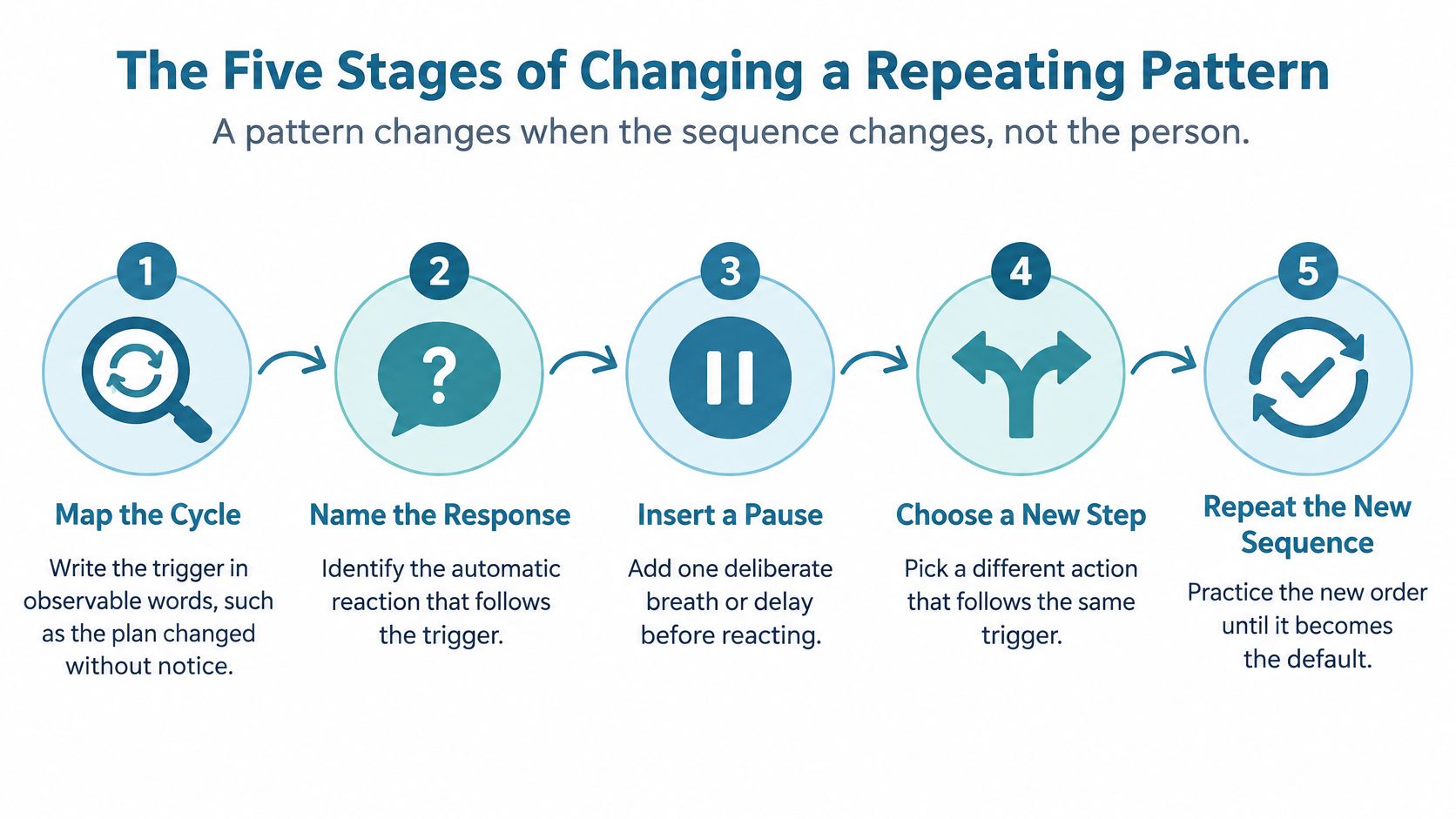
You can use this framework independently or alongside a partner. It doesn't require agreement about whose fault the pattern is, although cooperation makes shared changes easier to test.
Choose one recent argument or disappointing moment you can describe in detail. The entire history of the relationship is too much material to work with at once.
Map the Cycle Before You Try to Change It
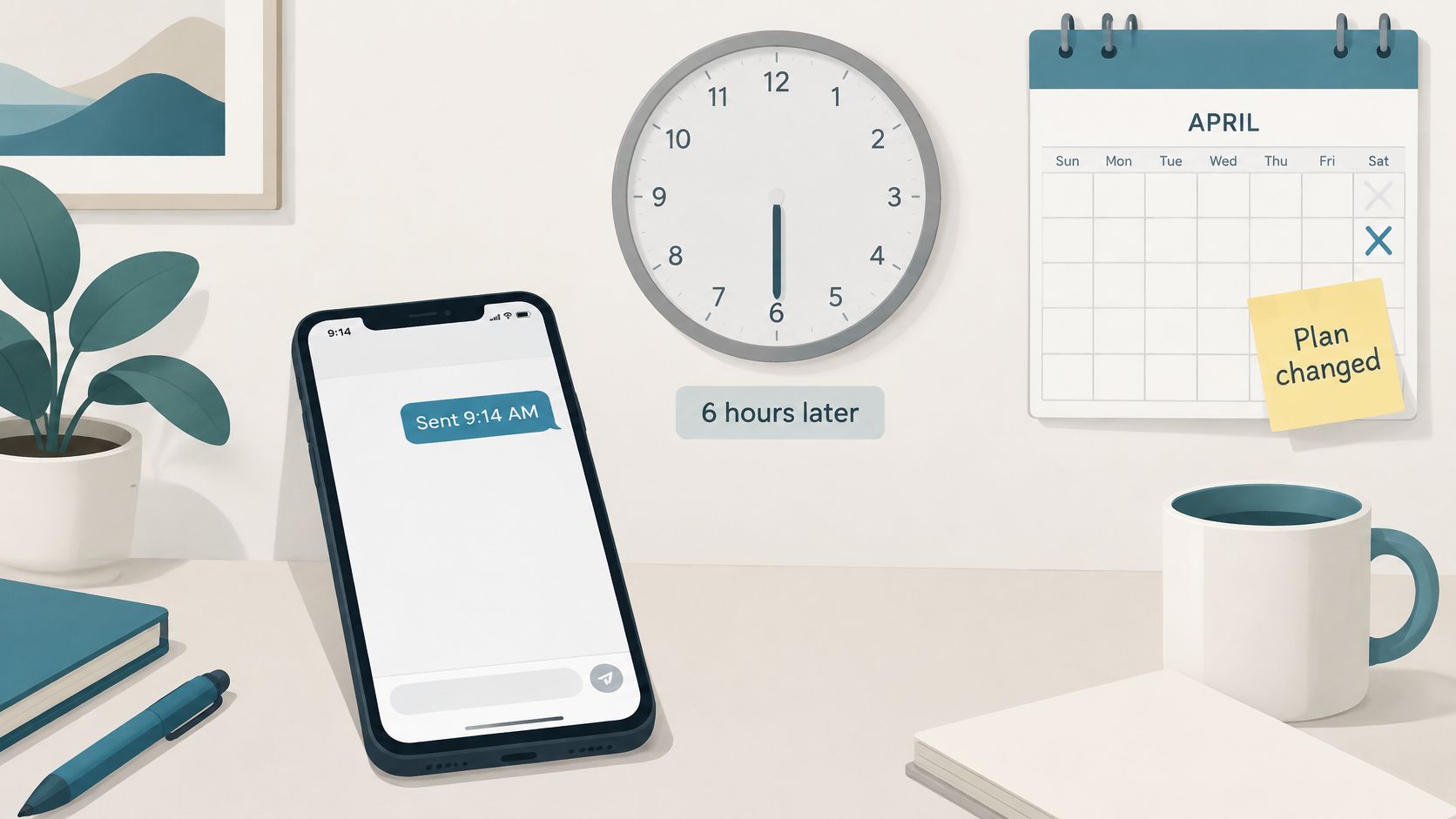
Start with an episode you can reconstruct, not a conclusion about the relationship. A phone, clock, and calendar can help you locate what happened rather than what you assume it meant.
Write Actions in Order
Describe the trigger observably. Write that the plan changed without notice, rather than that your partner stopped caring. Keep your interpretation on a separate line so you can examine it without confusing it with an event.
Record each person's actions. Give each statement, text, interruption, or exit its own line. Include your behavior with the same level of detail you use for your partner's.
Mark the shift in tone. Criticism attacks character; contempt involves mockery or superiority; defensiveness involves denial or counterattack; stonewalling means shutting down or becoming unavailable. Mark behavior, not identities: becoming defensive isn't the same as being a fundamentally defensive person.
Describe the ending and aftermath. Did someone apologize, leave, resume ordinary conversation, or act as though nothing happened? Note whether the original concern was resolved or merely abandoned.
Circle the earliest workable interruption. Choose a moment when you could realistically have changed your own response. Don't choose a point that requires your partner to become calm first.
A longitudinal study of marital interactions described a sequence in which criticism contributed to contempt, contempt to defensiveness, and defensiveness to stonewalling. These were associations in married couples, not proof that a behavior always causes separation or that every dating relationship follows the same path.
An Illustrative Episode
Say a canceled dinner leads to a global accusation about never making an effort. The other person lists previous dinners, the first person mocks that defense, and both stop discussing the actual disappointment.
Compare that with starting from a specific experience: I felt let down when Friday fell through. The disappointment remains, but the partner has a concrete event to respond to rather than an accusation to disprove.
Keep your written episode beside you if you watch the accompanying video.
Finish by underlining the sentence that most often starts these episodes. That's a useful candidate for your first experiment, even if other problems still need attention.
Work Out What Is Driving the Cycle
The same visible behavior can have different causes. Repeated texting might reflect old fear, an unreliable arrangement, or uncertainty about whether plans still exist. Each possibility calls for a different response.
Use these questions for self-observation, not diagnosis. Several drivers can operate within the same episode.
Common Drivers of a Repeating Cycle
Driver | What it tends to look like | Question to ask | Where to focus |
|---|---|---|---|
Old fear or attachment-based alarm | Reassurance-seeking rises even when signals are consistent | Does my reaction change when my partner's behavior changes? | Self-soothing and checking facts before reacting |
Present-day mismatch | A stated need keeps going unanswered, such as more contact or clearer plans | Has this need been named clearly and answered at least once? | A specific request and an agreed, measurable response |
ADHD-related support gap | Missed reminders, forgotten follow-through, or time slipping, interpreted as not caring | Is this about attention and systems, commitment, or both? | External supports and a repair routine |
Learned conflict pattern | Criticism, withdrawal, or silence across different topics | Does the same sequence appear with different subjects? | Changing the sequence and opening |
Safety concern | Coercion, intimidation, manipulation, or fear of a partner's response | Does someone feel unsafe or controlled? | Safety and specialized support, not communication fixes |
Checking the facts may reduce an old alarm, but it won't solve a genuine mismatch. If someone reliably offers less contact than you need, becoming better at tolerating anxiety doesn't automatically make that arrangement workable. Exploring fear of intimacy can help clarify avoidance without assuming that every wish for distance means the same thing.
When ADHD Creates a Support Gap
ADHD is a neurodevelopmental condition that can affect executive functioning, including remembering, initiating, and tracking commitments. Its effects vary, and it doesn't explain every relationship difficulty.
A study of 286 adults with ADHD in romantic relationships described in the Journal of Social and Personal Relationships found that desired support didn't always match received support. Practical help, reassurance, autonomy, and accountability aren't interchangeable.
After missed follow-through, use a brief repair routine rather than another broad promise:
Name the miss. State what didn't happen without arguing about whether you meant well.
Reset the commitment. Within a day, propose a new time or method.
Add external support. Set your own reminder or enter the commitment in a shared calendar.
Check the fit. Ask whether the response offered what the other person needed.
Accountability without shame: An explanation describes why something happened. An excuse removes the expectation of repair or change.
The non-ADHD partner shouldn't become the permanent reminder system. Look at each step of your mapped episode and identify the likely driver there, rather than assigning one explanation to the whole relationship.
Changing the Opening and the Pause in Hard Talks
The opening is a high-impact place to intervene because you can prepare it before you're overwhelmed. Gottman laboratory research involving 130 newlywed couples reported that the first three minutes predicted a conflict discussion's outcome 96% of the time, according to the Gottman Institute's explanation of conflict predictors. That finding comes from a specific research program, not a guarantee about your next conversation.
Make the Opening Answerable
Notice the early signal. A sigh, clipped reply, or sarcastic remark may tell you that you're preparing to attack or defend. Stop composing the strongest case against your partner and identify the concern you actually want addressed.
Name your experience with I. Describe an emotion or impact, not a disguised accusation. Feeling anxious is an experience; feeling that someone is selfish is a judgment about them.
Choose a specific situation. Stay with the changed plan, missed call, or unfinished task. A history of disappointments may deserve discussion, but adding all of it to the opening makes a useful response harder.
Ask for an observable action. A workable opening might be: I felt anxious when the plan changed without telling me; could we text each other when plans shift? Avoid opening with “you always” or “you never,” which directs attention toward defending the record.
A softer opening isn't self-erasure. You can be clear that something hurt, name a boundary, and ask for change without attacking character. If you routinely soften your words because you're afraid of retaliation, the task isn't to find an even gentler sentence.
For adults navigating ADHD and relationship problems, write the request before starting. That gives you something to return to if you lose your train of thought or begin arguing about side issues.
Make the Pause Predictable
A study of 275 couples entering therapy linked impulse-control difficulties, limited emotional awareness, and fewer effective regulation strategies with lower couple satisfaction in Family Process. This was a clinical sample, not a population estimate, but it supports paying attention to how you handle activation, not only what you're discussing.
Identify your bodily warning signs. Heat in your face, a tight jaw, faster speech, and shallow breathing can be easier to recognize than a precise emotion. Treat them as signals to slow down, not evidence that your position is wrong.
Agree on a return time. For example, propose a twenty-minute break and state the clock time when you'll resume. A pause is more workable when both people know whether the conversation is continuing.
Give the break a defined job. Settle physically, then write the request you intend to make. Don't spend the entire break rehearsing your partner's faults or sending arguments by text.
A pause that becomes disappearance recreates the withdrawal you're trying to change. Returning matters as much as stepping away.
If you're still too activated at the agreed time, communicate that and negotiate another return. Don't leave the other person guessing.
Turn One Change Into a Plan You Can Test
Insight is available when you're calm. A replacement behavior has to be available when your usual reaction is already starting. An if-then plan connects a recognizable cue to an action you've chosen in advance.
A review covering 642 independent tests found implementation intentions effective across cognitive, emotional, and behavioral outcomes, with effect sizes from d = 0.27 to 0.66, as described in this implementation-intention review. Plans worked better when they were contingent, strongly motivated, and rehearsed; that supports the planning method, not a promise that it will resolve a relationship.
Build a Small Experiment
Choose a visible cue. Use reaching for your phone to send another reassurance message, or noticing that you've stopped answering during a difficult topic. Being upset is too broad to guide a precise response.
Write the if-then connection. For example: If I notice the urge to send several messages, then I'll wait twenty minutes, take a physical reset, and send a direct request. Pick a replacement you can carry out without your partner's cooperation.
Rehearse the transition. Mentally picture noticing the cue and doing the action. Include where your phone will go or how you'll remember to return.
Test it with lower stakes. Practice around an ordinary scheduling frustration before relying on it during a conversation about trust.
Record what happened. Note whether the cue occurred, whether you used the response, and what followed. Describe the outcome without grading yourself as good or bad.
Review weekly. If you keep missing the cue, choose an earlier signal. If the action is too complicated, simplify it.
Vague intentions such as communicating better offer little guidance at the moment of choice. Targeting many behaviors at once also makes it difficult to learn what helped. Include a lapse response: acknowledge the slip, repair what you can, and resume the experiment instead of declaring it a failure.
Demand-and-withdraw habits need maintenance, not just an impressive conversation. A calmer exchange is useful, but it isn't the only outcome worth tracking.
Three Checks on Whether a Change Is Holding
Level | Question to check | How to record it |
|---|---|---|
Trigger and response sequence | Did the cue lead to the planned response? | Count cue, response, and outcome in a short weekly log |
Maintained under stress | Did the response hold when the topic was loaded or the day was hard? | Mark harder moments separately so they aren't averaged away |
Satisfaction or daily functioning | Do conflicts end more quickly, and do shared routines run more smoothly? | Briefly rate closeness and daily friction each week |
How Therapy Approaches Support Pattern Change
A therapist can help separate understanding a pattern from being able to interrupt it. Couple-focused work also offers a useful distinction: accepting a person's experience isn't the same as accepting every behavior.
In a randomized study of 134 distressed couples, integrative behavioral couple therapy produced greater long-term improvement in observed communication than traditional behavioral couple therapy, with reductions in negativity and withdrawal continuing through two years; at five-year follow-up, communication changes had limited associations with relationship outcomes, according to the review of integrative behavioral couple therapy findings. The same review describes a small effect for reducing demand/withdrawal in a newer study, reinforcing the need for practice and maintenance.
Therapy Approaches Compared
Approach | Focus | Where it helps |
|---|---|---|
Integrative behavioral couple therapy | Recurring cycles treated as a shared problem, paired with acceptance | Couple communication patterns such as demand and withdraw |
Acceptance and Commitment Therapy | Noticing thoughts and urges without automatically obeying them, then acting on values | Reactivity and avoidance in the individual's own part of the cycle |
Interpersonal Therapy | Current relationships, communication patterns, and life transitions | Recurring conflict and shifts in close relationships |
Humanistic approaches | A therapeutic relationship in which someone feels understood enough to grow | Self-understanding and confidence in personal choices |
Individual Work Has a Different Scope
In individual therapy, the focus is your decisions, anxiety, emotional responses, and any ADHD-related barriers. You might practice expressing disappointment, explore why a reasonable request feels dangerous, or examine whether you're taking responsibility for something outside your control. The therapist isn't managing your partner through you.
Our work draws from ACT, Interpersonal Therapy, Humanistic Therapy, and an understanding of emotional regulation. Sessions begin with what's been going on in your life, then get curious about patterns and what moving forward could look like.
Therapy includes figuring out what needs to change, not simply becoming better at tolerating what already happens.
That may mean practicing a different response, grieving a limitation, or reconsidering an arrangement. Therapy is a process for making those distinctions, not a guarantee of staying together or reaching a particular outcome.
Frequently Asked Questions
How Long Does It Take to See a Pattern Shift?
There's no reliable timeline for every relationship. A log kept over several weeks can help you notice movement; durable change generally requires repeated practice rather than a single conversation.
Can I Change a Pattern if My Partner Won't Participate?
You can change your own opening, pause, and response. You can't determine your partner's reaction, so treat their response as information about what's possible, not a verdict on your effort.
Does a Repeating Pattern Mean the Relationship Should End?
Not by itself. Ending may be reasonable when important needs remain unmet despite honest attempts; coercion, intimidation, or fear calls for safety planning and specialized support rather than another communication experiment.
Does Having ADHD Mean I'm Causing the Conflict?
No. ADHD may contribute to missed follow-through or emotional spikes, but it doesn't explain every argument or assign blame. Understanding its role should make repair more specific, not remove responsibility.
Deciding Whether to Bring in a Therapist
Consider support when you can describe the cycle but can't interrupt it, when you're unsure which driver fits, or when anxiety and overwhelm keep determining your choices. ADHD questions may also deserve attention when relationship strategies keep failing because remembering, initiating, or regulating emotions remains difficult.
Self-work can be enough to begin. You don't need to exhaust every strategy before asking for help, and functioning well at work doesn't mean relationship distress should be easy to solve. Readers who identify with that gap may find the discussion of therapy for high achievers relevant.
What Starting Can Look Like
Bring uncertainty. You don't need to know exactly what you want to work on. Part of therapy is figuring that out together.
Use the first session to orient. We'll get to know each other, discuss what's bringing you in and what you'd like from therapy, and begin deciding how to approach the work.
Expect an adjustable rhythm. Clients often begin weekly and move to every other week or less frequently as therapy progresses. Length depends on your goals.
Ask about fit first. Nick offers a free 15–20 minute phone or video consultation to ask questions, briefly discuss what's bringing you to therapy, and see whether the fit feels right before scheduling.
Therapy doesn't replace medical evaluation or medication management. Questions about possible ADHD may warrant a separate assessment, rather than treating relationship conflict as proof of a diagnosis.
If you're afraid of a partner or facing coercion or intimidation, prioritize immediate safety support and specialized resources. Don't use a vulnerable conversation or joint exercise to test whether an unsafe person will respond differently.
For a first conversation, choose one cycle, write the sequence, and identify the likely drivers. Bring that example, including the part you still can't make sense of.
Nick Donahue LICSW offers individual therapy for adults and teens in Washington, DC, with virtual therapy available across DC and Virginia, including support for ADHD and relationship difficulties. If you'd like help understanding a recurring cycle and practicing a different response, visit Nick Donahue LICSW to learn more or arrange a consultation.
Comments