
Men Who Fear Intimacy: Why It Happens and What Helps
Fear of intimacy in men is best understood as a measurable pattern of avoidance around emotional closeness, not a fixed male trait, and research has found higher attachment avoidance among men in couple samples. That pattern can be assessed and changed through specific behaviors, even when closeness feels risky.
What makes a man want connection and still go quiet when a partner asks what he feels? The answer isn't always lack of love or fear of commitment. Sometimes closeness brings up a threat of dependence, exposure, or losing control, and pulling back becomes a way to manage that discomfort.
Understanding the pattern doesn't mean excusing its impact. It means noticing what happens, what distance protects you from in the moment, and what it costs over time.
Table of Contents
What Fear of Intimacy in Men Actually Means
Fear of intimacy is a learned pattern of keeping distance when closeness feels risky. It shows up in observable behavior, which means it can also change through behavior.
A 2021 study of a representative community sample of 1,014 couples found that men scored significantly higher than women on attachment avoidance, a pattern involving discomfort with emotional closeness, strong self-reliance, and reluctance to depend on a partner (2021 couple study on attachment and relationship outcomes).
The same study found no significant gender difference in attachment anxiety or overall relationship satisfaction, while women scored higher on relationship instability. A man can value his relationship, feel satisfied with it, and still go quiet when his partner asks for emotional support.
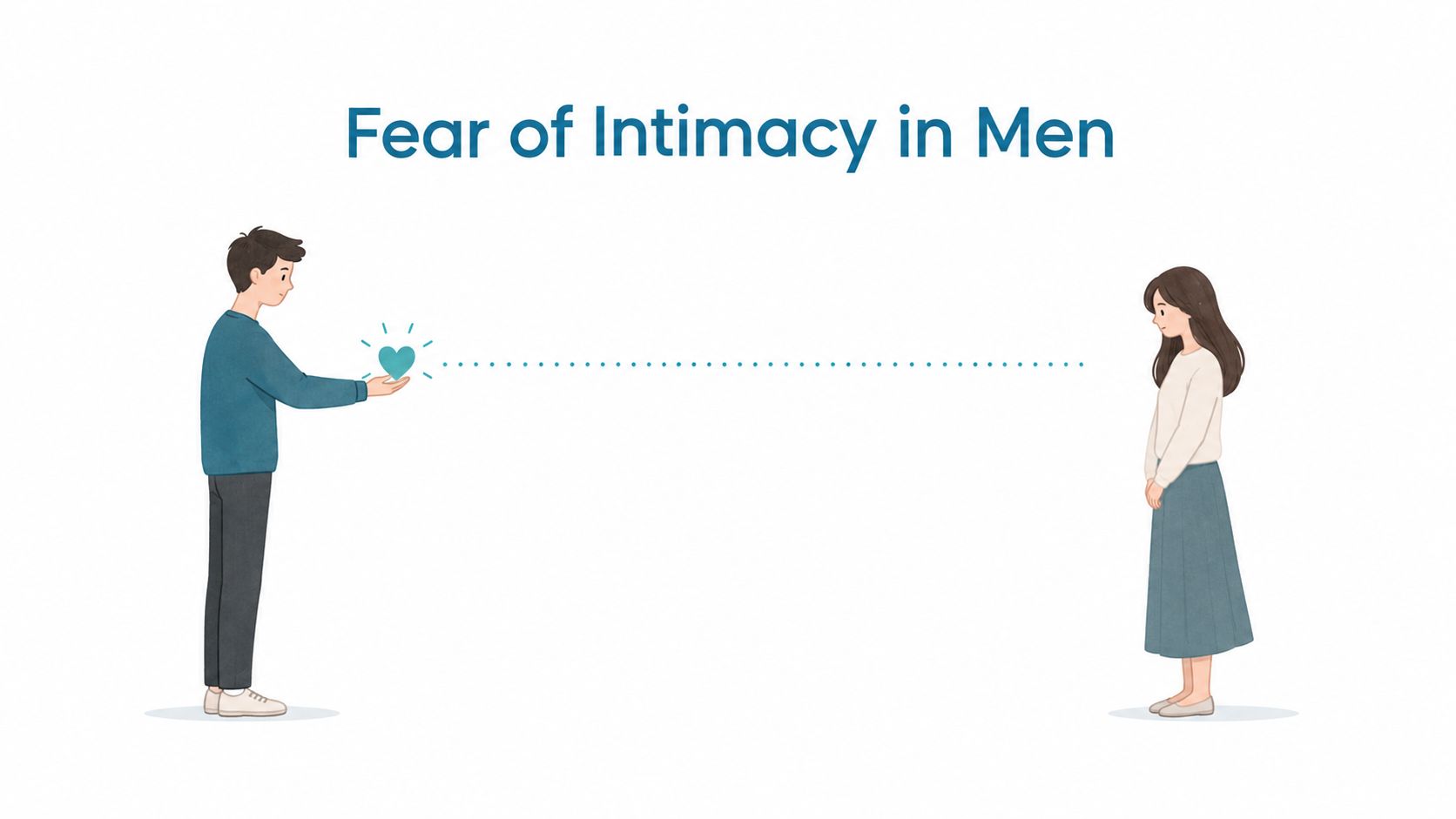
Fear of intimacy also differs from fear of rejection. A review of intimacy fear research describes a study of 679 university students in which men scored significantly higher on a standardized fear-of-intimacy measure, while women reported greater rejection sensitivity and interpersonal anxiety (review of intimacy fear and relationship research). Other research finds no gender gap on this measure, so read it as one finding rather than a settled pattern. Rejection fear is expecting someone to turn you down. Intimacy fear can make closeness itself feel exposing, engulfing, or hard to control.
When closeness feels like a loss of safety
Earlier work on intimacy fears named several specific ones: exposure, abandonment, angry attack, loss of control, destructive impulses, and loss of individuality. A man guards against them by limiting what he discloses, keeping conversations practical, or refusing to need anyone.
The behavior looks contradictory because it is. Wanting a relationship and holding back emotionally can happen in the same hour. Attachment avoidance is a description, not a diagnosis, and the research does not establish that gender causes it. What it gives you is a group-level tendency expressed in specific behaviors, which is exactly what makes the pattern workable.
Is Fear of Intimacy Really a Men's Issue
The stereotype says men guard against closeness while women seek it. The research supports something narrower. In a 2025 study of 200 young adults, researchers found no significant gender difference in fear of intimacy or relationship satisfaction, and fear of intimacy tracked with lower satisfaction for both men (r = −.40) and women (r = −.31) (2025 study on gender, intimacy fear, and relationship satisfaction).
Why did the 2022 study covered earlier find men scoring significantly higher on a fear-of-intimacy measure? The two studies asked different questions of different groups. One measured a single standardized scale across 679 university students; the other examined how fear related to satisfaction in a smaller young-adult sample. Findings in this literature shift with the measure used, the sample studied, and the age of participants, which is why sweeping claims about one gender tend to outrun the evidence.
Gender alone tells you little about whether a particular man fears closeness, how the pattern developed, or what it costs his relationship.
Social expectations still matter. In a 2025 survey on attitudes toward men's emotional expression, most respondents believed men are uncomfortable showing emotional vulnerability, and a substantial share said male emotional pain gets ignored, avoided, or mocked. These are beliefs about men rather than direct measures of behavior. They still point to messages that can make openness feel risky.
Learning to handle everything alone can earn respect in some settings. In a close relationship, the same habit can make it hard to let anyone know you.
Many boys absorb the lesson that toughness and self-reliance earn approval while vulnerability invites teasing or dismissal. Those lessons shape behavior, yet they leave plenty of room for individual variation. Women experience intimacy anxiety too, and expectations around emotional expression differ across families, cultures, and communities.
“Emotionally unavailable” describes a pattern, not an identity. A man may want connection while avoiding disclosure, rely on a partner while hiding his own needs, or withdraw whenever conflict starts. The useful question is what makes closeness feel unsafe for him specifically, and which responses keep the distance in place.
Signs of Fear of Intimacy and How They Show Up
Pattern | What it often looks like | What it may be protecting against |
|---|---|---|
Going quiet during conflict | Stonewalling, leaving the room, short replies | Feeling overwhelmed or judged mid-argument |
Keeping conversation light | Saying “fine” or “good” to open questions | Exposing needs that might be dismissed |
Turning feelings into logic | Analyzing a partner's emotions instead of sharing your own | Discomfort with naming what you feel |
Pulling back after closeness grows | Less contact after a good stretch together | Dependence feeling risky |
Hiding needs while relying on a partner | Handling everything alone and asking for little emotionally | Fear that needs will be a burden or rejected |
Keeping relationships shallow | Staying casual or ending things as they deepen | Loss of control or feeling engulfed |
Separating sex from emotional disclosure | Physical closeness with little talk about feelings | The exposure of emotional vulnerability |
Minimizing hurt | Saying “it's not a big deal” after painful events | Shame or feeling needy |
One behavior in a difficult season doesn't prove fear of intimacy. A repeated pattern across romantic relationships, friendships, and family relationships may be worth examining, especially if it leaves you or someone close to you feeling alone.
Consider a common moment: your partner says they want to talk about the relationship, and you make a joke or change the subject. That response may ease the tension briefly, but it also prevents you from finding out what your partner wanted to say or whether you could stay present through the conversation.
These signs can appear in men and women, and they can overlap with ADHD, anxiety, or other experiences. None proves intimacy fear on its own. If feeling distant or numb is part of the picture, understanding emotional numbness may help you describe what's happening without rushing to label it.
A useful first step is to track the moment you pull away: What happened just before it? What did you expect would happen next? What feeling or conversation did the distance spare you from? The answers can help you identify a pattern rather than judge yourself for having one.
How Early Experience and Avoidance Keep Distance in Place
Attachment describes expectations about whether other people will respond when you need them. Those expectations can form early and influence how adult closeness feels, though they don't determine how every relationship will go.
A 2024 study of 180 adults aged 21 to 30 who were in relationships found that childhood emotional abuse was associated with fear of intimacy through insecure attachment. Rejection expectancy and low acceptance expectancy were also linked to greater fear of intimacy (2024 study on emotional abuse, attachment, and fear of intimacy). In plain terms, if you expect closeness to bring criticism, rejection, or engulfment, you may distance yourself before you can learn whether that expectation fits the present relationship.
Hypothetical example: A boy learns that tears bring teasing, so he stops showing hurt. As an adult, he may describe his distance as practical rather than recognize how much it protects him from feeling exposed.
How distance becomes a cycle
In a study of 144 heterosexual couples aged 26 to 60, men's attachment-related avoidance was negatively associated with both their own intimacy and their partner's intimacy (study of attachment avoidance and intimacy in couples). That doesn't establish a simple cause-and-effect rule for every couple. It does help show how one person's protective distance can be connected with less closeness on both sides.
The cycle may look like this:
A trigger: A partner asks for more time together or raises a relationship concern.
A feared consequence: “I'll be criticized,” “I'll be trapped,” or “I won't know what to say.”
A protective move: Distraction, less physical contact, intellectualizing, delayed replies, or withdrawing.
Short-term relief: The difficult feeling eases because the conversation pauses.
Long-term cost: The partner has less information and may feel more distant, making future closeness harder.
Hypothetical example: A partner asks for more time together. The man sends a message about logistics instead of responding to the emotional request. He feels relief, while his partner feels that the issue remains untouched.
Research reviews suggest highly avoidant men may show less visible distress after breakups, potentially because they suppress negative thoughts and feelings, not because attachment needs are absent. But not everyone with painful early experiences becomes avoidant, and attachment patterns can change. A practical way to begin is to notice the trigger, name what you fear will happen, and choose a small response that preserves your autonomy without disappearing from the relationship.
ADHD and Other Factors That Complicate Closeness
ADHD can affect relationships through communication difficulties, emotional regulation, shame, or the sense of being misunderstood. That's different from saying ADHD causes fear of intimacy.
A qualitative study of 43 adults with ADHD reported a median participant age of 29 and a median age at diagnosis of 22, with diagnoses ranging from 5 to 34. Participants described difficulty maintaining relationships with neurotypical partners, with stigma and communication challenges contributing to masking. The sample was predominantly female, so it shouldn't be treated as evidence about men specifically (qualitative study of adults with ADHD and relationships).
A man who forgets plans, misreads a tone, or interrupts may pull away to avoid being judged unreliable. A study of 306 adults found that the ADHD-traits group had a higher divorce rate than the control group, while participants with ADHD traits reported higher average scores on passionate love. Desire and sustained relationship functioning can diverge. Pulling back after a relationship grows demanding doesn't necessarily mean the person never wanted connection (study of ADHD traits and romantic relationships).
But ADHD doesn't automatically create an avoidant attachment pattern. In a community sample of 690 adults, including 166 with self-reported ADHD, attachment anxiety was slightly higher in the ADHD group, but the difference wasn't statistically significant (p = .088), and no significant group differences in attachment avoidance emerged (study of ADHD and adult attachment).
A diagnosis can help explain some relationship challenges, but it can't tell you what closeness means to a particular person.
Anxiety, depression, shame from repeated setbacks, and substance use can also affect communication and emotional availability. If ADHD may be part of your experience, a qualified clinician can assess it. Therapy can complement medical evaluation or medication management; it doesn't replace them. When shame and self-doubt dominate, Nick helps clients get some distance from the critical voice in their head and build a different relationship with themselves. For more on how ADHD can affect connection, see ADHD and relationship problems.
Practical Ways to Let Someone In Without Feeling Exposed
Men are less likely than women to turn to their networks for social connection and emotional support. Pew also found that only 19% of U.S. adults are extremely or very likely to seek emotional support from a mental-health professional, while partners remain the most common source (Pew Research Center report on social connections and support).
Intimacy is a two-way skill: sharing something about yourself, responding to what another person shares, and allowing care without treating it as weakness. Healthy autonomy means you can choose when to lean on someone. Defensive self-sufficiency can feel like you're unable to ask, even when you want support.
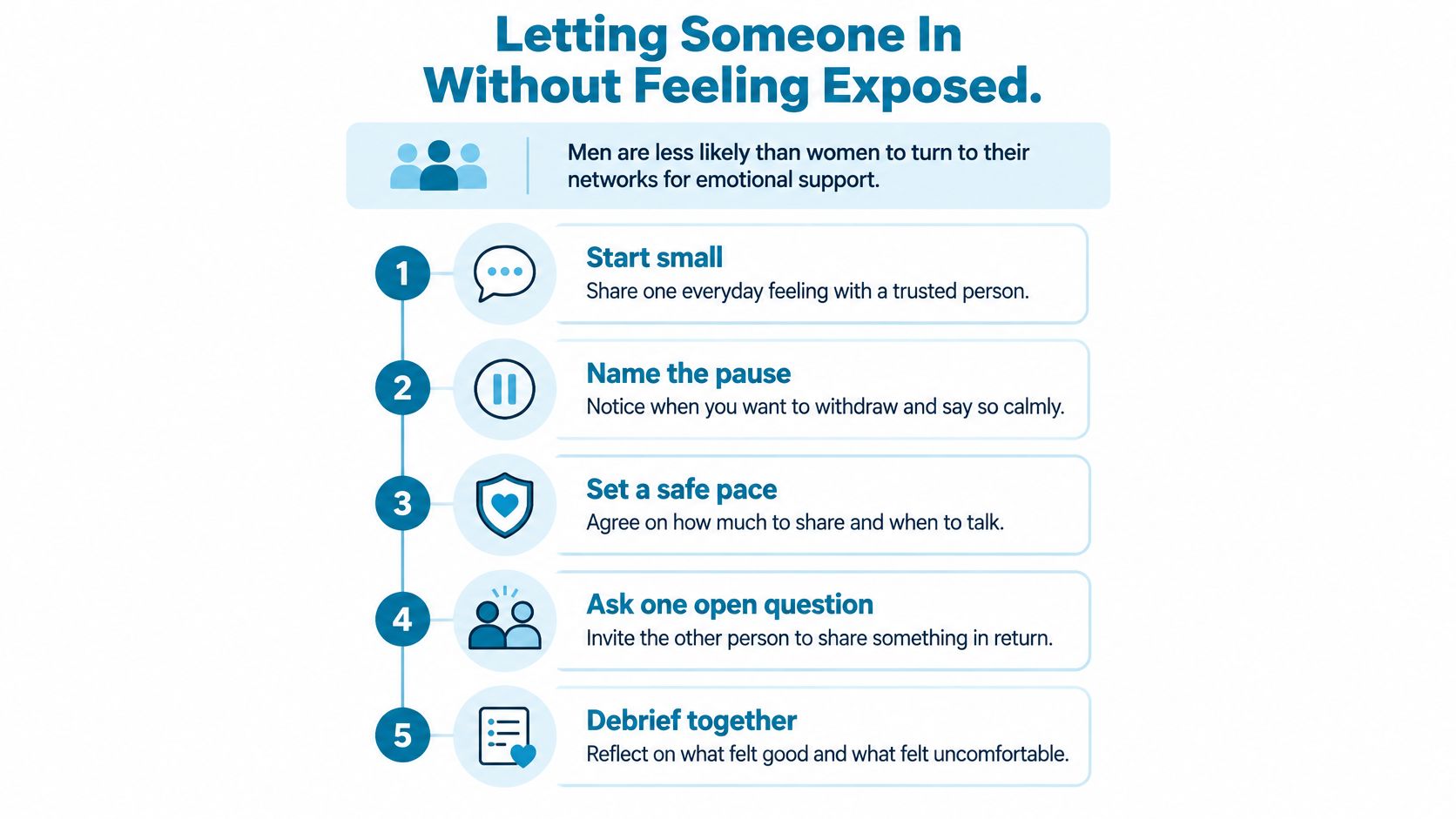
Try these steps at a pace that feels manageable:
Notice the pull-away moment. Name the thought that came with it, such as “I'm going to be criticized,” before acting on the urge to withdraw.
Name one need in one sentence. “I'd like some time together tonight” is easier to respond to than a long explanation that hides the request.
Let a pause happen. Wait briefly before defending, fixing, or changing the subject. A pause can give you time to hear your own reaction.
Reflect before advising. When a partner shares something vulnerable, say what you heard before offering a solution. You might start with, “It sounds like that left you feeling alone.”
Ask for one specific kind of support. Try, “Can we talk after work?” or “Could you help me think through this stressful task?”
Notice what followed. Afterward, write down what you feared and what happened. If ADHD makes it hard to remember, use a note or reminder.
Nick's approach to relationship and dating concerns is to slow down, understand what's happening, and begin responding differently, sometimes by first understanding yourself. If written prompts or a reminder help you pause long enough to choose your response, use them.
How to Respond When a Partner Pulls Away
You can't make another person open up, but you can name what you notice and be clear about what you need. Because partners are a common source of emotional support, withdrawal can leave the person closest to him carrying much of the uncertainty.
Start with observation, not a diagnosis: “You seemed far away after dinner. I'm wondering what happened.” That wording gives your partner room to respond without requiring you to decide in advance why he pulled away.
Make the request specific and bounded. “Can we talk for twenty minutes Thursday?” is more concrete than “We need to talk.” If your partner needs space, ask what that means and agree on when you'll return to the conversation.
A pause needs a return point. Space with a clear follow-up is different from leaving the other person to wait indefinitely.
Notice your own pursuit, too. Repeated pressure can make a withdrawing partner retreat further, but your needs still matter. A clear request for a return time offers structure without asking for immediate emotional disclosure.
Pay attention to the ongoing pattern. If you feel chronically lonely, get shut out during conflict, or face the same unresolved ending repeatedly, consider support for yourself or couples therapy. Your partner is responsible for their choices, and you aren't responsible for diagnosing them. The aim is a relationship where both people can say what they need and take responsibility for how their behavior affects the other.
Deciding Whether Therapy Is Your Next Step
Approach | What it works on | Often a good fit when |
|---|---|---|
Individual therapy | Shame, self-doubt, and the distance-keeping pattern itself | Closeness fears appear across relationships or alongside a harsh inner critic |
Interpersonal therapy | Current relationship patterns, communication, and conflict | Arguments or withdrawal repeat with a partner, friend, or family member |
Mindfulness-based approaches | Noticing urges to withdraw without acting automatically | Overthinking or shutting down takes over in emotionally close moments |
Therapy doesn't require a dramatic confession or a promise to become a different person. It can begin with one recent moment when you went quiet, avoided a request, or felt the urge to pull away. In session, the work is slowing that sequence down: what felt risky, what you did to protect yourself, and what response might fit better next time.
A secondary analysis of randomized-trial data involving participants with fear of intimacy found that reductions in fear were associated with increased social connectedness, partly through improvements in intimacy-related behaviors (analysis of intimacy-related behavior and social connectedness). That supports treating fear of intimacy as a pattern of specific behaviors, things you do or don't do in close moments, rather than a fixed trait. It doesn't guarantee a particular outcome, and people's needs and progress differ.
The work is behavioral, and it is gradual.
Starting involves reaching out, and a therapeutic relationship is established only through signed agreements and intake procedures. If anxiety is driving decisions, the work may focus on developing a different relationship with it, rather than expecting anxiety to disappear. If you're weighing whether therapy feels right, this guide to finding a therapist for high achievers may help you consider what kind of conversation would suit you.
ADHD, anxiety, depression, or substance use concerns may also warrant assessment by a physician, psychiatric provider, or licensed clinician. Therapy can be part of that broader process and doesn't replace medical evaluation or medication management when those are appropriate.
You don't have to know the whole story before seeking help. One clear memory of pulling away is enough to start the conversation.
Nick Donahue LICSW offers individual therapy for adults navigating ADHD, anxiety, relationship difficulties, and the discomfort of letting someone get close. If you'd like to explore whether therapy could help you understand your patterns and respond differently, visit Nick Donahue LICSW.
Comments