
Tired After Work and Can't Shake It? What It Means
You get home, set your bag down, and sit on the couch just for a minute. Dinner is undecided, a friend's text sits unanswered, and the workout or errand you intended to do suddenly feels impossible. Feeling tired after work that reliably is information worth sorting out. It is not proof that you're lazy, and it usually isn't solved by trying harder in the evening.
Table of Contents
What End-of-Day Exhaustion Actually Feels Like - Ordinary tiredness versus a heavier pattern
How the Workday Quietly Eats More Than You Think - Where the evening actually goes
Why More Sleep Alone Rarely Fixes the Problem - Four drivers that can look identical by 6 p.m.
Reading Your Own Fatigue Pattern - Three Exhaustion Patterns Side by Side
A Two-Week Tracking Protocol That Actually Works - Keep the daily record small
Building an Evening Routine That Actually Recovers You - Match the evening to the depletion
Setting Boundaries Without Burning Bridges - Make the boundary absorbable
What End-of-Day Exhaustion Actually Feels Like
The familiar version is quiet rather than dramatic. You were responsive in meetings, patient with a difficult email, and able to finish what mattered most. Then the structure disappears, and choosing between cooking and ordering food feels like another consequential decision.
You may scroll without enjoying it because scrolling asks for almost no initiative. A partner asks an ordinary question and hears irritation in your answer. Your child wants attention, and guilt arrives alongside the tiredness because coworkers received your best-regulated self while home is getting what's left.
Ordinary tiredness versus a heavier pattern
Ordinary tiredness tends to match the day. A long, interrupted, socially intense day leaves you spent, and food, quiet, movement, or sleep restores some capacity. A heavier pattern is less proportional. Even a manageable day ends with the same collapse, and weekends become mostly repair work.
Exhaustion after work is treatable information, not a verdict on your character or motivation.
People bring this concern into therapy often, usually apologizing for it. They'll say nothing terrible happened, they like parts of their job, or other people seem able to have a life afterward. That comparison rarely accounts for hidden effort, caregiving, anxiety, ADHD-related compensating, or a workday with almost no recovery built into it.
Shame can also make the pattern harder to examine. If every flat evening gets labelled a discipline failure, you'll keep prescribing effort for a problem that may involve load, transition time, sleep quality, or emotional demand. A more useful question is what the exhaustion tracks, what it travels with, and what restores you.
That distinction matters because the right response differs. Sometimes you need a gentler landing after work. Sometimes the job itself needs examination. Sometimes fatigue deserves medical or mental health evaluation rather than another evening routine.
How the Workday Quietly Eats More Than You Think
Start with arithmetic before self-blame. Bureau of Labor Statistics time-use data on average workdays show full-time workers averaged 8.1 hours of work on workdays in 2025, with 8.5 hours on weekdays and 5.5 hours on weekends. That's before commuting, messages after hours, or the time spent mentally rehearsing tomorrow.
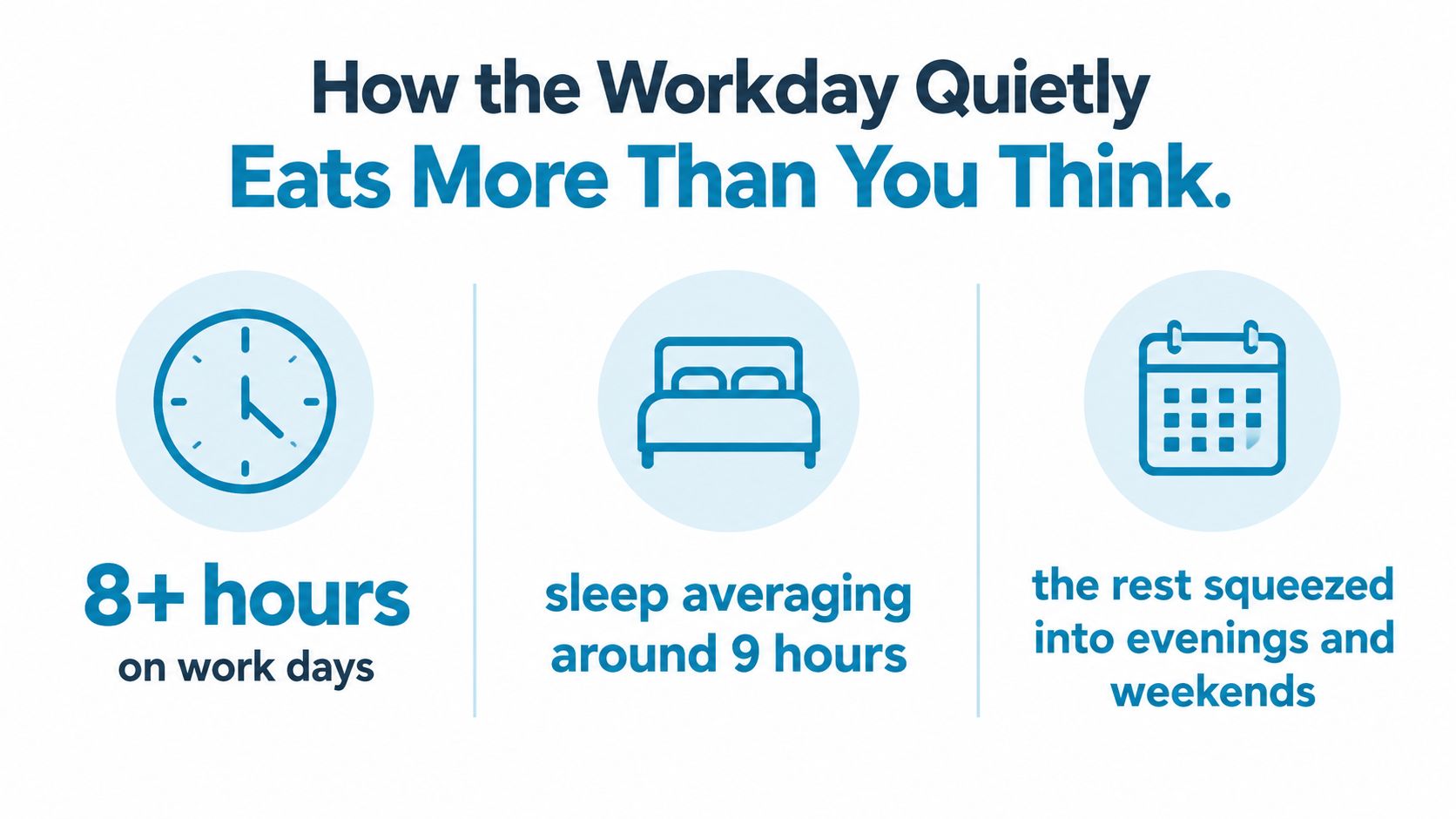
The broader average can mislead if you read it too quickly. People age 15 and older spent 3.56 hours per day on work and work-related activities across all days in the same Bureau of Labor Statistics time-use release, because that figure includes nonworkdays. On an actual workday, your discretionary window is much narrower than that number suggests.
Where the evening actually goes
After work you may still need to travel home, feed yourself or others, manage a household, answer personal messages, care for family, and set up tomorrow. None of those tasks is necessarily large. Together they consume the interval where recovery was supposed to happen.
Visible work: meetings, production, documentation, decisions, and responding to people.
Invisible work: remembering, switching tasks, managing impressions, and holding unfinished problems in mind.
Post-work work: commuting, chores, caregiving, scheduling, and preparing to repeat the cycle.
This is also why a desk job can leave someone depleted without much physical movement. If your attention repeatedly breaks and has to be rebuilt, difficulty concentrating during the workday may be part of the cost rather than a separate personal shortcoming.
An apparently normal schedule can leave very little slack. When recovery depends on everything going smoothly, one tense conversation, delayed train, sick child, or late request can spend the last reserve. The exhaustion then reflects a demand and recovery mismatch, not a mysterious lack of energy.
Why More Sleep Alone Rarely Fixes the Problem
Sleep matters, but treating it as the only lever can delay a better explanation. You can spend enough hours in bed and still arrive home depleted if the day required sustained inhibition, rapid switching, emotional performance, or constant vigilance. You can also sleep poorly because work remains psychologically unfinished.
ADHD makes this distinction especially important. In one comparison summarized in research on fatigue in adults with ADHD, 62% of participants with ADHD met the study threshold for clinically significant fatigue. That doesn't mean tiredness diagnoses ADHD. It does show how managing attention, impulses, organization, and task initiation can make an ordinary schedule unusually expensive.
Four drivers that can look identical by 6 p.m.
Cognitive load builds through decisions, interruptions, and holding details in working memory. By evening, even pleasant choices can feel like work because choosing itself is depleted.
Emotional labor is different. Staying calm, reassuring others, absorbing frustration, or performing confidence may leave you wanting silence rather than sleep. More hours in bed won't fully address a day spent regulating around other people.
Transition failure happens when work ends on the clock but not in your nervous system. You replay a comment, monitor messages, or keep solving tomorrow's problem while eating dinner. Passive scrolling can prolong that state because your body stops moving while your mind stays connected.
A useful test: If rest leaves you calmer but still unable to start anything, the problem may be cognitive depletion rather than simple sleepiness.
Sensory and sedentary load also matter. Hours of screens, noise, bright light, and stillness can produce a heavy, powered-down feeling. A commute then adds stimulation while taking time from food, movement, and quiet.
Matching the response to the driver is more useful than adding generic self-care. Cognitive depletion may need fewer evening decisions. Emotional depletion may need low-demand connection. Sensory overload may need dimmer, quieter transition time before conversation or chores.
Reading Your Own Fatigue Pattern
A label is less useful than a pattern. Notice when exhaustion appears, what happened that day, what improves it, and whether it stays confined to work or follows you into days off. Those details help separate ordinary depletion from patterns that deserve closer attention.
Burnout requires more than feeling tired. The World Health Organization definition of burnout describes energy depletion or exhaustion, increased mental distance from or negativity toward one's job, and reduced professional efficacy. WHO classifies it as an occupational phenomenon, not a medical condition.
Three Exhaustion Patterns Side by Side
Pattern | Typical trigger | What helps most | When to escalate |
|---|---|---|---|
Ordinary fatigue | A long, fragmented, or socially intense day | Food, sleep, quiet, movement, a real day off | It stops tracking workload or no longer improves with rest |
ADHD-related depletion | Sustained focus, switching, self-monitoring, compensating systems | Fewer transitions, external structure, lower evening decision load | Daily functioning, mood, work, or relationships keep shrinking |
Burnout pattern | Chronic workplace stress that hasn't been successfully managed | Reduced exposure, workload change, support, genuine recovery time | Cynicism, dread, and reduced efficacy persist despite time away |
If feeling overwhelmed has become your baseline, don't assume the answer must be better coping. Ask whether demands keep rising, whether support is absent, and whether recovery time is real or only theoretical.
Some patterns warrant medical evaluation rather than self-management. Persistent or worsening fatigue despite adequate sleep is one. So are fatigue with loud snoring, witnessed breathing pauses, depressed mood, major changes in functioning, or sleepiness that affects driving.
Also pay attention to companions. Exhaustion with hopelessness, loss of interest, emotional numbness, anxiety that won't switch off, or inability to recover on days off points beyond a simple scheduling problem. You don't need to settle on one explanation before asking a clinician for help sorting it out.
A Two-Week Tracking Protocol That Actually Works
Tracking works when it's brief enough to repeat on your worst evenings. Skip elaborate apps at first. A notes app, paper notebook, or simple spreadsheet is enough if you'll use it after work.
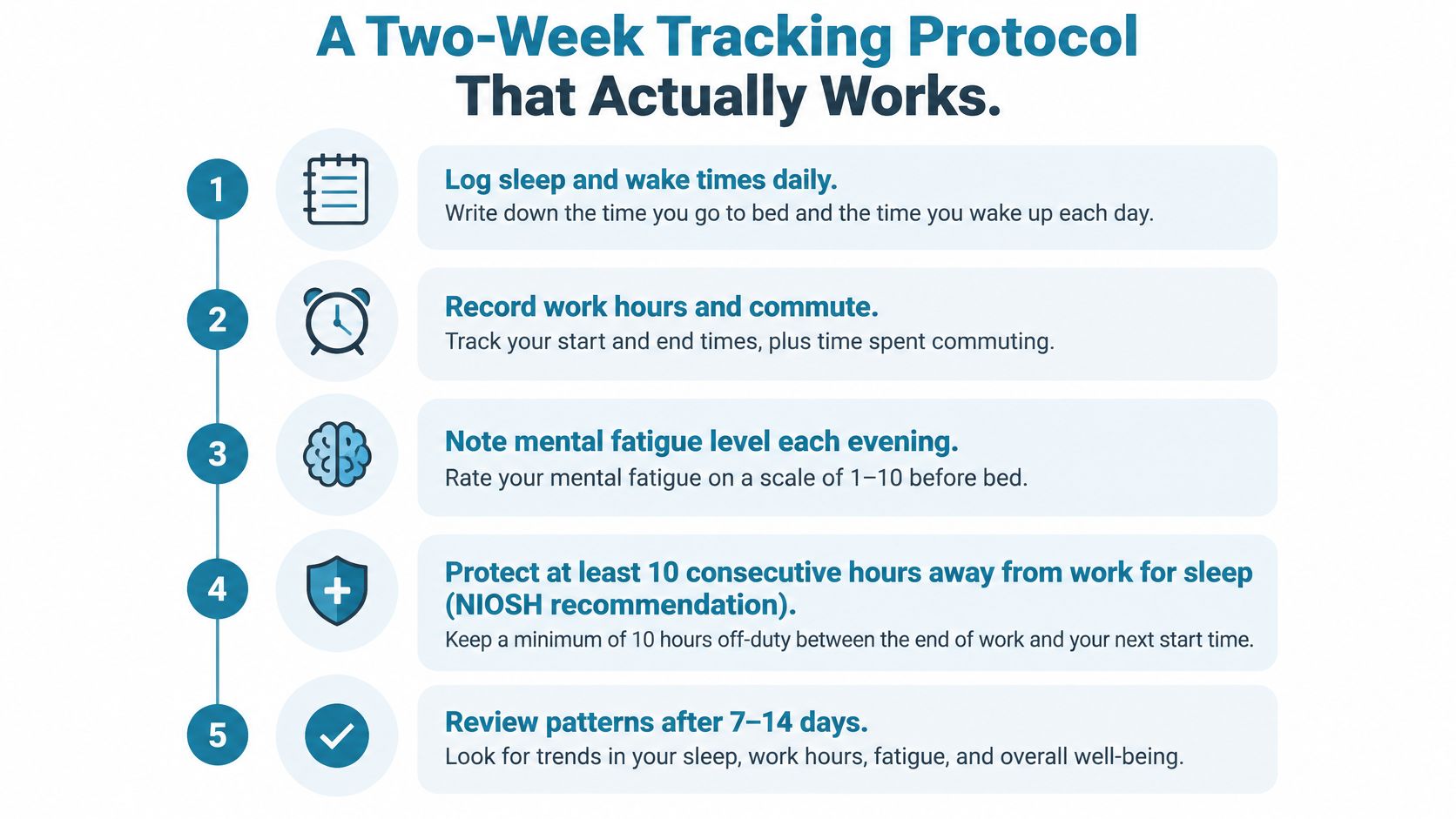
For 7 to 14 days, rate fatigue from 0 to 10 immediately after work, at bedtime, and on waking. Alongside those ratings, record sleep duration, shift or work length, commute, caffeine, workload intensity, and emotionally demanding tasks.
Keep the daily record small
After work: Give fatigue a number and name the day's biggest drain in a few words.
At bedtime: Note whether you detached from work, kept checking messages, exercised, socialized, or collapsed.
On waking: Record approximate sleep duration and whether you feel restored, groggy, or already behind.
Once weekly: Compare your highest and lowest fatigue days instead of averaging everything into a blur.
The protected recovery window matters as much as bedtime. NIOSH guidance on safer work hours recommends at least 10 consecutive hours away from work each day so workers can obtain roughly 7 to 8 hours of sleep. It also recommends frequent brief breaks every 1 to 2 hours during demanding work and full rest days after blocks of long shifts.
Time off isn't automatically recovery. Commuting, caregiving, chores, and late-night screen use can consume the protected interval before sleep begins.
Don't change five variables at once. First stabilize wake time and protected off-duty time for one week. Then add scheduled microbreaks and reassess. If you overhaul caffeine, exercise, bedtime, and workload simultaneously, you may feel better without learning which change mattered, or quit because the experiment became another job.
Look for modifiable drivers, not perfect correlations. Maybe high-fatigue days follow back-to-back meetings, late caffeine, skipped lunch, or emotionally charged tasks. One or two recurring pressure points are enough to design the next test.
Building an Evening Routine That Actually Recovers You
An effective evening starts by ending work deliberately. Change clothes, shower, walk around the block, leave the room where you worked, or play music that belongs to home rather than work. The ritual can be short. Its job is psychological detachment, not self-improvement.
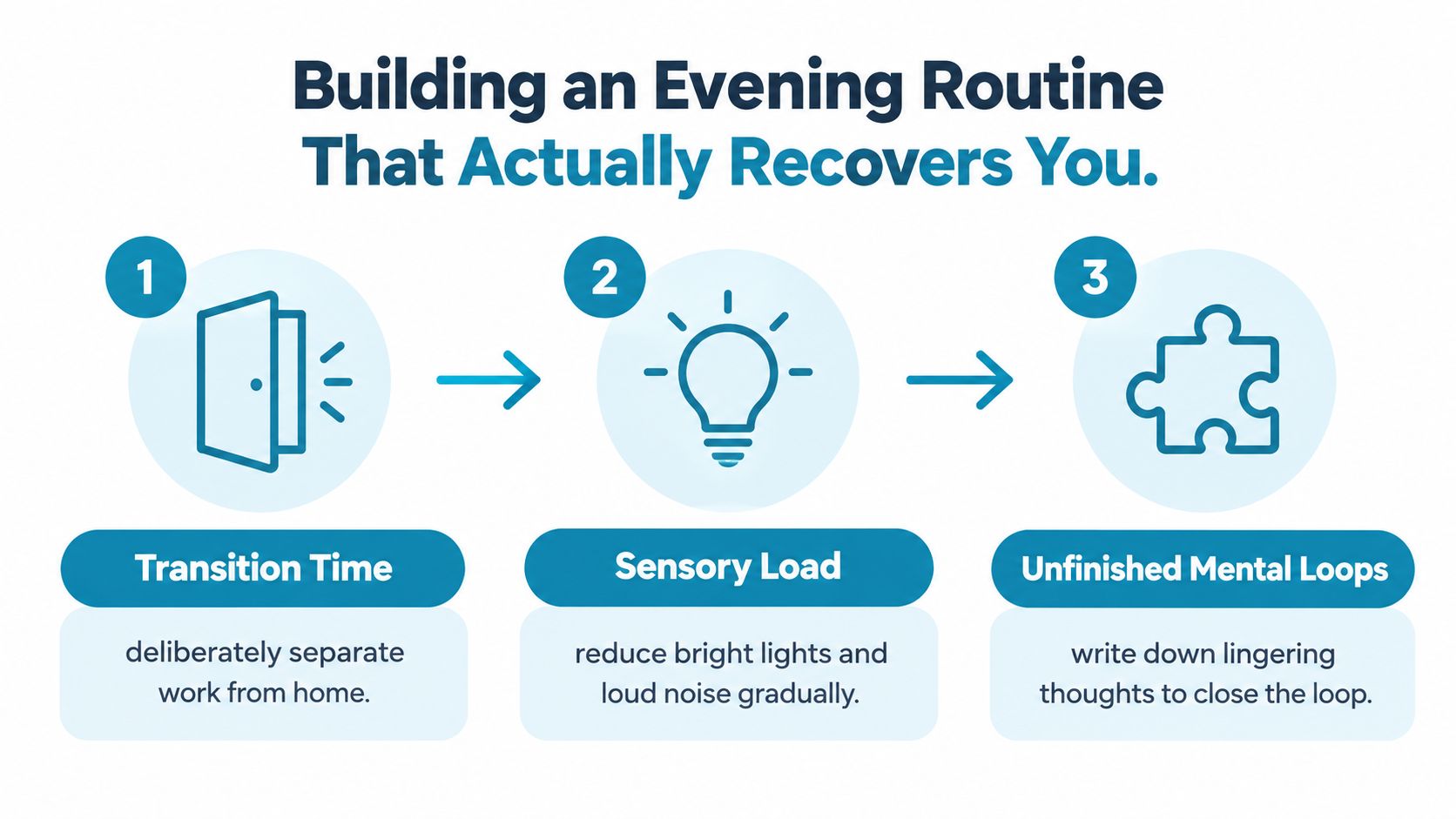
Next, offload unfinished loops before they follow you through the night. Write tomorrow's first task, the message you owe, and anything you're afraid you'll forget. Close the note. This won't solve the underlying workload, but it can stop your brain from using rumination as a reminder system.
Match the evening to the depletion
After emotional labor: Choose low-demand company, solitude, or a familiar show before asking yourself for a big conversation.
After sensory overload: Lower light and volume gradually, reduce notifications, and delay errands in bright, crowded places when possible.
After decision fatigue: Use a default meal, a preselected walk route, or one small achievable activity that restores agency without requiring planning.
After sedentary work: Treat light movement as a transition tool, not a performance test you can fail.
Reducing exposure also matters. In a randomized study described in research on reduced working time and sleep, 33 workplaces and 580 full-time employees were followed while the intervention group worked 75% time with preserved pay for 18 months. Sleep duration increased by about 23 minutes, while sleepiness, perceived stress, and bedtime worry declined.
Few people can't unilaterally reproduce that schedule. Use it as a benchmark instead. Test one exposure reduction for a few weeks, such as no routine evening messages, consolidated meetings, or one protected non-work evening, and compare it with your tracking data.
The short video below can support a wind-down if guided audio helps you separate from the day.
Keep caffeine earlier when late use is part of your pattern, and don't mistake temporary alertness for recovery. A realistic routine is one you can repeat when you're already tired, not an ideal sequence that collapses after two demanding days.
Setting Boundaries Without Burning Bridges
Evening strategies have limits when the workday keeps expanding. A boundary helps only if it reduces demand or clarifies priority. If you stop answering messages at night but inherit the same unresolved pile with more urgency in the morning, you've mostly moved the cost.
Commute belongs in that calculation too. In a 2025 National Safety Council survey of working adults involving 2,010 people, 31% had commutes of at least 30 minutes. Longer commutes reduce time available for sleep, personal responsibilities, and recuperation, so a schedule that looks reasonable on paper may be tighter in practice.
Make the boundary absorbable
State the operational change, the reason in neutral terms, and what will happen instead. For example, you might say you'll review nonurgent messages at set times, flag true emergencies through one channel, and confirm priorities when new work exceeds capacity. Specifics make it easier for a supervisor or team to adapt.
Protect one evening: Choose the night your tracking shows the steepest midweek decline rather than defaulting to Friday.
Triage visibly: When a new task arrives, ask what should move rather than borrowing from recovery time.
Use brief breaks: Step away after demanding or monotonous tasks instead of saving all recovery for bedtime.
Name capacity early: A calm conversation before errors or resentment build is usually easier to hear than a crisis announcement.
Some workplaces respond well. Others reveal that the workload was never designed to fit the stated hours. Either result gives you useful information, though it may raise harder questions about role fit, staffing, or whether perfectionism and guilt are making limits feel dangerous.
Therapy can help when exhaustion is entangled with anxiety, ADHD-related overload, emotional regulation, shame, or repeated difficulty setting limits. The work isn't to make an unsustainable job feel acceptable. It's to sort what belongs to the environment, what patterns travel with you, and what choices are available. For readers whose competence hides the cost, therapy for high achievers who feel depleted may be a relevant next read.
If your evenings have narrowed to recovering from work and preparing to do it again, you don't have to diagnose yourself before seeking support. Nick Donahue LICSW PLLC offers ADHD-informed individual therapy for adults and teens in Washington, DC, with virtual sessions available across DC and Virginia. Reach out for an initial consultation to talk through your pattern, what may be driving it, and whether therapy feels like a good fit.
Comments