
What Causes Rejection Sensitive Dysphoria? Key Factors

Your phone buzzes at 9:40 at night. It's a reply from a friend, four words long, no punctuation at the end. You read it twice, then a third time. By 9:42 your chest is tight, and by 10:00 you've assembled a fairly detailed theory about what you did wrong last weekend and why she's been polite but distant for a month.
That gap, between a small social cue and a reaction that feels enormous, is what people are reaching for when they say rejection sensitive dysphoria. The experience is real and often exhausting. The name is where things get slippery, because it sounds like a diagnosis and travels online as though it were one.
The honest answer to what causes rejection sensitive dysphoria is that nobody has isolated a single cause. What exists instead is a set of overlapping factors that tend to show up together: ADHD and the way it affects emotion regulation, a temperament that feels things quickly and hard, and a long history of being corrected, excluded, or overlooked. Each one changes what would help.
Table of Contents
What Rejection Sensitive Dysphoria Describes and What It Does Not
How ADHD and the Reaction Loop Connect to Rejection Sensitivity - What the 2024 Study Found - The Loop, Stage by Stage
Emotional Sensitivity as a Separate Factor - What the Child Study Suggests
Getting a Proper Assessment Before You Label It - What to Bring to a First Conversation
What Rejection Sensitive Dysphoria Describes and What It Does Not
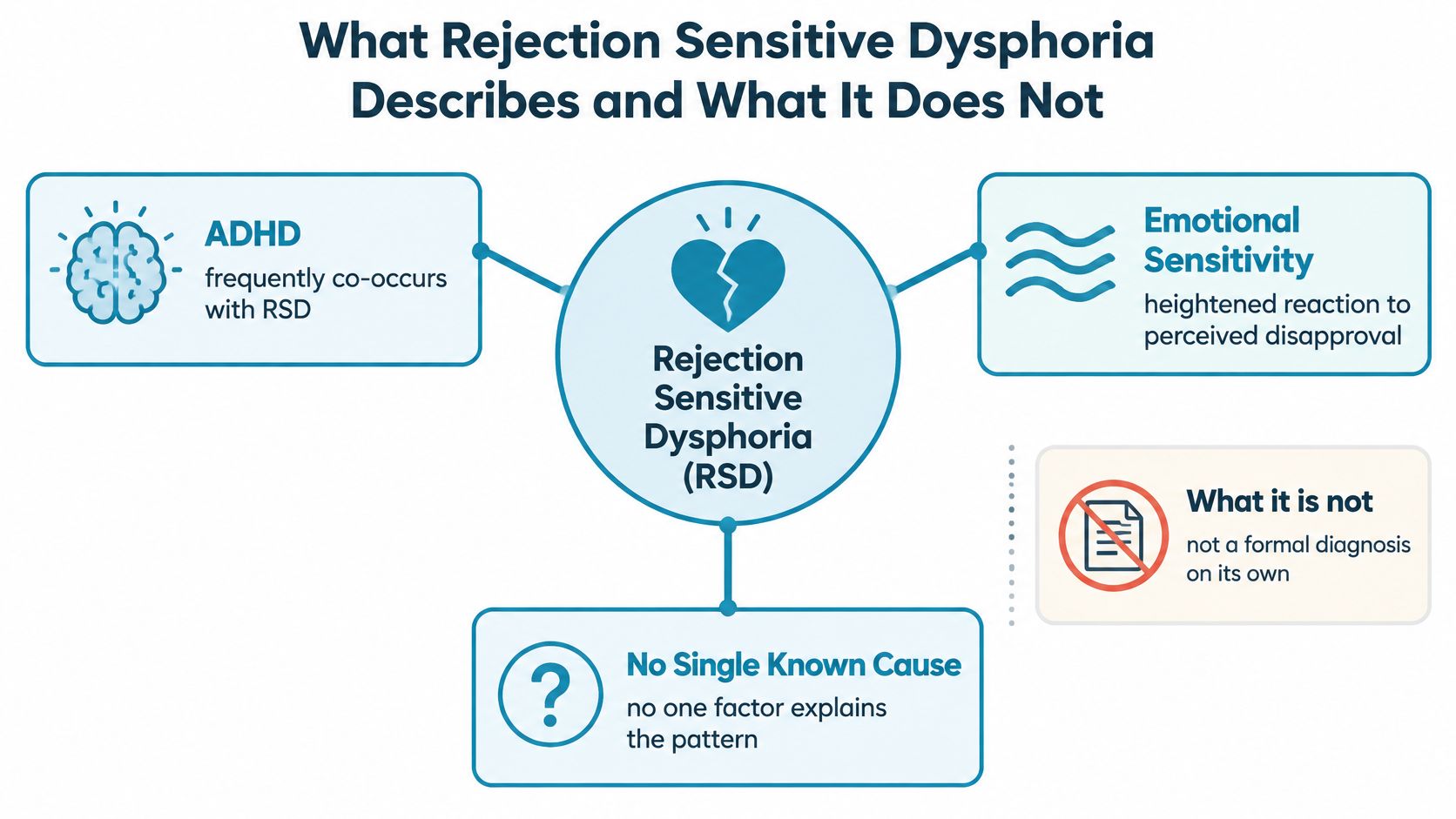
There's no single known cause of rejection sensitive dysphoria. That sounds like a dodge, but it's the accurate answer, and it comes from the term's status rather than from a lack of curiosity among researchers. What exists is a cluster of contributing factors rather than one mechanism you could point to.
Rejection sensitive dysphoria is a descriptive label for unusually rapid, intense emotional pain after actual, anticipated, or perceived rejection, criticism, or failure. The emphasis sits on rapid and intense. A brief sting is common when a message lands coldly. This pattern skips the sting and goes straight to something closer to grief, often within seconds.
It isn't a formal diagnosis. The term appears in neither the DSM-5-TR nor the ICD-11, and researchers haven't established it as a distinct clinical disorder, as the American Psychological Association notes in its coverage of ADHD and emotion dysregulation. The experiences behind the label, strong reactions, sensitivity to criticism, and trouble settling distress, overlap heavily with the broader literature on emotional dysregulation.
That distinction has practical consequences. A person can experience severe rejection-related pain without having a separate condition called RSD, and the label on its own can't diagnose ADHD or anything else. It describes a pattern. It doesn't explain one.
So why does the phrase stick? Because it names something people have felt for years and never had words for. That's genuine value. It's also the point where a useful description can harden into a self-diagnosis that shuts down the questions worth asking.
Here's a first step worth taking before you read further. Write down the last time your reaction was much bigger than the event. Note what happened, what was said, who said it, and how long the feeling lasted. Don't interpret it yet. That small record gives you something concrete to hold against each explanation that follows.
How ADHD and the Reaction Loop Connect to Rejection Sensitivity
A short reply arrives, and the thought “she's probably just busy” never gets a chance to form. The message feels like rejection, and distress rises before there is time to consider another explanation. ADHD can make that pause harder to access, although it does not explain every painful reaction to social feedback.
ADHD is a neurodevelopmental condition that can affect attention, inhibition, planning, and emotional regulation. Executive function refers to mental processes that help a person pause, hold information in mind, and weigh alternatives. Emotion regulation helps a person settle a strong feeling after it spikes. When these capacities are strained, the space between a social cue and a response can narrow.
What the 2024 Study Found
A 2024 study by Vanessa Müller, David Mellor, and Bettina F. Pikó examined 304 Hungarian college students using the Adult ADHD Self-Report Scale and the Rejection Sensitivity Questionnaire. 12.2%, or 37 students, fell into the high-positive ADHD-risk category, according to the published findings. ADHD symptom scores were positively associated with rejection sensitivity scores, with a standardized coefficient of β = 0.466 (p < 0.001), as reported in the full text of the study.
The result describes an association, not a cause. Because the study was cross-sectional, it cannot show that ADHD produces rejection sensitivity or establish which came first. Nor does ADHD determine how a person will respond: some people with ADHD do not report intense rejection-related distress.
The Loop, Stage by Stage
Some brain-response research suggests that ADHD symptoms may be linked with heightened sensitivity to social feedback. This offers one possible way to understand why a cue can feel unusually intense, but it does not establish a single mechanism or explain every person's experience. A descriptive label such as rejection sensitivity identifies a pattern; it does not settle whether ADHD, life experiences, emotional sensitivity, or another factor is behind it.
A reaction loop can help make the pattern more concrete. A cue is interpreted as rejection, distress rises, and the person may withdraw or try to repair the interaction immediately. Those responses can limit opportunities to discover that the other person was not upset. The cycle can then become easier to repeat, though each stage offers a chance to respond differently.
A cue arrives. Someone's tone shifts, or a reply is shorter than expected. Separate what happened from what you think it means. “She wrote two words” describes the cue; “she's annoyed with me” is an interpretation.
Distress rises fast. You may feel heat in your face, tightness in your chest, or an urge to fix things immediately. Try delaying a reassurance text or sudden exit for five minutes. The pause is brief, not a demand to ignore the feeling.
The feeling gets a label. Naming the emotion, such as anger, embarrassment, or shame, can make it easier to work with. Then lengthen your exhale beyond your inhale.
You go quiet, over-apologize, or perform competence. These responses may feel protective, but fewer genuine exchanges also mean fewer chances to learn what the other person intended. The loop can tighten.
You collect corrective evidence. Ask an ordinary question, notice the answer, and write down what happened. Evidence from actual exchanges can help loosen the pattern over time.
Withdrawal can shape relationship habits that neither person enjoys. Therapy for ADHD and relationship problems can offer a place to slow down, understand what is happening, and begin responding differently, sometimes by first understanding yourself.
It can also help to notice when reactions intensify. If rejection-related distress rises during periods of missed deadlines, a chaotic calendar, or several unfinished tasks, that pattern may suggest ADHD-related overwhelm is part of the picture. It is a clue to explore, not proof of a cause.
Emotional Sensitivity as a Separate Factor
Some of this isn't about rejection at all. Emotional sensitivity is a temperament trait, meaning how quickly a feeling arrives, how intense it gets, and how long it takes to return to baseline. Two people can have identical ADHD symptoms and similar histories and still differ widely here. One shrugs off a curt email. The other feels it in the jaw for two hours.
What the Child Study Suggests
A study of children with more pronounced ADHD symptoms found measurable differences in how they responded to failure and social rejection. ADHD symptoms were associated with greater parent-rated emotional negativity and emotional lability, along with blunted withdrawal of respiratory sinus arrhythmia during social rejection, according to research on ADHD and emotional reactivity. Those associations held after accounting for oppositional-defiant symptoms and internalizing problems, so disruptive behavior, anxiety, and depression didn't explain the pattern on their own.
That's physiological and behavioral evidence that some children respond differently to rejection-related stress. It's also a study of children, and children vary. Nothing there establishes a fixed pattern in adults, and temperament is a starting point rather than a life sentence.
Intensity isn't a character flaw. It's a fact about how your nervous system registers events, and facts can be worked with.
One question is worth sitting with here. Do strong feelings show up mainly in social situations, or do they also arrive when you're stuck on a task, when plans change suddenly, or when something breaks that you can't fix? If it's the second, you're probably looking at broader emotional reactivity, with rejection as one place it surfaces rather than the whole story.
How Life Experiences Shape Rejection Sensitivity
The first time you were told you were too much, you probably didn't believe it. By the twentieth, some part of you had started scanning for the evidence in advance.
Sensitivity to rejection is partly learned. A childhood of missed deadlines, blurted remarks, unfinished homework, and corrections delivered in front of other people teaches a person to expect disapproval and to monitor for it closely. The monitoring becomes automatic. By adulthood it looks like a personality trait, though it started as an adaptation.
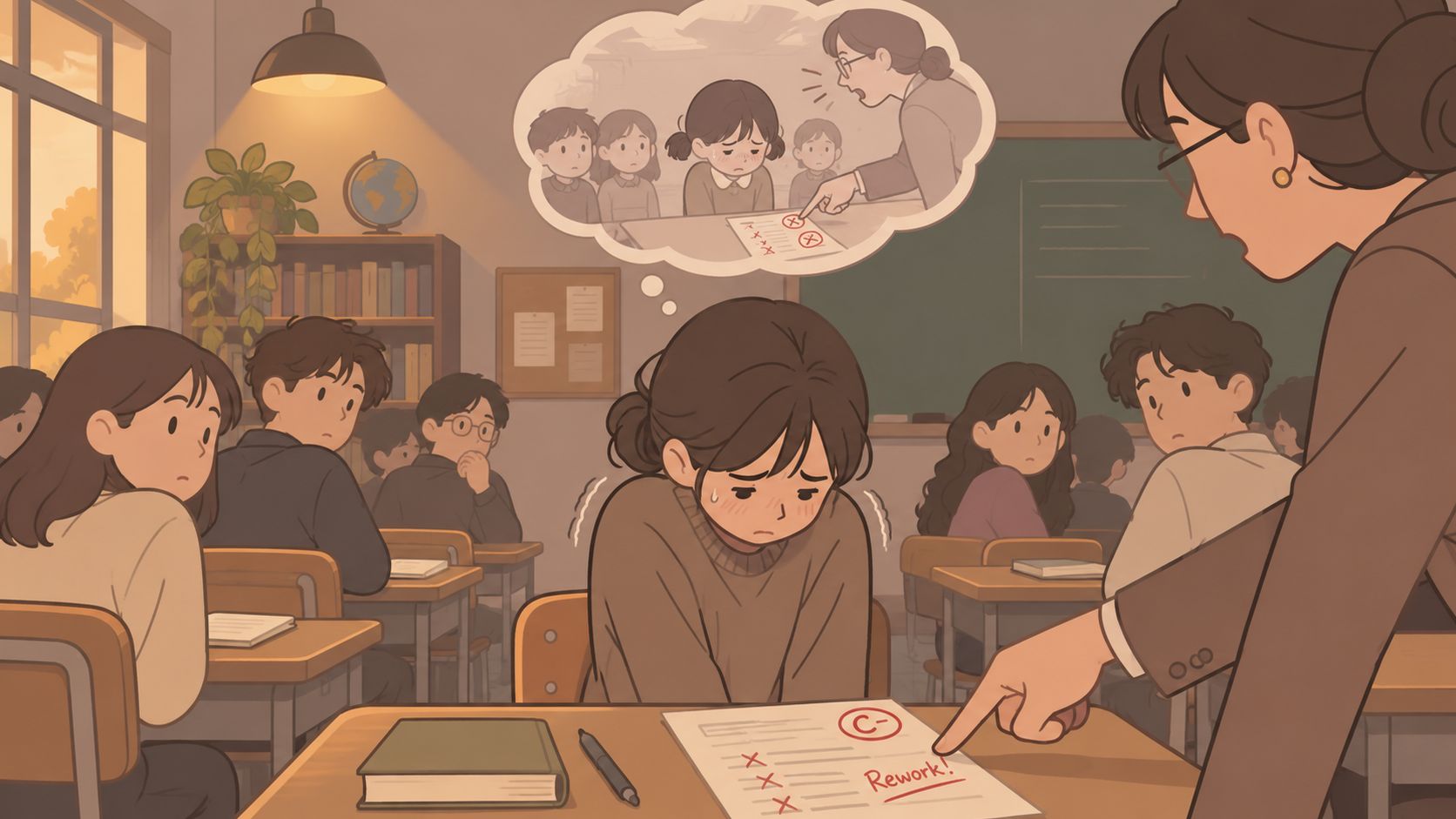
Caregiver responses matter enormously. A parent who sighs before helping with homework teaches something different from a parent who asks what would make the work easier. School matters too: which teacher assumed effort, which one assumed attitude. Peers matter most of all, because the social corrections that land hardest tend to come from people whose approval you needed.
Then there's masking, the work of hiding the struggle so nobody sees the cause. It buys safety in the short term and charges for it later, in exhaustion and in the sense that no one knows you.
Consider a young man who was called careless throughout school because his backpack was a disaster and his assignments came in late. Nobody asked about attention. He learned to open every message braced for irritation and to apologize before anyone complained. His coworkers find him pleasant and slightly odd. He finds every meeting faintly dangerous. That isn't a diagnosis borrowed from the internet. It's a sensible adaptation to a long record of being corrected.
Research increasingly favors a biopsychosocial account, in which neurobiology, relationships, and environment interact, over a purely brain-based one. Beyond possible neurobiological differences in ADHD, the literature points to accumulated interpersonal rejection, caregiver responses, school experiences, masking, and trauma as factors that may shape rejection sensitivity, as Cleveland Clinic's clinical overview describes. A 2025 qualitative study of autistic adults identified both neurodevelopmental traits and lifelong rejection experiences as predisposing factors, which suggests repeated social exclusion may not just trigger this kind of sensitivity but help sustain it.
Three questions help you see your own version of it.
When did it start? Not a date. The era, and what else was happening in your life during it.
Where does it intensify? Work, family, dating, or all three. A narrow pattern points somewhere different from a broad one.
How wide is it? Does it show up across most relationships, or mainly with people whose good opinion carries real weight?
Shame and self-doubt usually sit underneath these answers. A good deal of therapy involves getting some distance from the critical voice in your head so it registers as a voice rather than a verdict, and then building a different relationship with yourself over time.
Sometimes hearing this described out loud lands differently than reading it. The short video below is a good companion to this section.
If you want to do this on your own first, sketch a timeline. Two or three moments where you learned something about how safe it was to be imperfect. Don't decide yet what they mean.
Other Conditions That Can Look the Same
Two people can describe the same sharp pain after a social interaction and be reacting to different things. One may be responding to perceived rejection, another to fear of being judged, a reminder of past harm, or the strain of social demands. The term rejection sensitive dysphoria describes a pattern of intense distress; by itself, it does not explain what causes that pattern.
Research on rejection sensitive dysphoria remains limited, and definitions are not consistent across sources, as this review of the evidence discusses. That makes careful distinctions useful, but the descriptions below are prompts for reflection, not a way to diagnose yourself.
Condition | Typical Trigger | Typical Pattern | Key Question |
|---|---|---|---|
Rejection sensitive dysphoria (descriptive term) | Perceived or actual criticism or rejection | Intense, short-lived pain that can feel sudden | Does the pain follow specific social cues? |
Social anxiety | Anticipated negative evaluation in social situations | Worry before and after events, avoidance | Is the fear mainly about being judged in advance? |
ADHD emotional dysregulation | Rapid affect, not always rejection | Strong feelings that rise and fall quickly | Do intense reactions also appear outside rejection? |
Trauma-related responses | Reminders of threat, shame or relational harm | Hypervigilance, flashbacks or avoidance of reminders | Does the reaction connect to a past event? |
Depression | Setbacks that confirm negative beliefs | Lasting low mood, self-criticism, withdrawal | Does the pain persist beyond specific cues? |
Autism | Social misreading, sensory or social overload | Exhaustion from social rules and masking | Is masking or social strain a large part of the difficulty? |
Social anxiety often begins before an event, as someone anticipates being evaluated. The worry may continue afterward, too. A rejection reaction, by contrast, may surge in response to a particular cue and ease unevenly over time. These patterns can overlap, so timing alone cannot settle the cause.
Trauma-related responses may involve vigilance around reminders of threat or relational harm, while depression can include persistent low mood and withdrawal beyond a particular social moment. Autistic people may experience distress in connection with social mismatch, sensory overload, or the effort of masking. Those experiences can resemble rejection sensitivity without having the same explanation.
A cue can be clear, ambiguous, or misread. Feeling hurt is real, but the intensity of the feeling does not prove that another person intended rejection. Holding both ideas together can reduce self-blame without turning a descriptive label into a diagnosis.
Anxiety may accompany these experiences. Therapy does not have to aim at eliminating anxiety; it can help someone develop a different relationship with it, so anxiety does not make every decision. If the experience feels more like persistent overarousal than a response to specific social cues, this discussion of feeling overwhelmed all the time may offer a useful frame.
Use the table as a starting point for noticing patterns, not as a test. You might note which situations tend to bring the reaction on, whether it appears outside moments of perceived rejection, and whether it affects other parts of life. Similar outward reactions can have different roots, and the label alone cannot determine which explanation fits.
Getting a Proper Assessment Before You Label It
A proper assessment looks at several things at once: trigger specificity, when the pattern began, how long reactions last, what they cost you in daily functioning, your ADHD symptoms, trauma history, and whether the response tracks an actual interpersonal threat or a bias in how you read one, as WebMD's clinical overview lays out. The list is deliberately unglamorous. It's also the difference between a name and an explanation.
What to Bring to a First Conversation
The last three reactions. What happened, what was said, and how you responded. Concrete beats abstract every time.
When the pattern started. Not the exact date. The era, and what else was going on then.
Where it shows up. Work, family, dating, or everywhere. Narrow patterns point in one direction; broad ones in another.
How long the pain lasts and what it stops. Hours or weeks, plus the things you've stopped attempting because of it.
Whether focus and follow-through are part of it. Lost keys, missed deadlines, and half-finished projects belong in the conversation, because they change the picture.
Questions about ADHD diagnosis or medication belong with a medical evaluation, and therapy doesn't replace that work. What an adult ADHD screening involves is a separate conversation with its own process.
Therapy itself is less mysterious than it sounds. It usually begins with a consultation about what you're looking for and whether the fit is right, then settles into regular sessions that build understanding alongside practical skills. Outcomes depend on the person, the pattern, and the work, and anyone promising you a specific result is promising more than they can deliver.
You don't need a diagnosis or a perfectly clear reason for being there to start. Early sessions are for thinking aloud, and clarity tends to arrive after a few of them rather than before the first one.
If this pattern is costing you relationships or sleep, an initial consultation for therapy in Washington, DC or virtually in Virginia is a reasonable next step, and asking about it commits you to nothing.
Nick Donahue, LICSW works with adults and teens in Washington, DC and virtually with clients across DC and Virginia, and much of that work begins with a reaction that arrives faster than the thinking does. Sessions run 60 minutes, in person or online, and they start with a consultation about what you're hoping to change and whether the fit feels right. If this pattern is costing you sleep, relationships, or a steady sense of yourself, visit Nick Donahue LICSW to ask about getting started.
Comments