
8 Nervous System Regulation Exercises to Try in 2026

You're in a meeting, a hard conversation, or a quiet bedroom at night, and your body is already ahead of you. Your heart is up, your jaw is set, or you've gone blank while everyone else looks fine. Thinking your way out rarely works in that first minute, because the alarm started below the level of a plan.
These nervous system regulation exercises are not a cure for anxiety, and they are not a shortcut through ADHD-related overwhelm. They are ways to notice which state you're in and shift it a little, so you have more room to choose the next move. Wired and racing needs a different tool than a braced body, a flat shut-down, or a shame spiral after a missed deadline.
I don't rank these as one best list. Match the exercise to the moment. If you're revved, start with breath. If your muscles are doing the worrying, use release or a short scan. If you've left the room mentally, look around or name what you can sense. If the loudest line is "I messed this up again," name the feeling and answer it with something steadier than the usual attack.
None of this replaces therapy, a medication conversation, or a medical check when symptoms are new or frightening. Practice while you're relatively okay, so the skill is easier to find when you're not. The eight below are short enough for a class change, a commute, or the minute before you walk back into the kitchen.
Table of Contents
1. Diaphragmatic (Belly) Breathing - How to keep it small enough to use
3. Progressive Muscle Relaxation - When the body won't settle at night
4. 5-4-3-2-1 Sensory Grounding - Make the list harder to lose
5. Body Scan Meditation - When turning inward makes things worse
8. Self-Compassion Break - Keep it from turning into a spiral
1. Diaphragmatic (Belly) Breathing
Say you're about to walk into a test, a tense talk with a partner, or a morning that always turns chaotic. Your breath has already gone quick and high in the chest, and you didn't decide to do that. Belly breathing is the reverse. You let the belly rise on the inhale and fall on the exhale, instead of pumping only the upper ribs.
The picture below shows the basic shape of the practice, including where it helps and where it falls short.
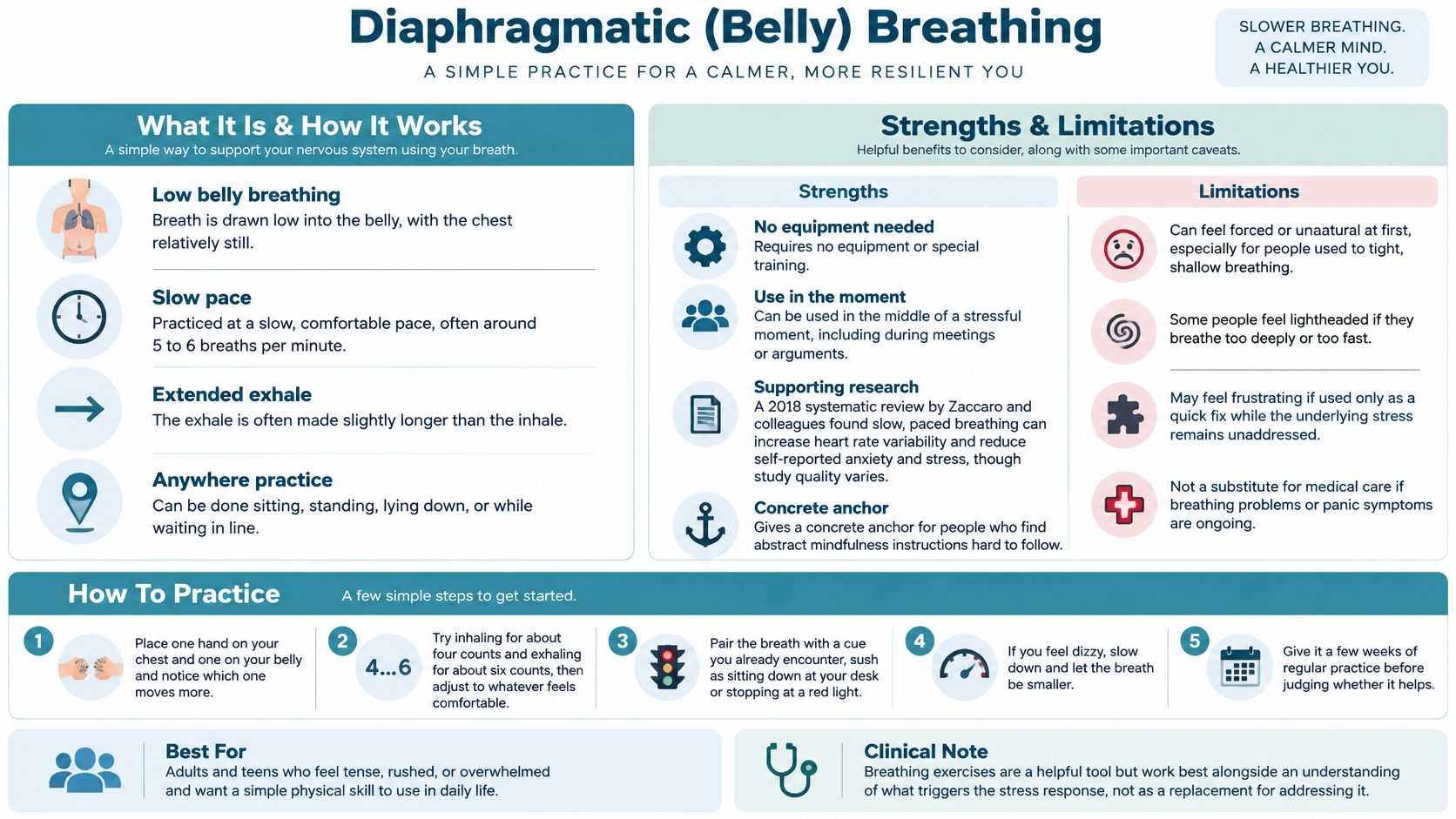
A meta-analysis of slow-paced breathing found immediate benefits for systolic blood pressure, heart rate, and time-domain heart-rate variability measures such as RMSSD and SDNN, while effects on diastolic pressure and frequency-domain HRV were not significant, and practical pacing often sits near six cycles a minute, well under the roughly 12 to 20 cycles of typical adult breathing, according to a Mindfulness review of slow-paced breathing. That is a physiology signal, not proof that a wearable score means your mental health is fixed.
How to keep it small enough to use
Hand check: One hand on the chest, one on the belly. Notice which one moves.
Count, then drop the count: Try about four in and six out, then change it if that feels forced.
Pair it with a cue you already hit: A red light, sitting down at a desk, or the pause before you answer a frustrated kid.
Shrink it if you get dizzy: Smaller breaths, slower pace, and stop if you feel worse.
Practical rule: Give it a few calm weeks before you decide it "doesn't work" in a panic. A tool you only meet at full alarm is a tool you don't know yet.
Two minutes in the car before a hard conversation is a fair test. Three slow breaths before a teen walks into a difficult class is also enough. If you only use it when you're already flooded, it will feel like a weak trick. That's a practice problem, not a character flaw.
2. Cyclic Sighing
Cyclic sighing is a double inhale through the nose, then a long, unhurried exhale through the mouth. The second inhale is a small sip, not a gulp. The long out-breath is the part that usually takes the edge off anticipation, the kind you feel waiting for a video call or walking out of a rough class.
It is easy to oversell. A 2025 study found that slow breathing increased heart-rate variability more than 4-7-8 or square breathing, yet none of those patterns produced meaningful immediate improvements in mood or blood pressure, as reported in an International Journal of Clinical Practice trial write-up. Your numbers can shift before your mood does. If you expected a reset and you still feel edgy, the exercise didn't fail you. The promise was too big.
A short version you can actually finish
Start with one to three cycles. Build only if your head stays clear. Keep the shoulders soft on the exhale. A teen can use a minute in a bathroom between classes. An adult who can't sit for meditation can use it at the end of the workday as a doorway home. Same time each day, such as after lunch, beats a heroic session you skip.
Stop if you feel lightheaded and go back to ordinary breathing. For some people with panic or trauma histories, extra air and a focus on the breath make the alarm louder. If that's you, this is the wrong tool for a spike. Look outward instead, which is what the grounding and orienting exercises later on are for.
I like cyclic sighing when the problem is a short, predictable edge, not when you're already dizzy, numb, or deep in a shame story. It is a dimmer switch, not a personality change.
3. Progressive Muscle Relaxation
If your anxiety lives in a clenched jaw, tight shoulders, and a body that won't lie down, progressive muscle relaxation gives you a job. You gently tense one area for a few seconds, then release it, and you notice the difference. Physician Edmund Jacobson built the method in the 1920s and 1930s around that contrast. People under chronic stress often stop feeling the brace until it becomes the background.
This short video walks through a full pass if you want a guide the first time, especially when sitting still with only your thoughts feels impossible.
A shortened version is often more honest for ADHD. Hands, shoulders, and face before bed, when the day keeps replaying. Jaw and shoulders at lunch after back-to-back calls. Gentle tension, not a max squeeze. Skip anything injured or already painful. Five or six areas beat a 20-minute routine you abandon.
When the body won't settle at night
Practice once while you're not overwhelmed, so the contrast is familiar later. If you try to force "relax" during the release, you'll add a second layer of effort. The point is to feel the drop, not to perform calm.
Racing thoughts at night are a different problem from muscle tension, even when they show up together. A short routine for the body can sit next to a plan for the mind, including the steps in how to stop racing thoughts at night. If tensing makes you more panicky, or you can't tell tension from pain, drop PMR and use something that looks out at the room.
4. 5-4-3-2-1 Sensory Grounding
When your mind is spinning, give it a list that lives outside your head. Name five things you see, four you can feel, three you hear, two you smell, and one you taste. It is a common tool in trauma-informed work and in dialectical behavior therapy for panic, overwhelm, or the sense of leaving your body. Formal trials of this exact script are thin, so treat it as a practical clinical habit, not as a proven biological reset.

A student in a test panic can count objects in the classroom until the room comes back. After an upsetting call, you can sit in the car and notice the steering wheel's texture and the heater's sound. On a long commute, the same sequence can interrupt a worry loop that ADHD makes very sticky.
Make the list harder to lose
Say it or write it: Silent counting falls apart when attention is shot.
Use rooms you already know: Practice once while calm in the car, the kitchen, or a hallway at school.
Get specific: Not "a poster," but the chipped corner of that poster.
Use it as a bridge: Once you're back in the room, add one slower breath or name the thought that started the spiral.
If you have a history of dissociation, walk through this with a clinician before you use it alone. For some people, a sensory checklist increases body monitoring instead of settling it.
Grounding won't decide the argument or finish the assignment. It buys you the next ordinary minute. That's the job.
5. Body Scan Meditation
A body scan is attention moving slowly through the body, with no project to fix what you find. It sits at the center of Mindfulness-Based Stress Reduction, the program Jon Kabat-Zinn developed at the University of Massachusetts Medical School in the late 1970s. The useful part, for a lot of anxious and ADHD nervous systems, is catching a tight jaw or lifted shoulders before they become the whole afternoon.
You don't have to lie down for 40 minutes. An adult might use 10 minutes before bed, when worry piles up the moment the lights go off. A teen might do a one-minute check at lunch before a hard class. If a full tour is too long, scan three regions and stop. Feet, hands, and jaw are plenty.
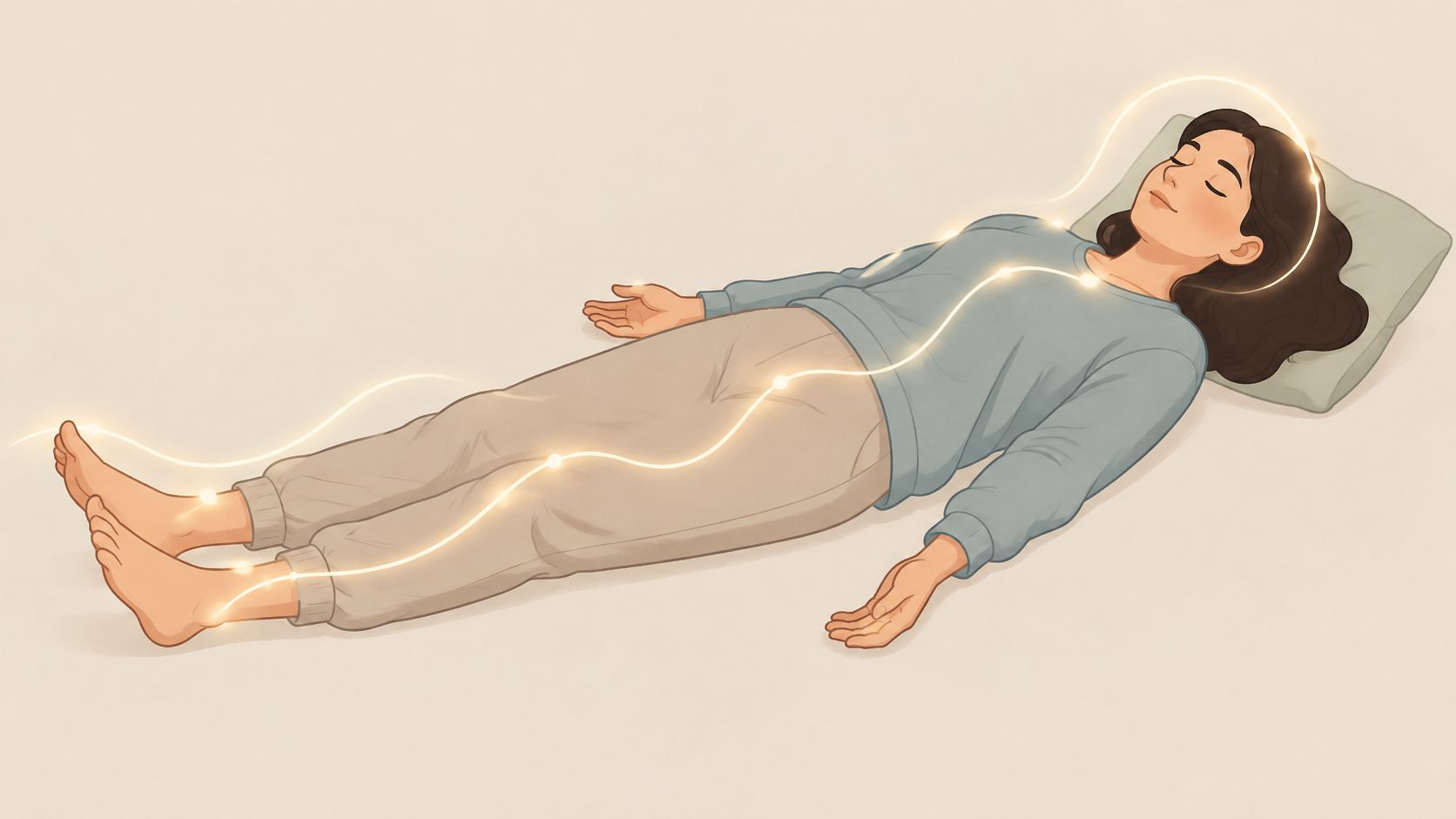
A guided recording helps at the start, because you aren't also trying to remember the instructions. When attention leaves, and it will, note that and come back without a speech about how bad you are at meditation. A short scan before you get out of the car can mark a transition better than a long one you resent.
When turning inward makes things worse
Body-focused attention is not automatically soothing. Reviews of body- and movement-oriented interventions for PTSD report symptom reductions, but the evidence varies a lot, studies often carry a moderate or high risk of bias, and long-term evidence is still limited, which is the cautious reading in this guide to somatic therapy for trauma. If a scan brings panic, numbness, or a flood of memory, stop. Open your eyes, shorten the practice, or switch to looking around the room.
Pain, dizziness, asthma, and some medications also change what "notice your body" feels like. You get to adapt the dose. Persistent overwhelm is a reason to get assessed, not a reason to push a harder self-help routine.
6. Orienting to the Environment
Under stress, a lot of people lock their eyes on one point, or they stop seeing the room at all. Orienting is the opposite. You let your head and eyes move at a normal pace and you pick up colors, shapes, and distance. You're not hunting for a threat. You're letting the nervous system register that this bedroom, classroom, or meeting is an ordinary place.
A teen stuck on a rejection text can look around their room and name a color and a texture. If you wake up already anxious, look at the morning light before you touch the phone. In a tense meeting, a quiet scan of the table and the door can remind you that you're physically safe even if the topic isn't comfortable.
Polyvagal theory, from Stephen Porges, made this kind of safety-cue language popular, and researchers still argue about parts of it. You don't need the theory to use the practice. Orienting is low risk, and it doesn't ask you to believe a model of the vagus nerve.
Move like a person looking for their keys, not like a security camera. Three to five neutral objects, then let your gaze rest. A slow exhale can ride along, but the looking is the exercise.
Use it when you walk into a new room, when you feel far away, or when a body scan makes you more wired. Also notice what you don't want to look at. That avoidance is information, not a failure. Orienting is a poor fit if you're in real danger. It is a good fit when your body is acting as if you are, and the room says otherwise.
7. Affect Labeling
Affect labeling means giving the feeling a specific name. Anxious, ashamed, overwhelmed, hurt, dread. "Bad" and "stressed" are too vague to help. The name doesn't solve the problem. It puts a little space between you and the surge so you can pick a response.
A teen feels a hit of anger after a friend's comment, names it as hurt and embarrassment, and pauses before firing back. In a couple's argument, "I'm feeling criticized" can land before the defense does. Faced with a pile of tasks, "this is dread" sometimes makes one small starting step possible, where "I'm a mess" does not.
This skill sits under a lot of therapy, including Acceptance and Commitment Therapy. You acknowledge the feeling without handing it the steering wheel. For teens, the same move shows up in everyday blowups at school and at home, which is why emotional skills need more than a poster on the wall. The piece on emotional regulation for teens goes further into that pattern.
A label is a pause, not a verdict
Get narrower than stressed: Frustrated, lonely, disappointed, embarrassed.
Add one body detail: Heat in the face, a drop in the stomach, tight hands.
Ask what it's pointing at: A boundary, a fear, a need for a smaller task.
Watch the week: Jot the words down. Patterns show up faster on paper.
Don't obey every feeling: Named is not the same as acted on.
Labeling falls short when you're dissociated and no word is available, or when you use the word as a new way to attack yourself ("of course I'm pathetic and ashamed"). If naming makes you more flooded, stop at one word and orient to the room. Precision can wait.
8. Self-Compassion Break
The self-compassion break, from Kristin Neff and Christopher Germer, has three moves. You admit this is hard. You remember that struggle is ordinary, not proof you're the only one who can't cope. You offer a kind phrase or a small gesture, like a hand on your chest.
For a lot of people with ADHD, the crash after forgetting, missing a deadline, or snapping is harsher than the original mistake. Shame revs the body back up, and then regulation gets even harder. This practice is about lowering that second hit. It is not a pardon for the harm, and it is not a speech about how everything happens for a reason.

A teen who studied and still bombed a quiz can say, "This is hard, and I feel discouraged," and remember that tests throw plenty of students. An adult who missed an appointment can acknowledge the stress, then decide how to repair it. After snapping at a partner, softening the self-attack makes a clean apology more likely, not less.
Keep it from turning into a spiral
Write two phrases before you need them, in a voice that sounds like a steady coach rather than a critic or a cheerleader. Pair the break with one concrete next step, or it slides into rumination. Practice on a medium day so the words aren't brand new during a crisis.
If kindness feels fake, irritating, or dangerous, that's worth taking seriously. Sometimes the critic has been the only strategy that felt safe. That pattern is hard to redo alone, especially alongside burnout. The notes on how to help burnout are a useful companion when exhaustion and self-attack are feeding each other. I wouldn't use this exercise to skip accountability. I'd use it so accountability is possible.
How the eight nervous system regulation exercises compare
Item | Best For | Typical Time | Equipment Needed | Strength of Evidence |
|---|---|---|---|---|
Diaphragmatic (Belly) Breathing | Adults and teens who feel tense, rushed, or overwhelmed | Flexible; often 5–6 breaths per minute | None | Stronger support than many calming techniques; study quality varies |
Cyclic Sighing | People seeking a short daily practice or an alternative to longer mindfulness exercises | 1–5 minutes | None indicated | Promising, but based on relatively small, recent studies |
Progressive Muscle Relaxation | Adults and teens with physical tension or difficulty winding down | 15–20 minutes for a full routine | None indicated; guided audio is optional | Substantial research history; effects vary across studies |
5-4-3-2-1 Sensory Grounding | Teens and adults with racing thoughts who need a quick way to refocus | 1–3 minutes | None | Limited direct research; widely used in clinical settings |
Body Scan Meditation | Adults building mindfulness skills and body awareness | 20–45 minutes; shorter versions are available | None indicated; guided recording is optional | Research supports mindfulness-based programs, with evidence varying by outcome and population |
Orienting to the Environment | People feeling stuck in their thoughts or focused on distressing worries | 1–3 minutes | None indicated | Limited research specifically on orienting |
Affect Labeling | Teens and adults who feel overwhelmed by emotions or struggle to identify them | Seconds | None | Supported by neuroscience research; broader benefits are not guaranteed |
Self-Compassion Break | Adults and teens who experience shame or self-criticism after setbacks | 1–2 minutes | None indicated | Growing research support for self-compassion |
Choosing the Right Tool for the Moment You Are In
No single exercise fits every afternoon, and the breath that helped yesterday can feel useless today. Start with two or three that match your usual pattern. If you race, keep a short exhale practice and a grounding list. If you brace, keep a tiny muscle release. If you disappear, keep orienting. If you collapse into shame after ADHD moments, keep a feeling word and one kinder sentence.
Practice them when you're calm enough to learn the steps. Then notice which one you can still reach when you're late, embarrassed, or overstimulated. Track something simple for a few weeks. Did you do it, did stress drop even a notch, and can you use it during the hard moment rather than only on the couch afterward?
A large trial is a useful reality check on effort. In a randomized study, 400 adults were assigned to about 5.5 breaths per minute or an attention-matched pace of 12 breaths per minute, about 10 minutes a day for four weeks, and self-reported adherence was about 70% in both groups, with the slower pace not automatically winning on mental health because the comparison condition was built to control for expectancy and attention, per a trial of coherent breathing indexed on PubMed Central. Completion matters as much as the "right" technique. A wearable HRV number is optional context, not a diagnosis and not proof that therapy worked.
If the same state keeps coming back, or these tools make you dizzier, more panicky, or more checked out, that is information. Stop the exercise. You don't have to push through. Nick Donahue, LICSW, works with teens and adults in Washington, D.C. and Virginia on ADHD, anxiety, and emotional regulation. An initial consultation is a low-pressure way to see whether slowing this down with someone else fits what you're dealing with.
Nick Donahue LICSW offers individual therapy for teens and adults who want practical help with ADHD, anxiety, and emotional regulation, in person in Washington, D.C. and virtually for clients in D.C. and Virginia. Sessions are a place to match skills like these to your actual patterns, including shame, relationships, and the moments when your body gets there first. If you want to talk through whether that work fits, visit Nick Donahue LICSW.
Comments