
How to Stop Racing Thoughts at Night: What Actually Helps

You're tired enough to fall asleep on the couch. Then you get into bed, and suddenly you're replaying an awkward conversation, remembering an unanswered email, and calculating next week's bills. You try to stop thinking, only to become more aware that you're still awake.
Learning how to stop racing thoughts at night starts with identifying what's keeping your mind active, not finding the perfect relaxation technique. When thoughts spike specifically in bed, changing the association between bed and wakefulness can help. When worry, ADHD-related attention shifts, low mood, or medication effects are involved, the first move may be different.
Table of Contents
Sort Your Racing Thoughts by What Is Driving Them - Match the pattern to the first move - Look at the shape of the thoughts
How to Run the Bedtime Reset Step by Step - Follow the sequence without turning it into a test - Avoid the slips that make the routine harder
Use a Worry Period to Clear Your Head Early - Give each concern a clear destination - Respond differently when the worry returns
Adjusting the Routine When Leaving Bed Is Hard - Change the logistics, not the purpose - Make safety and accessibility explicit
When Racing Thoughts Point to Something Bigger - Signals to bring to a professional - What therapy can help you understand
Test One Change for Two Weeks - Keep the record simple - Decide what comes next
Sort Your Racing Thoughts by What Is Driving Them
A useful starting point is to sort nighttime thoughts into five common patterns. These aren't diagnoses or mutually exclusive categories. They're a way to choose a reasonable first step instead of trying every sleep tip at once.
Notice both what you're thinking about and when it happens. Feeling sleepy until you reach the pillow suggests a different pattern from worrying through dinner, work, and bedtime. The American Academy of Sleep Medicine's clinical guideline describes how insomnia treatment addresses conditioned wakefulness and unhelpful sleep beliefs, while also recognizing the importance of assessing psychiatric, medication, substance-related, and medical contributors.
Match the pattern to the first move
Racing thought patterns and the first move for each
Pattern | What it feels like | First move | When to get assessed |
|---|---|---|---|
Bed-linked arousal | Wide awake once the lights go out, even after feeling tired earlier | Leave the bed after about 20 minutes awake and return only when sleepy | Insomnia lasting three months or more, or daytime functioning is impaired |
Worry loops about specific problems | The same concerns cycle, each with a new what-if | Schedule a worry period earlier in the evening | Worry feels uncontrollable or spreads into daytime life |
Attention that keeps jumping | Thoughts hop between topics, hard to follow one through, often with restlessness | Write a brain-dump before bed and use one quiet task outside the bed | Racing thoughts occur alongside daytime inattention or impulsivity |
Low mood at night | Heavy thoughts about self or the future, often with early waking | Track mood and energy for two weeks and note when thoughts turn negative | Low mood or loss of interest most days for two weeks |
Substance or medication pattern | Jitteriness or a racing heartbeat after caffeine, alcohol, cannabis, or a new medication | Review timing and amount, and discuss medication changes with the prescriber | A recent medication change or regular use coincides with the pattern |
These assessment signals are reasons to seek help, not requirements you have to meet first. Don't wait for a particular duration if you're struggling, and don't stop or change prescribed medication on your own.
Look at the shape of the thoughts
Bed-linked arousal might look like nodding off while watching television, then becoming alert as soon as you lie down. Worry loops are more specific: you keep calculating the same bills without reaching a new decision. Understanding rumination versus problem-solving can help you notice whether you're making a plan or repeating distress.
With jumping attention, you might move from a missed email to a song lyric to an idea for reorganizing the kitchen. ADHD is a neurodevelopmental condition that can affect executive functioning and emotional regulation, but nighttime topic-switching alone doesn't establish ADHD.
With low mood, an unfinished task may become a broad judgment about your worth or future. A substance or medication pattern is more about timing: your mind feels unusually accelerated after something you've taken or changed.
Start with the closest fit: Choose the pattern that best describes your usual difficult night, not your worst-ever night.
If two patterns fit, choose the most manageable first move while noting the other. Worry and conditioned wakefulness, for example, can coexist without needing identical responses.
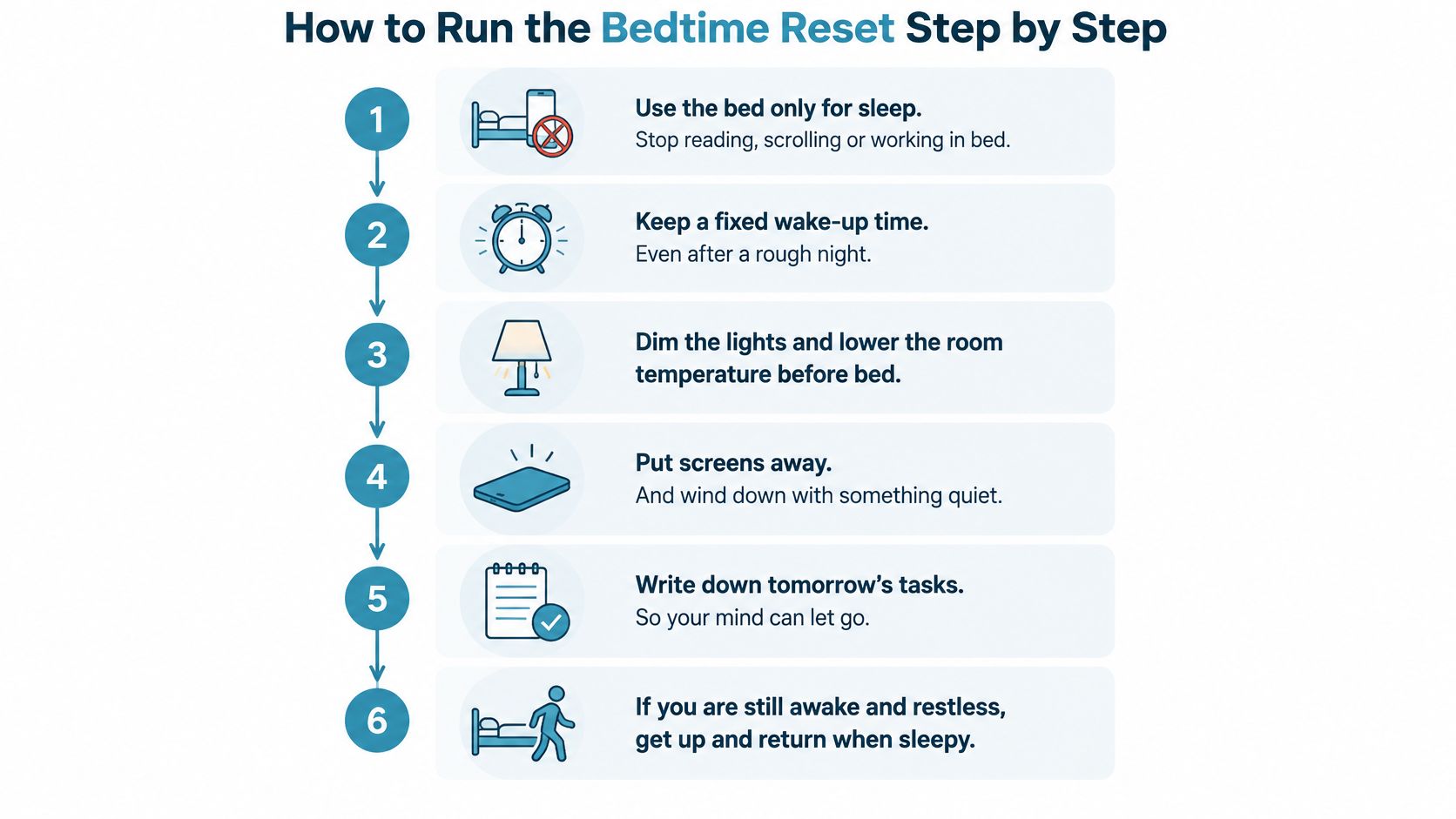
How to Run the Bedtime Reset Step by Step
If your mind becomes especially active once you're in bed, start by changing what you do during that awake time. Stimulus control is the name for rebuilding a clearer connection between bed and sleep, rather than bed and mental effort.
The visual below offers a reminder of the routine's main ingredients. Use the written sequence to guide what you do when you're awake and restless.
Follow the sequence without turning it into a test
Reserve the bed for sleep. Move reading, scrolling, work, and problem-solving somewhere else. The purpose is to stop practicing extended alertness in the place where you want to sleep.
Get up when wakefulness becomes a struggle. If you've been awake for about 20 minutes, or your mind is clearly racing, move to a dim, quiet space. Treat that interval as a rough cue, not a reason to watch the clock.
Choose something low-stimulation. Read a calm paper book, fold a little laundry, or sip a caffeine-free warm drink while avoiding bright screens. Pick an activity that won't become a project or invite another hour of decisions.
Return when you're sleepy. Look for heavy eyelids, yawning, or difficulty following the page, rather than going back because you think you should. Being exhausted and frustrated isn't always the same as being ready to drift off.
Capture recurring thoughts briefly before getting up. Jot each thought in a line, then leave the analysis for daytime, when you can ask: What evidence supports it? What would I tell a friend in the same situation?
Keep your wake time consistent. Get up at your usual time after a rough night rather than repeatedly extending the morning. A steadier schedule supports sleep timing and the buildup of sleep pressure, the increasing readiness for sleep during wakefulness.
This routine draws on cognitive behavioral therapy for insomnia, or CBT-I, which combines behavioral changes with work on sleep-related thinking. In 2017, the AASM identified CBT-I as the primary intervention for adults with chronic insomnia, as described in Psychiatric News' account of the guideline.
The thought-testing step matters, too. A 2024 component network meta-analysis of 241 randomized trials linked cognitive restructuring to a 68% increase in the odds of insomnia remission, an odds measure rather than a guarantee that an individual will recover.
Avoid the slips that make the routine harder
Staying in bed while increasingly frustrated, repeatedly checking the clock, and sleeping in to compensate can undermine the reset. Another trap is using the quiet activity as a reward for being awake, such as opening an absorbing game or starting work.
The leave-bed step isn't a punishment for failing to sleep. It's permission to stop struggling in bed.
You may need to repeat the sequence during a difficult night. Keep the activity simple and the environment subdued, without demanding that you feel calm before you're allowed to return.
For an additional explanation of bedtime mental activity, this video offers another way to engage with the topic.
During an initial two-week trial, look for changes such as spending less time frustrated in bed or settling more easily after returning. Those are observations to track, not promised milestones. A difficult night doesn't mean you've undone the practice.
Use a Worry Period to Clear Your Head Early
When your thoughts revolve around unfinished problems, give those concerns a place before bedtime. A worry period isn't an invitation to dwell on everything that could go wrong. It's a limited appointment for separating something you can act on from something you can't resolve tonight.
Set aside 15 to 20 minutes earlier in the evening, not at lights-out, and use a timer. Keep a notebook somewhere outside the bed so planning doesn't become another pillow-time activity.
Writing can make the boundary between thinking and acting more visible.

Give each concern a clear destination
Write each concern in a sentence. Keep it specific, such as an upcoming bill or uncertainty about a conversation.
Label it actionable if there's a concrete step available, or hypothetical if you're trying to settle an uncertain possibility.
For an actionable concern, record a next step and when you'll take it. Checking the bill after breakfast is a plan; repeatedly imagining financial disaster isn't.
Leave hypothetical worries on the page without trying to solve every possible outcome.
Close the notebook when the timer ends and move to something calm.
The evidence supports a modest expectation. In a 14-day randomized trial involving 186 participants, augmented worry postponement reduced daily worry duration by approximately 15 minutes compared with standard postponement, but neither version significantly improved sleep outcomes relative to controls.
That distinction matters. You might spend less time caught in worry without immediately sleeping better, especially if you've also developed a strong pattern of wakefulness in bed.
Respond differently when the worry returns
Use an if-then response: if the thought returns in bed, label it tomorrow's problem, return attention to breathing or body sensations, and revisit it during the scheduled period. You aren't promising the concern is unimportant. You're deciding not to keep working on it at bedtime.
This is mindfulness as attentional disengagement, not thought elimination. Notice the worry, then gently redirect attention to the sensation of the blanket, your feet, or an ordinary breath. You can understand more about how anxiety contributes to overthinking without needing to analyze your anxiety while trying to sleep.
A 2024 meta-analysis available through the National Center for Biotechnology Information combined 40 randomized controlled trials involving 3,537 participants and found that mindfulness-based interventions reduced sleep disturbance compared with controls, with a standardized mean difference of −0.523. That finding concerns structured interventions, not proof that a brief breathing exercise will work immediately.
Avoid turning the worry period into a performance test. Scheduling it too close to bedtime, producing pages of analysis, or arguing with every thought can leave you more engaged rather than less. A useful session can end with uncertainty still present.
Adjusting the Routine When Leaving Bed Is Hard
Leaving bed isn't equally practical for everyone. You might need to hear a young child, manage pain, or work around a changing shift schedule. Adapt the movement and setting without turning awake time into work or entertainment.
The options below are practical accommodations, not separate treatment protocols. Choose a setup you can use safely when tired.
Change the logistics, not the purpose
Adjusting the bedtime routine by situation
Situation | What to change | What to keep |
|---|---|---|
Parent with young children | Use a chair in a dim room or hallway for the leave-bed step, and schedule the worry period after the kids' bedtime routine | A consistent wake time and the bed reserved for sleep |
Teenager with school demands | Move the worry period to after homework and charge the phone outside the bedroom | A steady wake time on school days and dim light in the hour before bed |
Adult with ADHD | Add a written brain-dump and one low-stimulation task within reach, and keep the quiet activity short and simple | Leaving the bed when wide awake and avoiding bright screens |
Shift worker | Anchor the sleep window to your schedule and keep sleep and wake times as close as possible on days off | Dim light during the sleep window and the bed-for-sleep rule |
Chronic pain or limited mobility | Use a supported chair in a quiet room if safe, and keep the quiet task within reach | Relaxation practice and a consistent wake time |
Medical or mood concerns | Don't use sleep restriction without professional guidance when bipolar symptoms, seizure risk, severe depression, or safety-sensitive work are present | Medical evaluation and steady daily routines |
For parents, the chair needs to be somewhere you can still respond to your child. For teens, agree on the plan during the day rather than turning a restless night into a conflict about phone use or effort.
With ADHD, the adjustment is often more external structure, not more willpower. Put the notebook and quiet activity in place beforehand, and choose a wake time that doesn't drift substantially on weekends. A complicated routine can become another task that's hard to start or stop.
Make safety and accessibility explicit
If you can't safely leave the bedroom, use a nearby chair. If transferring isn't safe, discuss a workable change in position or setting with a clinician rather than risking a fall. Pain also deserves attention in its own right, not an instruction to ignore discomfort.
Accessibility comes first: Don't force yourself to walk through a dark home or make an unsafe transfer to follow a sleep rule.
Sleep restriction is a separate CBT-I technique that deliberately limits time in bed. It isn't staying up as late as possible, and professional guidance is particularly important with the medical, mood, and occupational concerns listed above.
ADHD-related difficulty shifting attention isn't a moral failing. In our work with ADHD, we focus on understanding how it shows up in a person's life and building practical strategies that work with their brain, not against it.
Keep the anchors as consistent as your circumstances allow: bed is for sleep, and wake time stays steady. Shift work may require a schedule-specific plan rather than an identical clock time every day.
When Racing Thoughts Point to Something Bigger
Nighttime thoughts deserve an assessment when they're persistent, impairing, or part of a broader change in mood, energy, or physical health. You don't need to exhaust every self-help strategy before asking for support.
A useful assessment looks beyond bedtime. It considers your daytime attention, emotional state, sleep schedule, medications, substance use, and what other people have noticed about your sleep.
Signals to bring to a professional
Persistent sleep disruption: Thoughts keep you awake most nights for three months or longer, or daytime functioning is declining.
Wider anxiety: Worry spreads through the day, feels uncontrollable, or comes with panic-like symptoms.
Mood changes: Low mood, hopelessness, or loss of interest becomes prominent.
A timing connection: Symptoms coincide with substance use or a recent medication change.
Possible breathing disruption: Loud snoring or witnessed breathing pauses suggest a medical sleep disorder.
Unusual energy: You need much less sleep without feeling tired, alongside marked mood changes or impulsivity.
The last pattern calls for prompt professional assessment, rather than treating it as ordinary insomnia. If you feel unable to stay safe or have thoughts of harming yourself, seek urgent help through emergency services or an emergency department.
Depression and insomnia can require attention together. In a 2024 randomized study available through the National Center for Biotechnology Information, 83.6% of participants with recurrent depression screened positive for insomnia at baseline, and prolonged sleep onset affected 60.0%. Those findings describe that particular group, not everyone whose thoughts become negative at night.
What therapy can help you understand
A 60-minute session starts with what's been happening in your life, then looks for patterns rather than assuming every restless night has the same cause. Treatment may involve insomnia-focused work such as CBT-I, Acceptance and Commitment Therapy, or interpersonal work, depending on the problem and the clinician's training.
For example, replaying a disagreement might involve more than sleep habits. You may need help recognizing shame, tolerating uncertainty about the relationship, or deciding whether a daytime conversation would be useful.
In our approach to anxiety and overwhelm, we slow things down together and figure out what's happening so anxiety doesn't run the whole show. Our discussion of anxiety therapy in DC describes this work in more detail.
The aim isn't to eliminate anxiety or thoughts completely. It's to develop a different relationship with them so they no longer make every decision. Therapy doesn't replace medical evaluation or medication management when those are appropriate.
Test One Change for Two Weeks
Choose one change to test for two weeks, rather than building an elaborate routine tonight. Return to the matching row in the pattern table and use its first move as your starting point.
If you're awake in bed for about 20 minutes or more, start with the leave-bed rule. If your mind repeatedly revisits unresolved problems, start with the worry period. If the clearest pattern involves medication, substances, or a significant mood change, make assessment the first step instead of treating this as a routine-building project.
Keep the record simple
Each morning, note:
Estimated minutes to fall asleep: Make a rough morning estimate, without checking the clock overnight.
Number of awakenings: Record what you remember rather than trying to monitor sleep continuously.
Staying in bed while frustrated: Use a simple yes or no.
That last entry is a behavior marker, not a sleep score. Together, these notes can help you distinguish an unpleasant night from a pattern that's gradually changing.
Don't add a lengthy journal if keeping it will become another burden. The record only needs to be useful enough to support a decision.
Decide what comes next
After the trial, look for direction rather than perfection. If you're spending less time struggling or settling more easily, keep the change steady and consider adding another element. If nothing is improving, or sleep is affecting work, school, relationships, or mood, consider an initial consultation.
Our sessions are 60 minutes, offered in person in Washington, D.C., and virtually for clients in D.C. and Virginia. We begin with what's been going on in your life, get curious about patterns, and figure out together what moving forward could look like.
You don't need to arrive knowing whether this is ADHD, anxiety, insomnia, or some combination. An initial conversation can be about getting clearer on what you're experiencing and whether the fit feels right.
Nick Donahue LICSW offers individual therapy for teens and adults navigating ADHD, anxiety, overthinking, and emotional regulation, including concerns that become harder to manage at night. Visit Nick Donahue LICSW to learn about the practice or arrange an initial consultation to discuss what's keeping you awake and what support might fit.
Comments