
Rumination vs Problem Solving: How to Tell the Difference

Rumination circles around why you feel bad, while problem solving works out what you can do next, and the difference shows up in whether the thinking ends in action. If you've been turning something over for an hour and still don't have a decision, a test, or a next step, which kind of thinking have you been doing?
That question is uncomfortable because both modes can feel serious and effortful from the inside. You might be trying to be responsible, careful, or prepared. The distinction in Rumination vs Problem Solving isn't about how hard you're thinking, though. It's about what your attention is doing and whether it leaves you with something you can try.
Table of Contents
Rumination vs Problem Solving at a Glance - Why the difference matters
Signs You Are Ruminating or Problem Solving - Signs the loop has taken over - The three-question test
Why Rumination Keeps Anxiety Running - What happens over time
Which First Move Fits Your Situation - Break first or plan first
Turning a Worry Into Values-Guided Action - A general example
Why ADHD Makes Looping Easier to Fall Into - How this can look day to day
Decide Your Next Step Before You Think Again - When to bring this to a professional
Rumination vs Problem Solving at a Glance
You can spend twenty minutes on the same worry and leave with a next step, or leave heavier than when you sat down. That split is the whole difference.
Rumination is repetitive attention to how you feel, why it happened, and what it might mean about you. Problem solving is attention to a specific difficulty and what can be done about it. One stays with distress. The other moves toward a response.
Rumination works like a washing machine that keeps the same load spinning. The motion feels busy, and nothing comes out clean. Problem solving takes one item out and decides where it goes: a choice, a small test, or a next step. If none of those appears, the thinking has not finished its job. Anxiety makes the spin easy to mistake for progress, because urgency feels like effort. A mind that already jumps, as often happens with ADHD, can replay the scene before you notice you never chose anything.
That distinction comes from Susan Nolen-Hoeksema's Response Styles Theory, proposed in 1991. In the framework summarized in Perspectives on Psychological Science, rumination means repeatedly focusing on symptoms of distress, their possible causes, and their consequences without necessarily taking constructive action, while problem solving involves identifying a difficulty, generating options, evaluating likely consequences, and implementing a response.
Feature | Rumination | Problem solving |
|---|---|---|
Guiding question | Why do I feel this way, and what does it say about me? | What is the problem, and what can I do about it? |
Processing style | Abstract, global and self-focused | Concrete, specific and situational |
Typical output | No decision; the same loop repeats | A chosen option, test or next step |
Effect on mood | Tends to intensify distress | Often restores a sense of control and lowers distress |
Research label | Affective rumination | Problem-solving pondering or reflection |
Why the difference matters
Longitudinal research has linked frequent rumination to a higher later risk of major depression, which suggests it may be a risk factor and not only a symptom of existing depression.
Useful reflection can still slide. The same worry starts as analysis of what happened and what you can control, then keeps going after it has stopped producing a decision or a next step. Time spent thinking is a weak measure. The output is the measure: a chosen option you can try, or the same question in a new costume.
Signs You Are Ruminating or Problem Solving
It can be hard to tell which mode you're in by how it feels. Both can feel urgent. Both can feel like work. The output is a better guide than the intensity.
Signs the loop has taken over
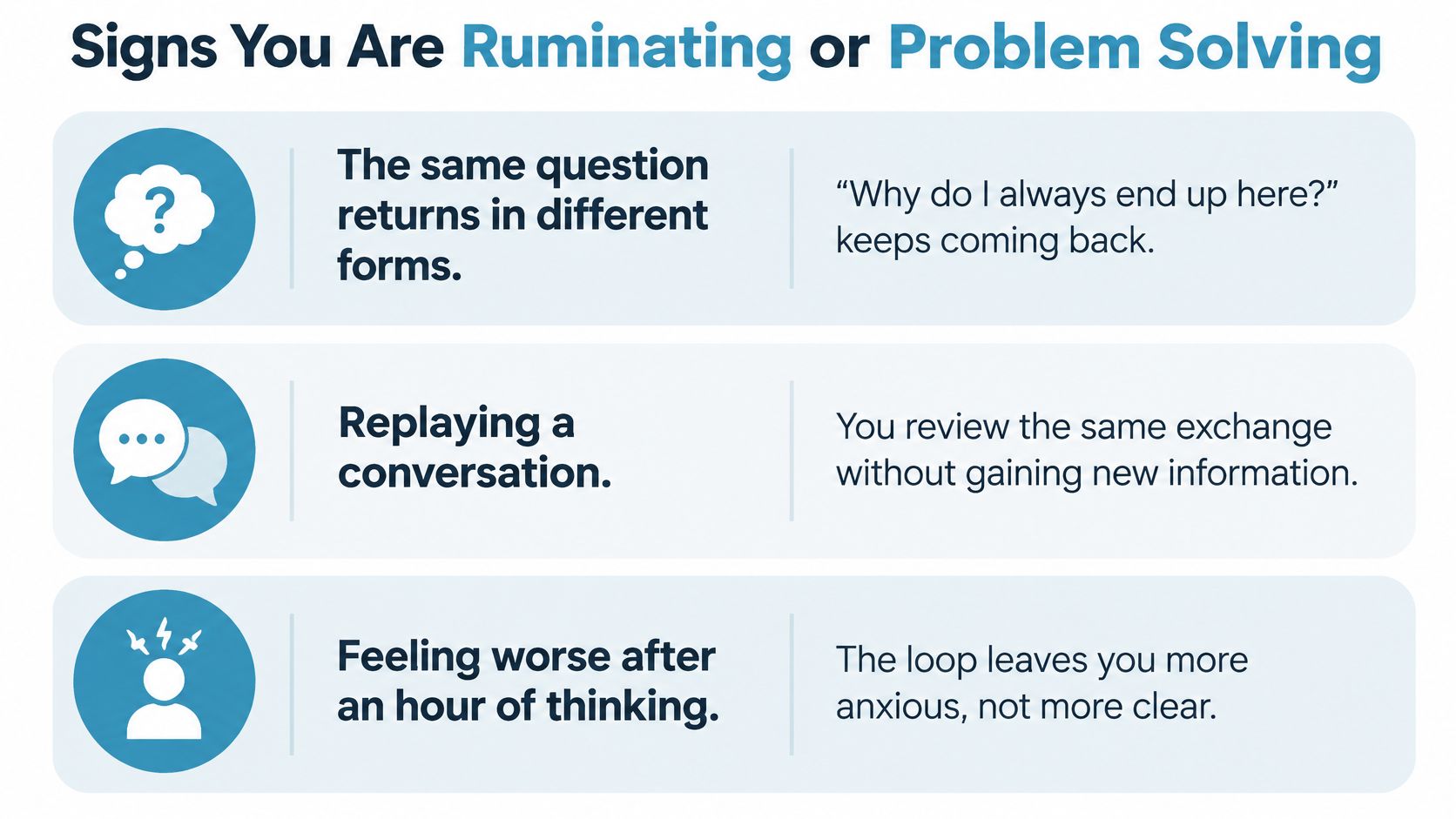
The same question returns in different forms: "Why do I always end up here?" becomes "What's wrong with me?" and then "Why can't I handle this like other people?"
You replay without new information: You review a conversation word by word, but you don't learn anything you didn't know on the first pass.
You feel worse after thinking: An hour passes, you're more anxious or ashamed, and you're no closer to a choice.
The focus shifts to character: The thoughts stop being about a missed deadline or a tense exchange and start being about what kind of person you are.
Problem solving looks quieter and more specific. You ask what happened, what you can control, and what you'll try first. You might write two or three options, pick one, and put a date on it. Relief isn't guaranteed, but there's often a small drop in pressure once a next move exists on paper.
The three-question test
Practical rule: Judge the thinking by what it produces, not by how responsible it feels.
Ask yourself three things. Is there a specific goal? Did I generate at least two options? Does this end in a decision, an experiment, or a request for information?
If the answer is no to most of those, you're probably ruminating, even if the topic is a real problem. That doesn't mean you should force a plan while you're flooded. Name the loop for what it is, pause, and replace the big question with one concrete one. Instead of "Why do I always do this?" try "What's one thing I can do tomorrow morning about this?"
Repeated thinking isn't automatically rumination. You may need to revisit a hard decision more than once. The test is whether each pass brings new information or moves you closer to acting.
Why Rumination Keeps Anxiety Running
Why does turning a problem over leave you more anxious than when you started? Rumination parks your attention on questions that are almost impossible to finish in one sitting. "Why do I always fail?" has no next step. It invites more evidence of failure. Distress rises, and the question feels even more urgent.
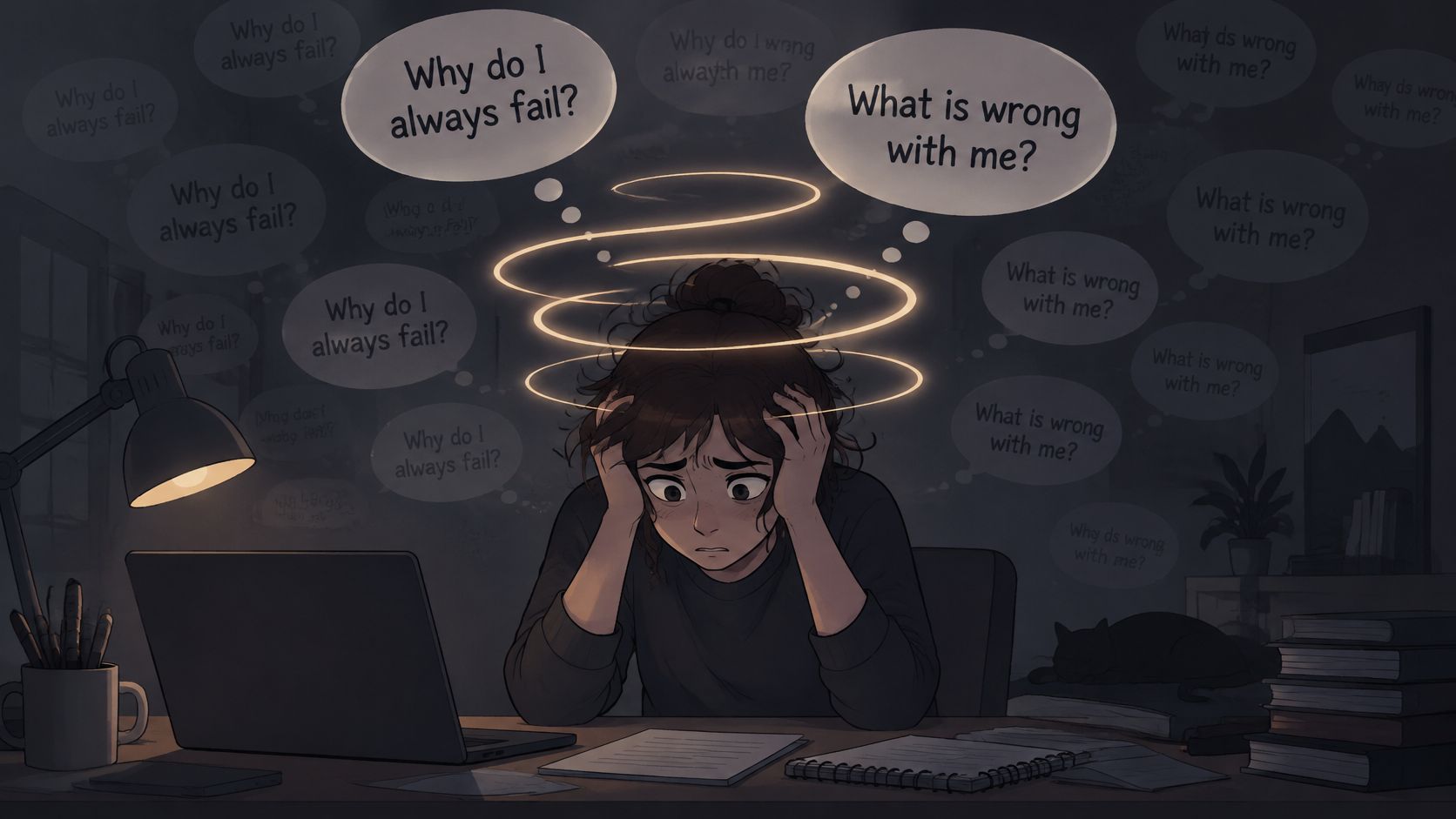
Abstract processing pulls you toward meaning and a verdict about yourself. Concrete processing stays with the situation, its sequence, and its timing. "Why am I so bad at relationships?" cannot end in a decision, a test, or a request for information. "I interrupted twice during dinner, I felt tense, and tomorrow I can ask if we can restart that conversation" can. Anxiety stays in charge when the thinking has nowhere to land.
What happens over time
A three-wave study of Japanese university students, with 284 participants at the first assessment, 198 at the second, and 165 at the third, four weeks apart, found that a one-standard-deviation increase in rumination was associated with a subsequent 0.12-standard-deviation increase in depression scores, and that an impulsive or careless problem-solving style predicted a smaller rise of 0.06 standard deviations, as reported in the Journal of Rational-Emotive and Cognitive-Behavior Therapy study.
Hurried action is not constructive problem solving.
Studies more generally link rumination with greater anxiety and depression, while constructive problem solving is tied to lower distress. The difference is what the thinking produces, not how responsible it feels.
Distress starts the loop. The loop makes a next step feel unlikely to work, so you wait. Waiting leaves the original problem untouched, and the distress now has a reason to stay. Worry can feel like preparation. In practice, it often wears down confidence before you have tested anything. Anxiety makes that easier to miss, because the loop feels like work. For how anxious spirals and repetitive thinking feed each other, this post on whether anxiety causes overthinking looks at that connection directly.
How to Turn a Worry Loop Into a Plan
Constructive problem solving is bounded and concrete. It converts a concern into a target, generates alternatives, evaluates consequences, and selects a next step you can do. Experimental work summarized in a PMC review of abstract and concrete processing finds that abstract processing produces poorer social problem solving than concrete processing, and that inducing worrisome rather than objective thinking reduced confidence in solutions, lowered experimenter-rated solution effectiveness, and reduced intention to implement the chosen solution.
Use paper or a notes app. Keeping the whole process in your head makes it easier for the loop to reclaim it.
A six-step protocol
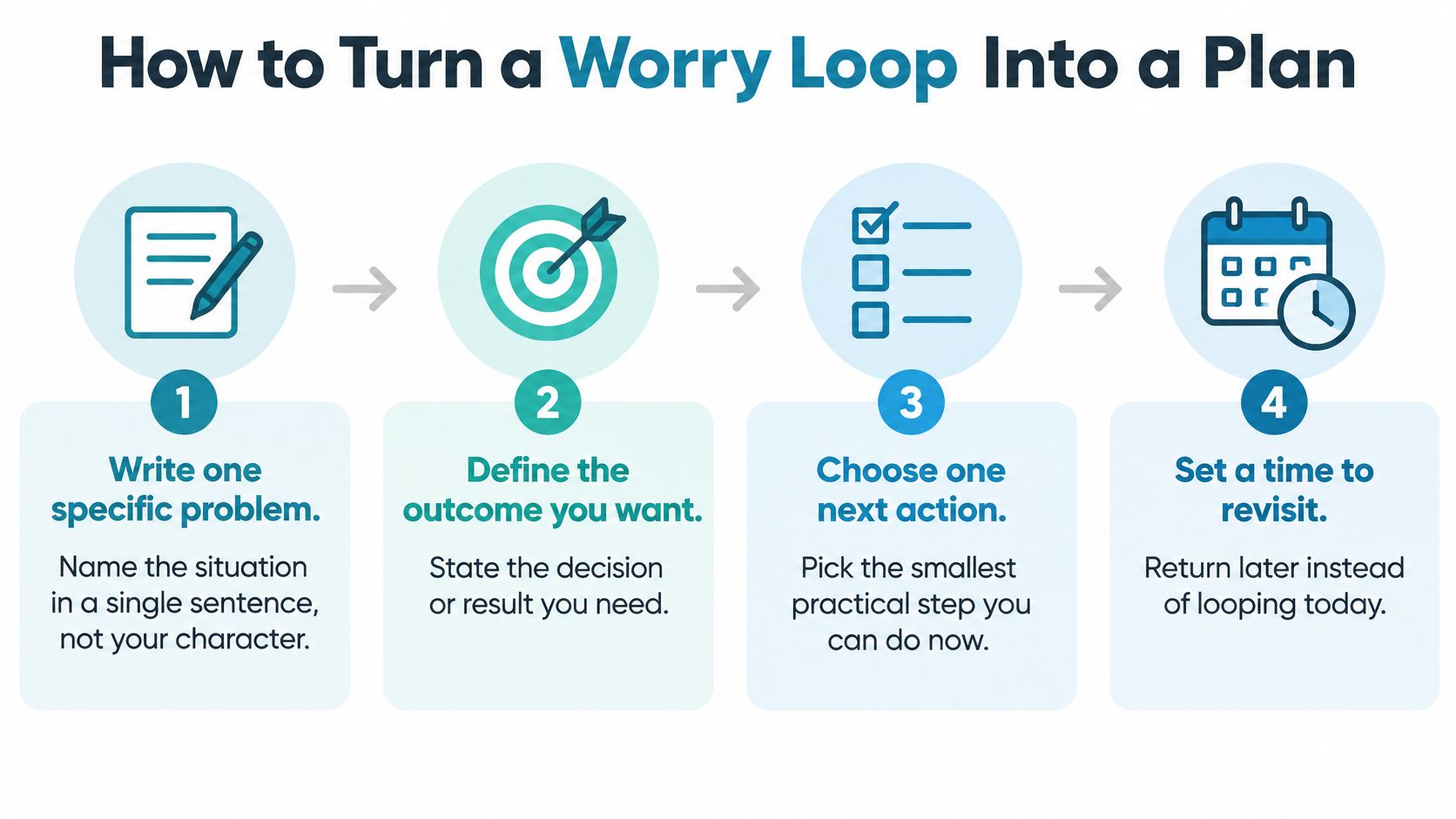
Write one specific problem in a single sentence: Name the situation, not your character. "I haven't replied to my manager's email about Friday's deadline" works. "My life is a mess" doesn't, because there's nowhere to start.
Define the outcome you want: A decision by Friday, a clearer plan for a difficult conversation, one call made. The common slip is choosing an emotional outcome, such as "feel confident," which you can't schedule.
List two or three actions under your control: Draft the email, ask for one missing fact, block thirty minutes to start. If every option depends on someone else changing first, the plan stalls before it begins.
Choose the smallest feasible action: Write the exact first move, including time and place. "At 9 tomorrow, at my desk, I'll draft three sentences asking for the budget figure" is more usable than "deal with work."
Set a review point: Decide when you'll check whether the step helped. Without an end date, your mind treats the topic as open all day and keeps reopening it.
Pause if anxiety spikes: If self-criticism takes over, use grounding, a brief distraction, or a mindfulness exercise before you continue. Trying to solve a problem while fused with threat often turns planning back into rumination.
You don't need a perfect plan. You need a plan that's specific enough to test and small enough to start.
Afterward, notice what changed. Do you have a clearer next move? Has the urgency dropped a notch? Did you identify one missing fact you can go get? Those are signs the thinking did a job. If you only feel more certain that you're the problem, that's information too. It tells you the mode drifted.
Don't use this protocol to argue with every painful thought. Some days the honest output is, "I don't have what I need to decide yet, and I'll ask for it tomorrow." That's still problem solving. It has a stopping point.
Which First Move Fits Your Situation
Not every loop should start with analysis. Sometimes your body is too activated for planning to be useful, and a break comes first.
Situation | First move | Follow-up |
|---|---|---|
Mind racing, anxiety high | Ground yourself with breathing or a physical reset, or take an 8-minute break from the topic | Return to the problem only once attention feels steadier, then write one concrete question |
Self-criticism about the past | Name the thought as a thought and shift to a present-tense question | Write the one thing you can do this week that relates to it, then stop |
Decision stuck for days | Write the two or three options you control | Pick the smallest option and set a review date |
Missing information | Write the one fact you need and where to find it | Send one message or make one call |
Conflict replaying in your head | Write what happened, including the specific words and actions | Choose one conversation or boundary to test |
Break first or plan first
In experiments summarized in Perspectives on Psychological Science, as little as an 8-minute distraction period improved solution quality, perceived control, self-efficacy, and optimism relative to induced rumination. A short break isn't avoidance when you use it to return with steadier attention.
Use your body as a rough guide. If your shoulders are up, your breathing is shallow, and your thoughts are racing, slow down first. If you're calmer and you have the facts but no decision, plan. The aim isn't to suppress feelings. It's to keep them from making decisions for you.
That slowing down is also central to how we work with anxiety here. For anxiety and overwhelm, Nick and the client slow things down and figure out what's going on, so anxiety doesn't get to run the whole show.
Some worries aren't tasks at all. They're about values or long-running patterns. If a loop keeps returning despite breaks and concrete steps, it's worth discussing with a clinician rather than doubling down on thinking.
Turning a Worry Into Values-Guided Action
Some loops persist because the underlying issue isn't a solvable task. It's something that matters to you. You want to be a more present partner, a steadier parent, a more reliable friend, or someone who leaves a job that no longer fits.
In Acceptance and Commitment Therapy, values give action a direction even when discomfort doesn't disappear. A values question asks, "What kind of person do I want to be in this situation?" A rumination question asks, "Why am I like this?" The first can guide a step today. The second usually can't be settled today.
A general example
Say a man keeps replaying a strained friendship. He reviews what he said, wonders what it says about him, and feels worse. A values turn would sound different. He asks what closeness he wants, then chooses one small action that expresses it, such as sending a message this week to suggest getting coffee.
He doesn't need anxiety to drop before he sends it. The test isn't whether the step removes discomfort. It's whether the step moves toward the value.
Values work builds on concrete planning rather than replacing it. You still name the action and when you'll take it. The value explains why that action matters, which can help when motivation is thin or the outcome isn't fully in your control. If you're in a broader period of change, this reflection on a major change in life may help you sort what you're moving toward.
Some patterns, especially those tied to shame or repeated relationship dynamics, are hard to shift alone. That's not a failure of effort. It's often a sign the loop needs another person in the room to help you see it clearly.
Why ADHD Makes Looping Easier to Fall Into
Looping does not mean you have ADHD, and ADHD looks different from person to person. The two can still overlap around attention, open tasks, and emotional regulation. An unfinished worry is easier to reenter, and harder to notice, when attention keeps treating it as unfinished and anxiety keeps it feeling urgent.
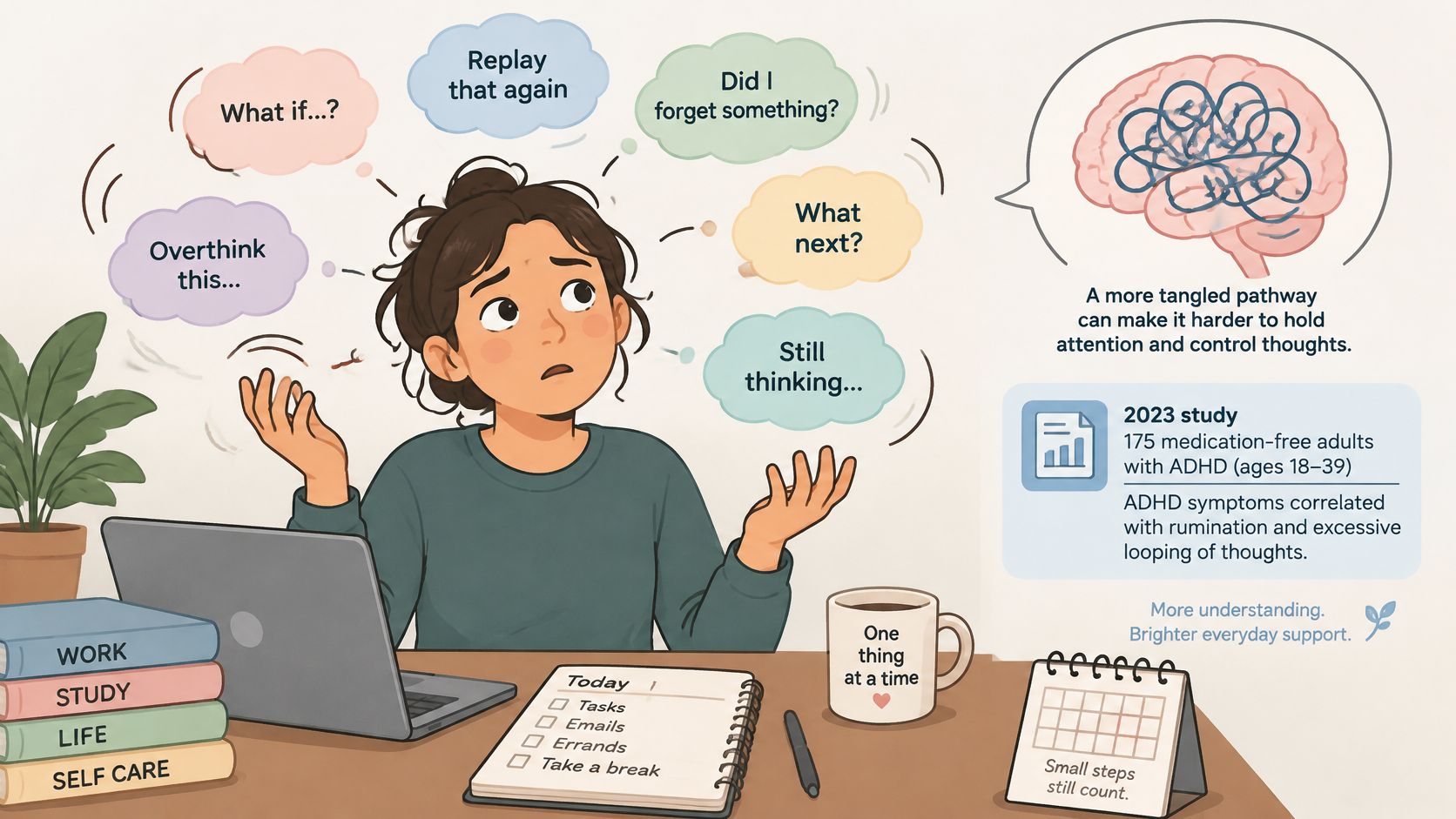
A 2023 study of 175 medication-free adults with ADHD, ages 18 to 39, found that ADHD symptoms, rumination, excessive mind wandering, anxiety, and depression were all positively correlated, while mindfulness was negatively correlated with those mental-health symptoms, according to the PMC report of the clinic study. Mediation analysis indicated ADHD symptoms were associated with greater anxiety and depression indirectly through increased rumination and excessive mind wandering, alongside reduced mindfulness ability.
How this can look day to day
A problem held only in your head works like a browser tab you never close. You drop it, then it reopens in the shower, in the car, or at 2 a.m. A deadline stays vague until it is suddenly urgent. An unfinished conversation returns the moment attention is free. Detail can disguise the loop as careful planning.
The output test still applies. Ask whether the next minute of thinking ends in a decision, a small test, or a next step. If it only restates the worry, you are looping, even when the details sound useful.
The video below offers additional context on how these patterns show up in daily life.
A private decision to stop thinking rarely holds the task. External anchors do. Write the problem down. Put the review date on a calendar. At the moment the loop starts, turn a broad worry into one concrete question you can answer today. A separate post on apps for executive functioning describes tools that can hold reminders and task lists outside working memory, so the plan does not depend on catching the loop in time.
In therapy, Nick helps clients with ADHD by working to better understand how ADHD shows up in their life while building practical strategies that work with their brain, not against it. A study describes groups, not one person, and none of this is a diagnostic tool. If looping sits inside a wider picture of attention and motivation difficulties, a proper evaluation is the right next step.
Decide Your Next Step Before You Think Again
Tonight, pick one action you can take before the next round of thinking. Write what it is and the time you'll do it. Keep it small enough that you don't need to feel ready first.
When to bring this to a professional
Loops lasting weeks: The same topic returns daily and concrete steps don't quiet it.
Sleep or work affected: You're losing rest, missing deadlines, or avoiding people.
Mood keeps rising or sinking: Anxiety or low mood intensifies despite your efforts.
Self-blame won't ease: The thoughts stay focused on your worth rather than the situation.
Therapy can offer a place to slow the loop, map the patterns that keep it going, and practice different responses between sessions. It won't promise specific outcomes, and it doesn't replace a medical evaluation, which is the right place to ask about medication where that may be relevant. Clients don't need to know exactly what they want to work on before starting therapy. Part of therapy is figuring that out together.
Sessions are 60 minutes, providing time to talk, dig into what's going on, and do work together rather than a quick check-in. Nick offers a free 15 to 20 minute phone or video consultation to ask questions, briefly discuss what's bringing the client to therapy, and see whether they're a good fit before scheduling the first session, in person in Washington, DC or by video for clients in DC and Virginia.
If looping thoughts are crowding out your work, sleep, or relationships, therapy can help you notice the pattern sooner and build concrete, values-guided ways to respond. Nick Donahue LICSW offers ADHD, anxiety, and relationship therapy in Washington, DC and by video across DC and Virginia, and you're welcome to reach out for a consultation to see whether it's a good fit.
Comments