
Setting Personal Boundaries with Family: A Practical Guide

You're halfway through dinner when the family group chat lights up. Someone posted a photo of you, a sibling wants a loan "just this once," and a parent expects a reply before the plates are cleared. You still want these people in your life. You don't want them in every hour, every photo, and every decision.
Setting personal boundaries with family is mostly about changing access, not cutting people off. You decide who shows up, what gets shared, who pays, and how fast you answer. Guilt after the first no is normal. It doesn't mean the limit was wrong. Family patterns shift through repeated conversations, not one flawless speech. If ADHD, anxiety, or a shared household makes follow-through messy, a smaller limit you can keep beats a dramatic one you drop by Thursday.
Table of Contents
How to Set a Boundary in Four Steps - Decide, time, and state it - Agree on follow-through - Make the agreement predictable
What to Say When Family Pushes Back - Three habits that keep the line intact
Setting Digital Boundaries With Relatives - Parents, teens, and what gets watched
When Limits Keep Getting Ignored - Check the agreement before you blame your willpower
Name the Boundary Before You Talk About It
A family boundary is a specific limit in one part of life. Name the area and the decision, or the conversation stays vague and easy to talk you out of.
I recommend changing one channel of access in a way you can keep. Visits, money, caregiving, and digital visibility can shift a little at a time. When you still share housing, a budget, or a parent's care, full independence often is not realistic. A narrower decision still is: who may drop by, how much you will lend, which appointments you will cover, and what stays off the group chat.
Family-boundary research treats closeness and distance as patterns, not as automatic signs of health. A study of 200 high-school students in Sari, Iran identified three dimensions (normal boundaries, enmeshment boundaries, and disengaged boundaries), found those factors explained 62.28% of the variance in the measured family-boundary relationships, reported Cronbach's alpha values above 0.60 and structural-reliability values above 0.70, and supported that three-factor structure in confirmatory analysis.
A normal or flexible boundary leaves room for affection, support, and shared responsibility while you keep privacy and the right to decide. Enmeshment shows up as intrusion, blurred roles, or pressure to disclose and comply. Disengagement shows up as emotional distance or little support. A limit is a relational process. The workable aim is a limit clear enough to protect your autonomy and flexible enough to keep connection, especially when the practical ties stay in place.
Scan the six areas below and pick one before you open your mouth.
Boundary area | Common example | Decision to make |
|---|---|---|
Visits | Dropping by unannounced | Set a notice window and the days you are open |
Money | Regular requests for loans or help | Set an amount, a limit, and how often you will revisit it |
Caregiving | Being the default person for a parent's appointments | Name the tasks you will do and the ones you will hand off |
Medical information | Relatives asking for test results or diagnoses | Choose what you share, with whom, and what stays private |
Digital access | Posting family photos or stories, or being monitored online | Decide what you post, what needs permission, and how you handle being checked |
Hurtful comments | Remarks about your job, partner, or ADHD | Decide your response and the point where you end the conversation |
Self-check: Which row makes your stomach drop, and what will you do if the other person says no?
If the answer is fuzzy, values clarification exercises for adults can help you sort what you care about from what you've been trained to absorb.
How to Set a Boundary in Four Steps
Sunday dinner is still on the calendar, the car is still shared, and you still drive your mother to two appointments. Cutting contact is not the goal. You are changing access, money, caregiving, and what relatives can see of your life, one piece at a time, while the rest of the shared arrangement stays in place.
Treat the limit as an agreement about space, time, responsibility, technology, and follow-through. A 2023 qualitative study of families working from home found families define boundaries by repurposing parts of the home, revisiting each person's responsibilities, aligning schedules, and distributing technology access. They keep those limits by naming someone to watch them, keeping agreements revisable, talking more, using incentives or consequences, and outsourcing tasks when needed. A usable agreement names the behavior and what follows it. "Please be more respectful" leaves both sides guessing.
Decide, time, and state it
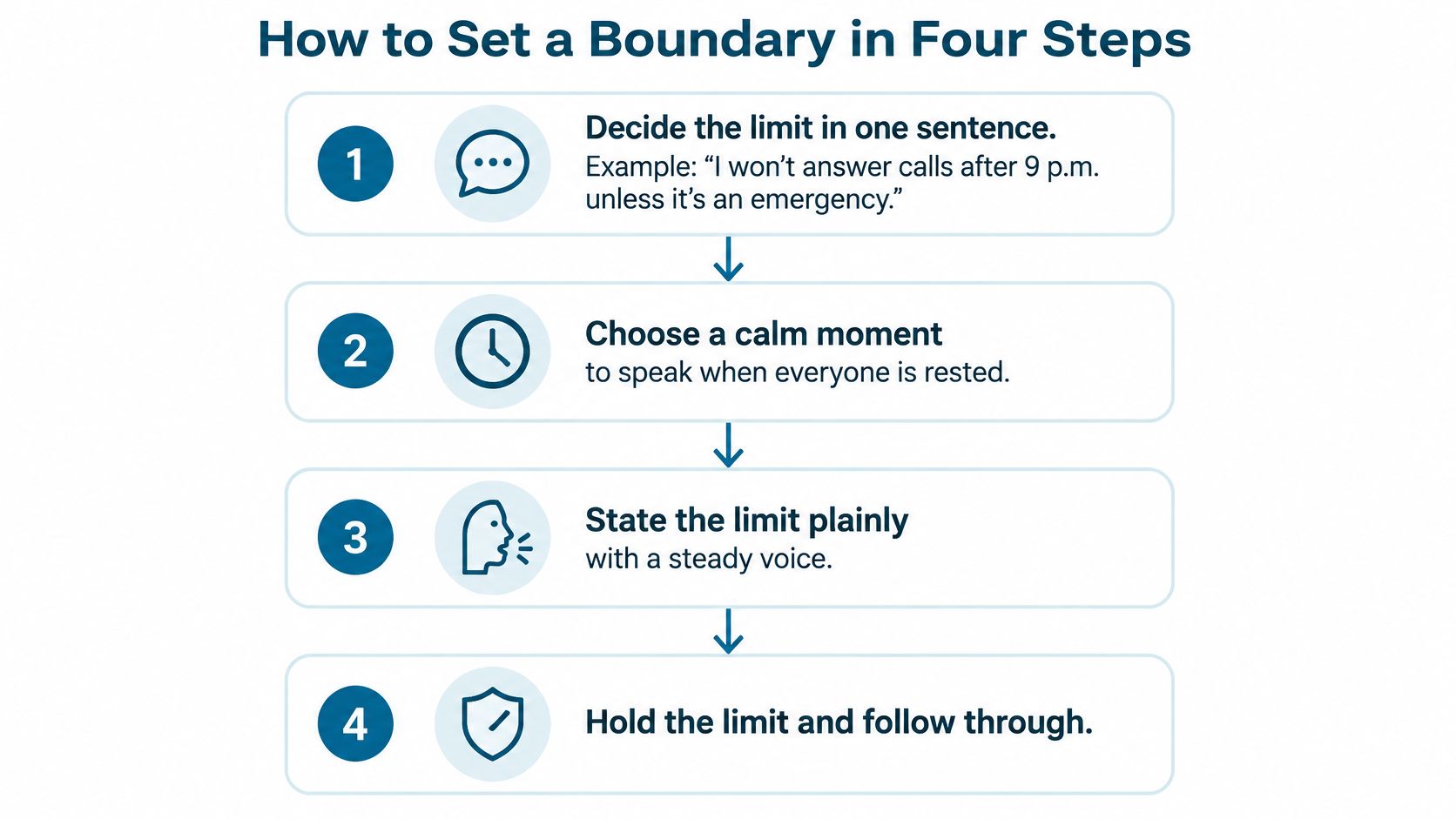
1. Write the limit in one sentence. Say what you will do, what you won't do, and what it covers. Start small if you still share a household or a bank account: "I won't answer calls after 9 p.m. unless it's an emergency," or "I can cover Tuesday appointments, not the rest of the week." A single sentence is harder to stretch than a speech about how tired you are.
2. Pick a calm moment and a fitting medium. A private call or an in-person talk works better than the middle of an argument or a holiday table. People hear a limit when they aren't already defending themselves. The common slip is delivering it while you're flooded, then spending the rest of the night apologizing.
3. State it once, briefly, without a long case. "I'm not going to lend money anymore, and I still want to see you." A long justification invites a debate about your feelings. You don't have to win that debate for the limit to stand. Guilt afterward is common. It does not mean the sentence was too harsh.
Agree on follow-through
4. Name what happens if the limit is crossed, who handles it, and when you'll review it. "If you call after 9, I won't pick up. We'll talk on Sunday and see how this week went." Without this step, the first conversation is only a wish. I would rather set a small consequence you'll use than a dramatic one you'll abandon, especially when you still share housing, money, or care and have to see each other tomorrow.
A finished first conversation looks like this. They've heard the limit. You know the next step. You haven't been asked to defend your character.
Make the agreement predictable
Vague requests fall apart when family life is already jumpy. A large-scale longitudinal examination of ADHD behaviors found that increases in a child's ADHD behaviors relative to that child's own average were followed by increases in family conflict (B = .02, 95% confidence interval 0.002 to 0.04) and reductions in parental monitoring (B = −.006, 95% confidence interval −0.01 to −0.0006). Clear agreements about reminders, task ownership, and what follows a missed commitment make the limit easier to keep.
Say the communication rules before a change, not after the mismatch. A qualitative study of students with ADHD transitioning to college found that limits with parents often had to be renegotiated as students became more independent, and that mismatched expectations made that renegotiation harder. Spell out how often you'll talk, which topics need consent, and when support is offered rather than assumed. Shift one rule at a time: call frequency this month, money next, then what gets posted or checked online.
What to Say When Family Pushes Back
Expect pushback, even from people who usually respect you. The most common opening is some version of "you're being selfish." That usually means they fear losing what the old arrangement gave them, not that you've become a worse person. Guilt after you hold the line is common. It isn't proof the limit was wrong.
What they say | What it often means | Reply you can use |
|---|---|---|
You're being selfish | They fear losing what the old arrangement gave them | I know this is a change. I still won't do that, but I want to hear what matters to you. |
After everything we've done for you | Past obligation is being used as leverage | Thank you for what you did. My answer on this one is still no. |
Why are you so sensitive now? | They are testing whether you will back down | I'm not asking you to agree. I'm telling you where I stand. |
You always do this | They are reacting to the change, not the specific request | Let's stay with this one request for now. |
Fine, but you'll regret it | Pressure through a future consequence | I may feel that. I'm still choosing this. |
Three habits that keep the line intact
Keep the reply short and repeat it. A second explanation becomes a negotiation. If you've said the sentence, saying it again is the work.
Don't argue their version of your history. "After everything we've done" pulls you into a ledger you can't win. Thank them for what was real, then return to this request.
Name the feeling without moving the decision. "I can see this is hard to hear, and my answer is still no." Warmth and a limit can sit in the same sentence.
Shame makes pushback harder to hold. A relative's criticism lands on top of an old voice that already calls you difficult, lazy, or too much, especially if ADHD has left a trail of missed commitments. Nick helps clients with shame and self-doubt by giving them distance from the critical voice in their head and a chance to build a different relationship with themselves. That distance lets you hear what is fair and set aside the self-doubt that pushes you back into giving in. The same skill shows up in dating and communication, where a short, repeated sentence often does more than a perfect explanation.
Before the next call, pick the one sentence you will repeat and the minute you'll end it. "I'm going to hang up at 8:15 if we're still on this" is a plan. Hoping you'll feel braver in the moment isn't.
Setting Digital Boundaries With Relatives
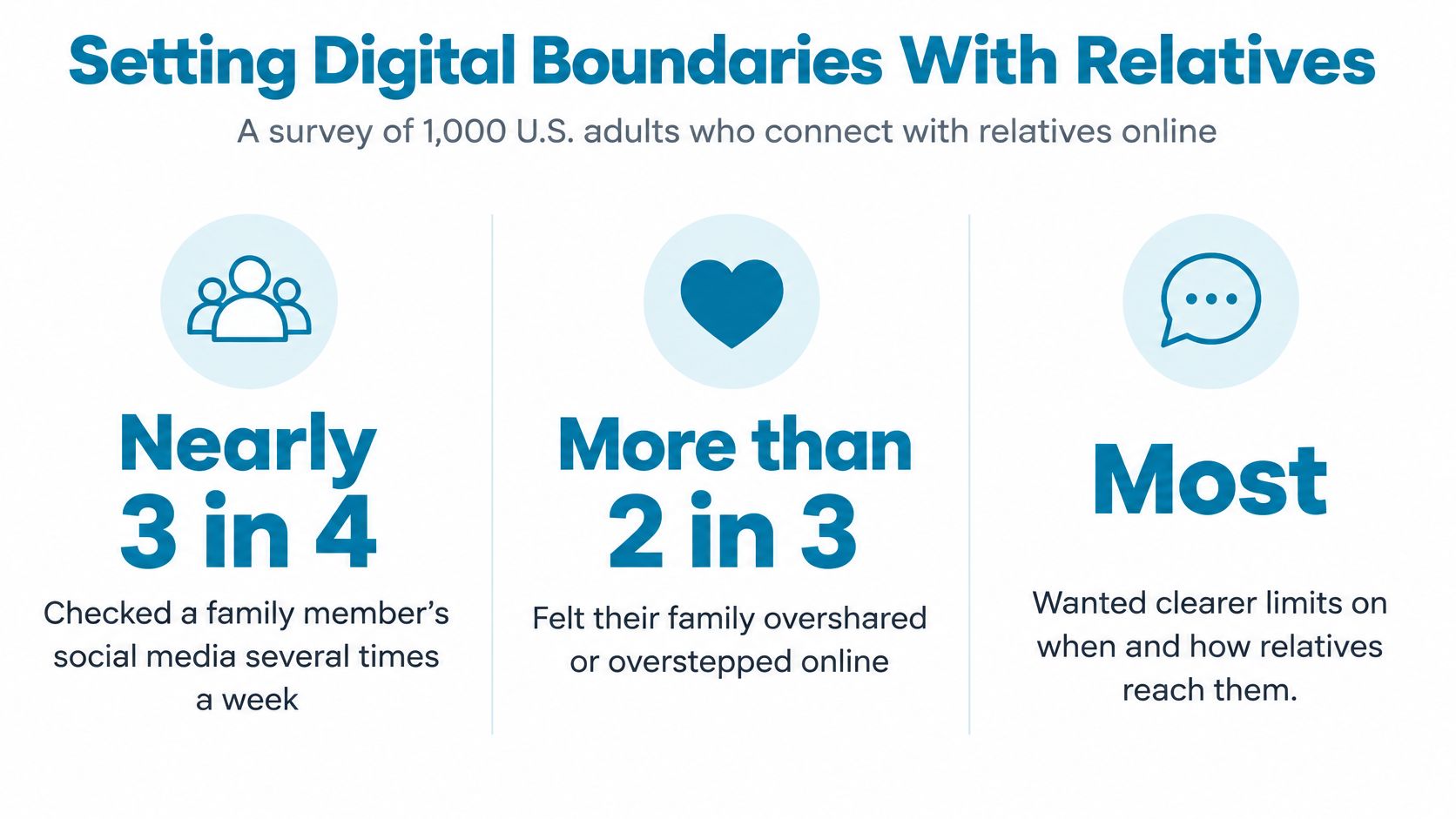
Online contact makes privacy, access, and speed into relationship issues you can see. In a survey of 1,000 U.S. adults who connect with relatives through social platforms or messaging apps, nearly 3 in 4 checked a family member's social media at least several times per week, and more than 2 in 3 felt monitored by a relative during the previous year.
Finding | Share of respondents |
|---|---|
Checked a relative's social media at least several times a week | Nearly 3 in 4 |
Felt monitored by a relative in the previous year | More than 2 in 3 |
Changed what they posted because relatives could see it | 55% |
Believe relatives should ask permission before tagging or posting about them | 76% |
Admitted posting about a family member without asking | 40% |
Felt pressured to respond quickly in a family group chat | 51% |
Said a family group chat contributed to a real-life argument | 36% overall; 58% Gen Z; 14% baby boomers |
Fifty-five percent had changed what they posted because relatives could see it. 76% believed relatives should ask permission before tagging or posting about them, yet 40% acknowledged posting about a family member without asking. In group chats, 51% felt pressured to respond quickly, and 36% said a family group chat had contributed to an argument in real life. That rate was 58% among Gen Z respondents, compared with 14% among baby boomers.
Turn each figure into a decision this week.
Being checked: Decide whether relatives may look at your stories, location, or "last active" status, and turn off the feature you don't want used.
Permission: Decide which posts need a yes first, including photos of your home, partner, or diagnosis.
Reply speed: Pick hours you'll answer the family thread, then mute it outside those hours.
Arguments: If a thread already spilled into a real fight, leave that thread rather than winning it.
Closeness doesn't require unrestricted visibility or instant replies. You can send one line and mean it. "I'll read this thread between 7 and 8 p.m. and reply then."
Parents, teens, and what gets watched
For parents of teens, a screen-time rule isn't the same as a rule about reading messages, posting family content, tracking location, or screenshotting a chat. A 2025 Social Media Impact Survey from Rutgers researchers and SSRS, published by the New Jersey Department of Education, found parent-teen conflict most often involved time online (66% of parents), sleep disruption (43%), broken rules (30%), and academic effects (29%), with privacy, oversharing, and relationship drama as further flashpoints.
Parents and teens often don't experience the same interaction the same way. A dyadic study of adolescents with ADHD found only moderate agreement between parent and adolescent reports, and that lower family flexibility predicted more externalizing behavior while adolescent-rated cohesion predicted fewer externalizing behaviors in some analyses. Ask each person to describe the arrangement separately, then negotiate what parents may monitor, share, or screenshot, and revisit it as the teen gets older.
Boundaries When You Share Money, Housing or Care
Popular advice assumes you can reduce contact, move out, or refuse family obligations. That fits some adults. It doesn't fit people who share a lease, rely on a relative's income, provide multigenerational care, or live in cultures where interdependence and filial duty are central. Closeness itself isn't the problem. Unclear access, money, and decision-making are.
A useful frame, laid out in guidance on how to set boundaries with family, splits the problem into three groups instead of treating distance as the only healthy outcome.
What you control is your time, what you spend, and how you respond. You can stop answering money texts after 9, keep a separate account for "help," and leave a conversation that turns insulting even if you still live there.
What needs family negotiation is the shared load. Who drives to which appointments. A fixed dollar amount instead of open-ended support. A written week for the shared kitchen, guest room, or caregiving nights. Put the agreement where everyone can see it.
What needs outside support is a safety concern, or a load one person can't carry. That might mean a clinician, a benefits counselor, adult protective services, or another relative who has been left out of the rotation.
A boundary here is often a gradual cut in access, not an exit. One caregiving task handed to a sibling. Visits on two Sundays a month. A loan cap you can actually keep.
Anxiety, ADHD-related overwhelm, a life transition, or substance-use concerns make dramatic limits hard to sustain. Inconsistent follow-through teaches the family the limit isn't real. Plan the smaller version you'll still do on a bad week.
Ask yourself which of the three groups this problem belongs to before you announce a break you can't live with.
When Limits Keep Getting Ignored
A boundary is tested by repetition. The useful moment is the second or third time a clearly stated limit gets ignored, not the first awkward silence.

You have four realistic options.
Restate the limit and the consequence you already named. Don't invent a harsher one in the heat of it.
Reduce contact in that one area. Stop the loans and still go to the holiday visit.
Change the setting. An hour at a restaurant instead of an evening at home.
Step back for a set period. Decide the date you'll revisit the agreement before you go quiet.
Check the agreement before you blame your willpower
Three questions matter. Have you stated the limit in one sentence? Do you have a consequence you will follow? Does the pattern repeat across situations, or only in one? If the answer is yes to all three, the agreement is the problem, not your character.
Distance is a real outcome for some families, and it is more common than dinner-table talk suggests. In 2025, 38% of 4,395 U.S. adults reported being estranged from at least one family member, according to YouGov. Choosing distance after repeated attempts isn't a failure. It also isn't required. If insults, monitoring, or money pressure keep crossing into harm, it helps to name toxic behaviors in relationships without turning every disagreement into one.
Therapy for this pattern starts with the relationship, what you've already tried, and what you want it to look like. The first session is a chance to get to know each other, discuss what's bringing you in, what you'd like to get out of therapy, and begin deciding how to approach the work together. Nobody can promise how a relative will respond.
If you want a short walk-through of holding a limit while someone pushes, this conversation is a useful companion to the four options above.
Confirm Your First Boundary This Week
Pick one row from the first table. Write the sentence you will say and the follow-through you'll use if it's ignored. Schedule a calm moment in the next few days, not a holiday meal and not the hour after a fight.
Note the reaction you expect and which reply you'll repeat. Then decide what you'll do if the first conversation goes badly, so the next step is already chosen. If the pattern keeps repeating, therapy can give you room to sort what is yours to change from what has to be negotiated, and to plan changes at a pace you can sustain. It doesn't control how relatives respond.
If you aren't ready to book, use the sentence once and see what happens. When you want to learn more about working with Nick Donahue, LICSW, you can schedule either a free consultation or an initial therapy session online, whichever feels like the better fit. The free option is a 15–20 minute phone or video conversation to ask questions, briefly discuss what's bringing you in, and see whether you're a good fit before a first session.
Nick Donahue, LICSW, offers individual therapy for teens and adults in Washington, DC, and virtual sessions for clients in DC and Virginia, including people sorting ADHD, anxiety, and family patterns that won't shift on willpower alone. Sessions are a place to practice a clear limit, tell guilt from a real obligation, and plan follow-through you can keep. If that kind of conversation would help, visit Nick Donahue LICSW to learn more or schedule a free consultation.
Comments