
Dating and Communication: Scripts That Actually Help

It's 11:40 on a Tuesday, and you're rewriting the same message for the fifth time. Thursday's date went well, or you think it did. Now you're trying to sound interested without sounding intense, casual without sounding cold, and every version reads like it was written by a committee.
That stuck feeling is a mechanics problem. Early dating compresses attention, memory and emotional intensity into a few lines of text, so a delay can look like a verdict and a short answer can read as a door closing. Pew Research Center found that 30% of U.S. adults have used a dating site or app, and among partnered adults younger than 30, 20% met their current partner that way (Pew Research Center's 2020 online dating report).
Clear wording helps more than perfect timing. Set a pace you can defend, say what you mean plainly, and keep a repair process ready for the inevitable miss. In the first month, that does more than chemistry.
Table of Contents
Why Messages Get Misread So Easily
Two lines arrive at 9:14 on a Wednesday night, six hours after a first date that ran long and ended well. "Had fun tonight. Get home safe." No question. No follow-up. You spend the next hour deciding what it means.
That hour is the whole problem. When the beginning of a relationship lives in text, you're interpreting intent through words alone, and words are the weakest channel you have. Pew Research Center's 2022 survey of U.S. adults who had used dating sites or apps found that 53% described their overall experiences as very or somewhat positive and 46% as very or somewhat negative, an almost even split; among current or recent users, 55% said they had at least sometimes felt insecure about the number of messages they received, and 36% said they had felt overwhelmed by message volume (Pew Research Center survey of online daters).
Three misreadings account for most of the friction:
A slow reply means disinterest. Often it means a double shift, a dead phone, or a person who answers in batches.
Brevity means hostility. Short messages usually mean someone is typing one-handed, not withdrawing.
Enthusiasm means commitment. Warmth early on is real, but it's a mood, not a decision.
A slow reply tells you about someone's Wednesday. It doesn't tell you what they think of you.
When a pause feels threatening, the response is rarely neutral. People send a follow-up to "clarify," write three paragraphs where one line would do, or go quiet to protect themselves, which the other person reads as exactly the thing they were afraid of. Anxiety and rejection sensitivity speed all of this up, and therapy is partly a place to slow the inference down before it turns into a message you regret. Attention and memory shape response timing too, and not in the way many assume.
The distinction everything else depends on: a message is information about one exchange, not a verdict on the relationship.
Scripts for the Messages That Stall Things
In Fidelity Investments' 2024 Couples Study of 3,588 individuals, nearly 90% of couples said they communicated well or very well with their partner (Fidelity Investments Couples Study). Many believe they're good at this. The stall usually isn't a skill problem. It's the specific moment when you know what you want and can't find a sentence that says it without risk.
Treat these as starting lines, not scripts to memorize.
Situation | Starting line | Why it works |
|---|---|---|
Slow reply after a good date | "Hey, I enjoyed Thursday. Busy week on my end, but I'd like to see you again." | Names the interest and the delay without interrogating it |
Checking whether interest is still there | "I've enjoyed talking with you. Are you still up for getting together this month?" | Asks one clear question with a time frame |
Needing more time before meeting | "I like where this is going and want to get to know you a bit more by text first. Can we plan a call this week?" | States the pace and offers a concrete next step |
Declining a second date | "Thanks for a good evening. I don't see us as a romantic match, but I wish you well." | Short and kind, and leaves no opening for debate |
Three rules make any of these work:
Use your own vocabulary. If you'd never say "I'd like to see you again," say "want to get food next week?" A line you'd cringe at in your own voice reads as false on the other end.
Match length. A one-line message doesn't need a five-line answer. Length mismatch reads as pressure even when the words are warm.
Cut anything that asks them to prove interest. "Are you interested?" invites a defense rather than an answer, and it puts the burden of your uncertainty on them.
Watch what justification does to a message. Here's one that started as a draft and ended up unreadable:
"Hey, I know you're probably really busy and I don't want to be annoying, I just wanted to check in because I had a really nice time on Thursday and I wasn't sure if you felt the same or if I misread things, so no pressure at all, just let me know if you'd want to do it again sometime."
The same message, cleaned up: "I had a good time Thursday. Want to do it again next week?" The second version states the interest and offers a time frame. The first asks the other person to manage your anxiety for you.
Before your next message goes out, pick the one situation that has been stalling the conversation and draft the line while you're calm. Not as a test. Not as an ultimatum. Just a clear sentence you'd be willing to stand behind.
How Much to Share in the Early Weeks
A long message on day two about an ex, a diagnosis, and a family rupture feels honest when you send it. It usually lands as weight. The other person now holds information they didn't ask for, can't act on, and can't match without exposing something of their own. That's how closeness gets manufactured before trust exists.
Disclosure works better as a dial than a switch. Research on online dating has looked at self-disclosure alongside privacy concerns and the way people reduce uncertainty, and the pattern is consistent: people use profiles and messages to judge credibility, intentions, and interpersonal risk. In a study published in Communication Research, intentional disclosure was positively related to perceived strategic success (β = .13, p < .05), which is a statistical way of saying that choosing what to reveal, and when, tends to work better than spilling (study on self-disclosure in online dating).
A sequence that holds up in practice:
Start with specific, low-risk detail. What you do, what a good weekend looks like, one real opinion about something small.
Ask reciprocal questions and listen to the answers. Ask a follow-up that proves you were paying attention, not one that steers back to you.
Add depth after consistency. They followed through on a plan, remembered something you mentioned, showed up when they said they would.
State your intentions once you have enough information. Serious or casual, said plainly, saves months.
Move to a brief, public meeting. Coffee or a walk, ninety minutes, once you know enough to judge basic compatibility.
Practical rule: increase depth after consistency, not after chemistry.
The benchmark is proportionality. Disclose enough to be concrete and authentic, and preserve reciprocity. Sensitive information used as a shortcut to intimacy tends to produce a relationship that feels close and isn't.
If you're the one holding back, know that total withholding reads as guardedness. Saying "I'm more private until I know someone better" is a boundary, not deception. The check is simple: did your last message give the other person something to respond to, without asking them to carry your story?
Handling Pushy Contact and Scam Signals
You said no clearly. Three messages arrived that week anyway.
A slow reply can be attention, memory, or stress. Contact after refusal is different: the signal has already been sent, and the other person is choosing not to use it. Pew Research Center's 2022 survey of online daters found that 30% said someone had contacted them after they had expressed disinterest, 38% reported receiving unwanted sexually explicit messages or images, and 52% of people who had ever used a dating platform said they had encountered someone they believed was attempting a scam (Pew Research Center survey of online daters). That pattern is common enough that you do not need to treat it as a mystery about your wording.
A no is information the other person is responsible for acting on. You don't owe an explanation, a reason, or a negotiation. One line does the job: "I'm not interested in continuing, so please don't message me again." Send it once. If messages continue, block and report, and save screenshots before you do. If you share a mutual circle, state the same boundary once there too, then stop engaging; debate gives persistence more material.
Scam signals are usually structural rather than tonal:
Money or gifts come up early. Any request for funds, crypto, gift cards, or a package you need to forward.
They push to leave the app fast. Moving to a private channel removes the platform's reporting tools.
They won't hold a video call. Repeated technical excuses for a five-minute call are the tell.
Intensity arrives before knowledge. Big declarations in week one are acceleration, not intimacy.
Loneliness is the lever most scams pull. In a 2025 global Norton survey of 12,024 adults across 12 countries, one in four online daters reported being targeted by a dating scam, and 24% said loneliness had led them to make risky online-dating decisions (Norton global online dating survey). So slow the pace when you're lonely, verify on video before meeting, and keep first meetings in public.
How to Ask for What You Need in Six Steps
Direct requests fail less often because people are selfish than because the request arrives tangled up with an accusation. A sequence keeps the two apart.
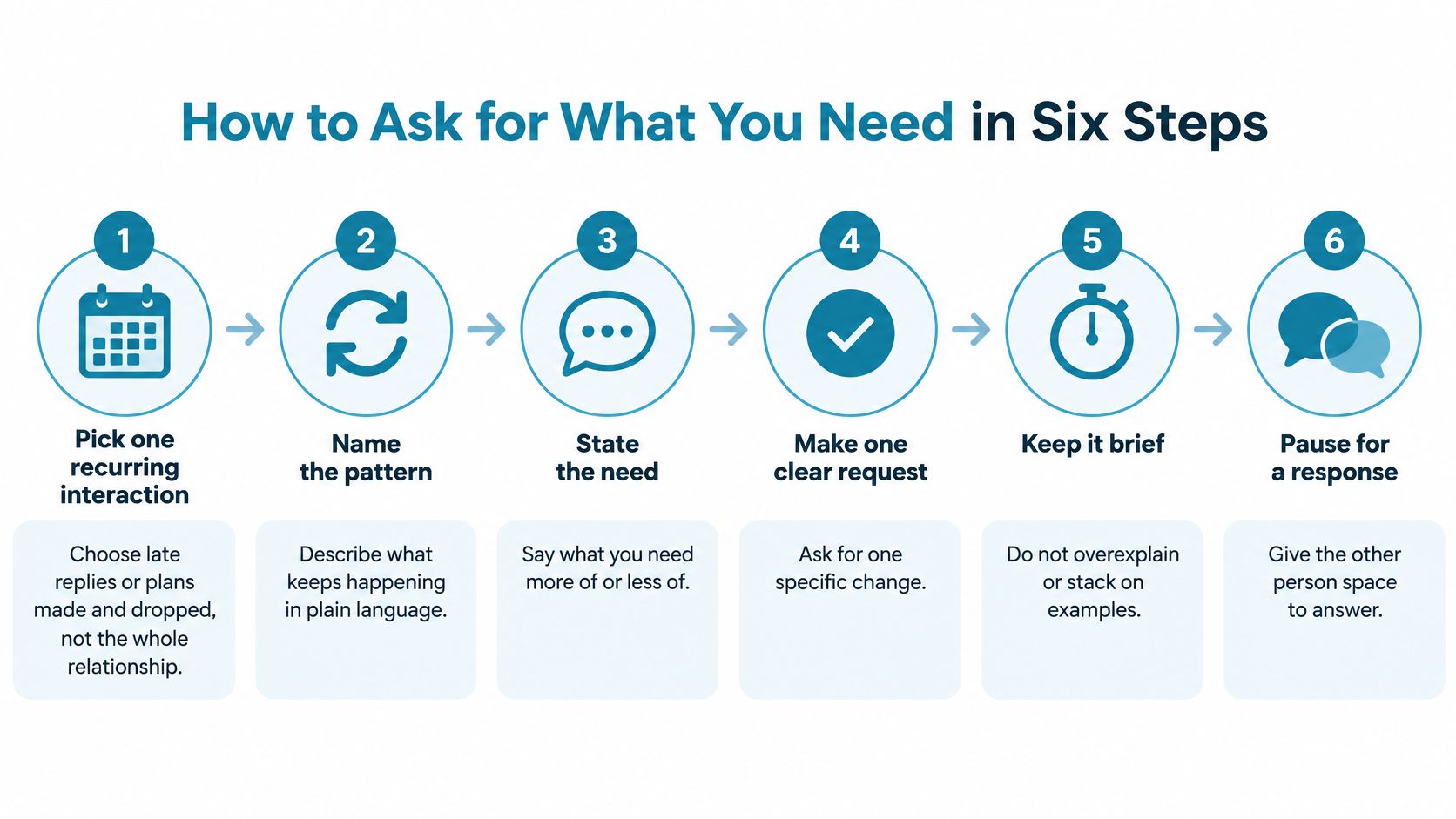
Run this on one conversation you can have this week, not on the whole relationship.
Pick one recurring interaction. Late replies. Plans made and dropped. One. If you name five, the other person hears a verdict on their character and stops listening.
Describe what you observe. "We set plans twice and both changed on the day." Motives are the thing you can't verify, and guessing them is where the argument starts.
Name the feeling and the need. "I feel unsure where we stand, and I need clearer plans." Feelings without needs sound like complaints; needs without feelings sound like demands.
Make one specific request. "Can we confirm the day before?" The common slip is a request that's really a demand for reassurance, like "Can you tell me you're into this?" That one can't be answered, only performed.
Ask them to reflect it back. "Before you answer, can you tell me what you heard?" It's awkward for ten seconds and prevents twenty minutes of arguing about two different topics.
Revisit once you've both calmed down. Not at midnight in a heated thread. Name a time: "Can we come back to this tomorrow evening?"
The same structure works on jealousy, which tends to arrive as an accusation when what's underneath is fear. If that's the recurring one for you, this piece on how to deal with relationship jealousy walks through the same steps with that pattern in mind.
A short walkthrough of the sequence, if you'd rather watch than read:
What to Expect From One Good Attempt
Structured communication work produces real but modest average change. A systematic review of marriage and relationship programs covering 39 studies found an average effect size of 0.26 for relationship communication, and a broader review of randomized prevention trials found d = 0.44 for communication across 37 studies. A large multisite trial of 6,298 couples found only very small effects (d = 0.09) and no effect on relationship dissolution.
What that means practically: don't judge the process by whether one conversation fixed everything. Judge it by fewer escalations, faster repair, and requests that get answered. One good round is a start, not a permanent fix.
When ADHD Shapes the Communication Pattern
A reply that arrives two days late. A plan that evaporates. A sharp text at 11pm that the sender barely remembers writing. It's tempting to file all of it under character, and most dating advice does exactly that, treating missed messages and inconsistent follow-through as evidence of low interest or poor character.
For many adults with ADHD, something else is running the show. Working memory and emotional intensity shape timing, follow-through, and tone, and a partner can read those differences as indifference when the intent was entirely different. A 2025 ACM study of ADHD and non-ADHD couples found recurring challenges around communication, emotional regulation, and conflict resolution, and it pointed toward mutual adaptation rather than correcting the ADHD partner. Participants commonly used practical external supports, including written notes and pinned messages, to compensate for working-memory difficulties (ACM study of ADHD and non-ADHD couples).
Pattern | What it can look like | Shared fix |
|---|---|---|
Delayed or missed replies | Responses arrive a day or two late with no acknowledgment | Agree on a response window and a simple check-in text if it slips |
Forgotten plans | A date or promise drops out of memory despite real intent | Confirm the day before, with reminders set by the person who forgets |
Intensity during conflict | A sharp tone or fast reaction that feels hostile to the other person | Agree on a pause and a specific time to come back to the topic |
Repeated arguments | The same issue returns in new forms over time | Write the agreed rule down and keep it visible, as couples in the study often did with notes |
Memory Failure or Disregard
The two get confused constantly, and the difference matters. A memory failure usually comes with warmth when you're face to face, quick repair, and follow-through once reminded. Disregard tends to flex around what the person values: they remember what matters to them. It's not a perfect test, but it separates a support problem from a respect problem.
Partners can help without becoming parents. Shared reminders and pinned notes are fine. Surveillance isn't. The person who forgets sets their own reminders, and the other person isn't responsible for policing them.
The mechanics are documented. A controlled study of adult women found ADHD symptoms positively associated with emotional dysregulation (β = .30, p = .004), and working-memory deficits positively associated with emotional dysregulation (β = .34, p = .001), which is a formal way of describing how a tense exchange can go from zero to loud before either person decides anything (study on ADHD symptoms, working memory, and emotional regulation). That study compared women with and without ADHD symptoms, so it shouldn't be generalized to everyone.
A 2025 qualitative study of 355 adults with ADHD, ages 19 to 71, found recurring relationship difficulties involving misunderstood intentions, emotional dysregulation, and conflict (qualitative study of adults with ADHD in relationships). It describes experiences within that sample, not a prediction about every person with ADHD. A separate 2025 survey of 287 college students found no overall difference in relationship satisfaction or affection between relationships with and without an ADHD partner, though some ADHD relationships used more destructive conflict styles and weren't necessarily more distressed by them.
That's the honest picture: real friction, real resilience. If you recognize yourself here and have never been evaluated, a medical assessment is the right next step, not a diagnosis from a blog post. And if this is your relationship, ADHD and relationship problems goes deeper into the cycle. Both people adapt. The person with ADHD isn't a case to be managed.
Repairing After a Missed Plan or Hurt Feelings
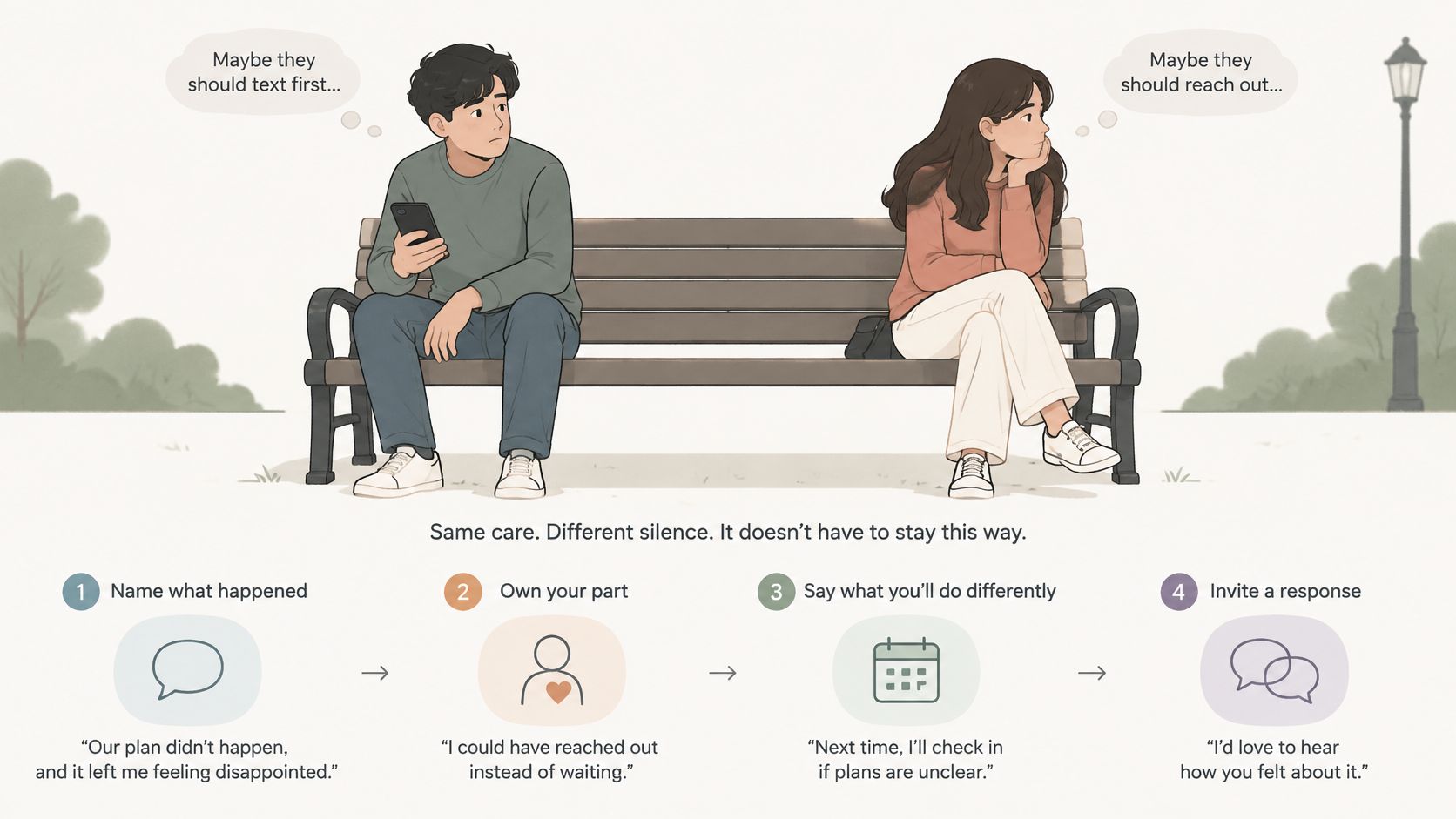
The most common repair mistake is waiting for the other person to make the first move. The second most common is writing a long explanation that's really about how bad you feel, which effectively hands them the job of comforting you for the thing you did.
Repair is short and specific. Four moves, in this order.
Name what happened in one or two sentences. "I said I'd text back Thursday and I didn't." No defense of your intent yet.
Own your part concretely. "You were left guessing, and that's a lousy place to be."
Say what changes and when. "I'm setting a reminder for the day before, and if something shifts I'll tell you that day."
Ask how they experienced it, then listen. "What was that like on your end?" Resist the urge to resolve it in the same breath.
Shame complicates this. When a missed message triggers self-criticism, the urge to over-apologize makes the other person responsible for managing your feelings, and the apology becomes another thing they have to handle. Getting some distance from the critical voice matters more than delivering a perfect speech. A brief, consistent repair usually does more than an eloquent one.
Sometimes it isn't accepted, and that's information. Give them room. Don't repeat the apology in new words, because repetition turns into pressure. Repair doesn't guarantee reconciliation.
One distinction worth keeping: a single incident needs an apology. A pattern that keeps recurring needs the request and the planning, not a better apology.
Signs it's working: they engage with the topic instead of shutting down, the issue shows up less often, and both of you can raise something hard without it becoming a fight.
Decide Whether a Consultation Makes Sense
Three signals suggest outside support is worth considering. The same conflict keeps repeating despite clear agreements. Shame or anxiety shapes nearly every message you send. Or you can't tell whether a pattern is yours or belongs to the relationship itself.
Therapy for dating and communication looks at what's underneath the exchange, such as the way anxiety pushes someone to chase reassurance and then feel worse when they get it. Then it practices different responses between sessions. A first session is usually just a conversation about what's been happening, the relationships in your life, and what you'd like to change. You don't need a tidy explanation before you start.
Structured help isn't one uniform thing, either. A systematic review and meta-analysis of 12 couple intervention studies found therapy programs produced the largest pooled improvement in couple relationship satisfaction (mean difference 0.53, 95% CI 0.35 to 0.71), while education programs produced 0.28. Different formats, different averages.
If ADHD or anxiety is part of the question, therapy doesn't replace a medical evaluation or a medication review. It sits alongside them.
Write down the single pattern that has repeated most. One sentence is enough.
Note one script or step from this article you tried, and what happened. Even if it went badly, that's data.
Decide whether you want to talk it through with a clinician. The decision can wait.
A free 15 to 20 minute phone or video consultation is a low-pressure way to ask questions and see whether the fit is right. Sessions run 60 minutes, which leaves room to dig into something rather than check in and stop. If anxiety about the relationship is the main thread, relationship anxiety therapy covers how that work tends to go.
Nick Donahue LICSW works with teens and adults in Washington, DC and virtually across DC and Virginia, and much of that work involves the exact territory this article covers: reading a silence accurately, saying a hard thing in one clear sentence, and repairing after it lands wrong. If the same thread keeps going sideways, that's workable material for a session, not a verdict about you. Visit Nick Donahue LICSW to learn more or to schedule a free consultation.
Comments