
Relationship Anxiety Therapy: What Helps and How It Works

Your partner's reply is shorter than usual. You read it again, check when they were last online, and spend the evening wondering whether something has changed. Part of you knows there could be an ordinary explanation, but knowing that doesn't settle the feeling.
Relationship anxiety therapy helps you understand these reactions, respond less automatically, and evaluate what's happening between you and another person. That includes taking your partner's behavior seriously, not just teaching you to question yourself. The work is to make room for uncertainty without overlooking reasonable needs or real problems.
Table of Contents
What Relationship Anxiety Is and Why It Feels So Consuming - An alarm isn't the same as an answer
Signs Relationship Anxiety Shows Up in Dating and Communication - Notice the function, not just the behavior
The Reassurance and Avoidance Loop That Keeps Anxiety Going - What the evidence supports - Practicing a different response
Telling an Internal Alarm From a Real Relationship Problem - Questions to ask without forcing a verdict
Choosing Individual Therapy, Couples Therapy or Both - When helping becomes accommodation - Keep your own decision-making space
What Therapy Targets and How Progress Shows Up - Skills connected to your actual life - The relationship with your therapist matters
Deciding Whether to Start Individual Therapy Now - A manageable first step
Common Questions About Relationship Anxiety Therapy - Is relationship anxiety a diagnosis? - Can I work on this on my own? - Do I need a medical evaluation first? - What if my partner won't come to therapy? - How long does relationship anxiety therapy take?
What Relationship Anxiety Is and Why It Feels So Consuming
Relationship anxiety means persistent worry about whether someone cares, whether your connection is secure, or whether you'll be left. It can involve doubts about your own feelings, too. Unlike passing uncertainty, the worry keeps pulling your attention away from the rest of your life.
It isn't a character flaw or proof that you're incapable of closeness. Past experiences of unreliable affection, betrayal, or painful endings can shape what you expect from someone now. Ordinary uncertainty may start to feel like a warning that you need to act immediately.
That waiting-for-a-message moment can look quiet from the outside while feeling consuming inside.
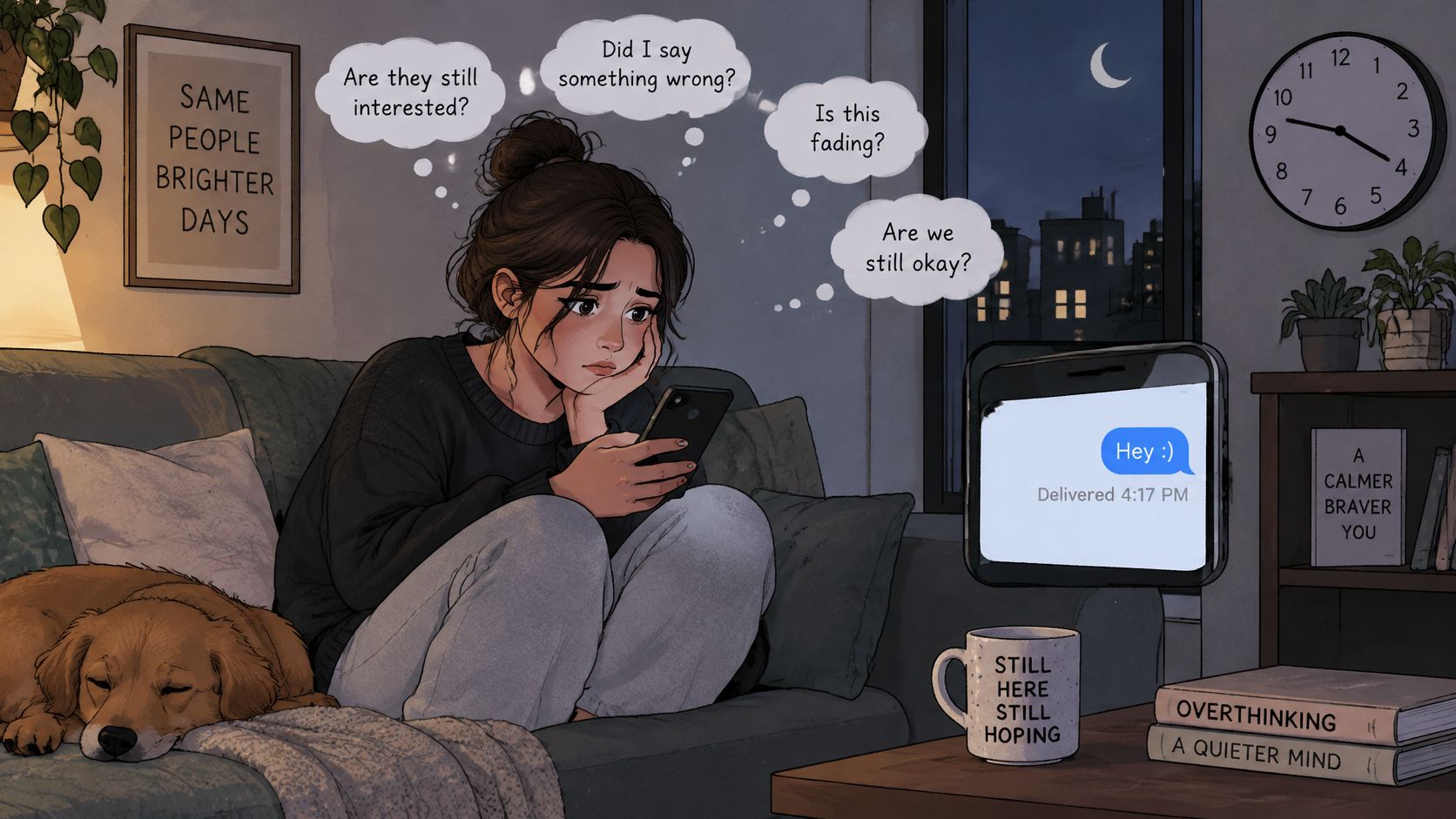
An alarm isn't the same as an answer
Think of a smoke alarm. You want it to detect a fire, but if it sounds whenever you make toast, you can end up organizing your whole kitchen around avoiding the noise. Relationship anxiety can feel similar: you spend so much energy preventing distress that you have less room to experience the relationship.
Still, not every alarm is false. Caring about someone, questioning compatibility, or feeling hurt after a broken agreement isn't automatically an anxiety problem. A therapist should help you distinguish those experiences rather than assume your reaction is unreasonable.
Relationship worry can arise in early dating, during a long partnership, or when considering closeness again after a breakup. It may sit alongside low self-esteem, depression, ADHD, or broader overthinking, without any of those explaining the whole picture.
Therapy isn't about eliminating anxiety completely. It's about developing a different relationship with it so it no longer gets to make all the decisions.
Signs Relationship Anxiety Shows Up in Dating and Communication
Relationship anxiety isn't always visible as asking for more closeness. Sometimes you move toward the person; sometimes you pull away before they can disappoint you. The behavior makes more sense when you ask what you're hoping it will prevent.
Common relationship anxiety patterns and what therapy targets
Pattern | What it looks like | What it often protects against | Where therapy focuses |
|---|---|---|---|
Reassurance seeking | Repeated check-in texts, asking if things are okay, needing frequent confirmation | Fear of being dropped or chosen less | Tolerating uncertainty and reducing checking cycles |
Avoidance | Delaying replies, skipping hard conversations, pulling back first | Fear of rejection or conflict | Approaching difficult topics in small, graded steps |
Mind reading | Assuming meaning from short replies, tone or changed plans | Threat monitoring for signs of loss | Testing predictions by asking directly and noticing outcomes |
Over-accommodation | Changing plans or hiding needs to keep the peace | Fear that expressing needs will cause conflict | Stating needs clearly and tolerating a partner's reaction |
Shutting down after conflict | Withdrawing, going silent for hours or days | Overwhelm and fear of escalating the argument | Recovering regulation and returning to repair conversations |
Notice the function, not just the behavior
A delayed reply could mean you're afraid of seeming interested. It could also mean you're working, exhausted, distracted, or unsure what to say. These patterns aren't a diagnosis, and the same action can have different meanings in different situations.
You might recognize several rows. For example, you may repeatedly ask whether everything is okay, then feel embarrassed and stop answering when your partner responds. Try not to turn recognition into another reason to criticize yourself.
A two-week observation habit can give you something concrete to discuss:
Record the moment. Describe what happened without interpreting it, such as a canceled plan or an unanswered question.
Name your next action. Note whether you checked, asked, withdrew, apologized, or changed your plans.
Notice the aftermath. Did you feel settled, briefly relieved, more ashamed, or still uncertain?
Keep the notes brief rather than documenting every interaction. The purpose is to understand a recurring response, not monitor your relationship more closely.
For adults with ADHD, emotional intensity deserves attention alongside attention and planning difficulties. A systematic review of emotional dysregulation in adult ADHD connects difficulties regulating emotions with impairment in personal relationships, while emphasizing that these difficulties aren't universal. ADHD is a neurodevelopmental condition, not a moral failing, and it doesn't explain every disagreement.
The first pattern you notice is often a useful starting point for therapy. You don't need a complete explanation before bringing it up.
The Reassurance and Avoidance Loop That Keeps Anxiety Going
An unanswered message can lead to a familiar sequence. You predict that your partner is losing interest, feel dread or tightness, and reach for your phone. Checking brings relief, but the relief doesn't last.
This diagram illustrates how reassurance and avoidance can become connected.
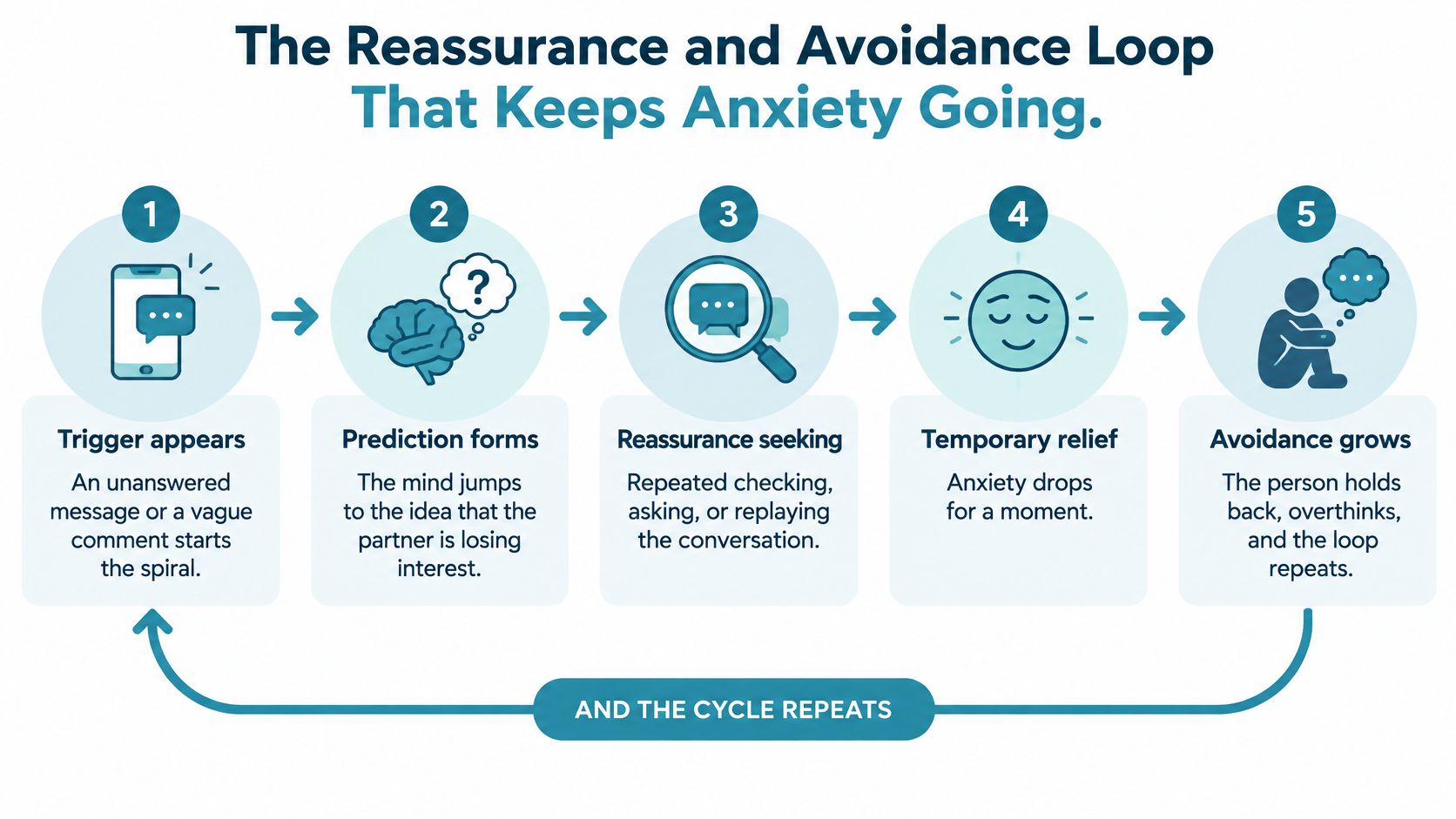
The sequence often includes a trigger, a prediction, a physical reaction, and an urge to do something immediately. You might ask for reassurance, replay a conversation, or withdraw to avoid feeling exposed. When distress drops afterward, it becomes tempting to repeat that response next time.
It's a little like scratching an itch: the immediate relief can make you reach for the same solution again, even when it leaves you more preoccupied afterward. The problem isn't needing comfort. It's becoming dependent on a particular action to feel okay.
What the evidence supports
Attachment-related anxiety involves expectations of rejection and close monitoring of a partner's cues. In a randomized trial of 495 adults with social anxiety disorder, cognitive-behavioral therapy reduced attachment anxiety and attachment avoidance after treatment, with gains largely maintained at 6- and 12-month follow-ups.
That trial enrolled people with social anxiety disorder, not people selected for relationship worry. Its attachment findings are suggestive for relationship anxiety treatment, not proof of a specific outcome for everyone seeking it. They do support treating attachment-related responses as changeable rather than fixed personality labels.
Practicing a different response
A therapist might help you test a feared prediction in a manageable situation. If your partner has been dependable, that could mean continuing with dinner rather than sending another check-in message, then noticing what happens.
Ask yourself: What do I know right now? Separate an observable fact, such as a late reply, from the conclusion that you're no longer wanted.
This isn't an instruction to ignore someone's behavior. It's practice choosing a response after evaluating it. Our discussion of breaking relationship patterns offers another way to think about recurring reactions.
For a video discussion alongside this reflection:
Telling an Internal Alarm From a Real Relationship Problem
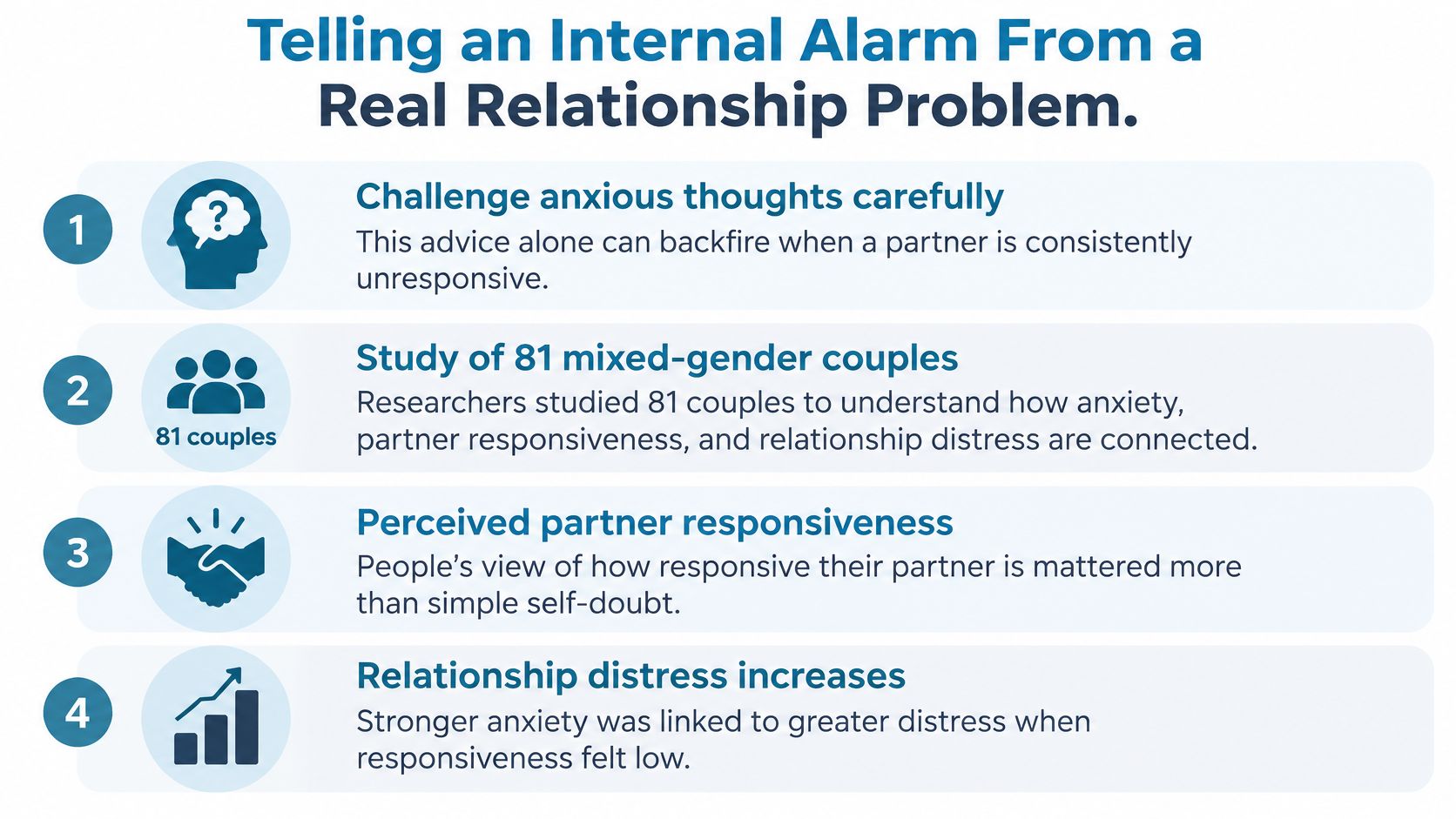
A smoke alarm that goes off every time you make toast is a different problem from a kitchen that is on fire. Both produce the same sound. Relationship anxiety works similarly: the alarm feels identical whether it comes from an old pattern firing or from a genuine response to how a partner treats you. Advice to challenge anxious thoughts can backfire when a partner is consistently unresponsive. If you repeatedly raise something important and receive dismissal, learning to tolerate disappointment better is only part of the answer. Your partner's responses are evidence to weigh, too.
In a study of 81 mixed-gender couples on anxiety and relational connectivity, perceived partner insensitivity fully mediated the association between anxiety intensity and relational connectivity, while perceived responsiveness partially mediated it. In plain language, participants' perceptions of how their partners responded helped account for the connection between anxiety and relational closeness.
That's an association, not proof of what caused distress in any particular relationship. Still, feeling chronically unheard is real information rather than automatically distorted thinking. Perceiving a partner as responsive can protect closeness, and perceiving them as insensitive can erode it. Either way, the perception deserves a fair look.
So the question splits in two: what is my alarm responding to, and what is my partner doing?
Questions to ask without forcing a verdict
Specificity. Is the worry tied to a particular event, or is it general dread without a clear object?
Consistency. Has your partner responded reliably over time, including when you aren't distressed?
Repair. When you raise hurt, can you reach understanding or a meaningful change?
Support. Do you repeatedly feel dismissed, belittled, or emotionally unsupported?
Safety. Does fear increase around controlling, threatening, or unsafe behavior?
Perspective. Would a trusted friend recognize the same pattern from the concrete events you describe?
Read as a group, these questions sketch a direction rather than deliver a score. Mostly general dread, alongside consistent care and repair, may point toward an internal alarm worth working on in individual therapy. Specific, repeated unmet needs suggest a relationship problem worth addressing directly. Both can exist at once, and neither conclusion should come from tallying answers like a test.
Practical distinction: Asking for a reasonable agreement is different from asking for certainty that nothing painful will ever happen.
Say your partner changes plans without telling you. Requesting notice is a concrete need; repeatedly seeking guarantees that they'll never leave is a different task. The same care applies when working through relationship jealousy: examine behavior without assuming either betrayal or irrationality.
If you feel unsafe, contact a trusted person or local emergency services before working on the relationship in therapy. You don't need to resolve whether your anxiety is justified before seeking protection.
Choosing Individual Therapy, Couples Therapy or Both
Much advice treats relationship anxiety as something one person needs to fix. But when distress develops through recurring interactions, the relationship itself may need attention. That doesn't mean your partner caused the anxiety or that you can't make progress independently.
A review of systemic and couple-based interventions supports their effectiveness alongside evidence-based individual psychotherapy for several conditions, with advantages for some forms of relationship distress. This doesn't establish that couples therapy is preferable for every anxious relationship. The useful question is what needs to change and which setting allows that work safely.
When helping becomes accommodation
Partner accommodation means repeatedly providing reassurance, changing routines, or avoiding situations to reduce another person's anxiety. A partner might agree to constant updates because they want to help, while both people become increasingly afraid of what happens without them.
Couples work can help partners develop supportive responses without organizing the relationship around immediate anxiety relief. Individual work can address personal fears, shame, and choices that need private space.
Which therapy format fits which situation
Situation | Individual therapy | Couples therapy | Both |
|---|---|---|---|
Anxiety shows up across most relationships | Strong fit | Less central | Possible later |
Anxiety tied to shame, trauma or substance use | Usually first choice | Only after individual stability | Possible with care |
Recurring conflict about reassurance and responsiveness | Helpful for personal patterns | Often useful if both are willing | Common combination |
Partner unwilling or relationship feels unsafe | Primary option | Not advisable | Individual only |
Uncertain whether to stay | Primary option with room to think | Not the place to decide alone | Individual first |
These are starting points for a conversation, not eligibility rules. Trauma or substance use doesn't automatically rule out couples work; readiness, safety, and the purpose of treatment matter. Likewise, an unwilling partner isn't necessarily an unsafe partner, but neither situation permits meaningful joint work without free participation.
Keep your own decision-making space
You may need somewhere to consider whether you want the relationship at all. Individual therapy gives you room to explore that question without turning every session into a negotiation with your partner.
Involving a partner is collaborative, never mandatory. If you're unsure where to begin, individual therapy is often a sensible first step, and the format can change as your needs become clearer. Our overview of anxiety therapy in Washington, DC describes the individual process.
What Therapy Targets and How Progress Shows Up
Therapy for relationships and dating offers a place to slow down, understand what is happening, and begin responding differently. Often that starts with understanding yourself before trying to change a conversation with someone else.
Anxiety gets treated as a signal worth examining rather than a command to obey. Sessions slow the alarm down and figure out what is going on: what triggered it, what your emotional history contributes, what your partner did, and which interpretation the evidence supports. That last step matters. Sometimes the alarm is internal, and sometimes it is pointing at a real relational problem. Part of the work is learning to weigh your partner's responses as evidence, not only to challenge your own thoughts.
Skills connected to your actual life
Individual work may include:
Recognizing triggers. Identify the moment between an event and your urge to check, apologize, or withdraw.
Practicing direct requests. Rehearse how to express disappointment without hiding the need or accusing the other person.
Allowing manageable uncertainty. Let an unanswered question remain open briefly while continuing something meaningful.
Returning after tension. Plan how to pause a difficult conversation and come back rather than disappear.
Acceptance and Commitment Therapy, or ACT, helps you act according to your values while uncomfortable thoughts and feelings are present. In practice that can look like noticing a racing thought as a thought, feeling your feet on the floor, and then choosing what to do next.
Interpersonal therapy focuses on relationship roles, recurring conflict, and the support around you, which suits anxiety that lives in how you relate to people. A meta-analysis of interpersonal problems and psychotherapy outcomes found that people who entered therapy with greater interpersonal difficulties tended to have poorer outcomes, though the effect was small.
The relationship with your therapist matters
Fear of judgment, mistrust, reassurance seeking, or withdrawal can appear in the therapy room, too. A therapist watches for these patterns early, revisits them, and works through misunderstandings rather than treating them as noncompliance.
You can bring up feeling misunderstood by your therapist. That conversation can be part of the work.
Progress should be observable, something more concrete than a vague sense of doing better. Someone might still feel anxious after a tense exchange but recover sooner, make a clear request earlier, and spend less time checking afterward. They might also catch themselves sooner when the alarm does not match what their partner did.
Repeated assessments of anxiety and relationship functioning can track that change over time. The aim is more flexibility and clearer decisions. Anxiety may still show up; it stops making all the decisions, and no therapy can promise that a relationship will last.
Deciding Whether to Start Individual Therapy Now
You don't need to know exactly what you want to work on before starting. The first session is a chance to get to know each other, discuss what brought you in, name what you hope to get from therapy, and begin deciding how to approach the work together.
Sessions run 60 minutes. Many clients begin weekly and move to every other week or less frequently as therapy progresses; the overall length depends on your goals.
A manageable first step
Bring a recent moment. An argument, a dating experience, or an evening spent overthinking gives you somewhere concrete to begin.
Consider the fit. Notice whether you feel able to speak openly and ask questions about the process.
Make room for other care. Therapy doesn't guarantee specific outcomes or replace medical evaluation or medication management when those are appropriate.
We provide individual therapy for teens and adults in person in Washington, DC, and virtually throughout DC and Virginia. Scheduling details are available on the practice website.
This week, notice a pattern from the table and briefly write down the moment. If it keeps returning or takes up more of your life than you want, consider a consultation to explore whether working together feels right.
Common Questions About Relationship Anxiety Therapy
Is relationship anxiety a diagnosis?
Relationship anxiety describes a pattern rather than a formal diagnosis. If worry is persistent, severe, or interfering with daily life, a clinician can assess what's happening and discuss appropriate options without assuming that all relationship distress has the same cause.
Can I work on this on my own?
Observation is a useful starting point. Try the brief two-week log, distinguish observable events from predictions, and consider whether your partner responds with consistency and repair. Structured support may help when you understand the pattern but keep getting caught in it, or when reflection turns into more rumination.
Do I need a medical evaluation first?
Not always. Sleep problems, changes in mood, attention concerns, substance use, or medication questions may make a medical evaluation appropriate alongside psychotherapy. You don't have to decide on your own which issue is primary before asking for help.
What if my partner won't come to therapy?
Individual work still gives you space to understand your reactions, express needs, establish boundaries, and consider your choices. Couples work requires both people to participate freely; persuading an unwilling partner isn't a prerequisite for getting support yourself.
How long does relationship anxiety therapy take?
There isn't a fixed timeline. Goals, history, current stress, and the problems you're addressing all matter, and no particular outcome is guaranteed. A useful ongoing conversation is whether therapy is helping you respond more deliberately, understand your needs, and make decisions with greater clarity.
Nick Donahue LICSW offers individual therapy for teens and adults navigating ADHD, anxiety, dating, and relationship difficulties, in person in Washington, DC, and virtually across DC and Virginia. If you'd like support understanding a recurring relationship pattern, visit Nick Donahue LICSW to schedule a free consultation or an initial session and explore whether the fit feels right.
Comments