
7 Values Clarification Exercises for Adults to Try

If someone asked what you value, would you have a real answer or a respectable-sounding one? Most adults can name what they should care about, such as family, health, and hard work. It's harder to explain what those words mean when an ordinary week requires choosing between them.
Values clarification exercises for adults make those choices more concrete. Rather than journaling about your best self, you sort priorities, compare daily behavior with intentions, and examine trade-offs. A value is an ongoing way you want to act, such as being caring or curious, not a goal you eventually finish.
You might be here because a decision about a job, move, or relationship won't resolve. Perhaps a transition dissolved your old routine, or your days feel full but pointed at nothing. For adults with ADHD who find open-ended reflection slippery, having something to sort, rate, or write can offer a more manageable starting point.
The exercises below move from concrete tools toward more reflective ones. Each includes what to do, a realistic example, and the adjustment that keeps it from becoming another way to judge yourself.
Table of Contents
1. Values Card Sort - Keep the Sort From Becoming an Approval Test
2. Valued Living Questionnaire and Life Domain Rating - Read the Gap Without Grading Yourself
3. Values-Action Check-In - Avoid Turning Values Into Productivity Targets
4. Eulogy or Legacy Exercise - Replace the Impossible Ideal With Ordinary Behavior
6. Peak Experiences and Ideal Day Reflection - Keep the Ordinary Part
How the seven exercises compare by format, best use, and known limitation
1. Values Card Sort
A Values Card Sort gives abstract priorities something you can physically move. Write values such as honesty, adventure, security, creativity, loyalty, and contribution on separate cards. Sort them into piles labeled very important, somewhat important, and not important to me.
Narrow the most important pile to a small group, then explain why each belongs there. A systematic review of values-clarification exercises describes identification and reflection on meaning and everyday behavior as essential components. Sorting alone leaves the exercise unfinished.

Keep the Sort From Becoming an Approval Test
The failure mode is choosing admirable words rather than personally meaningful directions. A rushed sort can reproduce a parent's expectations, workplace culture, or your own internal list of obligations.
For each card you keep, ask:
Meaning: What does this word mean in my life, rather than in someone else's?
Behavior: What would someone see me doing during an ordinary week?
Trade-off: What am I willing to give up to make room for it?
Say you're changing careers and initially choose achievement. After comparing cards, you realize the job title matters less than autonomy and contribution. That distinction gives you better questions to ask about prospective work.
For ADHD-related decision overload, work with a smaller selection and leave uncertain cards visible rather than forcing an immediate answer. Revisit the sort after a major change instead of treating it as a permanent identity statement. For context on the therapy model behind this approach, the practice's explanation of ACT versus CBT describes their different emphases.
2. Valued Living Questionnaire and Life Domain Rating
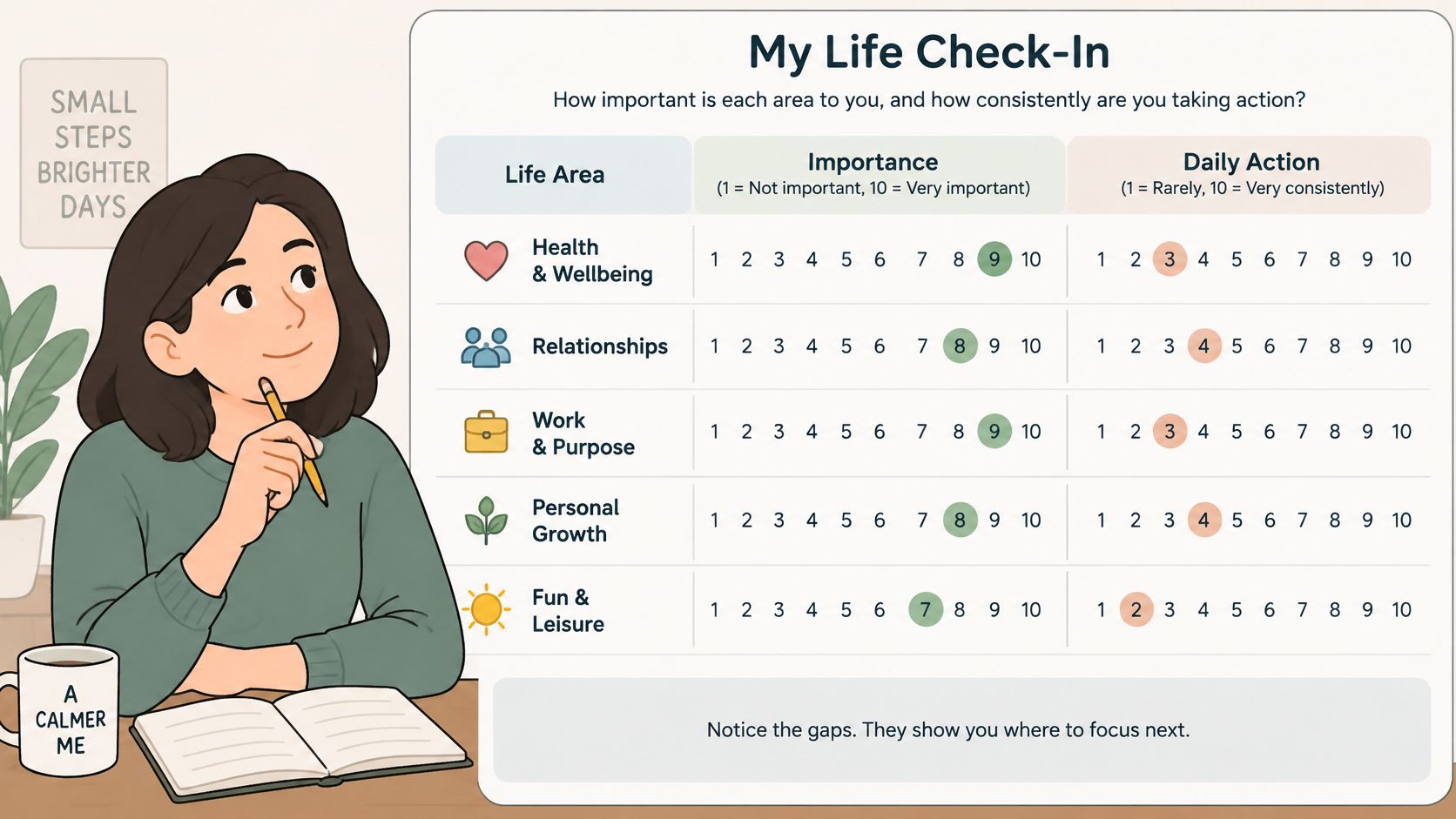
You can care a lot about friendship and still go weeks without contacting anyone. The Valued Living Questionnaire, associated with Kelly Wilson and Troy Groom, helps separate how important an area feels from how consistently you've acted on it.
The original VLQ psychometric paper describes an ACT-derived measure of importance and behavioral consistency across life domains. You can use the questionnaire with a therapist or make an informal reflection sheet covering family, intimate relationships, work, education, health, leisure, friendship, and spirituality. An informal sheet isn't a standardized assessment.
Read the Gap Without Grading Yourself
Rate each area for importance, then separately rate how closely your recent behavior matched what matters there. Add a brief explanation beside any uncomfortable mismatch.
The failure mode is treating consistency as a character score. Low consistency might reflect avoidance, but it might also reflect caregiving, money, disability, exhaustion, or an overloaded schedule. The ratings can't tell you which explanation fits.
Practical rule: Before deciding you need more discipline, describe the conditions under which you were trying to act.
Suppose friendship matters greatly, but your recent consistency feels low. Rather than planning a complete social overhaul, choose a manageable action, such as sending a voice message to a friend after lunch.
For adults with ADHD, discussing the ratings aloud or writing concrete examples beside each domain may make broad questions easier to answer. If every area looks neglected, choose something feasible rather than automatically attacking the largest gap. Repeat the exercise later to compare circumstances, not to prove that you've become a better person.
3. Values-Action Check-In
A Values-Action Check-In starts with a practical question: what did you do that expressed something important to you? It connects reflection with behavior without requiring a major decision or an unusually insightful mood.
An ACT-based physical-activity intervention protocol offers a useful model: consider important life domains, connect a behavior to those domains, and prepare for thoughts and emotions that might interfere. A protocol describes an intervention's design, not proof that this particular self-guided check-in will work for everyone.
Use a recurring routine, such as finishing your weekend coffee, to review:
Direction: Which value did I want to express?
Evidence: What did I do?
Barrier: What made that difficult?
Adjustment: What would make the next action smaller or easier to start?
Say you value connection but spent your evenings withdrawing after work. Your next step might be texting a friend before you get home, rather than expecting yourself to initiate plans when you're already depleted.
Avoid Turning Values Into Productivity Targets
The failure mode is building another performance dashboard. Counting completed actions can obscure whether they felt meaningful or whether the plan respected your actual capacity.
ADHD is a neurodevelopmental condition, not a moral failing. When difficulties with attention, initiation, or emotional regulation affect follow-through, add an external cue or reduce the steps instead of interpreting the missed action as proof that you don't care.
During a major change in life, your previous routine may no longer fit. Repeated barriers deserve curiosity, especially when they involve fear of rejection, resentment, or shame rather than forgetfulness.
4. Eulogy or Legacy Exercise
What would you hope someone close to you could say about how you treated them? The legacy exercise asks you to imagine a funeral or memorial and write about the qualities people would remember, rather than your résumé.
The exercise resembles Stephen Covey's end-in-mind framing. Keep the writing plain: perhaps you hope friends would remember that you listened, colleagues that you were fair, or family that you could acknowledge mistakes. This is a reflection prompt, not a prediction about what anyone will eventually say.

Replace the Impossible Ideal With Ordinary Behavior
The failure mode is writing a tribute to someone no human could sustain. Always available, endlessly patient, successful at everything, and never disappointing anyone isn't a workable set of values. It's an impossible job description.
A useful legacy statement leaves room for limits, mistakes, and repair.
Suppose you write that you want to be remembered as someone who showed up for friends. If you've been canceling plans, ask what showing up could realistically mean now. It might mean explaining your limited capacity and offering a shorter visit, not promising to accept every invitation.
Translate the qualities you chose into behavior on an ordinary Tuesday. Being fair might mean asking for a colleague's perspective before deciding; being loving might include setting a boundary without contempt.
For adults with ADHD, avoid equating reliability with flawless memory or constant availability. Build reminders and honest communication into your definition. If imagining death brings up grief or intense distress, stop or substitute a future birthday gathering where people describe what they appreciate about you.
5. Regret Review
Start with a decision you regret, but not the most painful event you can remember. Write what happened in a factual sentence, then ask what mattered to you that made the outcome hurt.
This is a Regret Review, not a trial of your past self. A future-looking variation resembles the regret-minimization framing associated with Jeff Bezos: consider what you might later regret leaving unexplored. That framing can generate a question, but it can't determine the right decision.
For example, regretting a friendship that drifted apart may point toward loyalty, connection, or repair. Regretting years in an unsatisfying job may reveal a wish for growth, but it doesn't mean leaving immediately would be financially possible or wise.
Stop Where Reflection Becomes Rumination
The failure mode is replaying the event without learning anything new. Reflection produces a clearer value, a more accurate account of your constraints, or a present-day choice. Rumination keeps prosecuting the same case.
Use these prompts to keep the review bounded:
What mattered: Name the value beneath the regret.
What was controllable: Separate your choices from other people's actions and information you didn't have.
What remains possible: Identify an action available now, without assuming you can undo the past.
Someone who regrets losing contact with a friend could send a thoughtful message without demanding reconciliation. The value is expressed through reaching out; the friend's response remains outside their control.
For adults with ADHD, hindsight can become especially harsh when past decisions involved missed deadlines, impulsive reactions, or forgotten commitments. Include the support and understanding you lacked at the time. If you keep returning to shame rather than reaching a usable next step, bring the material to therapy instead of pushing harder.
6. Peak Experiences and Ideal Day Reflection
Think of a time when you felt engaged, absorbed, or comfortably yourself. It doesn't need to be a graduation, promotion, or dramatic adventure. Helping someone solve a problem or working on a project counts.
The Peak Experiences and Ideal Day Reflection uses that memory to identify conditions you want more of. Abraham Maslow's writing on peak experiences provides historical context, but you don't need an extraordinary high to use the exercise. Moments of ease or satisfaction are enough.

Recall meaningful experiences and note what they shared: pace, people, purpose, environment, or degree of independence. Then describe an ideal ordinary day in the present tense, including meals, responsibilities, relationships, and rest.
Keep the Ordinary Part
The failure mode is designing a vacation instead of a life. A day without work, chores, financial limits, or competing needs may reveal a wish for relief, but it won't necessarily clarify how you want to live.
Say you felt engaged running a community project, and your ideal workday includes collaborative problem-solving. You might seek a team-based assignment before concluding that you need an entirely different career.
For adults with ADHD, distinguish what feels exciting from what remains meaningful after novelty fades. Include the recovery time and practical support that make an activity sustainable.
Choose a small element you can bring into your current week, such as an unhurried lunch or shared project. The reflection on a culture of joy offers a related way to consider pleasure and meaning without turning either into another achievement.
7. Values Continuum
Draw a line with strongly agree at one end and strongly disagree at the other. Choose a statement about work, relationships, rest, or money, then mark where you stand. You can also move physically along an imagined line if that feels more engaging.
The Values Continuum belongs to the values-clarification tradition associated with Sidney Simon, Leland Howe, and Howard Kirschenbaum. Its useful feature is the explanation you give for your position, not the position alone.
Try a statement about whether declining requests is a healthy boundary. You might agree when the request comes from a colleague but hesitate when it comes from family. That difference creates an opening to examine loyalty, fear, responsibility, and dependence.
Make Room for Competing Values
The failure mode is treating your position as a permanent moral verdict. Ask what circumstances would move you toward the other end and what you'd lose by staying where you are.
Research on value clarity distinguishes clarity from merely selecting attractive value words. In practice, that means asking why a position matters and whose expectations influence it, without assuming family or communal commitments are less authentic than independence.
When values conflict:
Name both: Perhaps autonomy and family loyalty both matter.
Compare costs: Consider immediate relief and longer-term consequences.
Check control: Separate available choices from constraints you can't remove.
Choose a workable action: Protect both values where possible, such as declining a visit while arranging another form of contact.
For ADHD-related emotional urgency, write down your reasoning and revisit it when you're calmer. A changed position may reflect context, not hypocrisy.
This video offers another format for engaging with values clarification.
How the seven exercises compare by format, best use, and known limitation
Exercise | Format | Best For | Watch Out For | Source |
|---|---|---|---|---|
Values Card Sort | Sort, narrow, and reflect on value cards | Making abstract values concrete and easy to compare | Cards may feel vague; quick sorting can reflect expectations | Russ Harris; Steven C. Hayes; William R. Miller |
Valued Living Questionnaire and Life Domain Rating | Rate importance and consistency across life domains | Spotting gaps between priorities and daily actions | Ratings can reflect mood and may feel discouraging | Kelly G. Wilson and Troy Groom; ACT practitioners |
Values-Action Check-In | Brief recurring review with one small next action | Keeping values connected to weekly choices | Can become self-critical or hard to sustain | Steven C. Hayes; Kirk Strosahl; Russ Harris |
Eulogy or Legacy Exercise | Write how you hope others would describe your character and contribution | Clarifying relational values and desired legacy | May stir difficult emotions or focus too much on approval | Stephen R. Covey; ACT practitioners |
Regret Review | Reflect on past decisions and identify the values beneath regret | Informing major choices and learning from past decisions | Can intensify rumination or self-blame | Jeff Bezos; Daniel H. Pink; ACT practitioners |
Peak Experiences and Ideal Day Reflection | Recall meaningful moments and describe an ideal ordinary day | Finding values and conditions that support engagement | Memories may be idealized; an ideal day may feel out of reach | Abraham Maslow; humanistic and positive psychology |
Values Continuum | Place yourself along a spectrum and reflect on your position | Exploring ambivalence, nuance, and value tensions | Leading statements or sensitive topics may cause discomfort | Sidney B. Simon; Leland W. Howe; Howard Kirschenbaum |
Turning a List of Values Into an Ordinary Tuesday
The point was never a beautiful list. It's a slightly different decision this week: asking a direct question instead of avoiding it, making room for rest, or contacting someone before another month passes.
Choose an exercise, rather than running through the entire collection in an afternoon. Work with a limited set of values for a month, and attach the Values-Action Check-In to a routine you already have. Keep the notes somewhere visible so the insight doesn't evaporate by Thursday.
A systematic review of values-clarification methods in health decisions found modest improvements in alignment between choices and stated values, along with reduced decisional conflict. Those findings support structured comparison, but they don't establish that these self-guided exercises treat ADHD, anxiety, or depression.
A useful next step: Name the value, describe the action, and decide how you'll respond when the predictable obstacle appears.
If you value honesty, the action might be telling your partner you're overwhelmed before withdrawing. If anxiety makes that difficult, prepare an opening sentence rather than waiting to feel completely confident. If remembering is the barrier, put the cue where the conversation usually happens.
A regret review or legacy exercise can also open something heavy: grief, shame, or a pattern you've been avoiding. A strong emotional response is information, not failure. You don't need to grind through it alone, and you can stop an exercise that feels overwhelming.
Therapy can help distinguish a chosen direction from an inherited demand, explore the emotions around a decision, and build supports for follow-through. At our practice, Nick Donahue, LICSW works with adults and teens in person in Washington, DC and virtually across DC and Virginia. Conversations about values can be a starting point even when you don't know exactly what you want to work on.
A free 15–20 minute phone or video consultation is available if you'd like to talk through what came up, ask questions, and consider fit before committing to a first session.
Nick Donahue LICSW offers individual therapy for ADHD, anxiety, relationship difficulties, and life transitions, with room to explore what matters and what makes acting on it difficult. Visit Nick Donahue LICSW to schedule a consultation or an initial session and bring along whichever exercise raised a useful question.
Comments