
ACT vs CBT: Which Therapy Fits Your Goals

If you've been sorting ACT vs CBT by asking which one wins, you're using the wrong scoreboard. Both are established, evidence-based therapies, and on average they help about as much as each other. What changes is the target. Cognitive Behavioral Therapy (CBT) works on the content of thoughts and the behaviors that keep distress going. Acceptance and Commitment Therapy (ACT) works on how you relate to thoughts and feelings, and on whether your next action fits what matters to you.
That difference shows up in ordinary weeks. You can explain, in detail, why a task should be easy and still not start it. You can rewrite a text, a performance review, or a dating message until the moment to send it has passed. You might be an adult who was diagnosed with ADHD late, or someone who has never had a label and still recognizes the pattern: shame, avoidance, and a mind that will not settle.
The useful question is not which therapy is stronger. It is which target matches the problem in front of you.
Table of Contents
How Each Approach Targets the Problem - What a CBT hour would do with the draft - What an ACT hour would do with the same urge
What the Research Shows About Outcomes - How to read the smaller comparisons - What that can and cannot support
Matching the Approach to Anxiety, Overthinking and ADHD - Two ways of working with the alarm - When shame takes the driver's seat - A simple way to see which gap remains
Choosing Between ACT and CBT by Goal - What to weigh before you pick a row - Mixed needs are normal
ACT and CBT Side by Side
ACT and CBT are both established, evidence-based psychotherapies. The difference lies in what each is trying to change.
Sessions are usually weekly and about an hour. Many therapists blend the two rather than treating them as rival brands. The table describes typical emphasis, not a rulebook. Individual therapists vary in how they combine the work.
Criterion | ACT | CBT |
|---|---|---|
Core goal | Build psychological flexibility so values guide action | Change unhelpful thoughts and behaviors that maintain distress |
Main target | Relationship with thoughts and feelings | Content and accuracy of thoughts, plus behavior patterns |
Typical techniques | Acceptance exercises, defusion, values clarification, committed action | Cognitive restructuring, behavioral experiments, graded exposure |
Stance toward unwanted thoughts | Notice them and make room for them | Examine, test and reframe them |
Typical homework | Values-based actions and mindfulness practice | Thought records, exposure tasks and activity scheduling |
Best fit when | Attempts to control thoughts have become the problem, or values feel lost | Specific beliefs or avoidance can be named and tested |
Two different jobs
CBT works on whether a thought is accurate and on the behavior loop around it. A situation sparks a thought, the thought stirs a feeling, and the feeling pushes an action that often confirms the original worry. If you can name the prediction, you can check it.
ACT works on the relationship you have with that thought, and on the values that should steer the next move. The aim is psychological flexibility: room for discomfort, plus action that still belongs to you. Fighting the thought is sometimes the thing that stalls the day.
Homework follows the same split. CBT often uses thought records, exposure tasks, and activity scheduling. ACT often uses a small values-based action and a mindfulness practice you can finish.
Is the main problem the content of my thoughts, or my struggle with them?
If you can point to a prediction and a behavior you avoid, CBT gives you something concrete to test. If years of arguing with your mind have become the avoidance, ACT may fit the stuck point better. Neither answer has to be permanent.
How Each Approach Targets the Problem
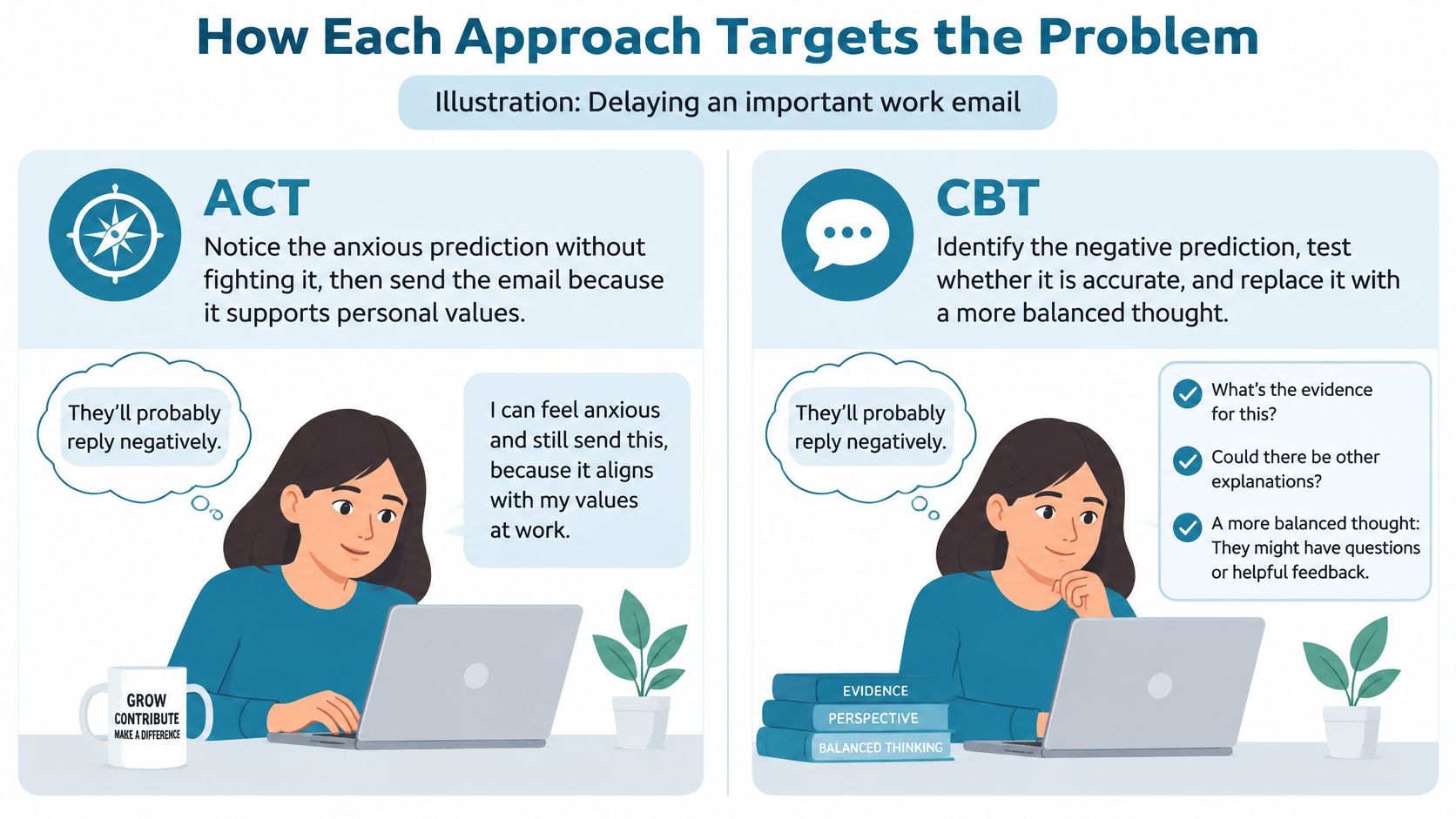
Same afternoon, two different sessions. This is an illustration, not a client story. Someone keeps putting off an important work email because they predict the reply will be harsh. The draft sits open. The prediction gets louder. The tab gets closed.
What a CBT hour would do with the draft
CBT uses a cognitive model: situation, thought, feeling, behavior. The situation is the unsent email. The thought is "They will think I am incompetent." The feeling is dread. The behavior is delay, which briefly lowers the dread and teaches the nervous system that waiting was the safe move.
In session you would write the prediction down and rate how strongly you believe it, maybe 80 out of 100. Then you would look for evidence on both sides. Harsh replies you have received. Messages that came back neutral or kind. Times you assumed criticism and got a scheduling question instead.
The test stays small. Share the draft with one trusted colleague before you send it to the intended recipient. Afterward you rerate the belief. The point isn't forced optimism. It's a cleaner read of a prediction you can check.
What an ACT hour would do with the same urge
ACT would not start by putting the thought on trial. It would use six linked processes.
Acceptance: make room for the tightness in your chest instead of trying to feel ready first.
Cognitive defusion: notice "they will think I am incompetent" as a thought, not a verdict.
Present-moment contact: feel your hands on the keyboard, one sentence at a time.
Self-as-context: you are the person noticing the worry, not only the worry itself.
Values: name what you care about at work, such as being reliable or clear.
Committed action: open the draft and send one honest version while the discomfort is still there.
The thought may still be loud after you hit send. ACT counts that as compatible with a good step.
A short video walks through how these two styles of therapy are often explained side by side.
CBT asks whether the thought is accurate and useful. ACT asks whether holding it is getting in the way of the life you want. On a single email, you can feel the fork. One path gathers evidence. The other changes your job with the thought and takes the valued step anyway.
What the Research Shows About Outcomes
Head-to-head comparisons don't crown a universal winner. A meta-analysis of 43 randomized controlled trials that directly evaluated ACT against CBT found no statistically meaningful difference in overall effectiveness at post-treatment or at follow-up. That same analysis found little evidence that therapist characteristics, client characteristics, treatment variables, or study design reliably decided which therapy performed better.
Comparable averages still leave room for a personal fit. They just don't support the claim that one approach outclasses the other for everyone.
How to read the smaller comparisons
Researchers often report a standardized mean difference (SMD) or Hedges' g. Zero would mean the two therapies landed in the same place. A positive number here leans toward ACT. The 95% confidence interval is the range that likely contains the true difference. If that range crosses zero, the study doesn't show a reliable gap.
Outcome | Evidence base | Effect | Reading |
|---|---|---|---|
Anxiety, clinician-rated, short term | 3 RCTs | SMD 0.13 (95% CI −0.17 to 0.43) | No significant difference |
Anxiety, follow-up through six months | 2 trials | SMD 0.26 (95% CI −0.10 to 0.62) | No significant difference |
Abstinence from substance use, follow-up | 3 studies | g = 0.34 (95% CI −0.04 to 0.71) | Small, nonsignificant, favors ACT |
Proposed processes of change | One meta-analysis | ACT g = 0.39; CBT g = 0.02 | ACT advantage on its own processes, not a symptom advantage |
For clinician-rated anxiety, a systematic review found no statistically significant difference in the short term (SMD 0.13, 95% CI −0.17 to 0.43, 3 trials) or at follow-up through six months (SMD 0.26, 95% CI −0.10 to 0.62, 2 trials). Both intervals include zero.
Substance-use results are thinner. A meta-analysis in the International Journal of Psychology and Psychological Therapy found a small, nonsignificant follow-up effect favoring ACT for abstinence (g = 0.34, 95% CI −0.04 to 0.71, 3 studies). The same line of research reported a significant advantage for ACT on its proposed processes of change (Hedges' g = 0.39), while differences favoring CBT on its proposed processes were not significant (g = 0.02).
What that can and cannot support
An edge on acceptance and psychological flexibility is not the same thing as better symptom relief. Processes can move without symptoms showing a clear winner. Many of these trials are small, especially the anxiety and abstinence comparisons, so a wide interval is a caution, not a footnote.
Similar outcomes don't mean the therapies are interchangeable. They mean the ranking is the wrong question.
The fair reading is two comparable options. Goals, readiness, the shape of the problem, and therapist skill should carry the decision, not a claim that one method is universally superior.
Matching the Approach to Anxiety, Overthinking and ADHD
ADHD is a neurodevelopmental condition. It can affect attention, executive functioning, and emotional regulation, and it doesn't look the same in every person. Missing a deadline, losing a thread in a meeting, or snapping in a way you regret is not proof of laziness or weak character. It also doesn't mean ADHD explains every hard thing in your life.
Anxiety is an alarm. It becomes a problem when it is too loud, too frequent, or in charge of your calendar. For anxiety outcomes, a systematic review and meta-analysis in Scientific Reports found ACT produced effects comparable to CBT, not a consistent advantage either way. Comparable results don't mean the two therapies do the same job.
Two ways of working with the alarm
CBT goes after threat appraisals. You name the catastrophe, test it, and build exposure in grades. A simple ladder runs from 1 to 10. You start with a rung you can finish, such as opening the document, then the next, such as writing the first paragraph in front of someone else.
ACT goes after experiential avoidance, the pattern of organizing your day so you never feel the alarm. Defusion changes how overthinking holds your attention. You move toward a valued activity while you are still uneasy, instead of waiting to feel certain. Overthinking often pretends to be preparation. A closer look at whether anxiety is what keeps the loop spinning can help you tell worry-as-planning from worry-as-avoidance.
When shame takes the driver's seat
Say a missed deadline becomes "I'm lazy," and that sentence makes the next start harder. The shame arrives before the task does.
ACT treats the self-judgment as a thought to notice. You take one small valued step while the shame is still in the room. Acceptance here doesn't mean approving of harmful behavior, dropping your goals, or tolerating unsafe substance use. It means less unproductive struggle with the inner experience, and a safer action you can stand behind. That matters if you're unsure about cannabis, stuck in avoidance, or waiting to feel like a person who deserves to begin.
CBT offers structure when the block is practical as well as emotional. Break the task down, schedule a short block, self-monitor what you did, and use behavioral activation so mood isn't the gatekeeper. We help people with ADHD understand how it shows up in their life and build strategies that work with their brain, not against it.
A simple way to see which gap remains
Track four things each week:
Anxiety rating: a 0 to 10 score on a typical day.
Avoidance frequency: how often you delayed or ducked something that mattered.
Valued activities: how many you completed, not how motivated you felt.
Quality of life: one rating for work, relationships, or energy, whichever you care about most.
If anxiety falls and your life stays narrow, flexibility work may be the missing piece. If you need a concrete test of a feared outcome, CBT procedures may be the faster tool. Many therapists combine both. Nothing in this comparison diagnoses you, and therapy doesn't replace medical evaluation or medication management when those are appropriate.
Choosing Between ACT and CBT by Goal
Read the rows as a starting map, not a diagnosis. Match your situation, notice which approach usually leans closer, and steal the question for a first conversation.
Situation | Often leans toward | Why | Question to ask |
|---|---|---|---|
Specific worries you can name and test | CBT | Behavioral experiments check predictions directly | How would we test this prediction? |
Ruminating on thoughts you cannot switch off | ACT | Defusion changes how thoughts hold attention | How will we work with the thoughts rather than argue them? |
Avoidance growing around work or relationships | Either, often combined | Exposure (CBT) and values-based action (ACT) both target avoidance | Which avoidance should we start with? |
Shame blocking any attempt to start | ACT | Self-compassion and values work alongside shame | How do we handle shame when it shows up mid-task? |
Skills gap, such as a hard conversation or planning a project | CBT | Skills training and structured practice fit this need | What skills will we practice between sessions? |
What to weigh before you pick a row
A few criteria sort the table quickly. How specific is the worry? Can you name a belief and a way to test it? How much has avoidance grown? Does shame shut down the attempt itself? Do your values feel missing, or only hard to act on? Are you willing to do structured practice between sessions?
CBT tends to suit people who want to examine thoughts and measure progress in behavior. ACT tends to suit people who feel that fighting their thoughts has become the problem. A life change can scramble both, which is why it helps to sort what the change is actually asking of you before you decide the therapy has to do everything at once.
Mixed needs are normal
Say you've already learned planning skills, and you still skip the conversation or the project that matters. Skills didn't fail. Avoidance stayed in charge. A therapist may pair exposure, so you approach the feared situation in steps, with values-based action, so the step is tied to something you chose rather than to a mood.
Goals shift. A first choice isn't a contract. Plenty of people do well with either approach when the therapist is skilled and the fit feels honest. Bring the row that sounds most like your week, and treat the question column as the opening, not the treatment plan.
Confirm the Fit Before You Commit
You do not have to settle the ACT versus CBT question before you book anything. The choice gets made in conversation, with a therapist who can hear what your actual week looks like and explain why one method fits it better than another.
A first call goes better with three things prepared. Bring a few specific situations that are hard right now, the more concrete the better. Bring what you have already tried, including apps, books, or a previous round of therapy that stalled. Bring a picture of what would look different in a month if the work were helping, stated as a behavior rather than a personality change.
If ADHD is part of what brings you in, an ADHD screening for adults can give that first conversation a sharper starting point. You do not need a diagnosis or a polished reason to begin therapy. Figuring out what you want to work on is part of the work itself.
Nick offers a free 15–20 minute phone or video consultation for exactly this: ask questions, say briefly what is bringing you in, and see whether the fit feels right before you schedule a first session. That session is for getting to know each other, naming what you want out of the work, and deciding together how to approach it.
Sessions run 60 minutes and usually start weekly, spacing out to every other week or less as therapy progresses. It is fair to ask any therapist how they review progress along the way. In-person sessions are available at two Dupont Circle offices, on Connecticut Avenue Wednesdays and Fridays and on P Street Mondays and Thursdays, with virtual sessions for clients anywhere in DC and Virginia.
Questions worth asking any therapist:
Approach: Which approach do you use here, and why this one for me?
Progress: How will we know the work is helping?
Blend: Do you combine ACT and CBT when both fit?
Session shape: What does a typical hour look like?
A clear problem, a therapist who can explain their method in plain language, and a plan you can practice between sessions will tell you more than any label on a website.
Nick Donahue LICSW offers individual therapy for teens and adults who want ADHD, anxiety, and overthinking work that is practical and emotionally honest, including ACT alongside other evidence-informed approaches. If you are deciding between ACT and CBT, a first conversation can match the method to your goals instead of forcing a winner. Visit Nick Donahue LICSW to schedule a free consultation or an initial session.
Comments