
How To Stop Burnout: A Practical Guide to Recovery

What if you're not failing at rest, and the job keeps recreating the exhaustion faster than you can recover from it? That's the question most advice about how to help burnout skips. It tells you to sleep more, meditate, and set boundaries, which can matter, but it rarely asks whether the workload itself is sustainable.
You don't need to decide today whether the problem is you or the job. You need a way to test both. Start by naming what you're experiencing, run a small recovery routine you can measure, and notice whether work conditions respond when you ask for change.
Table of Contents
How to Recognize Burnout and Tell It Apart From Tiredness - How tiredness usually differs
How to Set Up a Four-Week Recovery Routine - What to protect first
Setting Boundaries When Your Inner Critic Pushes Back - A defusion step before you answer - A three-part boundary statement
Change the Workload, Not Just Yourself - Build a request from evidence you collect
Deciding Whether to Get Professional Help - What individual therapy can and cannot do - Match the situation to the next step
How to Recognize Burnout and Tell It Apart From Tiredness
Burnout is a syndrome caused by chronic workplace stress that has not been successfully managed, classified as an occupational phenomenon rather than a medical condition, in the World Health Organization announcement on ICD-11 in May 2019. That distinction matters. You're not looking for a personal flaw, and you're not diagnosing yourself from a checklist.
The framework has three dimensions that tend to show up together over time. One rough week doesn't settle the question.
Dimension | What it looks like | Question to ask yourself |
|---|---|---|
Exhaustion | Drained even after rest, sleep that does not restore energy | Do I feel depleted most days, not only after a hard week? |
Mental distance | Cynicism, detachment or dread about work tasks and colleagues | Have I started seeing my job in consistently negative terms? |
Reduced efficacy | Work feels pointless, output slows or mistakes increase despite effort | Am I getting less done or feeling less capable than before? |
How tiredness usually differs
Ordinary tiredness often eases after a weekend, a few good nights, or a lighter stretch. Burnout more often survives rest. You return on Monday already bracing, you think about work while trying to fall asleep, and tasks you used to handle feel strangely heavy.
If you're tired after work most evenings but recover by morning, that's useful information too. It may point to pacing, sleep, or how you're winding down rather than a months-long pattern across all three dimensions.
A useful distinction: Tiredness asks for rest. Burnout asks what keeps draining you after you've rested.
WHO limits the term to work, so exhaustion centered on caregiving, school, or a relationship may need different language and a different assessment. Burnout can also overlap with depression and anxiety. Persistent low mood, loss of interest beyond work, panic, or hopelessness shouldn't be folded into burnout without separate evaluation.
For a self-check, write down which dimensions have been present for several weeks and what changed when they started. Note workload, staffing, expectations, control over your schedule, and conflict. You're building a timeline, not prosecuting a case against yourself.
How to Set Up a Four-Week Recovery Routine
A recovery routine works best as a measurement-guided cycle, not a personality overhaul. In a systematic review of 49 randomized trials, 67% reported a significant improvement in at least one burnout indicator, with emotional exhaustion most consistently affected. Results varied widely, so judge your routine by your own four weeks of data.
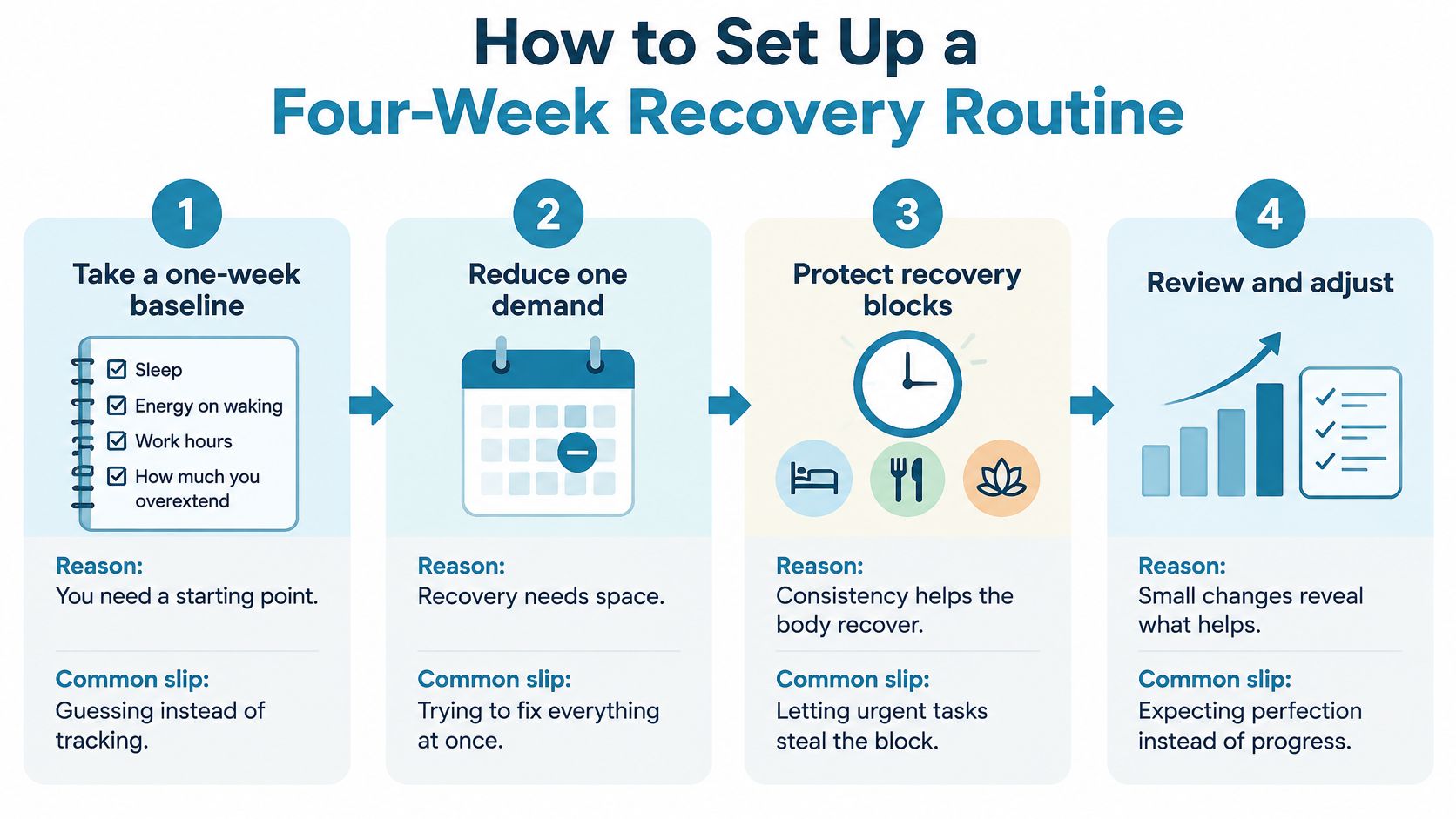
Take a one-week baseline. Note sleep, energy on waking, work hours, and how much you dread the next workday. You need a starting point. The common slip is guessing from memory, which usually captures only the worst day.
Choose three small behaviors. Pick one daily recovery action, such as a fixed shutdown time or a 10-minute transition ritual after work, one boundary action, such as a meeting-free block, and one values-consistent action outside work. Small matters because recovery needs room. The slip is trying to rebuild your whole life at once.
Practice for four weeks. Keep the routine small enough to survive a bad week and attach mindfulness or ACT practice to a cue. Before opening email, notice a racing thought, name it as a thought, then choose the next action by values rather than urgency. The slip is letting urgent tasks steal every protected block.
Review and adjust. Compare exhaustion with objective markers such as missed deadlines, sick days, sleep regularity, and workload. You're looking for patterns, not proof you're cured. The slip is quitting because adherence wasn't perfect.
What to protect first
Sleep deserves a concrete target. The CDC guidance on sleep and mental health says adults ages 18 to 60 should generally obtain at least seven hours of sleep per night, with a consistent bedtime and wake time. Regularity counts, not just time in bed scrolling while exhausted.
Three pitfalls can distort your conclusions. Don't judge only by immediate relief after one good evening. Don't treat lower exhaustion as proof the cause is gone. And don't abandon a minimum viable routine because you missed two days. Brief daily practice plus a weekly review tells you more than an ambitious plan you can't repeat.
Setting Boundaries When Your Inner Critic Pushes Back
Many boundaries don't fail because you lack the right sentence. They fail because guilt shows up first. You think, "I should be able to handle this," worry you're disappointing someone, and a reasonable limit turns into another yes. Burnout often grows from many small yeses, not one dramatic collapse.
The image below captures that moment of stopping guilt from making the decision for you.
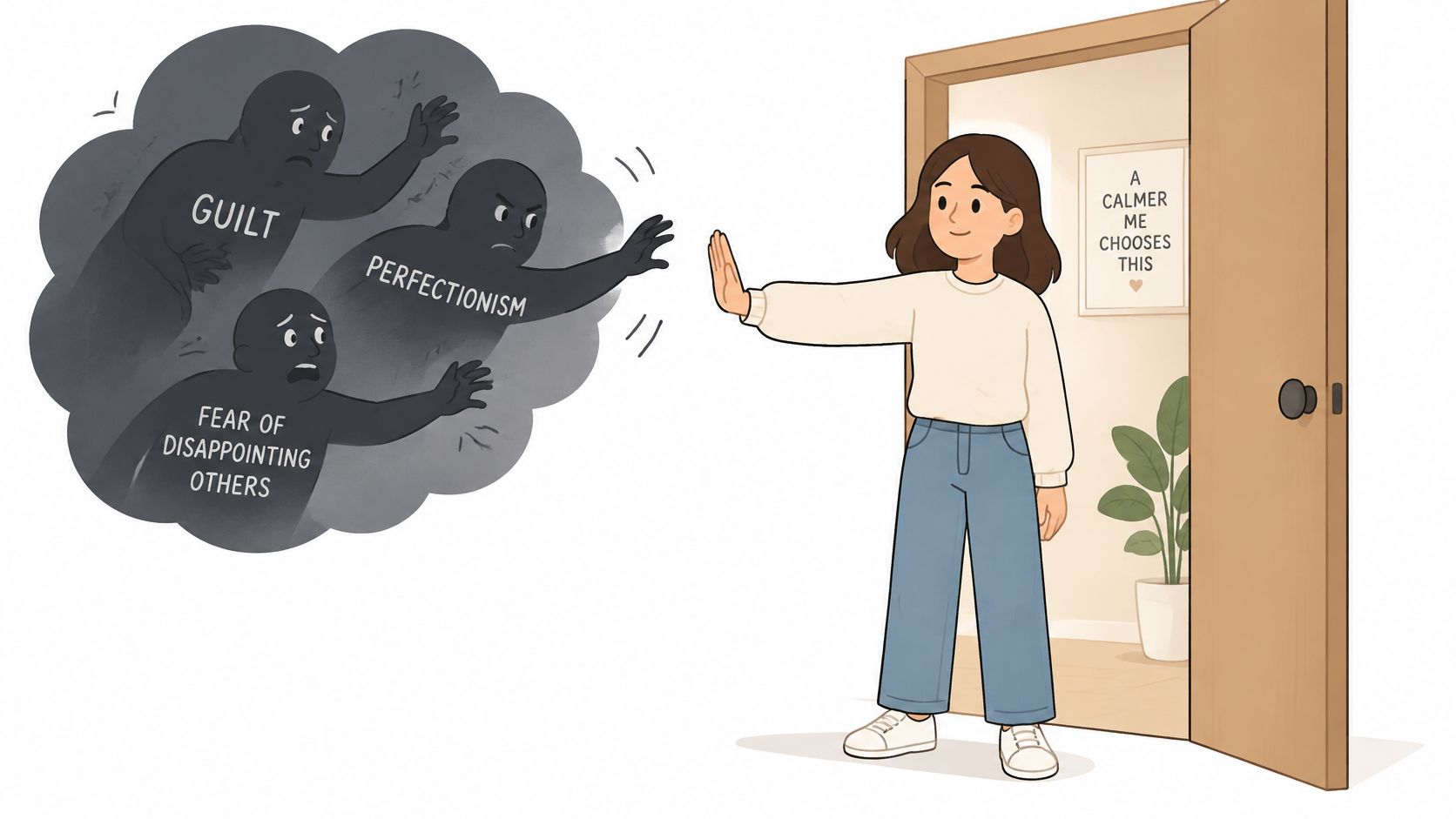
A defusion step before you answer
In Acceptance and Commitment Therapy, defusion means getting some distance from a thought so it doesn't automatically run your behavior. Notice the critical voice, name it as a thought rather than a verdict, then ask which action fits your values. Nick helps clients with shame and self-doubt by giving them distance from the critical voice in their head and a chance to build a different relationship with themselves.
That pause can sound simple internally. "I'm having the thought that a good employee would just absorb this." The thought may stay loud. You still get to choose whether tonight's extra work serves quality, health, or only avoidance of discomfort.
A boundary isn't a rejection of the work. It's information about timing, capacity, and trade-offs.
A three-part boundary statement
Use this structure and adapt the wording to your role:
Name the value at stake: "I want this done accurately."
State the limit plainly: "I can't add it today without dropping the client report."
Offer a realistic alternative: "I can take this on Thursday, or we can reassign the report."
Say a manager adds work late in the day. You might ask which existing priority should move. Say a colleague expects instant replies. You might state when you'll check messages during focused work. Say you volunteered for a project you now resent. You might renegotiate scope rather than carrying it.
For another view of how thoughts can hook you before you respond, watch this short video.
Some boundaries you can set alone, such as closing your laptop at a fixed time. Others need a conversation because only leadership can change staffing or deadlines. If ADHD affects how you start, sequence, or finish tasks, the boundary may also need a system, such as written priorities or a shutdown checklist. That doesn't mean ADHD explains every struggle at work.
Change the Workload, Not Just Yourself
A week can look manageable on paper and still end late because competing projects land at once, a meeting takes the recovery block, and the hardest task slides to the weekend. Better coping can help you endure that pattern longer. Endurance is not always a good outcome. If the same overload returns each week, asking only how to become more resilient leaves the main driver untouched.
A 2023 systematic review and meta-analysis in Occupational and Environmental Medicine included 23 studies and found an overall effect estimate of -0.33, a moderate reduction in burnout-related outcomes. Interventions aimed at workload and employee participation had stronger effects, while interventions aimed only at work schedules showed no measurable effect. The evidence was limited by small study numbers and substantial variation, so treat any single change as a test with an uncertain result.
Build a request from evidence you collect
Keep a log for two to four weeks. Record hours, workload peaks, sleep, exhaustion, and what displaced recovery. Then pick one or two demands driving the pattern and make a request specific enough that your manager can answer yes, no, or offer a trade-off.
Driver | Change to request | Example request |
|---|---|---|
Excessive workload | Reduce concurrent projects or reassign one task | Can we move the migration to next quarter so I can finish the reporting work well? |
Low control | Agree on who sets priorities and how changes are approved | Who decides which request wins when two deadlines conflict? |
Unclear expectations | Written scope and agreed response times | Can we confirm what done looks like and when you expect replies? |
Insufficient recovery | Protected focus blocks or a fixed end-of-day cutoff | Could I keep Tuesday and Thursday mornings free for focused work? |
Interpersonal conflict | Clear escalation path and a regular check-in with the manager | Can we set a 20-minute weekly check-in to catch problems early? |
Cutting low-value load protects attention for work that requires it. The school version of that question is whether less homework benefits students; at work, the test is which tasks can move, pause, or disappear without harming the result.
Judge the response, not only the tone. Does leadership engage with your log, clarify priorities, or negotiate a real trade-off? Or does every conversation end with you absorbing more? Therapy can help with values, communication, and boundaries, though it cannot correct unsafe staffing or impossible deadlines. A job that cannot change gives you different information than a job you have not yet asked to change.
Deciding Whether to Get Professional Help
Self-help has a role, but it shouldn't become another job you feel you're failing. A structured starting protocol is 6 to 8 weeks of mindfulness, cognitive-behavioral, or ACT-based practice tied to actual work triggers, alongside at least one concrete workplace change. Reassess at 8 to 12 weeks and again at six months, because early relief can fade when nothing around you changes.
That timeline fits what a 2025 systematic review of 14 workplace-program studies involving 3,572 participants found. Multilevel programs addressing both the person and the organization had the strongest evidence, mindfulness produced moderate effects at eight weeks, benefits often waned by six months without organizational reinforcement, and app-only interventions had attrition above 40%. If an app isn't holding your attention, that isn't proof you're unmotivated.
What individual therapy can and cannot do
Therapy usually starts with what's been going on, then gets curious about patterns. You might clarify values, notice how perfectionism or avoidance shapes your choices, and practice communication before a difficult conversation at work. For life transitions, therapy offers a space for people who feel burned out, disconnected, uncertain about their next step, or adjusting to a major change, without needing the "right" reason to come.
Sessions here are 60 minutes, providing time to talk, dig into what's going on, and do work together rather than a quick check-in. That length helps when the question isn't only "How do I relax?" but "Do I renegotiate this role, ask for leave, or start planning an exit?"
The central pitfall: Using meditation or time-management training to compensate for an unsafe workload doesn't make the workload safe.
Therapy also doesn't replace medical evaluation. A primary care visit can help assess sleep problems, thyroid issues, medication effects, depression, anxiety, or substance use that may be contributing to exhaustion. Sometimes burnout is the main frame. Sometimes it's only part of what's happening.
If you're exploring support designed for a therapist for high achievers, look for someone willing to discuss workload and job design alongside coping skills. A good fit won't promise that better breathing exercises will fix chronic understaffing.
Match the situation to the next step
Situation | Most useful next step |
|---|---|
Exhaustion lasts weeks despite routine changes | Talk with a therapist and your primary care provider |
Persistent low mood, anxiety or hopelessness | Medical evaluation alongside therapy |
Drinking, cannabis or other use increasing to cope | Prompt clinical assessment |
Work conditions unchanged after documented requests | Discuss options with HR, a manager or an employment advisor, and plan an exit if needed |
Trouble working, sleeping or caring for yourself | Prompt professional evaluation |
Start with one decision. If all three dimensions persist and the job hasn't changed, begin the four-week routine and schedule one workplace conversation. If symptoms last past 8 to 12 weeks, or a situation in the table applies, arrange a medical or therapy evaluation instead of relying on self-help alone.
You can reach out to the practice to talk through which path fits, or take the first step without contacting anyone. Nick offers a free 15 to 20 minute phone or video consultation to ask questions, briefly discuss what's bringing you to therapy, and see whether you're a good fit before scheduling the first session.
If burnout has left you unsure whether you need better coping tools, a redesigned workload, or a bigger change, Nick Donahue LICSW offers thoughtful, practical therapy in Washington, DC and virtually across DC and Virginia for adults navigating burnout, ADHD, anxiety, and life transitions. You can use that space to slow down, clarify your values, and decide on next steps without being told to try harder. Visit Nick Donahue LICSW to learn more or ask about a consultation.
Comments