
Less Homework Benefits Sleep and Learning

Dinner's over, the dishes are put away, and your teen is still staring at an assignment that looked manageable when they opened it. You've reminded them to keep going, then reminded them again. Bedtime keeps moving, and both of you are starting to sound more frustrated than you intended.
Less homework benefits students when it removes unnecessary work without removing meaningful learning. The strongest argument isn't that students should stop practicing. It's that practice needs a purpose, a realistic stopping point, and enough room around it for sleep and recovery.
Table of Contents
What Less Homework Benefits Really Mean - Less but better, not less learning - Look at the evening, not just the page
Where Extra Homework Stops Raising Achievement - Homework Time Benchmarks by Stage - A modest association isn't a promise
How a Lighter Load Protects Sleep and Mood - What the health findings do and don't show - Protect bedtime without promising a cure
What Overload Looks Like in Real Evenings - The elementary-school battle - The high-school evening with no room left - The assignment that expands
Choosing What to Cut and What to Keep - Compare the alternatives - Match support to the actual barrier
Using the Freed Time on Purpose - Build a finishable evening - Evaluate the pattern, not a difficult night
A Practical Next Step for Overloaded Teens - When the problem is bigger than homework - Make the next conversation specific
What Less Homework Benefits Really Mean
A completed worksheet can tell you whether a student answered the questions. It can't tell you what the evening cost them. A teen might finish while exhausted, a parent might spend the night supervising, and neither may feel ready to repeat the experience tomorrow.
Consider a hypothetical student who understands the math but keeps checking every answer because making a mistake feels unacceptable. Another student knows how to solve the problems but loses track of the directions whenever they switch tabs. Their evenings may look similar, but they need different kinds of support.
Less but better, not less learning
Less but better means choosing age-appropriate assignments that serve a clear learning goal and have a reasonable ceiling. Reading, recalling material without looking at notes, or practicing a skill can remain part of the evening. Repeating work after the student has demonstrated understanding deserves a closer look.
The research doesn't support treating time spent as a direct measure of learning. Longer completion times can reflect difficulty, heavier assignments, or different school expectations rather than greater understanding.
A useful distinction is:
Academic value: Does the assignment help the student practice something they need?
Personal cost: Does completing it repeatedly displace bedtime, meals, relationships, or recovery?
Practical fit: Can this student complete it with the skills and support currently available?
Look at the evening, not just the page
For families in Washington, DC and Virginia, the problem may feel familiar beyond school. An adult can lose an evening to restarting an unfinished work task, just as a teen can lose an evening to reopening the same assignment. That similarity can invite empathy without assuming everyone involved has ADHD.
ADHD is a neurodevelopmental condition that can affect executive functioning, the abilities involved in starting, organizing, and following through. Experiences vary, and anxiety, unclear instruction, or an overloaded schedule can also make homework difficult.
The useful question isn't simply whether a student finished. It's whether the assignment justified what finishing required.
That question leaves room for effort and accountability. It also makes room for changing an assignment when persistence has stopped being productive.
Where Extra Homework Stops Raising Achievement
Diminishing returns means that additional work eventually contributes less than the work that came before it. A student may benefit from practicing an unfamiliar skill, then gain little from continuing after they can already use it independently.
Age matters. Harris Cooper and colleagues' synthesis found a substantially stronger homework-achievement association for secondary students than for elementary students. The benchmarks below, summarized in Brookings' discussion of Cooper's homework research, describe approximate patterns and historical guidelines, not individual prescriptions.
Homework Time Benchmarks by Stage
Stage | Benchmark | What it suggests |
|---|---|---|
Elementary school | The historical 10-minute-per-grade guideline gives about 30 minutes in third grade | A reference for discussing unusually long evenings, not proof that every minute helps |
Middle school | Positive associations reportedly level off near 90 minutes nightly; the grade-based guideline gives 60 minutes in sixth grade | More work shouldn't automatically be treated as more useful practice |
High school | Benefits generally extend through roughly 90 minutes to 2.5 hours before weakening or potentially becoming negative; the guideline gives 120 minutes in twelfth grade | Longer assignments need a defensible purpose, especially when they displace rest |
These figures don't identify a universally safe or effective stopping point. Different subjects, instructional approaches, and student needs make that impossible. A student struggling with the underlying concept may need explanation rather than either more questions or a timer alone.
A modest association isn't a promise
A 2022 international meta-analysis of homework time and achievement combined 488 independent findings from 74 countries, covering 429,970 students across seven TIMSS survey cycles, and found a statistically significant but small overall effect of d = 0.186. Students doing moderate amounts generally performed better than those doing very little.
That effect size isn't a percentage improvement in grades. It describes a modest overall relationship across the included findings, not what will happen to a particular child if their homework changes.
For a parent, the practical interpretation is narrower than either side of the homework debate sometimes suggests:
Keep purposeful practice: Some homework can contribute to achievement.
Question added volume: Benefits don't increase proportionally with time.
Investigate difficulty: A long evening may signal missing instruction rather than insufficient effort.
A workload ceiling should open a conversation with the teacher, not become another standard a student can fail. The goal is to understand what the student is learning and whether additional work contributes enough to justify continuing.
How a Lighter Load Protects Sleep and Mood
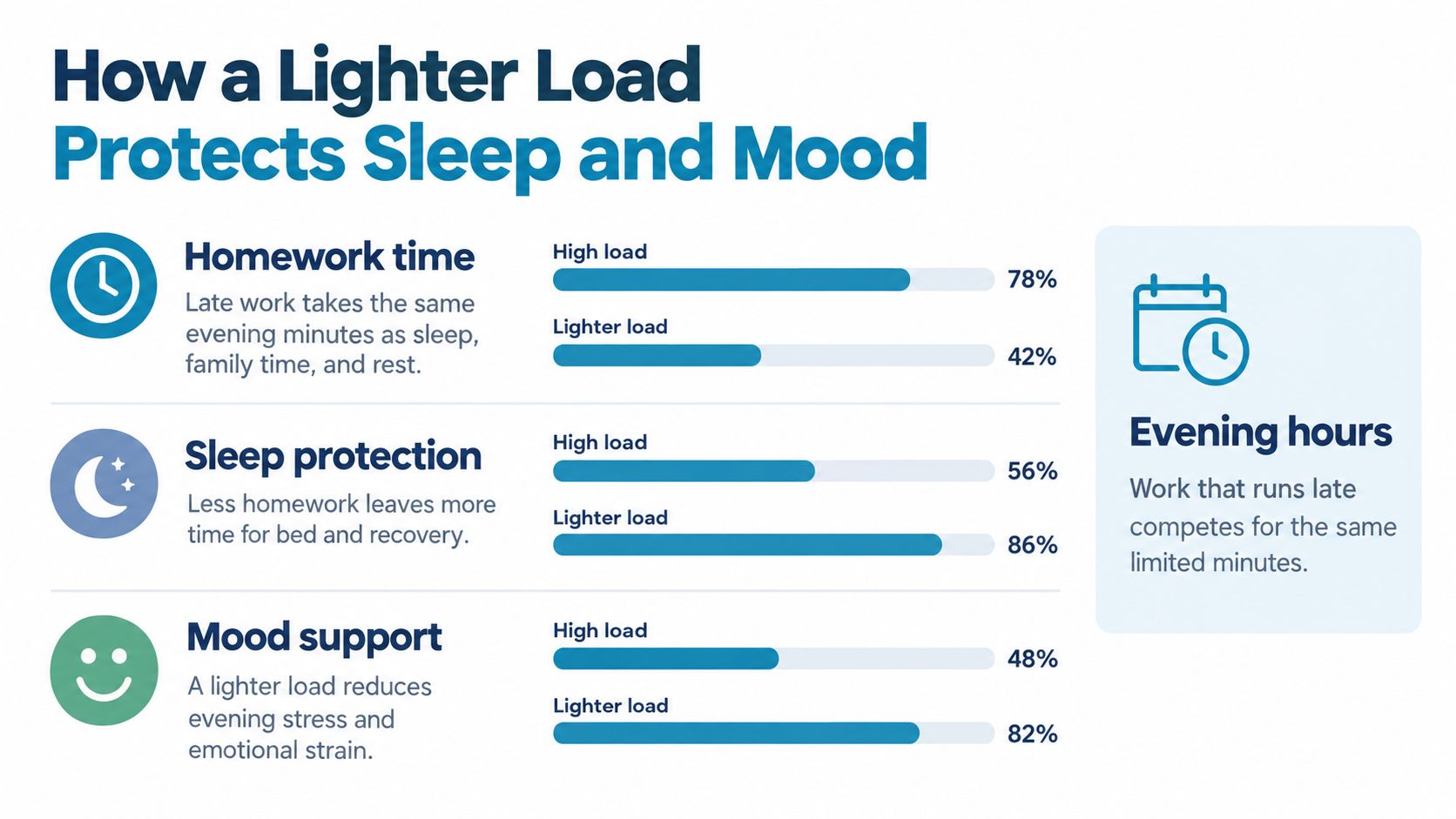
Homework and sleep use the same evening hours. When a student works later without changing their morning schedule, they have less opportunity to be in bed. That's a scheduling problem before it's a question of motivation.
In a Singapore study of adolescent studying, sleep, and depressive symptoms30124-8/fulltext), adolescents studying at least five hours daily had approximately 30–35 fewer minutes in bed than those studying two to under three hours. Those studying under two hours had roughly 15–20 additional minutes available for sleep and other activities, and heavier schedules were associated with less social time.
What the health findings do and don't show
A Shanghai adolescent cohort study associated high homework burdens with greater neurobehavioral-problem risk, reporting incidence-rate ratios of 1.345–1.688. Reduced sleep statistically explained part of that association, with stronger mediation among girls.
That doesn't establish that homework alone caused those problems. Statistical mediation identifies a possible pathway, not definitive proof of the sequence for every student.
The Singapore study also associated weekend homework with greater depression-symptom severity after accounting for sleep. That finding raises another possibility: losing choice, social connection, and downtime may matter independently of bedtime.
This visual summarizes the proposed scheduling pathway, rather than proving that reducing homework will improve every student's mood.
Protect bedtime without promising a cure
Sleep loss can make attention, working memory, and emotional regulation harder. For a teen already struggling with ADHD or anxiety, it's reasonable to consider whether late work is making tomorrow's demands harder to manage.
That's different from saying that homework reduction treats ADHD, anxiety, or depression. Those concerns may require assessment and support regardless of workload.
Notice the timing: Is distress concentrated around late-night work, or present throughout the day?
Protect recovery: Consider bedtime and social contact when discussing assignment changes.
Keep a wider view: Persistent mood changes deserve attention beyond a homework adjustment.
Families can also explore emotional regulation for teens when frustration repeatedly turns into shutdown or conflict. A workload boundary may help create room for that work, but it isn't a substitute for understanding the teen's broader experience.
What Overload Looks Like in Real Evenings
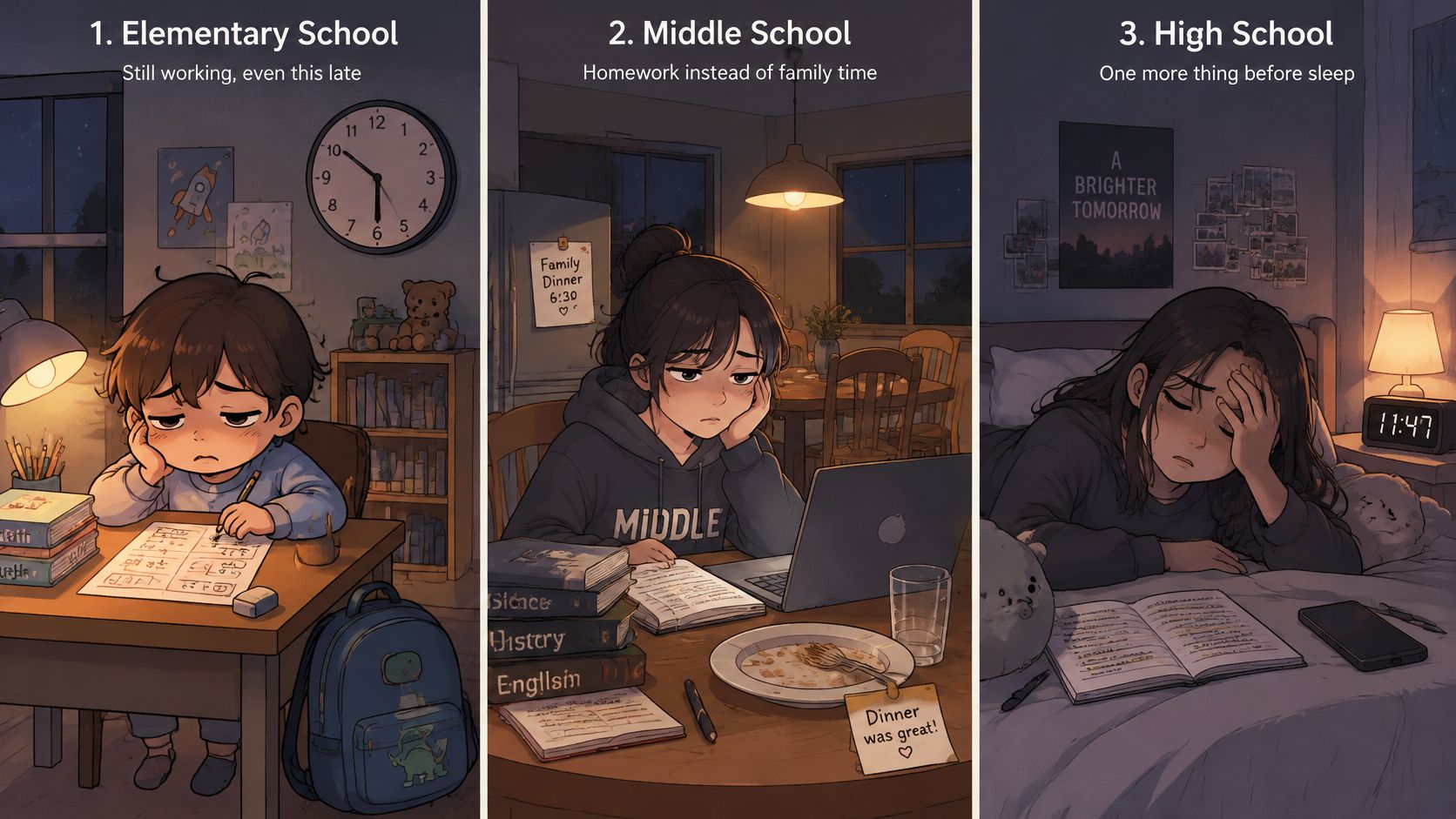
The following are hypothetical illustrations, not client stories. They show different reasons a household might need to change its homework routine rather than push harder.
The image offers a visual reminder that overload can appear across school stages.
The elementary-school battle
A child completes part of a packet independently, then starts resisting. Their parent sits beside them, corrects mistakes, and eventually supplies more and more of the thinking. By the end, the packet is complete, but the teacher has little information about what the child could do alone.
A nationally representative study of parental homework help found no statistically significant relationship with elementary mathematics or reading achievement after accounting for factors including socioeconomic status and parental education. That doesn't make parental involvement useless, but it challenges the assumption that more direct assistance necessarily improves achievement.
Here, a constructive change might be preserving the child's independent attempt and asking the teacher how to handle unfinished work. Less conflict needn't mean less care.
The high-school evening with no room left
Another student starts promptly and works steadily, yet still has no space to relax. Their problem isn't getting started. It's the amount assigned across classes.
A high-school survey discussed by ASCD reported average loads of 2.8 hours nightly, rising to 3.2 hours with an Advanced Placement course; researchers cited a significant effectiveness drop-off beyond two hours. In that survey, 59% identified insufficient sleep and 52% identified insufficient time for play, relaxation, friends, or family as major stressors.
For this student, another organizational system may miss the point. Coordinating deadlines and discussing assignment volume may be more relevant.
The embedded video provides an additional resource for considering the homework conversation.
The assignment that expands
A teen with ADHD repeatedly loses their place. A teen with anxiety keeps rewriting an acceptable answer. In either illustration, the visible assignment understates the effort required.
Possible adjustments differ:
For losing the thread: Keep directions visible and work from a selected portion.
For repeated checking: Agree on what counts as a completed response.
For unclear understanding: Ask for instruction rather than adding repetition.
Readers who recognize this pattern may find the discussion of feeling overwhelmed all the time useful. Recognizing overload is a starting point, not a diagnosis.
Choosing What to Cut and What to Keep
Before removing an assignment, identify what's making it costly. Does the student already understand the skill? Are they confused? Is the workload reasonable on paper but unmanageable in practice?
A 2025 study of 68,891 Chinese adolescents associated longer homework duration with shorter sleep, lower well-being, and higher ill-being. It identified approximate thresholds of 1.00 hour for primary students, 1.32 hours for middle-school students, and 1.80 hours for high-school students, varying by gender, outcome, and weekday versus weekend.
Those are study-specific findings, not universal clinical limits. They reinforce the value of examining developmental stage and health outcomes alongside achievement.
Compare the alternatives
Option | When to discuss it | What needs protection |
|---|---|---|
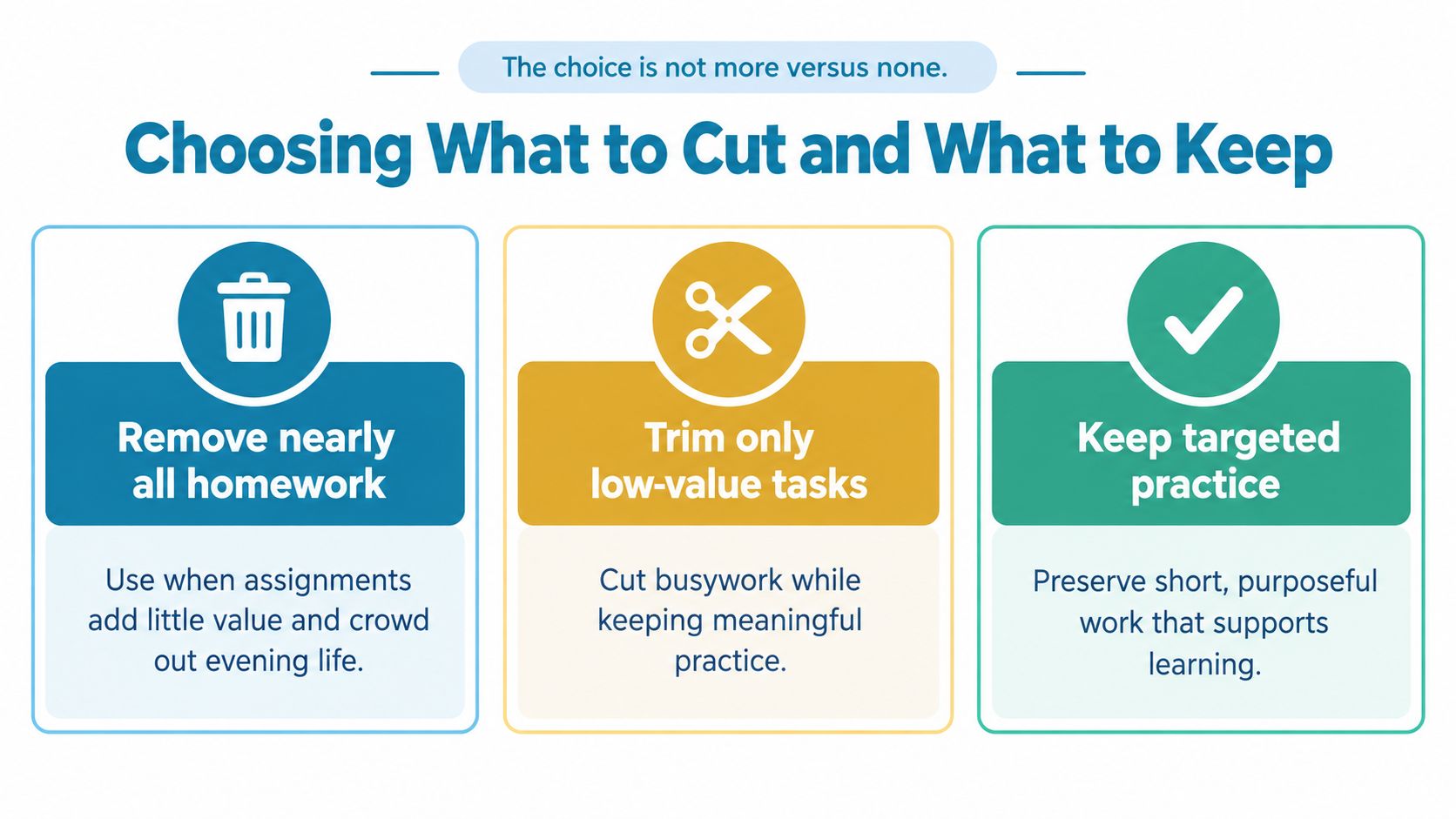
Remove nearly all homework | Assignments appear to offer little benefit and consistently crowd out essential needs | Access to instruction and any genuinely necessary practice |
Trim low-value repetition | The student can demonstrate the skill without completing every similar item | Representative questions, reading, problem solving, and feedback |
Change timing and support | Starting, organizing, or checking consumes more effort than the academic task | A manageable entry point and a clear definition of completion |
These options aren't interchangeable. Removing practice won't explain a misunderstood concept, and teaching a planner system won't reduce an excessive assignment load.
The comparison below highlights the difference between cutting volume and preserving purpose.
Match support to the actual barrier
A useful test is whether additional work changes understanding or merely prolongs completion. If quiz performance stays steady while avoidance and bedtime delays increase, discuss volume with the teacher. If understanding remains shaky, ask what instruction or feedback is missing.
Decision check: Keep the part that serves learning. Renegotiate the part that repeatedly displaces essential care without a clear benefit.
Therapy is a separate support option, not another homework policy. It may help a teen examine shame, tolerate imperfect work, communicate needs, or understand a recurring conflict with a parent.
For adults, the same conversation may involve unfinished work and the belief that stopping means being irresponsible. The practice's overview of research on homework offers another starting point for discussing workload without reducing the issue to effort alone.
Using the Freed Time on Purpose
An empty evening doesn't automatically become a restorative one. A student may switch from homework to scrolling, replay the unfinished assignment in their mind, or enter another argument about how they should use their time.
It helps to decide what the reclaimed time is for before changing the workload. A review of homework research reports that the positive junior-high achievement association disappeared at approximately one to two hours nightly. That supports questioning added volume, while still preserving purposeful practice.
Build a finishable evening
Start with a plan the student can understand without repeated reminders. Write it on paper or place it beside the assignment, rather than leaving it as a conversation everyone remembers differently.
Make the stopping point visible: Agree on when work ends and how unfinished work will be communicated to school.
Choose the priority: Identify the assignment or portion that most clearly addresses the learning goal.
Check for understanding: Review where the student became stuck rather than automatically redoing everything.
Name what comes afterward: Protect food, movement, a sleep routine, and ordinary contact with other people.
For a teen who struggles to start, the first action might be opening the document and writing a rough response. For someone who gets trapped in checking, the plan might define an acceptable draft before work begins. These are experiments to discuss and adjust, not techniques that work for everyone.
Evaluate the pattern, not a difficult night
As a practical home experiment, watch bedtime consistency and whether retained practice is reflected in quizzes over the next couple of weeks. This is a suggested observation period, not a validated treatment protocol. Include the teen's experience, especially whether the revised plan feels clearer or creates a different kind of pressure.
A realistic plan may reduce repeated decisions and restarts. It can also make it easier to distinguish difficulty with the material from difficulty managing the process.
Rest shouldn't depend on producing a flawless evening. Build it into the plan rather than leaving it as whatever time remains.
Coordinate assignment changes with the teacher. Home routines and psychotherapy don't replace school policies, an educational evaluation, or medical assessment when those are needed.
The aim isn't to fill every reclaimed minute with another improvement project. Sitting with a sibling, taking a walk, or having an unhurried snack can be enough. Recovery doesn't need to look impressive to belong in the evening.
A Practical Next Step for Overloaded Teens
A useful next step may be a conversation about a single difficult assignment, not an overhaul of the entire household. Bring the teacher an example: what the task required, where the student got stuck, what they completed independently, and what happened to bedtime.
That gives everyone something more workable than a disagreement about whether the student tries hard enough. It also leaves room for the teacher to explain the assignment's purpose or suggest a different way to demonstrate understanding.
When the problem is bigger than homework
Some families adjust the workload and still find that schoolwork brings intense shame, shutdown, or arguments. That doesn't mean they made the wrong adjustment. It may mean the homework situation also involves fear of failure, strained communication, or difficulty asking for help.
Therapy can provide a place to examine those patterns without making the teen the household problem. The work might include noticing a harsh internal story, practicing a more direct request, or learning to stay with discomfort without repeatedly checking an answer.
ACT-informed work: Explore what matters to the person and how to act on it even when difficult thoughts are present.
Interpersonal work: Understand how reminders, withdrawal, criticism, or rescuing affect relationships.
Mindfulness and humanistic work: Notice experience with less judgment while making room for the person's own perspective.
No approach fits everyone. Therapy can also help clarify when additional educational or medical support deserves consideration, without assuming that every homework struggle reflects ADHD.
Make the next conversation specific
Adults who recognize their own unfinished-work patterns in a teen's evening may want support too. A parent's frustration and a student's distress can both deserve attention without either person becoming the villain.
At Nick Donahue LICSW PLLC, Nick Donahue, LICSW, offers individual 60-minute sessions for high-school-age teens and adults, in person in Washington, DC and virtually for clients located in DC and Virginia. His approach draws on ACT, interpersonal, humanistic, and mindfulness-based therapies as appropriate, alongside firsthand understanding of ADHD. You don't need a diagnosis to begin.
Visit Nick Donahue LICSW PLLC to learn about services and request an initial consultation about ADHD, anxiety, school stress, or emotional overload. The conversation can focus on your needs and whether the practice feels like a fit, without a promise about grades or outcomes. For this week, start smaller: name an assignment to discuss shortening and a bedtime to protect.
Comments