
Stress Response Cycle Explained: Stages and Recovery

Why can you know a stressful situation is over and still feel as though your body hasn't gotten the message? A difficult conversation ends, the deadline passes, or the email turns out to be harmless. Yet you're still tense, distracted, or replaying what happened.
The stress response cycle is the body's process of responding to a demand and moving back toward its usual level of functioning. It isn't a single switch. Different parts of the response activate and settle at different speeds, and recovery looks different from person to person. Understanding that timing can be more useful than trying to find the perfect exercise to make yourself calm down.
Table of Contents
The Stress Response Cycle Stage by Stage - From the initial alarm to recovery - Why the same event can feel different later
The Body Systems Behind the Stress Response - Mobilizing, sustaining, and settling - What cumulative stress means
How Stress Shows Up in Emotions and Behavior - Notice more than anxiety - Where ADHD can complicate the picture
Why Your Stress Cycle May Look Different From Others - Learn the sequence that actually happens - When to seek another perspective
Ways to Support Recovery and Regulation - Match the practice to the problem - Address what keeps happening
The Stress Response Cycle Stage by Stage
The stress response cycle is a layered sequence: the sympathetic nervous system responds rapidly, while the hormonal response develops more slowly. That means activation can outlast the problem, without you deliberately holding on to it.
A helpful distinction is between the stressor, such as a tense meeting, and the stress response, which includes what happens in your body, attention, and emotions. Ending the meeting changes the situation. It doesn't instantly reverse everything your body has started.
From the initial alarm to recovery
The sympathetic nervous system prompts the release of adrenaline and noradrenaline. Your heart may race, your breathing may speed up, and your attention may narrow toward whatever seems urgent. Meanwhile, the hypothalamic-pituitary-adrenal axis, usually shortened to HPA axis, begins a hormonal sequence.
The hypothalamus releases corticotropin-releasing hormone, the pituitary releases adrenocorticotropic hormone, and the adrenal cortex releases cortisol. A review of acute stress physiology describes cortisol reaching its maximum about 20 minutes after socially evaluative stress ends, helping explain why you might remain preoccupied after a challenging interaction.
Stress response cycle stages and typical timing
Stage | When it happens | What the body does | What you may notice |
|---|---|---|---|
Sympathetic alarm | Begins almost immediately when the stressor starts | Catecholamines, including adrenaline and noradrenaline, rise | Racing heart, faster breathing, narrowed attention |
Cortisol rise | Peaks about 20 to 40 minutes after onset in typical studies | The hypothalamus and pituitary signal the adrenal cortex to release cortisol | Lingering tension and mental preoccupation after the event |
Catecholamine settling | Returns toward normal within about 30 to 60 minutes | Sympathetic output eases | Physical arousal starts to fade |
Cortisol return toward baseline | About 60 minutes after the stressor ends in typical studies | Cortisol clears gradually, with a half-life of about 60 to 70 minutes | Fatigue or flatness can follow |
Incomplete recovery | Extends when stressors repeat before recovery | Repeated activation creates ongoing demands | Poor sleep, irritability, and stronger reactions to small triggers |
The cortisol timing in this table reflects a systematic review of physiological stress measurement, which describes peaks approximately 20 to 40 minutes after onset, movement toward baseline about 60 minutes after the stressor ends, and a circulating half-life of roughly 60 to 70 minutes. A review comparing stress-response pathways describes catecholamines returning toward normal within approximately 30 to 60 minutes.
These are broad research patterns, not a countdown your body must follow. Studies differ in the stressor used, the people participating, and how measurements are collected. A hormone's half-life describes its gradual clearance, not the exact moment you should feel better.
Why the same event can feel different later
Time of day matters too. In a study of circadian differences in stress reactivity, cortisol was normally higher in the morning and lower in the evening, and an acute psychological challenge produced a stronger cortisol response in the morning. That doesn't make evening stress harmless.
Mental activity also matters. You might leave a meeting but continue rehearsing what you should've said, keeping your attention on the perceived threat even as physical arousal begins to settle.
Practical rule: Treat recovery as a pattern to observe, not a deadline you're failing to meet.
A single cortisol reading, stress rating, or wearable metric can't define the whole cycle. Notice when activation starts, what changes afterward, and when ordinary functioning becomes easier again.
The Body Systems Behind the Stress Response
Think of a smoke alarm and its reset mechanism. You need the alarm to respond when there's a problem, but you also need the system to quiet down afterward. Human stress regulation is more complicated because several interacting systems handle those jobs.
The diagram separates their main roles without implying that they operate independently.
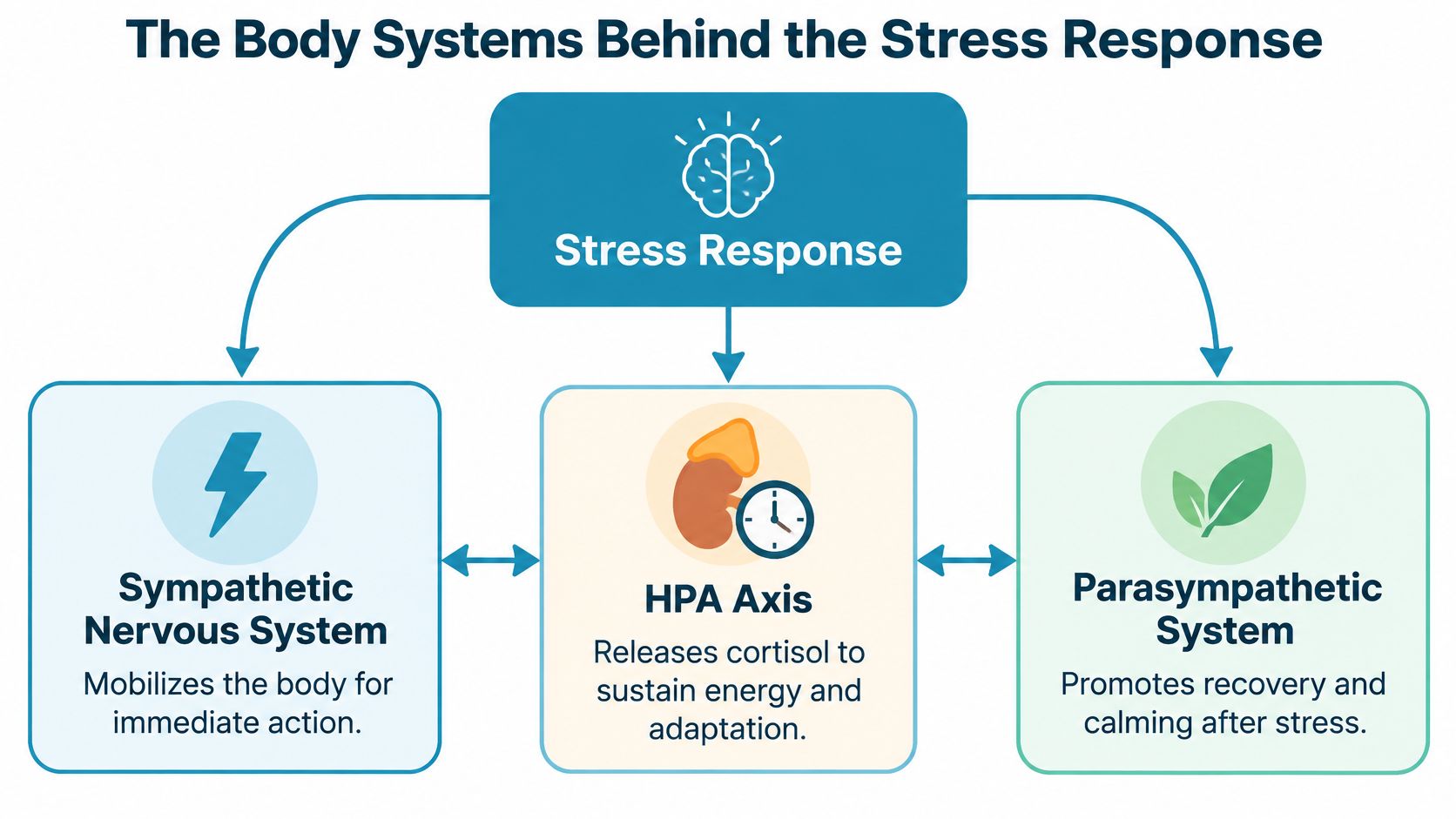
Mobilizing, sustaining, and settling
The sympathetic nervous system mobilizes you for action. The HPA axis supports energy availability and adaptation through cortisol. The parasympathetic nervous system helps restore conditions for rest and recovery.
Recovery also involves feedback from the hypothalamus and brain regions including the prefrontal cortex and hippocampus. A review of interacting stress systems explains that these pathways can respond together or in partly uncoupled patterns. Feeling physically tense and having higher cortisol aren't interchangeable.
That distinction matters when someone looks composed but feels overwhelmed internally. It also matters when someone feels a racing heart without identifying their experience as anxiety. There isn't a single bodily measurement that translates neatly into how stressed a person feels.
This video offers another way to approach the topic.
What cumulative stress means
Researchers use allostatic load to describe cumulative biological dysregulation across systems. It's not a synonym for a stressful afternoon, and it isn't something you can diagnose by noticing tension. A multi-cohort analysis of allostatic load illustrates why researchers examine patterns across physiological systems rather than treating a single hormone reading as the whole story.
Examples of research measurements include cortisol, blood pressure, and heart rate variability. Heart rate variability describes variation in the time between heartbeats, not whether your pulse is fast.
You don't need to turn your home into a laboratory to learn something useful about your stress response.
These measurements are research and clinical tools, not a checklist for self-testing. Your daily observations can stay much simpler: whether your heart feels faster, your jaw or shoulders tighten, your breathing changes, and your sleep feels restorative. The aim is to understand your experience, not to produce a perfect nervous-system score.
How Stress Shows Up in Emotions and Behavior
Illustrative example: You receive a short work email asking to discuss a project. You reread it, feel your chest tighten, and begin drafting a defensive reply. Before you've identified any anxiety, you've stopped working on everything else.
Later, you send a sharper response than you intended. Then you criticize yourself for overreacting and avoid opening the next email. The original message was brief, but your response now includes physical tension, uncertainty, avoidance, and a possible relationship repair.
Notice more than anxiety
Stress doesn't always announce itself as fear. Sometimes the first clue is how you're treating yourself or other people.
Emotional signs: Irritability, overwhelm, emotional flatness, or feeling unusually hurt by a small interaction.
Thinking changes: Narrowed attention, racing thoughts, difficulty switching tasks, or harsh self-criticism after reacting.
Behavioral changes: Procrastinating, withdrawing, snapping, or reaching for scrolling, food, or alcohol to take the edge off.
These signs aren't specific to stress, and they don't establish a diagnosis. They're starting points for curiosity: What happened just before this change, and what did I need at that moment?
Replaying an interaction can feel productive because you're working hard mentally. But reviewing the same unanswered question isn't always helping you decide what to do. Understanding rumination versus problem-solving can help distinguish repetitive mental rehearsal from thinking that leads to a concrete next step.
Where ADHD can complicate the picture
ADHD is a neurodevelopmental condition, not a lack of character or effort. It can affect executive functioning, emotional regulation, relationships, and daily responsibilities, although people's experiences differ substantially.
An analysis summarized by the American Psychological Association found significant emotion dysregulation in approximately 30% to 70% of adults with ADHD. Intense reactions, rapid emotional shifts, and difficulty settling arousal can make it harder to recognize where a stress response begins and ends.
Not everyone with ADHD experiences these difficulties, and ADHD doesn't explain every conflict or hard day. Anxiety, depression, sleep difficulties, and the demands of a particular situation may also deserve attention.
An Acceptance and Commitment Therapy, or ACT, approach makes room for the response without requiring you to obey every thought or urge. In the email scenario, that might mean noticing defensiveness, allowing the discomfort to be present, and choosing to ask for clarification rather than immediately arguing.
The useful observation isn't that you reacted badly. It's that chest tightness came before the defensive reply, and self-criticism came before avoidance. Those details give you something more workable than a judgment about your personality.
Why Your Stress Cycle May Look Different From Others
The familiar diagram of trigger, activation, recovery, and baseline is a useful teaching tool. It's not a universal script. Your response may be less orderly than a diagram suggests.
A 2025 study of acute stress responses found that heart rate generally rose immediately, while heart rate variability declined later and temporarily overshot after the stressor ended; some participants instead showed increased heart rate variability during stress, a pattern associated with higher anxiety. These subgroup findings are early and need replication. They aren't established categories you should use to label yourself.
Learn the sequence that actually happens
You might function well through a demanding event and feel shaky afterward. Someone else might become quiet or have trouble speaking, while another person notices bodily arousal without consciously feeling anxious. Outward calm alone doesn't tell you whether someone has recovered.
Use these questions to describe your own sequence:
What happens first? A body sensation, a thought, an emotion, or a change in behavior?
How long does activation last? Does it ease when the situation ends, or continue into unrelated activities?
What appears afterward? Tiredness, irritability, relief, disconnection, or an urge to avoid?
Which contexts change it? Consider sleep, time pressure, social conflict, and whether someone supportive is present.
If you've been asking why you feel overwhelmed all the time, these questions can make an otherwise vague experience easier to discuss. They're also useful for parents observing a teen who seems fine at school but struggles after getting home.
When to seek another perspective
Variation alone isn't evidence of a disorder. Persistent activation doesn't automatically mean trauma or a medical condition.
Seek professional support when the pattern continues for weeks, interferes with sleep, work, school, or relationships, or leaves you feeling unable to recover. Physical symptoms also deserve medical assessment rather than an assumption that stress explains everything. New or severe chest pain, fainting, or significant difficulty breathing warrant urgent medical attention.
Ways to Support Recovery and Regulation
Recovery can be slower and less direct than quick-fix advice suggests. A 2025 study of 620 midlife adults identified sleep quality as a key pathway linking perceived stress, resilience, healthy habits, and allostatic load. That finding supports taking sleep seriously, but it doesn't prove that improving sleep alone resolves stress-related difficulties.
Start by considering what's missing: an opportunity to settle physically, enough sleep, less ongoing demand, or support with something you can't manage alone. These are different needs, so they call for different responses.
The visual highlights a useful orientation: protect recovery time, experiment gently, and allow the process to take time.
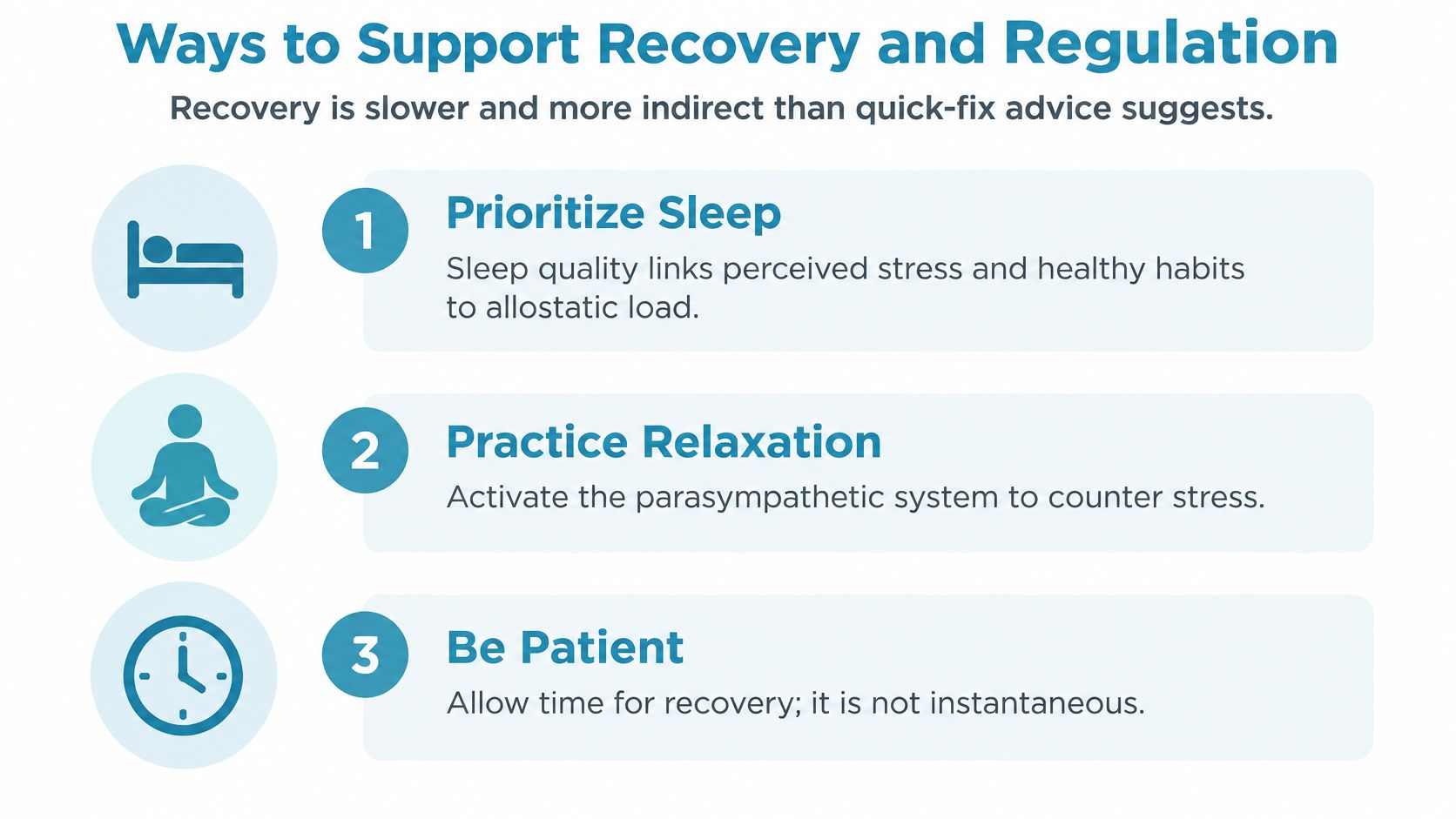
Match the practice to the problem
Recovery approaches and what each one targets
Approach | What it targets | What it does not do |
|---|---|---|
Slow breathing or gentle movement | In-the-moment physical arousal | Doesn't remove the load that keeps the cycle going |
Protecting sleep | Overnight recovery and sensitivity to later stressors | Doesn't fix stressors on its own |
Reducing ongoing load | Repeated, low-grade stressors that accumulate | Takes planning and time rather than offering quick relief |
Naming and labeling emotions | Emotional reactivity and urges to snap or withdraw | Doesn't replace addressing the trigger |
Social connection and support | Isolation during stress and the sense of overload | Doesn't resolve the source of stress by itself |
For physical arousal, try comfortable, unforced breathing or a gentle walk. You don't need to take unusually deep breaths or push through discomfort. If focusing on breathing makes you more uneasy, movement or noticing your surroundings may be a better starting point.
For sleep, identify the specific obstacle. That could mean moving unfinished-task reminders out of your bedroom, discussing nighttime caregiving responsibilities, or seeking help for persistent insomnia. A sleep routine can't compensate for every schedule or living situation.
A useful distinction: Soothing yourself and changing an unsustainable situation are different jobs. You may need both.
Address what keeps happening
If each evening becomes a scramble over forgotten tasks, another relaxation exercise may be less useful than changing the evening plan. Put responsibilities somewhere visible, renegotiate what must happen tonight, or ask someone to help you sort priorities.
Naming an emotion can create room to respond deliberately: frustration, embarrassment, disappointment. Social support can be equally concrete, such as asking someone to listen before offering solutions or requesting help with a particular responsibility.
You can explore nervous system regulation exercises as options rather than tests. Choose according to the pattern you notice, and evaluate whether a practice helps you return to meaningful activity, not whether it makes every uncomfortable sensation disappear.
Start Tracking Your Own Stress Cycle
Try a simple one-week observation exercise. These ratings are personal reference points, not diagnostic measurements.
Choose a recurring stressor. Watch something recognizable, such as starting homework or opening work messages.
Note the sequence. Record when it began and when you first noticed a body or mood change.
Rate activation. Use a 0-to-10 scale at the start, one hour later, and before bed.
Add context. Note sleep, caffeine or other substances, and what else was happening.
Review after a week. Look for timing patterns rather than trying to grade your coping.
Bring the notes, timeline, and situations involved to a therapist or medical provider if difficulties persist. You don't need a polished explanation before seeking help.
What therapy can add
For anxiety and overwhelm, we slow things down and figure out what's going on, so anxiety doesn't get to run the whole show. Therapy can include understanding self-criticism, practicing different responses, and examining relationship patterns, not just learning calming techniques.
Therapy length depends on your goals. Some people benefit from short-term work; others continue longer through new challenges and personal growth. Therapy doesn't replace medical evaluation or medication management when those are appropriate.
Nick Donahue LICSW offers individual therapy for teens and adults navigating ADHD, anxiety, overwhelm, and relationship difficulties in Washington, DC and Virginia. If you'd like help understanding your stress patterns and responding with more flexibility, visit Nick Donahue LICSW to book an initial consultation and talk about fit, with no obligation to continue.
Comments