
Life Transitions: Types, The Process, and Outcomes

You've started a new job, but you keep wondering whether you made a mistake. Or you're still in the same job, increasingly drained, trying to decide whether you can afford to leave. At home, ordinary decisions take more effort than they used to, and you don't quite feel like yourself.
Life transitions counseling helps you make sense of a major change and decide how to respond. That includes emotional work, but also decisions made under real constraints: income, housing, job security, caregiving responsibilities, and available support. Therapy can help you work with uncertainty. It shouldn't pretend those constraints disappear when you change your thinking.
Table of Contents
Common Transition Types and What Counseling Focuses On - Similar feelings can call for different work - ADHD can change what support you need
When Transition Stress Is Normal and When to Get Help - Look at interference, not a deadline - Match the help to the problem
How Counseling Approaches Differ for Life Changes - What ACT looks like in an ordinary decision - Relationships and attention also matter
How a Counseling Process Unfolds From First Session On - Getting a useful picture - Turning understanding into experiments - Reviewing and eventually ending
What Outcomes Look Like and How Progress Gets Measured - What session benchmarks can tell you - Track changes you can recognize
Choosing a Counselor and Taking the First Step - Questions that help establish fit
What Life Transitions Counseling Covers
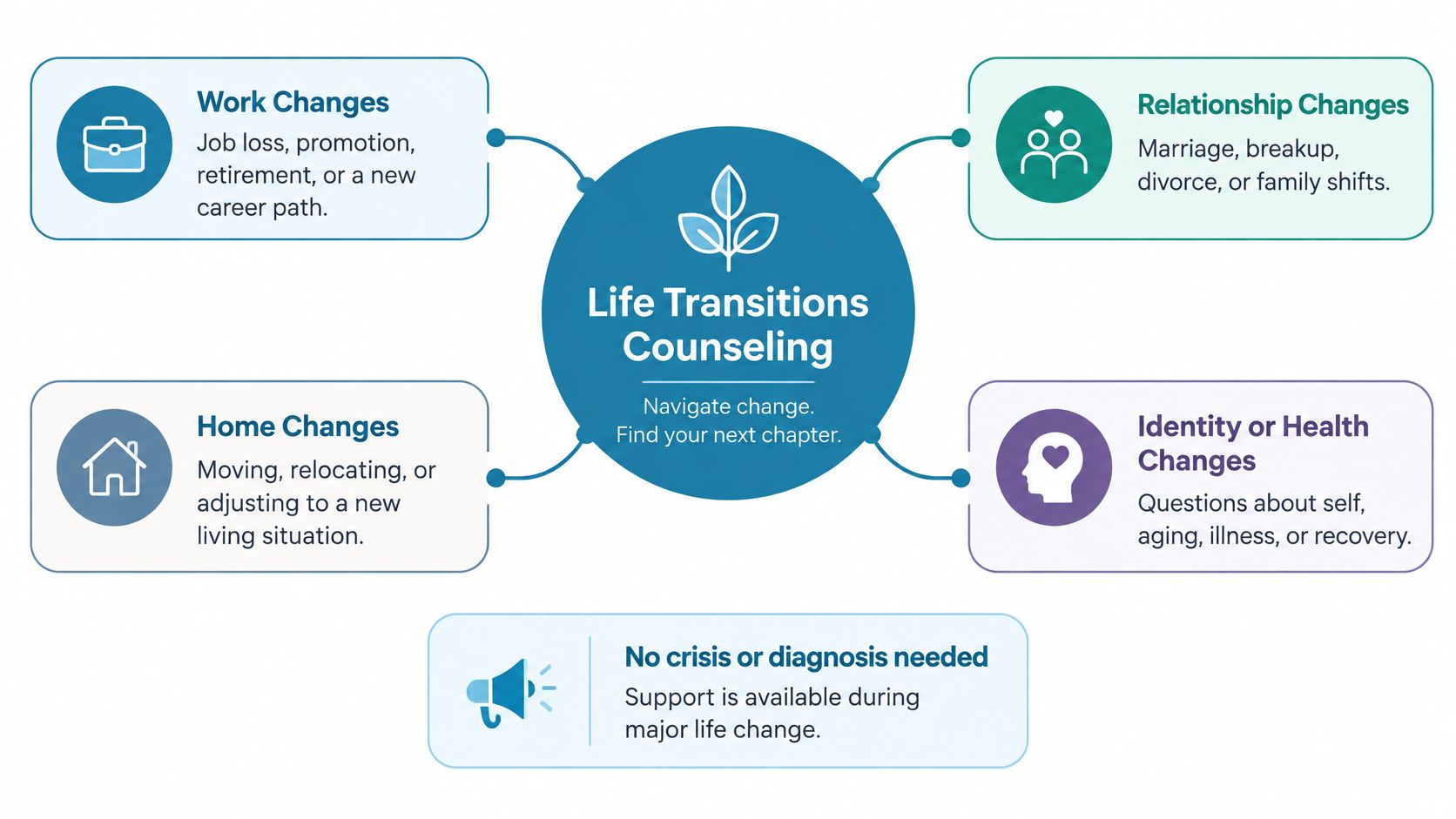
Life transitions counseling is individual psychotherapy focused on a major change in work, relationships, home, identity, or health. You don't need a crisis or diagnosis to begin. It can be useful when you feel burned out, disconnected, uncertain about your next step, or unsettled by a change you chose.
Say you've moved for an appealing opportunity, but your evenings feel empty. Counseling gives you room to separate missing your old community from doubts about your decision. You don't have to know exactly what to work on before starting; figuring that out together is part of therapy.
Think of crossing a stream on uneven stones. A counselor helps you find your footing rather than handing you a map that assumes everyone takes the same route.
The areas of change often connect with one another.
There's a broad evidence base for psychotherapy: Mary Lee Smith and Gene V. Glass's 1977 meta-analysis coded 375 controlled evaluations and found that the typical treated person was better off than approximately 75% of untreated individuals, with few meaningful differences among major therapy traditions. That historical comparison isn't a guarantee for any individual or modern transition-focused service.
The practical question is whether you'd benefit from space to understand what's happening and consider your next move.
Common Transition Types and What Counseling Focuses On
The same event can affect people differently because it changes different things. Leaving a job might mean losing income, valued colleagues, professional status, or the structure that helped you get through the day. Counseling starts with what the change means in your life, not what you're supposed to feel about it.
Transition types and what counseling focuses on
Transition | What Usually Changes | What Counseling Often Works On | Common Stuck Point |
|---|---|---|---|
Career change or job loss | Income, daily structure, professional identity | Clarifying values, testing options in small steps, managing self-criticism | Waiting for certainty before acting |
Burnout or a job that no longer fits | Energy, motivation, sense of purpose | Recognizing what drains you, setting limits, deciding whether to stay or change | Treating exhaustion as a personal failing |
Relocation | Social network, routines, sense of belonging | Building new support, pacing the adjustment, keeping valued routines | Isolation that goes unnoticed for months |
Breakup or divorce | Daily companionship, partner identity, shared plans | Processing loss, rebuilding routines, changing communication patterns | Rumination and urges to make contact |
Retirement or loss of role | Structure, status, daily purpose | Redefining roles, planning time, staying connected | Expecting the change to feel positive right away |
Caregiving or new parenthood | Time, sleep, identity, shared responsibilities | Managing overload, setting boundaries, sharing responsibility | Neglecting one's own needs |
School to work | Independence, expectations, comparison with peers | Decision-making, self-understanding, coping skills | Choosing based on what others expect |
Similar feelings can call for different work
For a career change, the useful starting point may be clarifying what you need from work: stability, autonomy, meaningful contribution, or a manageable schedule. Instead of quitting immediately or waiting for complete certainty, you might investigate an adjacent role, talk with someone in that field, and review your financial runway.
After a breakup, the immediate work might be more basic. You may need a plan for evenings, boundaries around messaging, and ways to notice when reviewing the relationship has shifted from reflection into repetitive rumination.
Burnout calls for looking at workload and expectations, not just improving your attitude. Relocation calls for deliberately rebuilding contact with people, rather than treating loneliness as evidence that you're unlikeable. Retirement may require finding purpose outside a role that used to organize your day.
ADHD can change what support you need
ADHD is a neurodevelopmental condition, not a character flaw or a synonym for low motivation. A transition can reveal how much you relied on familiar schedules, reminders, or another person's organizational support. Someone leaving school may understand the work but struggle when deadlines become less visible.
Caregiving and new parenthood can make it harder to protect your own appointments and recovery time. For teens entering greater independence, useful support may include practicing decisions while parents gradually adjust their involvement.
Many individuals aren't managing a single isolated event. A breakup during a move, or a new diagnosis during a job search, requires mapping the overlapping demands before deciding what needs attention first.
When Transition Stress Is Normal and When to Get Help
A new job can bring relief and worry at the same time. A move may offer a fresh start while leaving you unsure where you belong. Feeling anxious, sad, irritable, or distracted during a major change does not automatically mean something is wrong. A more useful measure is how the stress affects daily life.
Can you manage responsibilities, meals, sleep, and important conversations? Does the distress ease at times, or are you arranging more of your life to avoid it?
Look at interference, not a deadline
There is no universal timetable for adjusting. Overlapping changes, earlier mental health difficulties, shifts in identity, and financial strain can make adjustment harder. Pressure to feel settled by a certain date may add shame rather than clarity.
You can seek support without having a diagnosis or a perfectly clear reason. Many adults report needing more emotional support than they receive. Feeling stuck, directionless, ashamed, or unlike yourself is enough to bring up with a counselor.
Consider talking with someone if distress is persistent, responsibilities are becoming harder, or you keep postponing necessary conversations, applications, paperwork, or appointments. Changes in sleep, work, relationships, or self-care also matter. So does an increase in drinking or cannabis use to quiet worry or get through the evening.
Thoughts of self-harm or suicide call for immediate support, not a routine therapy appointment. If you might act on those thoughts, seek emergency help or go to the nearest emergency department. If possible, tell someone you trust and avoid being alone while arranging support.
Match the help to the problem
Counseling can help you understand your reactions and consider your choices, but it cannot change every condition around a transition. A new or concerning physical symptom may call for medical evaluation. Medication questions belong in an appropriate medical assessment. Bereavement groups, peer support, employment assistance, or financial guidance may address needs that conversation alone cannot resolve.
If work exhaustion is part of the picture, guidance on approaching burnout can help clarify what may need to change in the working conditions, not only in your coping habits.
Practical rule: If the obstacle is unpaid rent, an unsafe workplace, or unavailable childcare, include practical assistance in the plan. A resource problem is not a personal failure.
Counseling can sit alongside practical support and medical care. Each can address a different part of the situation, including the emotional strain and the practical constraints shaping your options.
How Counseling Approaches Differ for Life Changes
No single method suits every person or transition. A counselor should match the work to what's keeping you stuck, your preferences, and the demands you're facing. Our framework draws on Acceptance and Commitment Therapy, interpersonal therapy, humanistic therapy, and mindfulness-based approaches.
These approaches can overlap, but they emphasize different parts of your experience.
Counseling approaches and when they tend to fit
Approach | Core Focus | Often Useful When |
|---|---|---|
Acceptance and Commitment Therapy | Accepting difficult thoughts while acting on personal values | Avoidance, rigid coping, or decisions stalled by uncertainty |
Interpersonal therapy | Relationship roles, conflict, and social support | Breakups, loneliness after a move, or strained family roles |
Mindfulness-based approaches | Noticing thoughts and body states without reacting to them | Racing thoughts and overwhelm during change |
Humanistic therapy | Understanding your experience, needs, and choices without judgment | Identity questions, self-criticism, or difficulty knowing what you want |
What ACT looks like in an ordinary decision
Psychological flexibility, a central focus of Acceptance and Commitment Therapy, means making room for difficult internal experiences while choosing actions that reflect your values. It doesn't mean liking the situation or persuading yourself that everything will work out.
Say you want to apply for a job but keep thinking you'll embarrass yourself. The work isn't necessarily to eliminate that thought. You might notice the fear, recognize that meaningful work matters to you, and complete the application while the discomfort is still present.
In a randomized controlled trial of ACT for work- or career-related difficulties, 164 adults were assigned to a seven-week program, with 82 participants in the intervention and 82 in a waitlist control. The trial reported gains in psychological flexibility (d=0.64), meaning in life (d=0.42), and well-being (d=0.32), alongside reductions in psychological inflexibility (d=-0.51) and distress (d=-0.36); improvements were reported as persisting approximately nine weeks after the program ended.
Those effect sizes describe group differences, not percentages of people who recovered. The study used a group format and a work-focused population, so its results shouldn't be assumed for every transition or individual therapy arrangement.
Relationships and attention also matter
Interpersonal work might involve practicing how to tell a partner that your caregiving responsibilities have changed what you can reasonably take on. Humanistic work gives space to understand your own priorities before adopting someone else's definition of a successful life.
Mindfulness can help you notice a tight chest, racing thoughts, or an urge to react before sending a message you may regret. For someone with ADHD, that might mean using a brief, concrete pause rather than expecting a lengthy meditation practice.
When worry dominates the work, therapy for anxiety and overthinking may become part of the focus. The aim remains individualized: more room to respond deliberately, not a requirement to feel calm before living.
How a Counseling Process Unfolds From First Session On
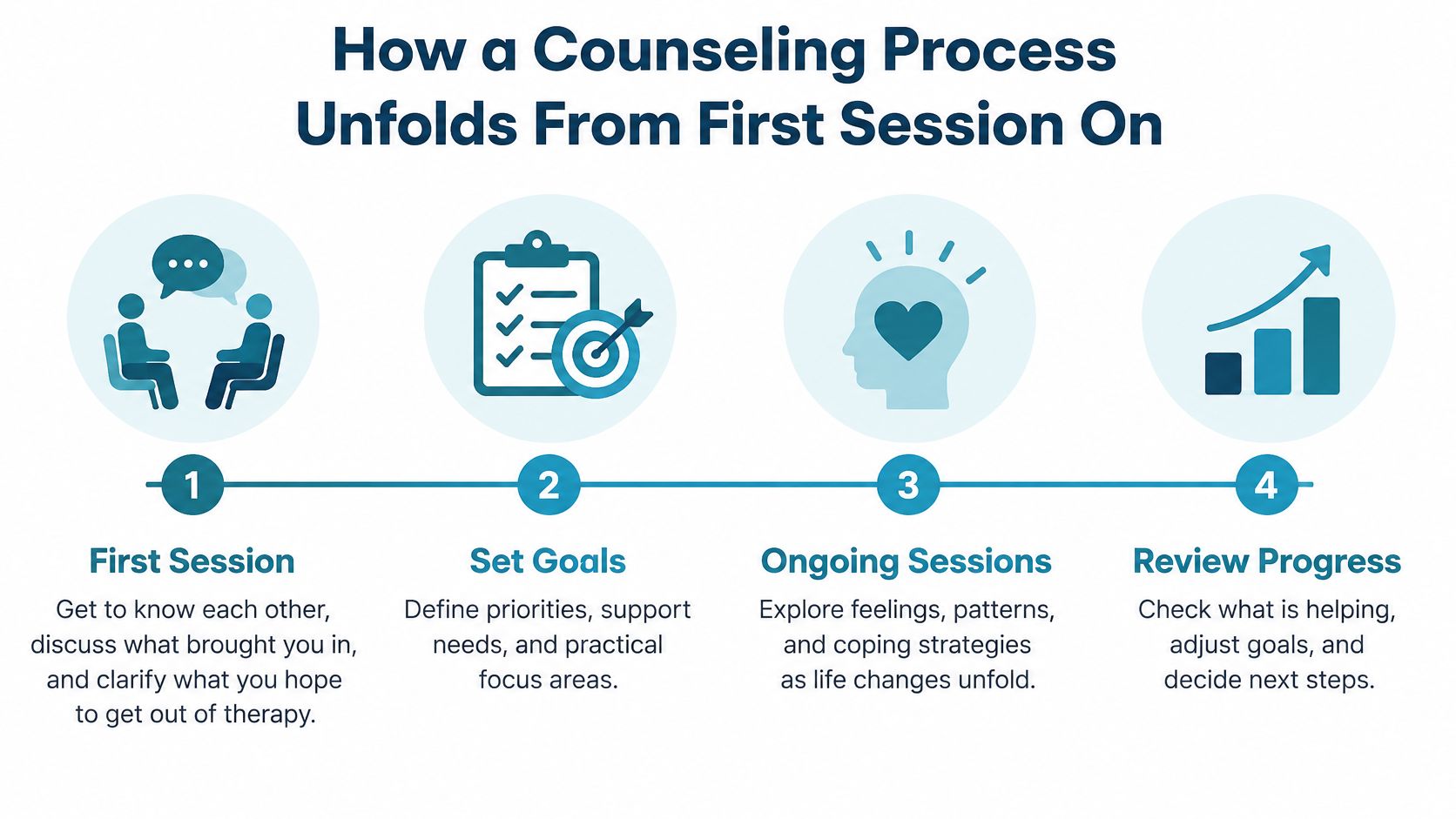
The first session is a conversation, not a test you need to prepare for. We discuss what brought you in, what you hope might change, and how you'd like to approach the work. We also begin getting to know your personality, relationships, values, and the way you make sense of your life.
You can bring a clear concern or a tangled description of what's been happening. Neither is a better starting point.
Getting a useful picture
Early sessions help distinguish the event from the difficulty it created. Did leaving work remove your social contact? Did becoming a parent expose an unequal division of responsibility? Are you unsure what you want, or afraid of the consequences of asking for it?
A counselor may ask about mood, anxiety, sleep, substance use, and daily functioning. Simple questionnaires can provide a starting picture, but they don't replace your account of what matters. Assessment should help decide where to focus, not reduce your experience to a score.
The process has a recognizable shape, with room to adjust.
Turning understanding into experiments
At our practice, clients begin with weekly, 60-minute sessions, moving to every other week or less frequently as therapy progresses. That's our usual rhythm, not a research-based requirement. Frequency changes with your goals and circumstances.
Sessions start with what's been going on in your life. Together, we get curious about repeating patterns and identify something worth trying outside the room.
For example, if you're considering relocation, you might separate the decision into concrete questions:
Financial feasibility: What would moving cost, and what information do you need from a financial or housing resource?
Support: Who would be available locally, and which relationships could you maintain remotely?
Personal priorities: What would the move make possible, and what would you be giving up?
A reversible test: Could you visit, investigate job options, or explore neighborhoods before committing?
For ADHD-related difficulties, an experiment might be making the next action visible in a calendar or drafting a difficult email together. The point isn't to prescribe another organizational system. It's to understand what gets in the way, including overwhelm, shame, conflict, or unrealistic expectations.
Reviewing and eventually ending
In the first month, you can expect an emerging picture of your concerns, some shared priorities, and initial ideas to test. You should also have room to say when an interpretation doesn't fit or an exercise isn't useful.
You don't have to perform progress for your therapist. Honest feedback about what isn't helping is part of the work.
Some people choose short-term therapy around a specific change. Others continue longer as new challenges arise. When it's time to finish, the work includes consolidating decisions, recognizing early warning signs, and planning how you'll respond to future stress.
What Outcomes Look Like and How Progress Gets Measured
Counseling doesn't promise a particular result, and progress during a transition rarely follows a straight line. You might make a necessary decision and still feel grief about it. You might become more confident while remaining uncertain about the outcome.
The useful question is whether therapy is helping you live and respond differently, not whether every session leaves you feeling better.
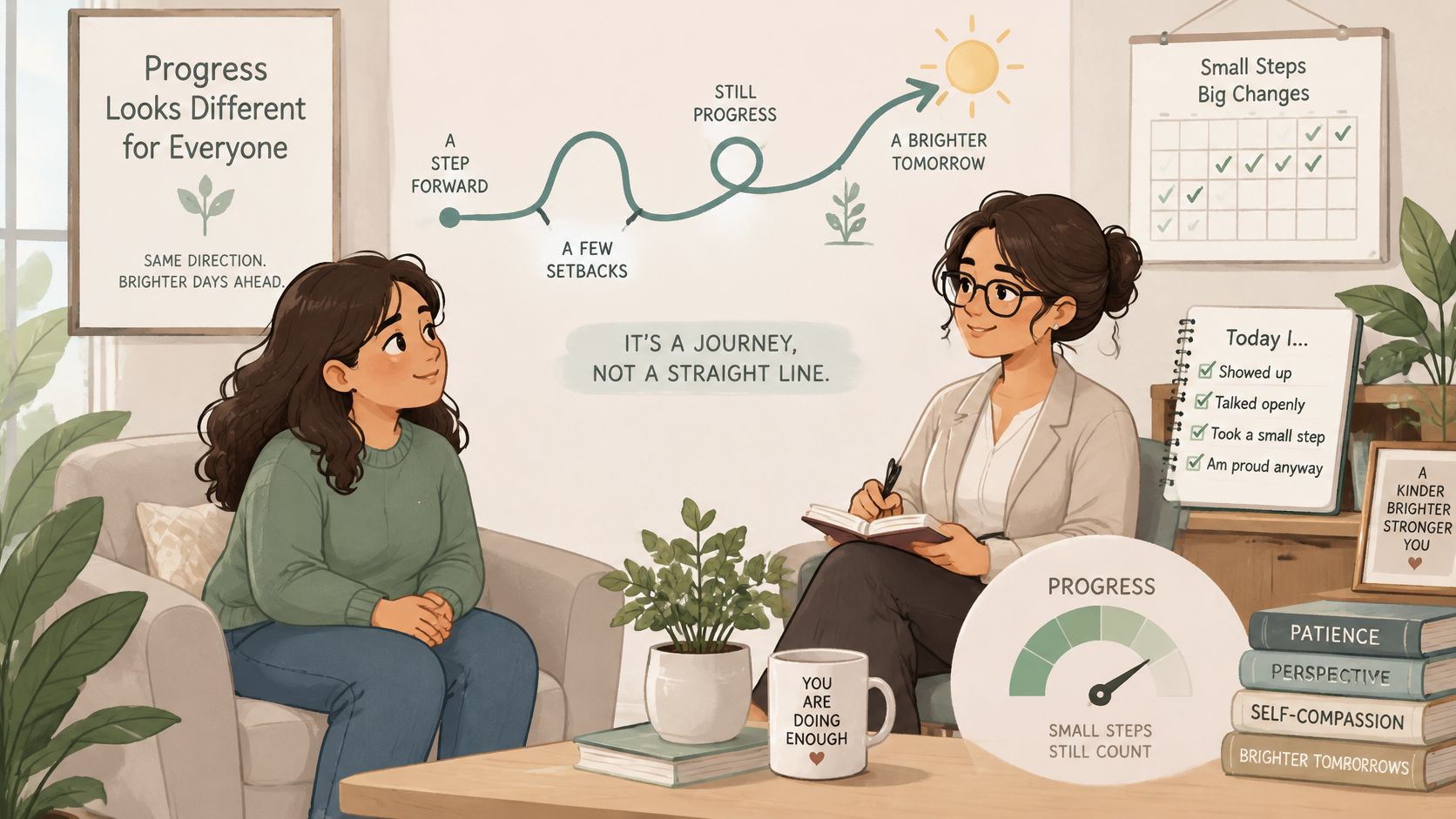
The image below reflects the conversational setting of therapy, not a promised outcome.
What session benchmarks can tell you
A 1986 analysis of psychotherapy dose and improvement, drawing on 15 datasets with more than 2,400 patients, estimated measurable improvement in approximately 50% by the eighth session and 75% by the twenty-sixth session. These are broad historical psychotherapy benchmarks, not life-transition-specific success rates or a prescribed treatment length.
Session benchmarks for psychotherapy improvement
Benchmark | Share Improved | Notes |
|---|---|---|
By session 8 | About 50% | 1986 meta-analysis of 15 datasets with more than 2,400 patients |
By session 26 | About 75% | Same analysis; not a fixed number of sessions for any transition |
Your pace will depend on the complexity of the change, anxiety or depression, available support, and how well you and your therapist work together. A practical obstacle can also limit what's possible even when you're gaining clarity.
Early progress may look like naming the actual problem, noticing a familiar pattern sooner, or having a workable response to an overwhelming evening. Later, you may follow through on decisions, communicate more directly, or spend less time mentally replaying what happened.
Track changes you can recognize
A useful review combines your experience with concrete observations. Rather than asking only whether you had a good week, you and your counselor might track:
Distress: How intense or disruptive is the worry, sadness, or overwhelm?
Valued action: Are you doing things that matter to you, even when they're uncomfortable?
Flexibility: Can you change an unhelpful plan or tolerate uncertainty without withdrawing?
Daily functioning: Are meals, sleep routines, responsibilities, and relationships becoming more manageable?
For someone with ADHD, completing a task isn't the only meaningful outcome. Asking for help before becoming overwhelmed, recovering from frustration without prolonged self-criticism, or explaining a need to a partner may matter just as much.
A video is available below as an optional companion to the discussion.
A difficult week doesn't automatically mean therapy has failed. But ongoing lack of progress deserves a direct conversation. Your counselor may revisit the goals, change the pace or approach, or discuss whether additional assessment or another kind of support would be useful.
Choosing a Counselor and Taking the First Step
Start with a format you can realistically use. A 2024 systematic review and meta-analysis found no statistically significant difference between remote and face-to-face treatment in symptom improvement for depression (standardized mean difference −0.10) or anxiety (−0.06).
The evidence isn't uniform: a 2025 telehealth review found a small advantage for in-person depression treatment (effect size 0.28, 95% confidence interval 0.03 to 0.54), while evidence favoring telehealth over waitlist controls for anxiety had very low confidence. Privacy, technology, symptoms, and personal preference should guide the choice.
Questions that help establish fit
We offer in-person or virtual sessions in Washington, D.C., and virtual sessions for clients in Virginia. Before starting with a counselor, useful questions include:
Relevant experience: How do you work with the kind of transition I'm facing?
Progress: How will we know whether the work is helping?
Scheduling and endings: How do you handle frequency, pauses, and finishing therapy?
Practical access: What are the fees and insurance options?
Initial fit: Can we talk briefly before scheduling?
If professional achievement makes it difficult to admit you're struggling, these reflections on therapy for high achievers may help you put that tension into words. You don't need a diagnosis or a perfectly clear goal to begin.
Nick Donahue LICSW offers individual therapy for teens and adults navigating life transitions, ADHD, anxiety, and relationship difficulties, with attention to both emotional patterns and practical next steps. Visit Nick Donahue LICSW to schedule a free 15-20 minute phone or video consultation, ask questions, and explore whether working together feels like a good fit.
Comments