
The Relationship Between Homework and Grades for Students with ADHD

The assignment is still open, bedtime is getting closer, and the grade portal shows another missing mark. Your teen says they understand the material. You're wondering why they can explain it at dinner but can't seem to turn it in. If you're an adult returning to school, you may recognize the same frustrating gap in yourself.
Homework and grades are related, but they aren't interchangeable. Understanding a subject, organizing the work, tolerating frustration, and submitting an assignment are different demands. Before deciding that someone needs more homework or more pressure, it helps to understand which demand is getting in the way.
Table of Contents
Why Homework and Grades Are Not Simple Twins - Separate learning from school logistics - Effort isn't visible in a grade
What the Evidence Says About Homework - A positive relationship isn't proof of cause - Read claims about grade gains cautiously
How Homework Load Can Hide a Real Problem - What longer hours do and don't tell us - Consider the environment, not just the student
What Low Grades May Actually Signal - Compare what happens before the missing work - Ask for evidence without cross-examining
Match the Homework Response to the Barrier - Match Homework Support to the Observed Barrier - Make reassessment part of the plan
Build a Homework Routine That Reduces Friction - Make the next action visible - Similar assignments can require different routines - Adapt the routine to the person
Support Homework Without Taking Over - Offer structure with an agreed stopping point - Negotiate help outside the conflict
Treat Grades as Information Not Identity - Review what can change - Therapy can make room for the whole person
Why Homework and Grades Are Not Simple Twins
Consider a hypothetical evening: a student explains a science concept accurately, then discovers that their worksheet never uploaded. A parent sees an avoidable mistake. The student sees an evening of effort that apparently didn't count. The teacher still needs evidence they can evaluate.
Nobody has to be dishonest for these perspectives to differ. Depending on the course policy, a grade may combine demonstrated understanding with homework completion, participation, deadlines, and assessment performance. The first useful question is what the mark represents.
Separate learning from school logistics
When reviewing an assignment, distinguish these questions:
Understanding: Can the student explain the concept or solve a similar problem independently?
Completion: Did they produce the requested work?
Submission: Did the teacher receive it in the expected place and format?
Context: Were the instructions clear, and were the necessary materials and support available?
Those distinctions don't make deadlines irrelevant. They make the response more accurate. Reteaching a concept won't resolve an upload problem, just as a better calendar won't explain unfamiliar algebra.
Effort isn't visible in a grade
For a student with ADHD, knowing what to do and reliably carrying it through may feel very different. Planning, beginning, keeping track of instructions, and shifting between tasks are examples of executive functioning, the everyday management side of getting things done.
A useful educational stance is to investigate those demands rather than infer laziness. That doesn't mean ADHD explains every missing assignment, or that every struggling student has ADHD. It means a low mark is a reason to gather information, not a reliable description of someone's character.
What the Evidence Says About Homework
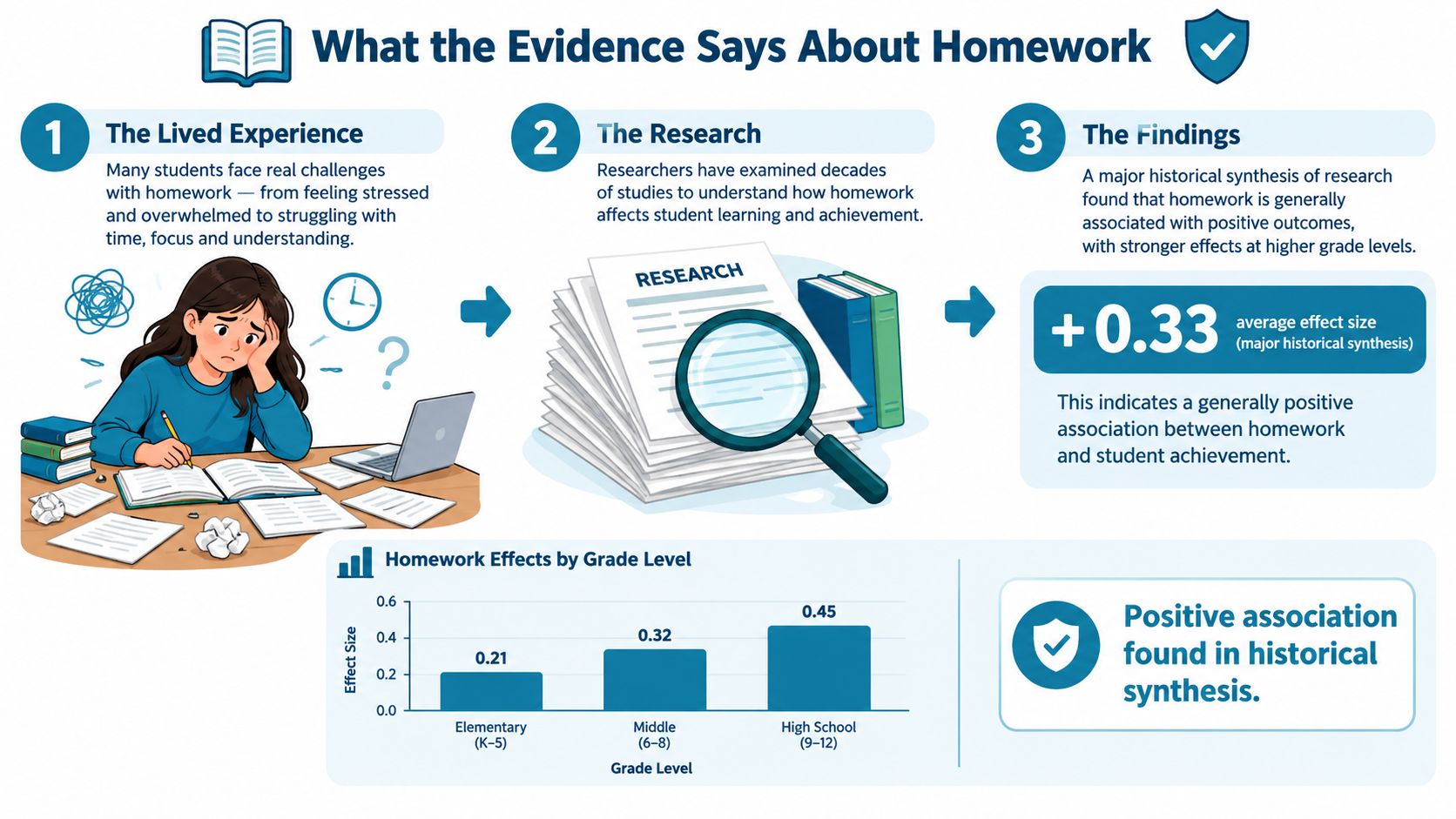
The research supports a qualified answer, not a promise that more homework produces better grades. The infographic offers an overview of that distinction.
A positive relationship isn't proof of cause
Harris Cooper, Jorgianne Robinson, and Erika Patall's 2006 synthesis of U.S. homework research conducted from 1987 to 2003 found generally consistent positive associations between homework and achievement across research designs, with stronger relationships in Grades 7–12 than K–6, while identifying important limitations in every design (homework research synthesis).
That review also found a stronger relationship when students, rather than parents, reported homework time. It didn't find strong evidence that the relationship differed substantially between course grades and standardized tests, or between reading and mathematics.
Those distinctions matter when evaluating confident advice about homework. Students who finish more assignments may also have stronger prior knowledge, more motivation, greater family support, quieter study conditions, or different teacher expectations. The historical findings can't isolate homework from all those influences.
Evidence check: An association tells us that things occur together. It doesn't establish that increasing homework alone will improve a particular student's grade.
Read claims about grade gains cautiously
Broader international evidence also points toward a positive but limited relationship, with diminishing returns when homework demands become extensive. That makes homework quantity a poor standalone explanation for achievement.
Before accepting a claim about remarkable improvements, ask:
What changed? More assigned work isn't the same as clearer instruction or more useful feedback.
What was measured? Assignment completion, subject knowledge, and overall grades answer different questions.
Who was included? Findings about secondary students shouldn't automatically become recommendations for younger children.
My practical interpretation is that purposeful practice can be useful, especially when students understand what they're practicing and can obtain feedback. Assigning more of the same work without checking its purpose or accessibility is a different proposition.
How Homework Load Can Hide a Real Problem
A student can spend an evening at a desk without spending that evening productively learning. Time may go toward searching for instructions, restarting after interruptions, or rewriting an answer that already meets the requirements.
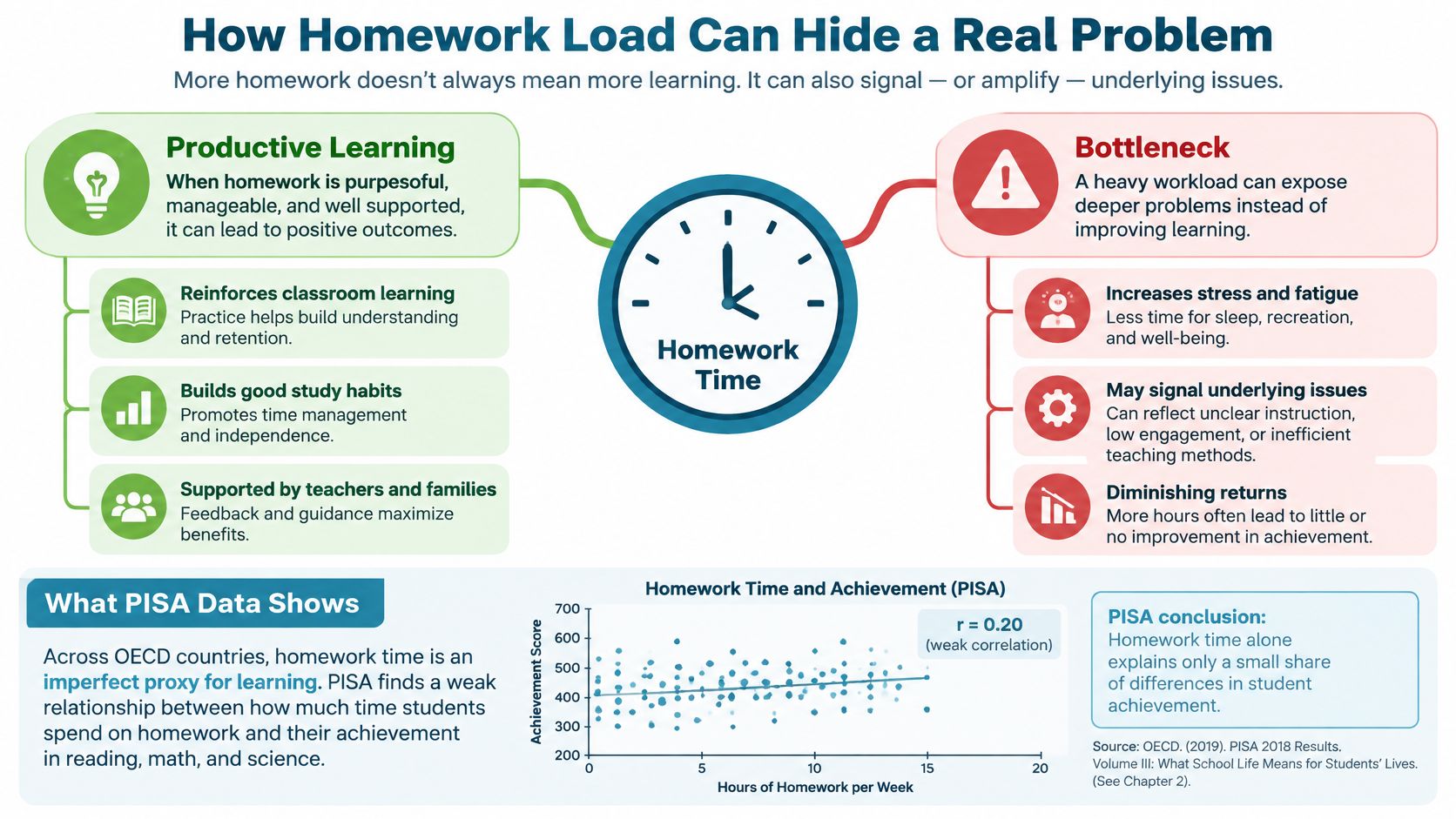
The distinction between time and useful practice matters when interpreting homework research.
What longer hours do and don't tell us
International evidence incorporating 488 independent findings from 74 countries and 429,970 students reported an overall homework-time effect of d = 0.186; another review reported d = 0.229. The same research discussion describes OECD patterns favoring systems with homework demands up to approximately two hours daily, while systems with larger shares spending three hours or more tended to score lower (international homework evidence and PISA discussion).
These are broad associations, not a universal daily target or stopping rule. The effect-size values describe small average relationships, not percentage improvements or guaranteed grade changes.
Consider the environment, not just the student
A 2025 study following 274 adolescents from eighth to tenth grade found that school climate predicted homework performance, motivation, emotion regulation, internalizing symptoms, and friendships after accounting for ADHD symptom severity. Fair, structured discipline and respect were especially consistent predictors (school climate and adolescent functioning).
That finding supports looking beyond individual effort. In a family discussion, useful questions include:
Workload: Is the student balancing more demands than they can realistically manage?
Conditions: Is there usable space, access to materials, and a reasonably predictable schedule?
School experience: Does the student understand expectations and feel able to ask for help?
For readers who recognize a broader pattern of feeling overwhelmed all the time, homework may be where that strain becomes most visible. Adding pressure before identifying the bottleneck risks responding to the wrong problem.
What Low Grades May Actually Signal
Start with a recent assignment rather than the entire report card. Ask the student to walk through what happened from receiving the instructions to the submission deadline. Their account may reveal more than the final mark.
Look for patterns across tasks, not proof of a diagnosis. A difficult evening after an upsetting day means something different from a recurring difficulty across subjects, settings, and types of work.
Compare what happens before the missing work
Pattern to investigate | What it might look like |
|---|---|
Knowledge gap | The student attempts the task but can't explain the concept or apply it to a similar question. |
Initiation difficulty | They can describe the assignment but remain stuck before the first action. |
Sustained-attention difficulty | Work begins, but attention repeatedly shifts away before meaningful progress. |
Working-memory or planning difficulty | They lose their place, forget an instruction while following another, or miss a dependency between tasks. |
Time-estimation difficulty | They plan as though a demanding assignment will fit into a brief opening. |
Perfectionism or fear | They repeatedly revise an adequate answer or avoid submitting work that feels imperfect. |
Unclear expectations | They can't tell what the teacher wants or what counts as finished. |
These are possibilities to explore, not labels to attach. A student might misunderstand the material and feel ashamed about asking for help. Another might understand it well but become anxious whenever the assignment involves evaluation.
Ask for evidence without cross-examining
Review an example: Ask the student to show where the process changed from manageable to difficult.
Compare conditions: Notice whether the same task feels different in class, at home, or with instructions written down.
Seek another perspective: Ask the teacher what they observe during independent work and assessments.
ADHD is a neurodevelopmental condition, but experiences vary substantially. This framework can guide a conversation; it can't replace educational, psychological, or medical assessment.
A support need and a character judgment are different conclusions. Only one helps identify what to try next.
Match the Homework Response to the Barrier
Choose support based on the observed difficulty, then agree on what would count as useful progress. That might mean beginning more independently, producing work that shows understanding, or asking a specific question instead of remaining stuck.
Try a modest change before building an elaborate system. If you change the schedule, workspace, reminder system, and reward structure simultaneously, it becomes harder to tell what fits the student.
Match Homework Support to the Observed Barrier
Observed pattern | Possible explanation | Helpful response | Sign to reassess |
|---|---|---|---|
Attempts contain repeated conceptual errors | Understanding gap | Ask the teacher to model an example, then have the student explain a similar problem without looking | The explanation still doesn't make sense |
Materials are ready, but work never begins | Initiation or planning barrier | Write a concrete first action, such as opening the document and copying the question | The first action remains unclear or feels unmanageable |
The student repeatedly loses their place | Attention or shifting barrier | Try a quieter setting and a visible marker showing the current task | Distraction continues across different conditions |
Work is repeatedly rewritten or hidden | Perfectionism or fear of failure | Define an acceptable draft and separate drafting from editing | Distress prevents participation despite reduced demands |
Effort goes into the wrong task | Unclear expectations | Ask for a written example or clarification of the requirements | Adults still interpret the directions differently |
Make reassessment part of the plan
Treat these responses as experiments, not prescriptions. Sitting beside someone, sometimes called body doubling, may be worth trying for a difficult start, but it shouldn't become mandatory surveillance.
When distress is the main obstacle, begin with a pause rather than another instruction. Resources on emotional regulation for teens can support a conversation about recognizing frustration and choosing what to do next.
After a difficult evening, record where the process stopped and identify the next available action. A reset should preserve useful information without turning unfinished work into a punishment carried into tomorrow.
Build a Homework Routine That Reduces Friction
A workable routine should answer a practical question: What do I do next? It shouldn't require the student to become a different person before they can use it.
Use this sequence as a flexible template, not another standard to fail.
Make the next action visible
Begin with a brief preview of the actual assignment list. Open the school's learning platform, gather the necessary materials, and check due dates against other commitments. A paper index card can hold the immediate plan; a calendar can hold deadlines.
Then separate starting from finishing. “Complete the essay” is an outcome. “Open the draft and write a rough sentence about the main idea” is an action a student can attempt now.
If company is welcome, a parent, classmate, or study partner can do their own work nearby. Agree in advance whether conversation is helpful or distracting. Presence doesn't need to involve checking every answer.
Choose a focus interval: Use a phone timer placed out of reach or a kitchen timer. Select a duration that feels manageable rather than borrowing someone else's ideal schedule.
Protect the break: Step away, stretch, get water, or eat something. Don't convert recovery time into another task.
Mark progress visibly: Check off completed actions and write down the exact stopping point before switching subjects.
Close deliberately: Confirm submission, gather materials, and leave a note about unfinished work or questions.
If a student can't proceed because they don't understand something, record the question precisely. “I don't understand how to choose the formula” gives a teacher more to respond to than keeping quiet and spending longer on the page.
Similar assignments can require different routines
The following examples are hypothetical, not client stories.
A student who doesn't understand the reading assignment might preview the question and realize they can't explain a central term. Their next action is to mark the confusing passage and request clarification. A longer focus interval wouldn't solve that gap.
Another student understands the reading but feels overwhelmed by opening the platform, locating the document, and organizing notes. Their starting plan might be to put those materials together with a willing study partner nearby.
A student caught in perfectionism might draft an answer, delete it, and avoid returning. Their plan could include leaving a rough version intact and checking it against the actual assignment requirements before editing.
A useful parent response: “Thanks for telling me where you got stuck. Would you like help understanding it, getting started, or deciding what to ask your teacher?”
Adapt the routine to the person
An adult returning to education may need to place study sessions around work and caregiving rather than copy an adolescent's after-school schedule. During a demanding deadline week, compare deadlines and ask instructors about priorities before assuming everything can fit.
For a student who becomes overwhelmed before beginning, make the preview itself smaller. Looking at the next assignment may be enough to establish the next action. The additional discussion of homework research can help keep the focus on useful practice rather than endurance.
Keep this distinction in mind alongside the video: a routine is a tool to adapt, not a test of commitment.
Support Homework Without Taking Over
Parents can care a great deal about school and still need to change how they participate in homework. The question isn't whether to help. It's how to offer enough structure without becoming responsible for every decision.
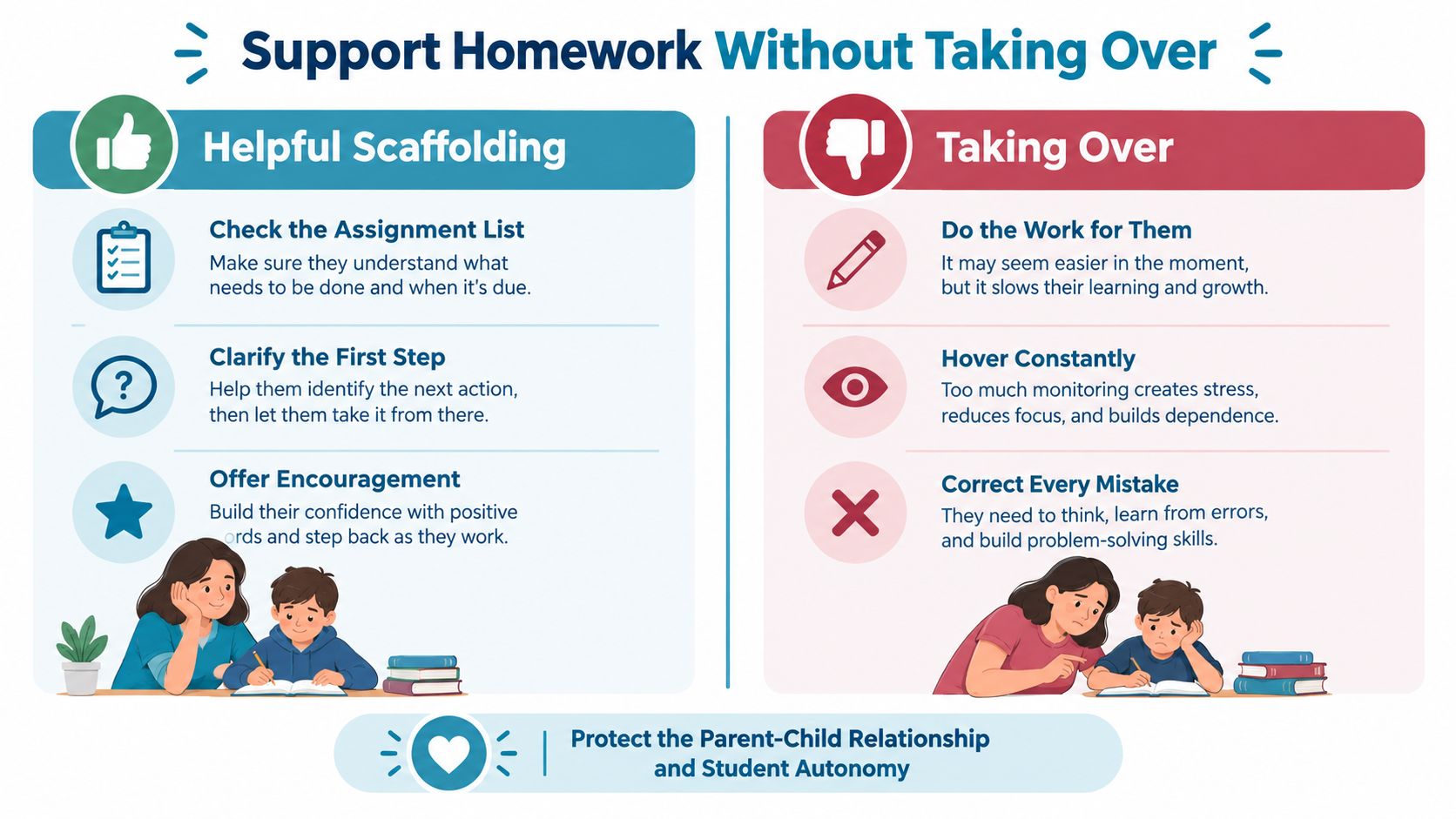
This comparison illustrates the difference between making work accessible and doing it for the student.
Offer structure with an agreed stopping point
Scaffolding means providing temporary support while leaving the thinking and work with the student. That might involve reviewing the assignment list together, making resources visible, or clarifying the starting point before stepping away.
A 2025 prospective study associated higher parental anxiety with poorer academic performance among children with ADHD, including stronger negative associations with homework completion; a 2025 systematic review found that school-based interventions targeting organization, homework management, and time management improved academic performance (parental anxiety and structured academic support).
These findings aren't a reason to blame anxious parents. They support considering both interaction patterns and structured skill support rather than intensifying supervision.
Negotiate help outside the conflict
Try a conversation when nobody is rushing to finish:
Ask permission: “Would you like help making a plan, or would you rather show me your plan afterward?”
Define the role: Agree whether the parent will locate materials, answer questions, or sit nearby.
Set a check-in: Choose when to reconnect so reminders don't fill the entire evening.
Respect the boundary: If help becomes unwelcome, pause and revisit the arrangement rather than escalating.
A parent can acknowledge their own worry without making the student responsible for soothing it. “I'm concerned about the missing work, and I'm trying not to turn that into constant checking” is different from predicting disaster.
Contact the school when the agreed support still leaves work persistently inaccessible, instructions remain confusing, or distress repeatedly disrupts participation. Ask about workload, explicit planning support, and whether an accommodation conversation is appropriate.
Therapy may be useful when shame, avoidance, or recurring conflict needs attention. It isn't a substitute for subject instruction, school support, or medical evaluation when those are needed.
Treat Grades as Information Not Identity
A disappointing grade can have real consequences. You don't have to dismiss those consequences to reject the idea that the grade defines the student.
A more constructive review separates what needs attention from what the person believes about themselves. “I didn't submit the assignment” identifies an event. “I always ruin everything” turns that event into an identity.
Review what can change
When everyone is ready to talk, focus on a specific decision:
Learning: What material needs explanation or further practice?
Access: What clarification, resource, or school support is missing?
Process: Where did the agreed plan become difficult to use?
Emotional cost: Is fear of failure, shame, or conflict making participation harder?
Leave room for the student's own priorities. They may care about understanding a subject, becoming more independent, or making evenings less tense, even when their immediate concern isn't the same as a parent's.
Therapy can make room for the whole person
For adults, school struggles may connect with familiar difficulties at work, in relationships, or with everyday responsibilities. Therapy can provide space to examine those patterns without reducing the conversation to productivity.
An ACT-informed conversation might explore how to take a valued action while uncomfortable thoughts are present, rather than waiting to feel completely confident. Mindfulness may involve noticing frustration before responding, while interpersonal work can examine how requests for help become arguments or withdrawal. The approach should fit the person, and improved grades aren't a guaranteed outcome.
If homework and grades have become entangled with ADHD, anxiety, or persistent self-doubt, consider an initial consultation with Nick Donahue, LICSW. Individual therapy is available for high-school-age teens and adults in person in Washington, D.C., and virtually across D.C. and Virginia. You can bring a recent difficult evening, an unfinished assignment, or a pattern you'd like to understand. You don't need a polished explanation to begin.
Comments