
Group Therapy in Washington DC: Types and How to Join

45.0% of D.C. adults with any mental illness received mental-health services in the preceding year, an annual average of approximately 60,000 people during 2017–2019, according to SAMHSA's District of Columbia Behavioral Health Barometer. That measures mental-health care broadly, not group participation, but it reframes the search: seeking professional help is already part of life for many people in the District.
If you're looking for group therapy in Washington, DC, the practical question isn't just which groups exist. It's which kind of room would help you, and whether you could realistically keep showing up. A group might offer useful practice with anxiety, ADHD-related shame, or relationships, but its topic alone won't tell you whether it's a good fit.
Table of Contents
Group Therapy Types in Washington DC - Look past the topic on the flyer - Choose a format you could use
How a Group Works and What Research Shows - What happens during a meeting - Why other members matter - What the anxiety evidence actually says - Define progress in everyday terms
Everyday Examples for ADHD Anxiety and Relationships - Late-diagnosed ADHD and the interruption spiral - Anxiety after an unanswered text - Cannabis ambivalence without a morality play
Privacy Fit and When to Skip a Group - Confidentiality is an agreement, not a guarantee - Virtual convenience and personal safety
How to Find and Join a Group in DC - Make the search specific - Ask what staying enrolled requires - Take a short checklist into screening
Choose a Group or Individual Therapy Next - Choose the kind of conversation you need
Group Therapy Types in Washington DC
Group psychotherapy is treatment led by a licensed clinician with several members participating together. It isn't a class, meetup, or advice forum, although local listings sometimes place therapy groups, educational programs, and peer support under the same heading.
Group therapy formats in Washington DC
Format | Best suited to | What the hour emphasizes | Usual size and enrollment |
|---|---|---|---|
Interpersonal process group | Relationship patterns, shame, communication | Here-and-now feedback among members | Small, screened membership; often ongoing; confirm the member limit |
Skills or CBT-style group | Anxiety, depression, emotion regulation | Agenda, skill teaching, and practice | Small-group practice; often time-limited; confirm size and start date |
Topic group such as ADHD, anxiety, or substance use | A shared problem rather than a method | Discussion tied to that problem | Program sets the member limit and whether enrollment is open or closed |
Psychoeducation or support group | Learning and belonging more than deep process | Information plus member sharing | Organizer sets capacity; often open enrollment; may not be psychotherapy |
Virtual group | The same concerns when telehealth is permitted | Therapeutic work with camera and home-privacy agreements | Facilitator sets capacity; participation must meet location and licensure requirements |
A group is a practice room for how you relate, not a lecture about your symptoms.
Look past the topic on the flyer
An adult ADHD group could mean an organized skills course, a therapist-led discussion of shame and relationships, or a peer gathering. Those experiences aren't interchangeable. Before enrolling, ask what participants do during a meeting and what the facilitator is trained to help them change.
Cognitive behavioral therapy, or CBT, examines connections among thoughts, feelings, and actions. A CBT-style group might help members recognize an anxious prediction, test it through a manageable action, and review what happened. A process group spends more attention on interactions in the room, such as apologizing before speaking or assuming disagreement means rejection.
A topic group identifies the concern, not necessarily the treatment method. An anxiety group might use structured exercises or open interpersonal work. Likewise, virtual describes the delivery format, not a separate therapeutic approach.
Choose a format you could use
The U.S. Department of Health and Human Services' TAGGS grant database reports that, in 2024, 29% of Washington, D.C. adults had any mental illness, while 55% of those needing treatment didn't receive it. Those figures make access important, but they don't tell you which group to choose.
Start with the problem you want help addressing. If you want tools for managing emotion spikes, look toward structured skills work. If you want to understand why conversations repeatedly end in withdrawal or conflict, consider interpersonal work. If you mainly want information and connection, a support or educational group may be enough.
Pick a row before you call, even provisionally. You don't need to know the perfect treatment name, but you should be able to explain what you hope to do differently.
How a Group Works and What Research Shows
A well-run group begins before the shared meeting. During screening, a clinician asks about your goals, current safety, treatment history, and ability to keep other members' stories private. They're also considering whether being with peers would help you participate or leave you too overwhelmed to benefit.
Screening isn't an audition for being good at therapy. Tell the clinician if you interrupt when excited, lose the thread during long discussions, or shut down when someone seems disappointed. Those details help the facilitator assess the match and discuss participation supports.
What happens during a meeting
For illustration, imagine a weekly meeting lasting 60 to 90 minutes. That's a hypothetical schedule, not a promise about local programs. The actual length, frequency, and commitment should be clear before enrollment.
A skills group might begin with a check-in about using an exercise outside therapy. The facilitator then teaches a skill, demonstrates it, and invites members to practice. Reading about setting a boundary isn't the same as saying it aloud while someone listens.
A process group may have less of a preset agenda. Suppose a member says they feel ignored, while another says they were trying not to interrupt. The facilitator can slow that exchange down so both people describe their experience without deciding who's wrong.
This overview shows how screening, participation, and practice fit together.
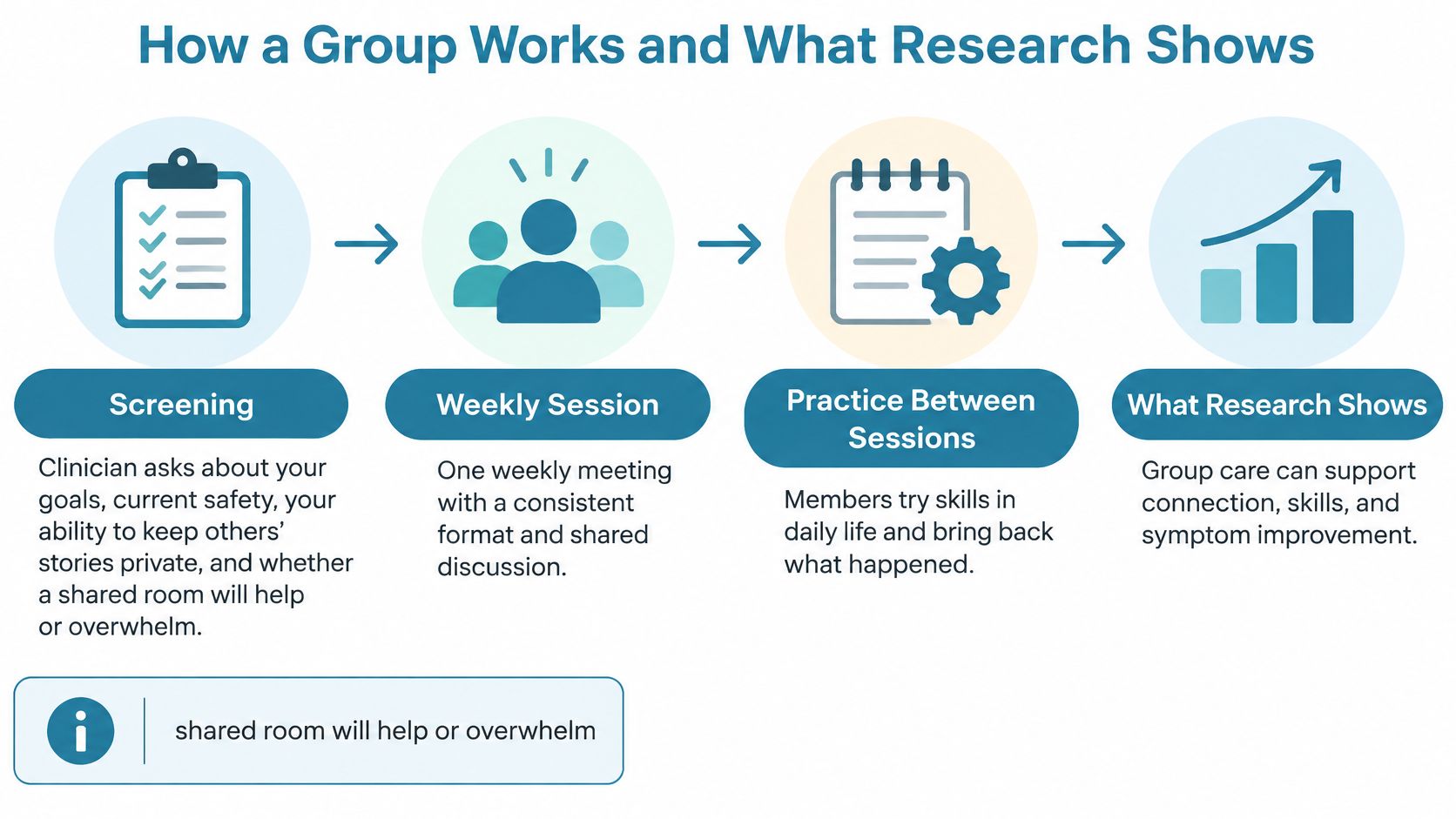
The useful work isn't necessarily dramatic disclosure. It might be asking for clarification instead of withdrawing, hearing feedback without immediately defending yourself, or saying you need a moment. The facilitator should help members attempt those behaviors without letting the meeting become criticism or unsolicited advice.
Before starting, expect explicit participation agreements:
Speaking and listening: Members take turns, and the facilitator addresses patterns that crowd others out.
Choice about disclosure: You can discuss how to pass on a question without disappearing from the work entirely.
Contact between meetings: The program explains boundaries around messaging, socializing, and relationships that could undermine treatment.
Privacy and its limits: Everyone understands the confidentiality agreement before sharing personal information.
Why other members matter
A group offers feedback that isn't available from private reflection alone. You can notice the story you tell yourself about another person's reaction, check whether it's accurate, and try responding differently. Watching someone else attempt that can also make the task feel more approachable.
The American Psychological Association's overview of group therapy summarizes more than 50 clinical trials finding group therapy as effective as individual therapy for several conditions, including depression and social anxiety. It also describes the importance of interpersonal learning, cohesion, and a well-managed therapeutic environment.
That evidence doesn't make every gathering therapeutic. A facilitator needs to clarify the treatment's purpose, attend to participation, and respond when an interaction becomes harmful. Feeling connected matters, but connection shouldn't replace clinical direction.
For someone exploring ADHD therapy, this distinction is useful. A room where members exchange scheduling apps may provide ideas. A therapeutic group can also examine what happens emotionally when you miss a deadline, expect criticism, and avoid the person you need to contact.
What the anxiety evidence actually says
A systematic review and meta-analysis of group psychotherapy for anxiety disorders, covering 57 studies and 3,656 participants, found a large benefit over no treatment (g = 0.92), a smaller benefit over interventions containing only nonspecific therapeutic factors (g = 0.29), and no statistically significant difference from individual psychotherapy (g = 0.24) or pharmacotherapy (g = −0.05).
The letter g describes a standardized difference between treatment outcomes. A large effect means participants receiving group treatment improved substantially relative to the comparison group, on average. It doesn't tell you the percentage who recovered, guarantee improvement, or predict your own experience.
The review also found mixed-diagnosis groups comparable to diagnosis-specific groups, while noting that more evidence is needed. That's a reason not to reject a group automatically because every member doesn't have your diagnosis. Shared goals and an appropriate treatment approach may matter more than identical labels.
Evidence boundary: An effective group treatment isn't proof that every group, facilitator, or online format works equally well.
These findings concern anxiety treatment, not proof that group therapy resolves every ADHD-related difficulty. They also don't justify stopping medication or replacing individualized treatment without a clinical discussion.
Define progress in everyday terms
Before joining, identify a change you could notice outside the meeting. You might want to ask a question at work without rehearsing indefinitely, discuss conflict without leaving, or return to an uncomfortable conversation after calming down. Those goals make it easier to evaluate whether the work is helping.
A facilitator may use symptom or functioning questionnaires alongside your observations. You can also bring back a specific attempt that didn't go well. Group therapy should make room for examining that attempt, not turn homework into another reason to feel ashamed.
Everyday Examples for ADHD Anxiety and Relationships
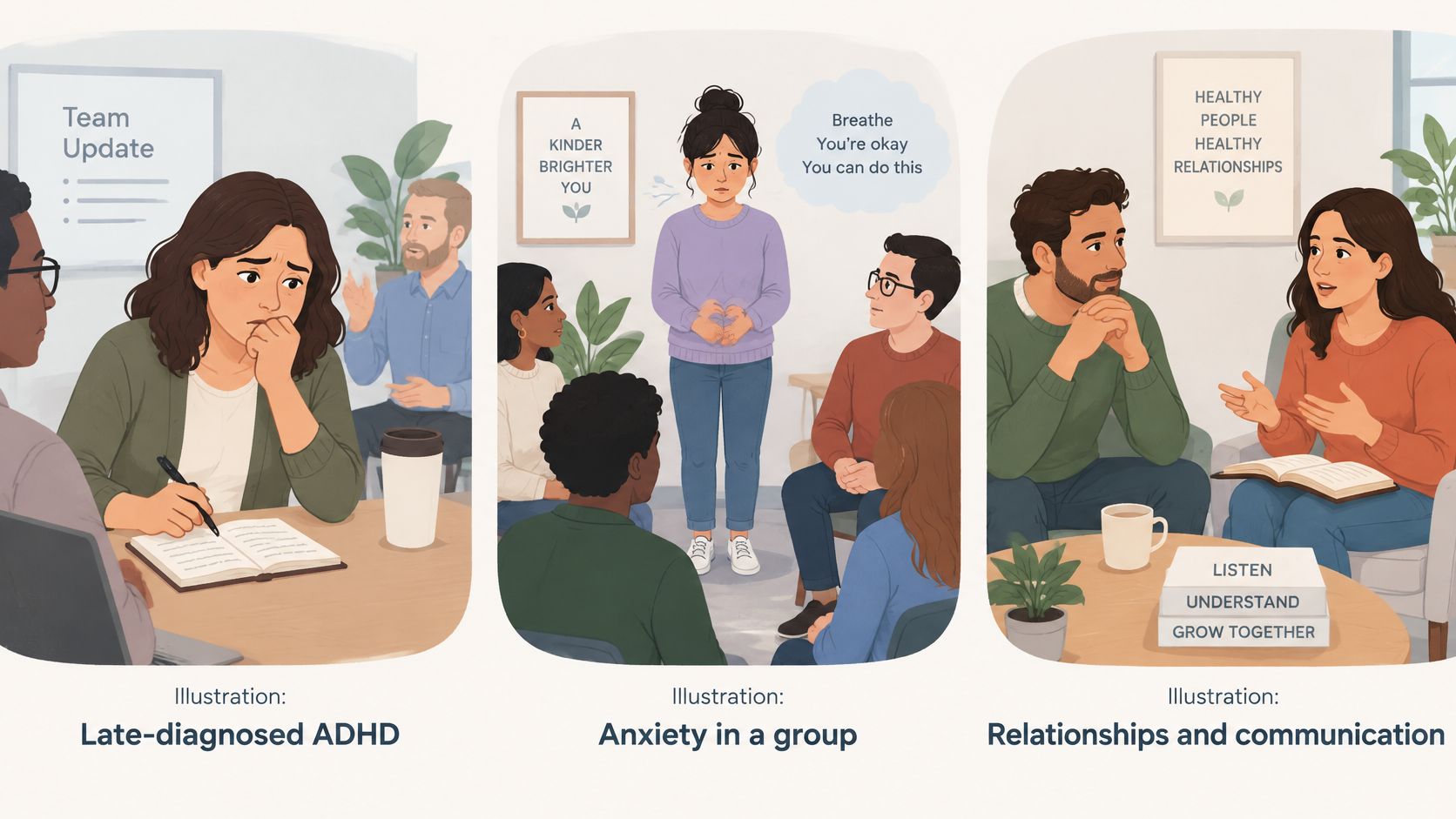
The following composite illustrations are hypothetical, not stories about actual clients. They show how similar concerns can call for different kinds of practice.
These illustrations represent experiences someone might bring into a group.
Late-diagnosed ADHD and the interruption spiral
In this composite example, an adult diagnosed with ADHD later in life dreads speaking at work. They interrupt, feel embarrassed, and then stay silent. In a skills group, they practice acknowledging the interruption, returning the floor, and contributing again rather than abandoning the conversation.
That evening, they notice a similar shutdown with their partner. ADHD is a neurodevelopmental condition that can affect executive functioning, emotional regulation, and daily life, but experiences differ substantially. The useful question isn't whether this person cares enough, but how attention, shame, and relationship expectations interact.
The group can help rehearse a repair. It can't settle medication decisions, and it may not provide enough privacy to explore the whole relationship history. The discussion of ADHD and relationship problems offers another way to think about those patterns.
Anxiety after an unanswered text
In this composite illustration, someone repeatedly rereads a message, convinced they sounded needy. In a process group, they admit they've also been avoiding eye contact because they expect rejection. Another member explains that they interpreted the withdrawal as disinterest.
That response supplies interpersonal information, not a verdict about the person's character. They can practice asking what someone means rather than treating an anxious interpretation as fact. The group can't determine what an absent dating partner thinks or manage a safety crisis through ordinary discussion.
For another perspective on the topic, this video can accompany reflection on your own questions.
Cannabis ambivalence without a morality play
In this composite scenario, a person wants to understand their cannabis use but isn't ready to commit to abstinence. An appropriate group helps them compare what they intended to do with what happened, including what they wanted relief from.
They can practice describing an urge candidly and choosing a response that fits their goals. The group can't replace medical evaluation or a private assessment when substance use raises safety concerns.
These exercises reflect acceptance and commitment therapy, or ACT, and interpersonal ideas in plain language: notice the urge, make room for discomfort, and try a more intentional response with real people. None of that requires pretending the discomfort is small. It does require a room that feels safe enough to attempt something unfamiliar.
Privacy Fit and When to Skip a Group
When to start with a group or with individual therapy
Situation | Better start | Why |
|---|---|---|
Crisis, active safety risk, or need for private risk planning | Individual therapy or higher-level care | A routine group isn't designed for urgent, individualized risk management |
Strong shame about ADHD, dating, or substance use and fear of being seen | Individual therapy, or a small group after screening | Safety and readiness come before peer practice |
Want feedback on how you come across in conversation | Interpersonal process group | Other members can describe their real-time responses |
Need repeatable skills for anxiety or emotion spikes | Skills or CBT-style group | Teaching, rehearsal, and between-session practice provide direction |
Childcare, mobility, or a DC-Virginia commute blocks attendance | Virtual group if the clinician may treat your location | Removes travel but requires private space and appropriate clinical fit |
Only want information, not interpersonal work | Psychoeducation or a trusted article plus individual care when needed | A process group asks for participation beyond learning facts |
Confidentiality is an agreement, not a guarantee
Members should agree not to repeat names, identifying details, or stories. However, a clinician can't guarantee that another participant will honor that agreement. Don't assume disclosure in a group has the same practical privacy protections as speaking alone with your therapist.
Clinicians also have confidentiality exceptions that can involve serious danger, abuse-reporting duties, and legally required disclosures. The exact obligations depend on the circumstances and jurisdiction. Ask the facilitator to explain what applies and how they would handle a breach, rather than relying on a general promise that everything stays private.
Virtual convenience and personal safety
A systematic review of online and face-to-face group interventions examined 15 randomized trials and found outcomes were usually comparable, but concluded it was premature to assume equivalence for every population or problem; some studies favored in-person treatment. Convenience is a reason to consider virtual care, not proof it's the right clinical format for you.
For home participation, plan for:
A closed door and headphones: Reduce the chance that someone overhears another member.
No recording: Don't take screenshots, recordings, or transcripts.
Clear camera expectations: Learn whether cameras are required and discuss accommodations before joining.
A workable environment: Avoid participating while driving, caregiving actively, or sharing a room.
Language, cultural safety, gender mix, disability access, transportation, and childcare are real fit questions. You should be able to ask how a facilitator handles misunderstanding or bias without being treated as difficult.
Practical rule: Don't force yourself into a group because a place is available when your needs point toward private or more intensive care.
How to Find and Join a Group in DC
A listing can show an available meeting without showing an accessible treatment. D.C.’s public behavioral-health system served 43,836 people through core mental-health and locally funded programs in FY2025, while access and overall satisfaction changed little or declined, according to the Department of Behavioral Health's performance measures. Service availability and a manageable path into care aren't the same thing.
Make the search specific
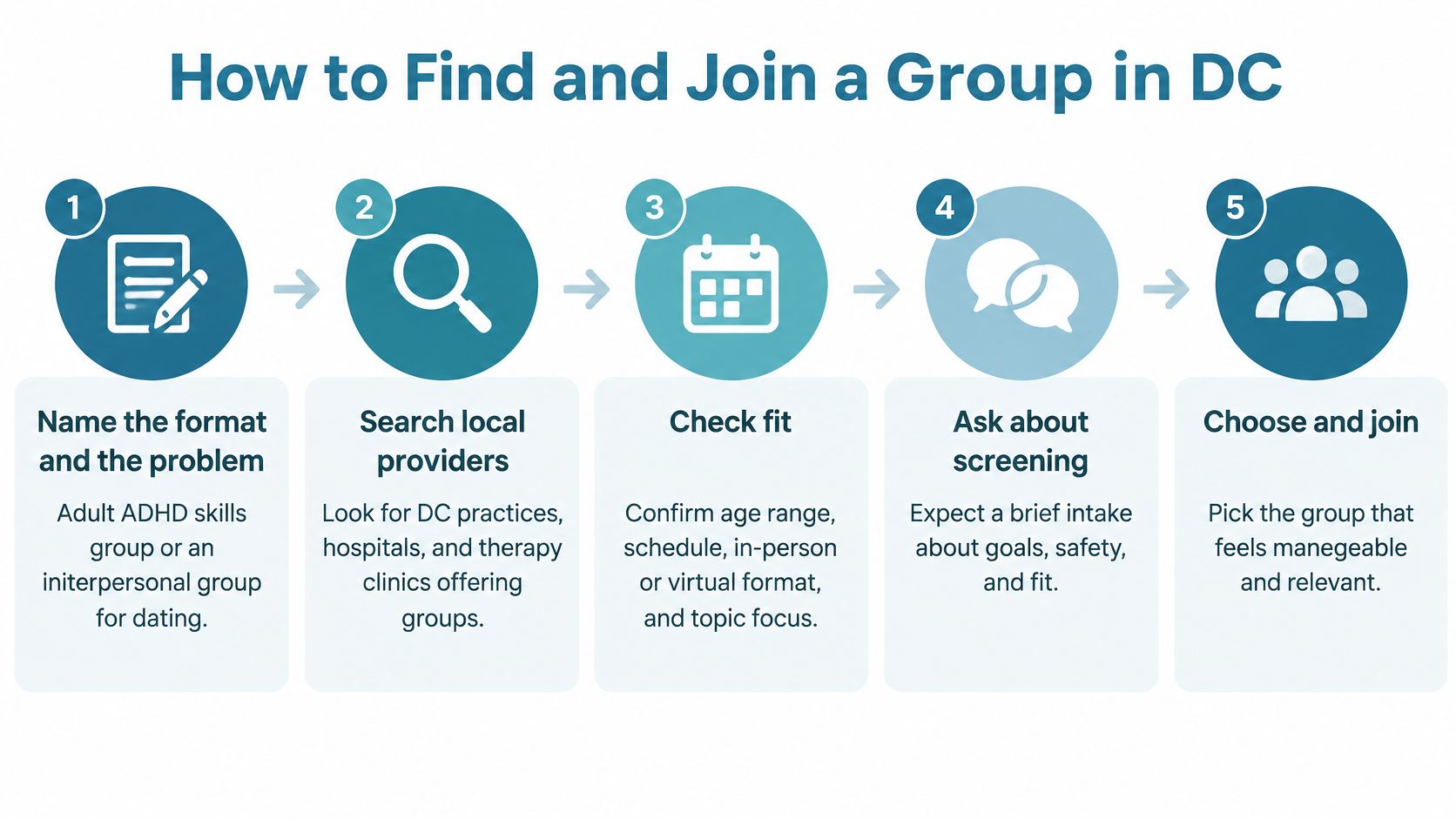
Name the format and the problem. Search for an adult ADHD skills group or an interpersonal group addressing relationship patterns, rather than therapy alone. Add your age group and preferred meeting format. For a teen, look for an age-appropriate program rather than assuming an adult group can accommodate them.
Search established clinical settings. Use clinician directories, hospital outpatient programs, and community clinics serving D.C. Confirm the facilitator's professional license and ask about their training in the group's approach. A peer-led gathering can be valuable, but it shouldn't be mistaken for clinician-led treatment.
Check the location rules for telehealth. Ask whether the clinician may treat you where you'll physically be during sessions, including a home in Virginia or an office in D.C. An available video link doesn't establish permission to provide treatment across jurisdictions.
Use this visual as a prompt while organizing your search.
Ask what staying enrolled requires
Get the practical terms before accepting a place. What does each meeting cost? Is insurance accepted, is a sliding scale available, and are missed sessions charged? Ask about wait time, meeting length and frequency, open versus closed enrollment, disability accommodations, and language access. If the group is full, ask whether there's a waiting list, another start date, or a referral option.
Use screening to assess the room. Ask the member limit, confidentiality boundaries, participation expectations, camera rules, and how conflict is handled. Explain constraints plainly, including caregiving, a commute, or difficulty following lengthy discussions. You're assessing whether the program is workable, not asking permission to have needs.
Decide after the conversation. You can decline a mismatch, wait for a better group, or begin individually. A full program is an access problem, not evidence that you've failed at getting help. Group work can complement private treatment rather than replacing it.
If cost is the main obstacle, the guide to finding free ADHD support groups can help you distinguish community support from psychotherapy. Keep the purpose of each option clear as you compare them.
Take a short checklist into screening
Goal: What specific change would make attendance worthwhile?
Feasibility: Can I sustain the cost, schedule, travel, and caregiving arrangements?
Clinical match: How will this format address my concern?
Contingency: What happens if I struggle, miss meetings, or need more support?
Put the answers somewhere you can find them later. For an ADHD-friendly approach, save the meeting details and next action in the calendar or task system you already use, rather than creating a new organizational project.
Choose a Group or Individual Therapy Next
If you can name a relevant format, make room in your schedule, and tolerate being known by other members, a screening conversation is a reasonable next step. You don't need to arrive comfortable or confident. You need enough willingness to explore whether this particular setting supports the work you want to do.
If shame makes speaking feel impossible, your goals remain unclear, or your circumstances require privacy, individual therapy is a legitimate starting point. You don't have to push yourself toward the more exposing option to prove you're serious about change.
Choose the kind of conversation you need
A private session can help you describe experiences you're not ready to share publicly, separate overlapping concerns, and develop a more specific treatment goal. For someone dealing with persistent overthinking, learning about anxiety therapy in D.C. may be a more useful starting point than choosing a group by its title.
You also don't need to settle your long-term treatment plan immediately. Individual work and a group can serve different purposes at different times, with coordination when appropriate.
Start with the setting where you can speak honestly enough to do useful work.
At our practice, Nick Donahue, LICSW, provides individual therapy for teens and adults, in person in Washington, DC and virtually throughout DC and Virginia. You don't need a diagnosis or a perfectly clear reason to begin. The first conversation can include whether individual care or a group elsewhere would better suit your needs.
Nick Donahue LICSW offers individual therapy for ADHD, anxiety, relationship difficulties, substance-use questions, and life transitions, with space to consider whether group work belongs in your care. Visit Nick Donahue LICSW to schedule either an initial therapy session or a free 15–20 minute phone or video consultation to discuss your questions and fit.
Comments