
Free ADHD Support Groups: 10 Options for 2026

You've just received an ADHD diagnosis, or you're beginning to wonder whether ADHD explains some familiar struggles. You want to talk with people who understand unfinished tasks, missed messages, and the exhaustion of trying to stay organized. But joining a room full of strangers, even a virtual room, raises questions. Will you have to share? Do you need a diagnosis? Will anyone try to sell you something?
Free ADHD support groups exist in both local and virtual formats, but eligibility, enrollment, and schedules vary widely. Some welcome people who suspect they have ADHD. Others require a diagnosis, serve a particular community, or close enrollment once a group begins. Confirm details directly before putting a meeting on your calendar.
Peer support and therapy serve different purposes. A peer group can offer understanding and practical ideas without providing assessment or individualized treatment. The CDC's guidance on ADHD in adults describes clinical treatment as potentially involving medication, therapy, behavioral treatments, or a combination, with ongoing monitoring and adjustment.
If you're searching for free ADHD support groups near me in Washington, D.C., or Virginia, the options below include local organizations and virtual alternatives. Treat them as starting points, not guarantees of current availability.
Start with the enrollment question: Before describing your history, ask whether the group is accepting new members and whether you're eligible.
Table of Contents
1. CHADD of Northern Virginia & Washington, D.C. - What to do before signing up
2. New Hope Counseling Group Adult Neurodivergent Support Group - Clarify the format before committing
4. Rockingham Memorial Hospital ADHD Advocacy Group - Make the call before making the drive
6. ADDNashville - A predictable rhythm, with clear eligibility
8. ADHD Adults Support Group at Summers ADHD Coaching - Support without needing certainty
9. LDA Minnesota Adult ADHD Support Groups - Questions for a new participant
10. CHADD of Greater Baltimore Women's Online Support Group - Look for respectful facilitation
How the 10 free ADHD support options compare on format, cost, eligibility, and schedule
Choosing a Group You Can Return To - A practical first-meeting checklist
1. CHADD of Northern Virginia & Washington, D.C.
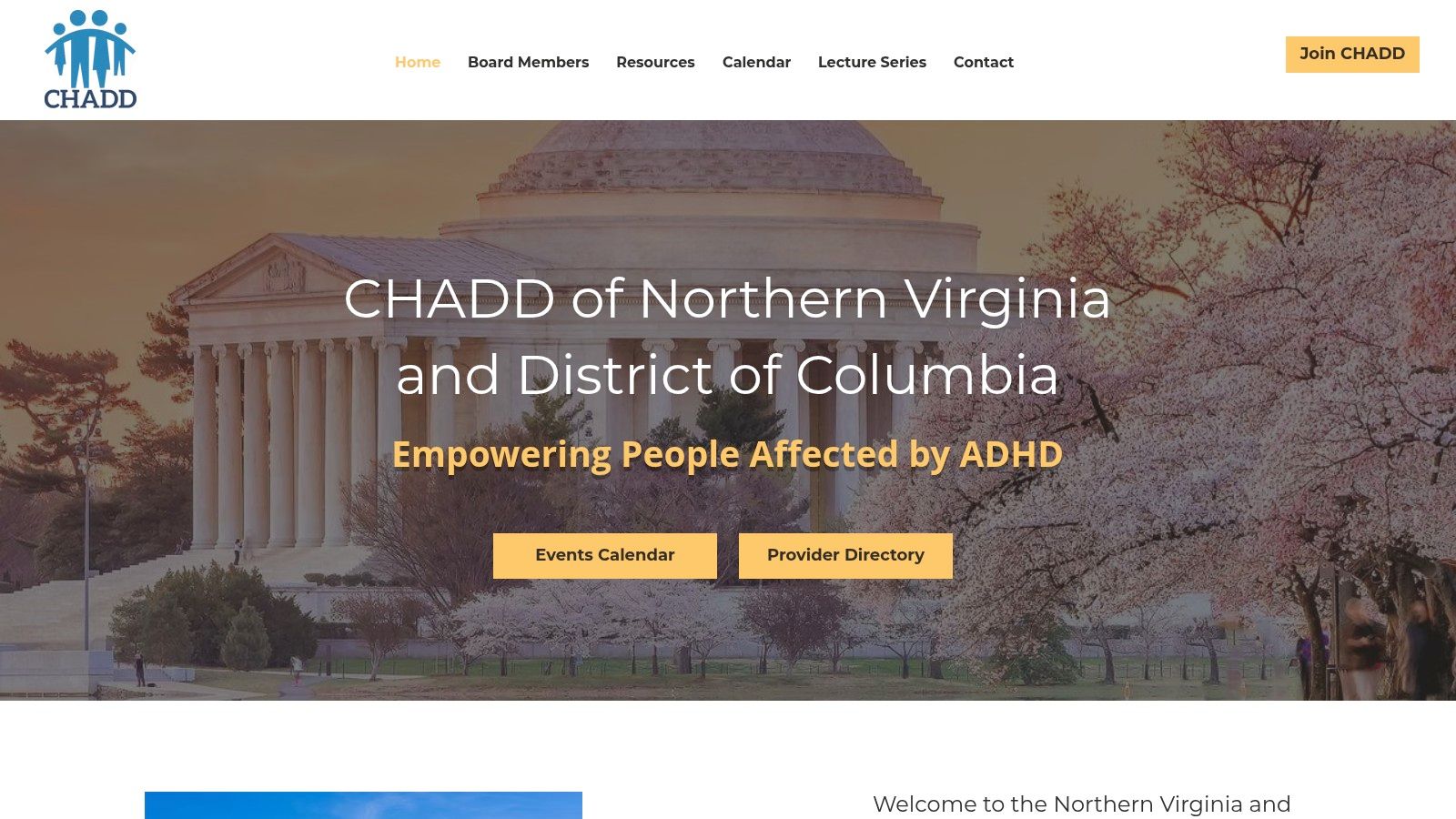
Best for finding regional resources, rather than an immediately available recurring group. CHADD of Northern Virginia & Washington, D.C. connects people in the D.C., Maryland, and Virginia area with ADHD education, lectures, and resource events. Its local focus makes it a sensible starting point if you want community connections close to home.
The regional chapter website lists quarterly online lectures and says its support groups are being revitalized, with an interest survey for people seeking meetings. That's an important limitation: it isn't currently advertising a regular active support group you can join.
What to do before signing up
Ask about enrollment: Find out whether a group has launched, whether new participants are welcome, and which ages it serves.
Check individual events: Public education events may provide useful connections, but confirm registration requirements and any costs separately.
Clarify your need: Say whether you want adult peer discussion, parent resources, or help finding an evaluation.
The advantage is a direct connection to a regional ADHD organization. The trade-off is uncertainty about when ongoing support meetings will be available. An educational lecture can be useful, but it doesn't provide the same opportunity for recurring conversation.
If you're still sorting out whether ADHD fits your experience, our guide to ADHD screening for adults can help you distinguish screening from a fuller clinical evaluation.
2. New Hope Counseling Group Adult Neurodivergent Support Group
If open-ended conversation feels too unpredictable, a structured group may be more appealing. New Hope Counseling Group's offering addresses both practical difficulties and the emotional strain of navigating everyday expectations as a neurodivergent adult.
The Adult Neurodivergent Support Group page describes a free, eight-session virtual group for adults living in D.C. or Maryland, with 5–10 participants, and states that the current cohort is closed to new members. Future availability needs confirmation, and Virginia residents shouldn't assume they're eligible.
Topics include executive functioning, sensory needs, burnout, emotional flooding, shame, communication, and self-advocacy. That breadth matters if your difficulty isn't just remembering appointments, but also feeling embarrassed, overwhelmed, or misunderstood when plans fall apart.
The main advantage is structure. A small, defined cohort can suit someone who wants continuity and focused topics rather than a drop-in discussion.
Clarify the format before committing
Ask whether a future cohort is planned, how attendance works, and whether the offering is clinical group therapy, facilitated education, or another support format. A counseling practice hosting a group doesn't, by itself, tell you its clinical scope.
While waiting, you might explore our guide to apps for executive functioning. Use an app to support a specific task, such as remembering appointments, rather than expecting it to address burnout or shame.
3. CHADD of Maryland Greater Baltimore Adult Support Group
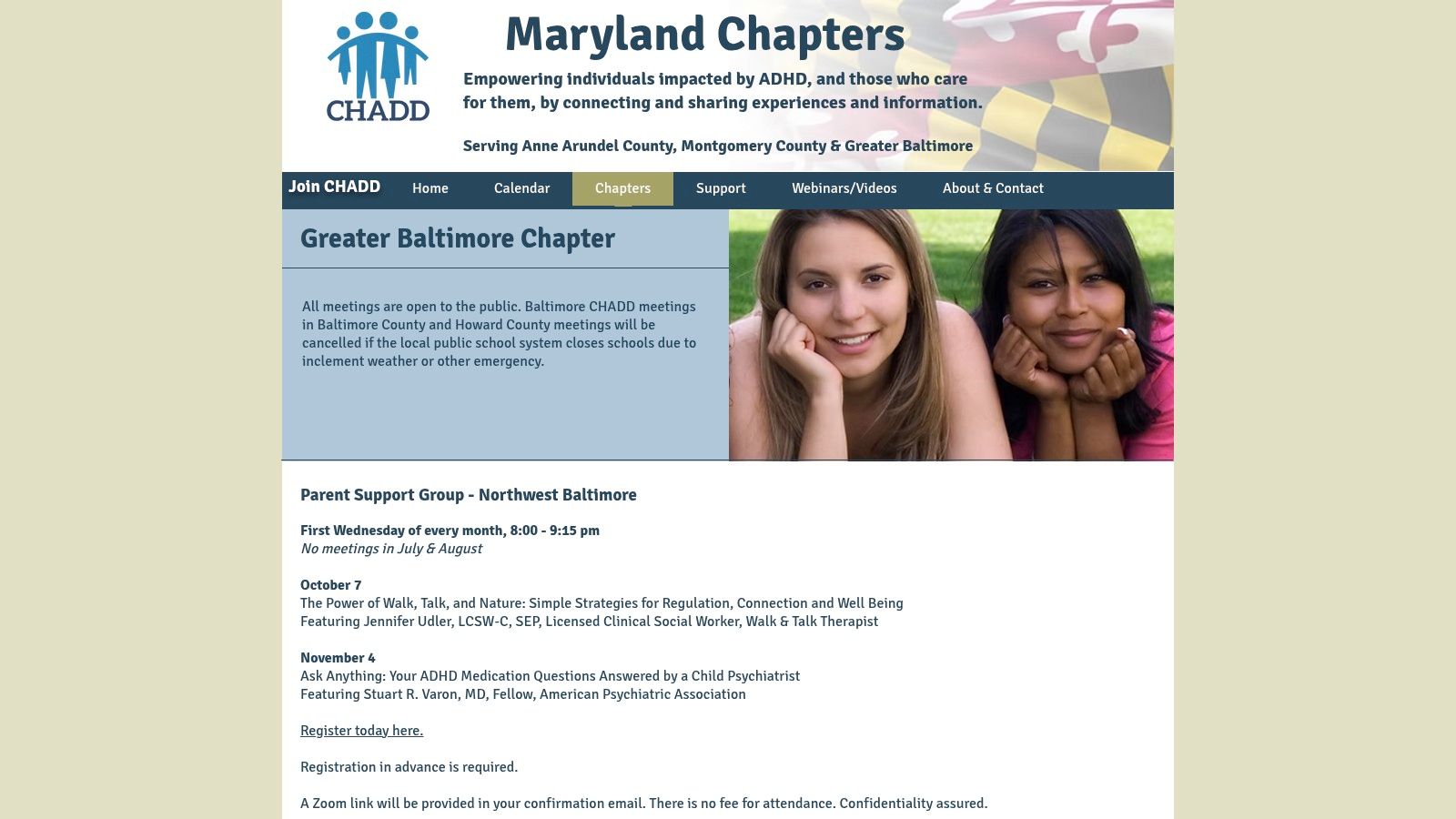
This is a more direct option for adults looking for informal ADHD peer discussion. The Greater Baltimore group focuses on everyday concerns, including time management, organization, family, and work. Its Zoom format removes the need to travel to Baltimore, although geographic eligibility still deserves confirmation.
The CHADD of Maryland Greater Baltimore page lists a free adult support group on the third Wednesday of each month. Contact the organizer for the meeting link and to confirm that the group is still running and accepting participants.
What works: An informal discussion can make room for the problem that's most relevant to you that day.
What may not: Open-ended conversation offers less predictable coverage than a structured course.
What to verify: Ask about diagnosis requirements, participation from outside the region, and whether listening without sharing is welcome.
Say you're struggling with unanswered work emails. Hearing how others approach that task may give you something concrete to try, without requiring you to explain your entire history.
The limitation is equally important: another participant's strategy isn't an individualized treatment recommendation. Peer support isn't therapy, and advice about medication, diagnosis, or significant mood symptoms belongs in a clinical conversation. A well-run group should make room for different experiences rather than treating one person's solution as the answer for everyone.
4. Rockingham Memorial Hospital ADHD Advocacy Group
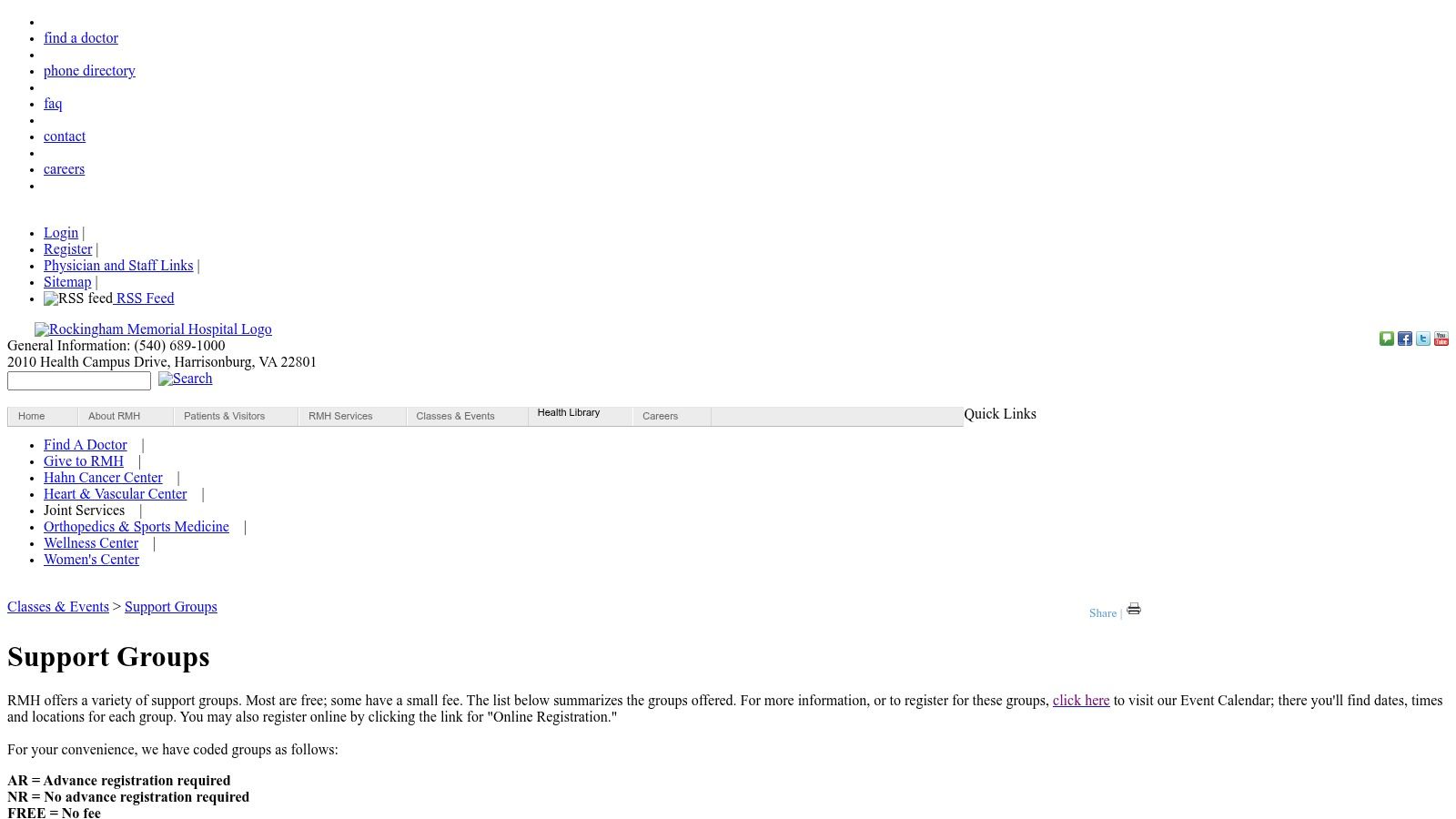
For someone near Harrisonburg, Virginia, an in-person meeting may be preferable to another evening on a screen. Rockingham Memorial Hospital's ADHD Advocacy Group is a local lead, but the listing leaves important questions unanswered.
The Sentara RMH support-group listing gives a meeting schedule of the second Tuesday, from 6:30 to 8 p.m., and says most hospital support groups are free; call 540-943-5383 to confirm this group's cost, schedule, and location. Don't treat the hospital's general statement about fees as confirmation that this particular meeting is currently free.
Make the call before making the drive
Ask who the group serves: adults with ADHD, parents, families, or a mixed audience. Also ask whether it's peer-led, professionally facilitated, or primarily focused on advocacy and education.
The benefit is local, face-to-face contact. The drawback is limited published detail, along with travel that won't be practical for many D.C.-area residents.
A hospital-hosted meeting isn't automatically psychotherapy. Ask what happens during the meeting and who facilitates it.
For an in-person group, practical access matters as much as the topic. Confirm the building entrance, parking, accessibility, and whether registration is necessary. If arriving somewhere unfamiliar feels stressful, getting those details beforehand removes a preventable obstacle without requiring you to feel completely comfortable before attending.
5. AHA! ADHD Peer Support
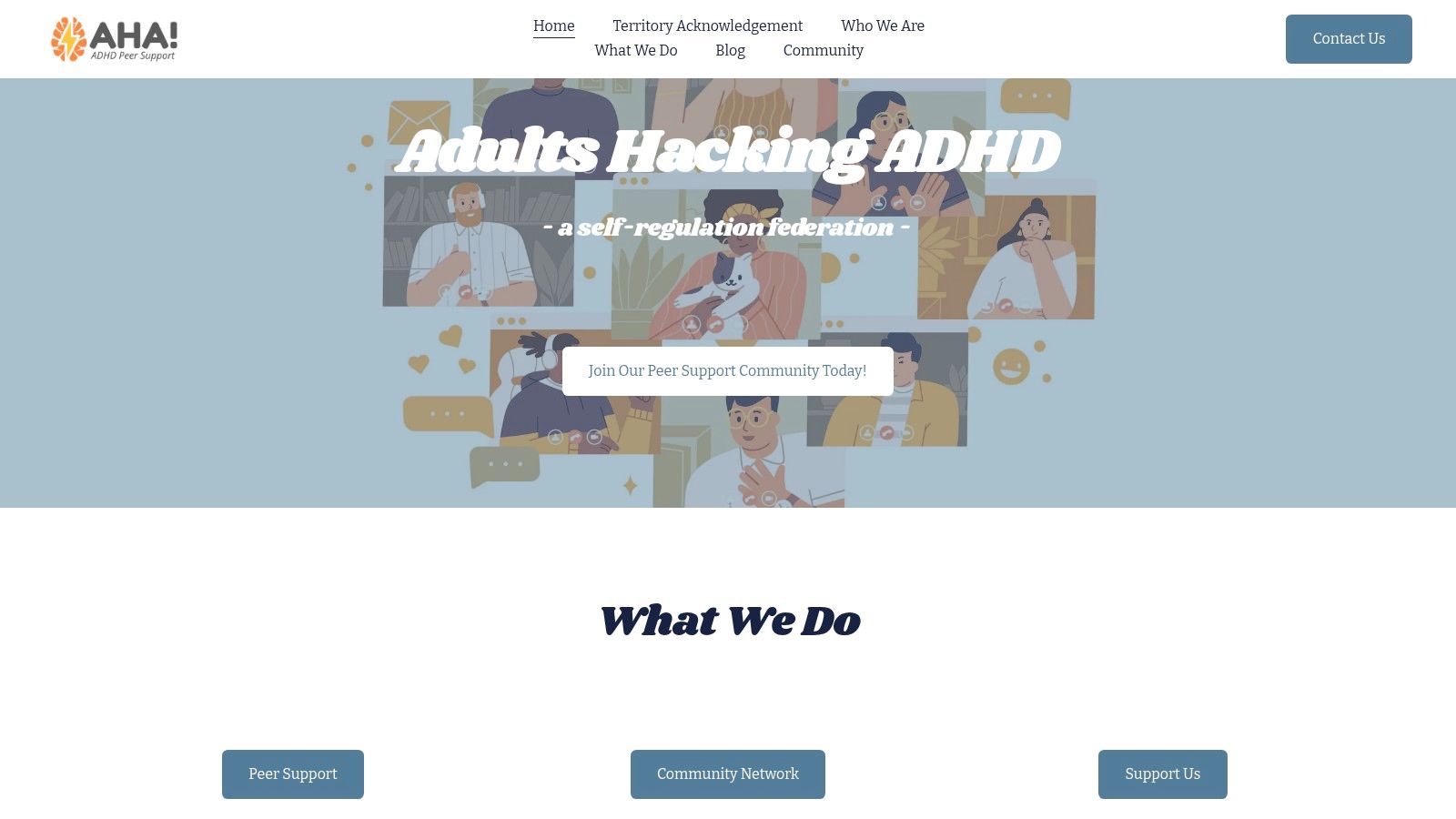
Sometimes you want to talk about the task. Sometimes you want company while you do it. AHA!, short for Adults Hacking ADHD, offers both peer connection and virtual co-working.
AHA! ADHD Peer Support describes all its services as free, including peer-support meetings, virtual co-working, and an online community for adults with ADHD. Check its current meeting times and participation instructions before joining.
That combination offers a useful distinction. A discussion meeting gives you space to compare experiences, while co-working provides a setting for doing your own work alongside others.
Choose peer discussion when you want understanding, perspective, or ideas.
Choose co-working when you already know the task and want a shared setting in which to begin.
Check community expectations before posting personal information or joining ongoing conversations.
Neither format requires treating productivity as a measure of your worth. You can want help finishing paperwork and also recognize that unfinished paperwork doesn't make you lazy.
The trade-off is that this remains peer support, not clinical treatment. Co-working won't assess why you're avoiding a task or provide individualized care for anxiety or depression. Ask about diagnosis requirements, moderation, and whether meetings have expectations around cameras, introductions, or sharing.
6. ADDNashville
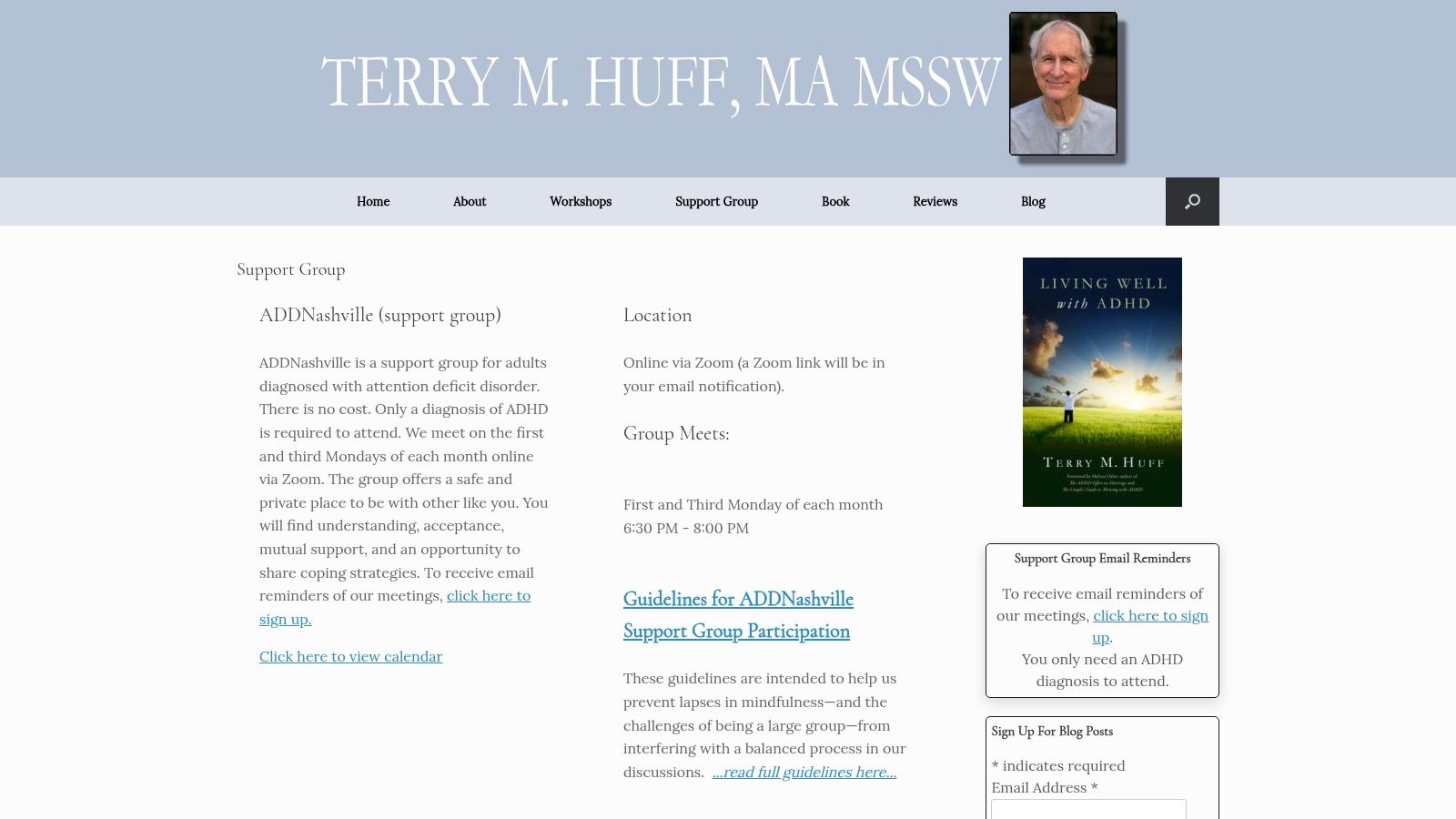
A diagnosis is required for this option. ADDNashville is an online support group for adults diagnosed with ADHD, so it's not the right starting point if you're still exploring whether you might have the condition.
The ADDNashville support-group website lists free Zoom meetings on the first and third Mondays of each month, from 6:30 to 8 p.m. Central, and states that participants need an ADHD diagnosis. Group guidelines and email reminders are available; confirm the current schedule and sign-up process before attending.
A predictable rhythm, with clear eligibility
A recurring schedule can be useful if you want ongoing contact rather than an occasional event. Email reminders may also help you remember a meeting you intend to attend.
The trade-offs are the diagnosis requirement and the Central time schedule. Put the meeting into your calendar with its stated time zone rather than relying on memory, particularly if you live in D.C. or Virginia.
Read the guidelines before your first meeting. Look for expectations about confidentiality, respectful disagreement, advice-giving, and participation.
This is peer support, not therapy. You can use it to hear how others manage ADHD while keeping treatment decisions with your own healthcare professional. If a conversation brings up something personal, you don't have to process it publicly just because the group is discussing a similar experience.
7. Atlanta Adult ADD Support Group
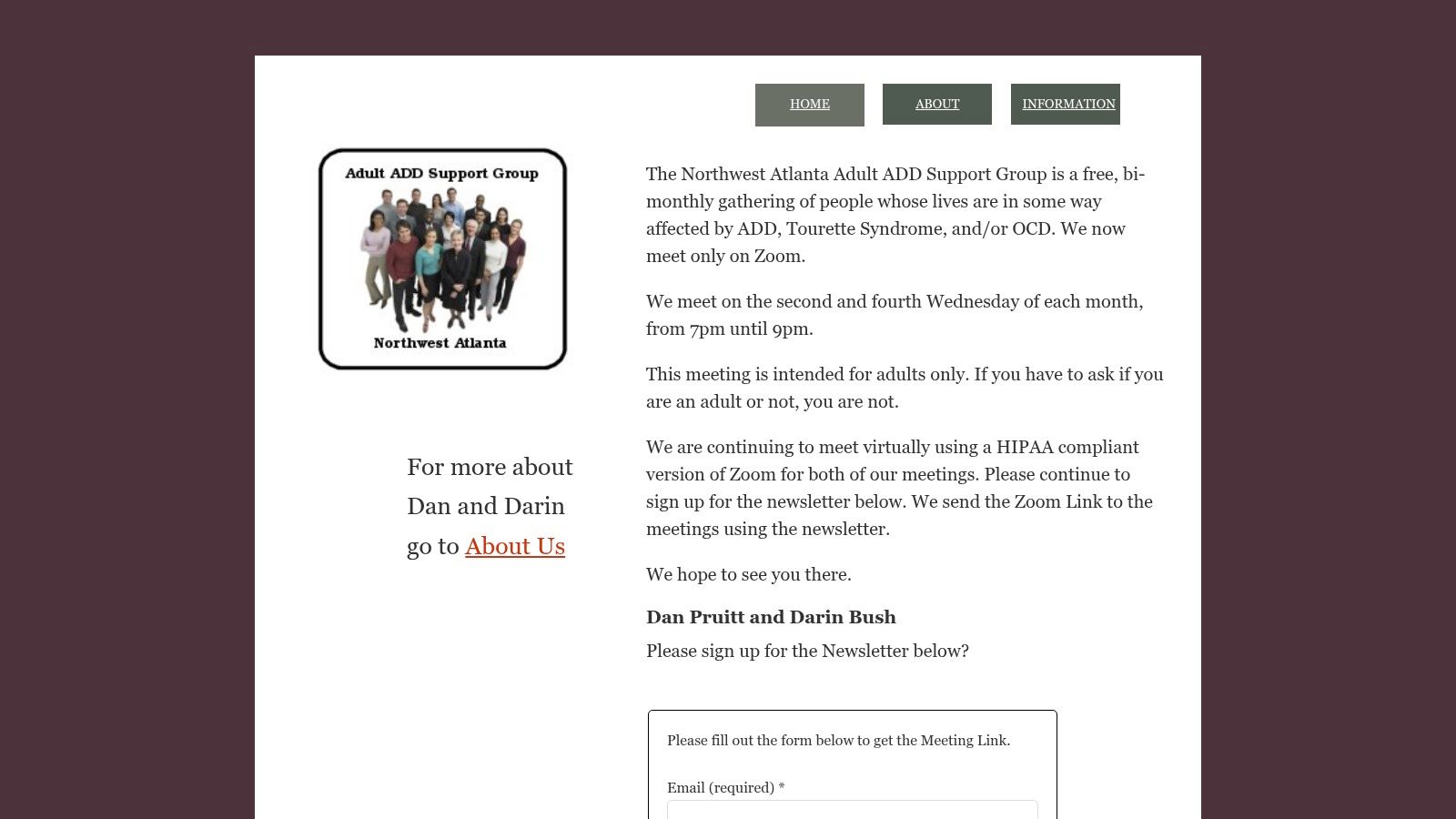
A group doesn't have to be exclusively about ADHD to be useful. Atlanta Adult ADD Support Group welcomes adults affected by ADHD, Tourette syndrome, and/or OCD, making it a broader peer community than some other options.
The Atlanta Adult ADD Support Group website lists free Zoom meetings on the second and fourth Wednesdays, from 7 to 9 p.m. Eastern. Newsletter registration is used to receive meeting access, so sign up ahead of time and confirm the upcoming session.
The advantage is accessible online peer connection. The trade-off is that discussion may include experiences that don't closely match your own.
Check audience fit: Ask how the group interprets adults affected by these conditions and whether a diagnosis is required.
Plan for access: Use an email account you check, and look for meeting instructions before the scheduled start.
Set a privacy boundary: Decide beforehand which details you're comfortable sharing.
A broader group may suit you if your concerns cross diagnostic categories. It may be less satisfying if you want every conversation to focus specifically on ADHD-related work or relationship difficulties.
Don't judge fit only by whether everyone sounds like you. Notice whether the facilitator makes room for different experiences and whether participants can disagree without dismissing each other. Shared diagnoses alone don't guarantee a respectful group.
8. ADHD Adults Support Group at Summers ADHD Coaching
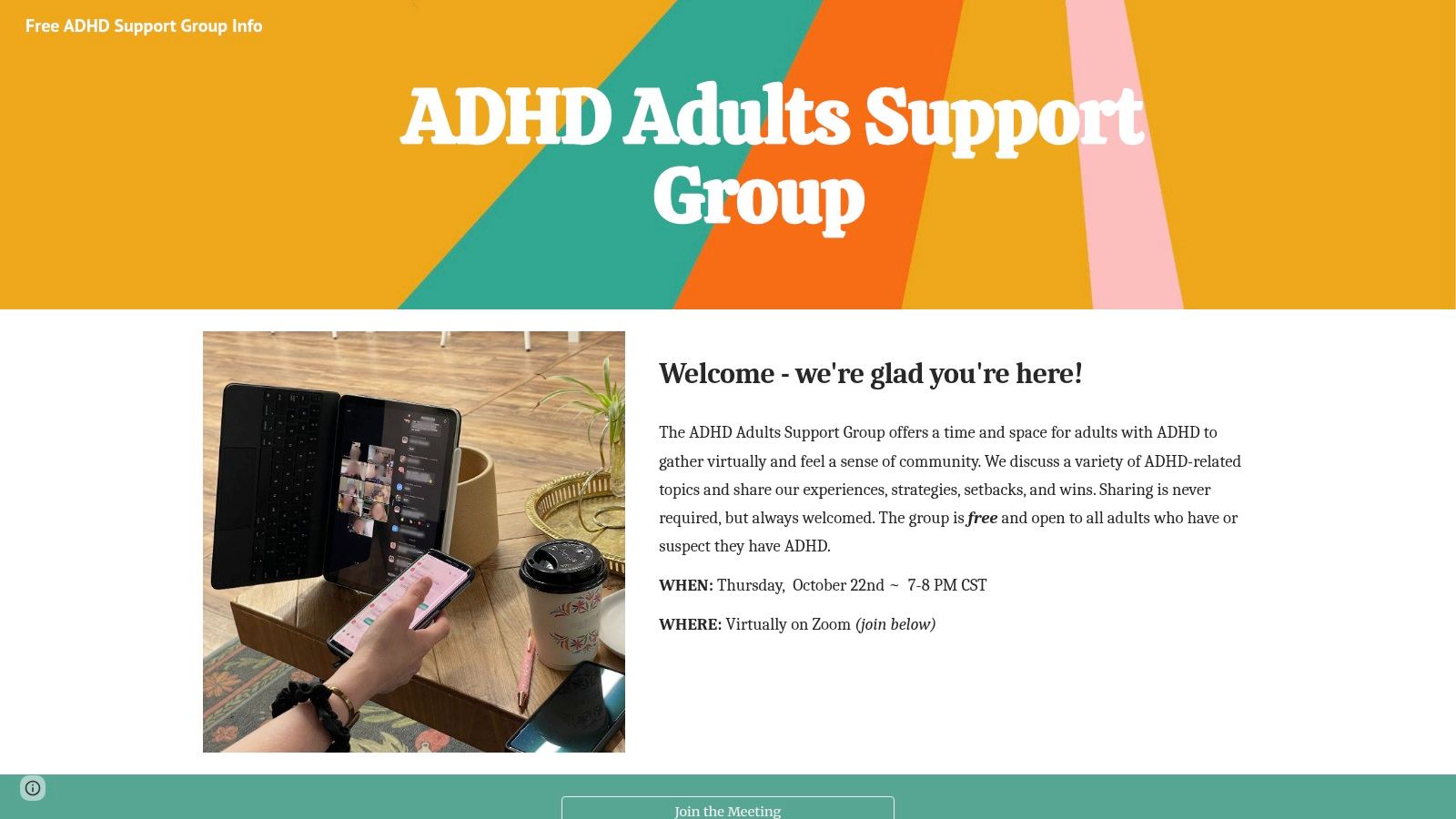
This option explicitly welcomes people who suspect they have ADHD. That matters if you want connection before an assessment without presenting uncertainty as a confirmed diagnosis.
The Summers ADHD Coaching support-group page describes free virtual peer support for adults aged 18 and older, including people who suspect ADHD, with no coaching purchase required. It distinguishes the group from coaching and therapy; check the page for the next meeting because listed dates may change.
Support without needing certainty
You can attend to listen and compare experiences without asking the group to decide whether you have ADHD. Recognition can feel meaningful, but it isn't diagnostic evidence on its own.
The strengths are low-pressure access and a clear boundary between the support meeting and paid coaching. The limitation is that current dates and Zoom access need verification.
A useful boundary: You can relate to someone's story without concluding that you share their diagnosis or need their treatment.
Before joining, ask about moderation, confidentiality, and participation expectations. A group hosted by a coaching business should still make its peer-support boundaries clear.
If you're waiting for an evaluation, keep notes about concrete difficulties across settings, such as work, home, and relationships. Those notes can support a later clinical conversation without turning every group discussion into a search for proof.
9. LDA Minnesota Adult ADHD Support Groups
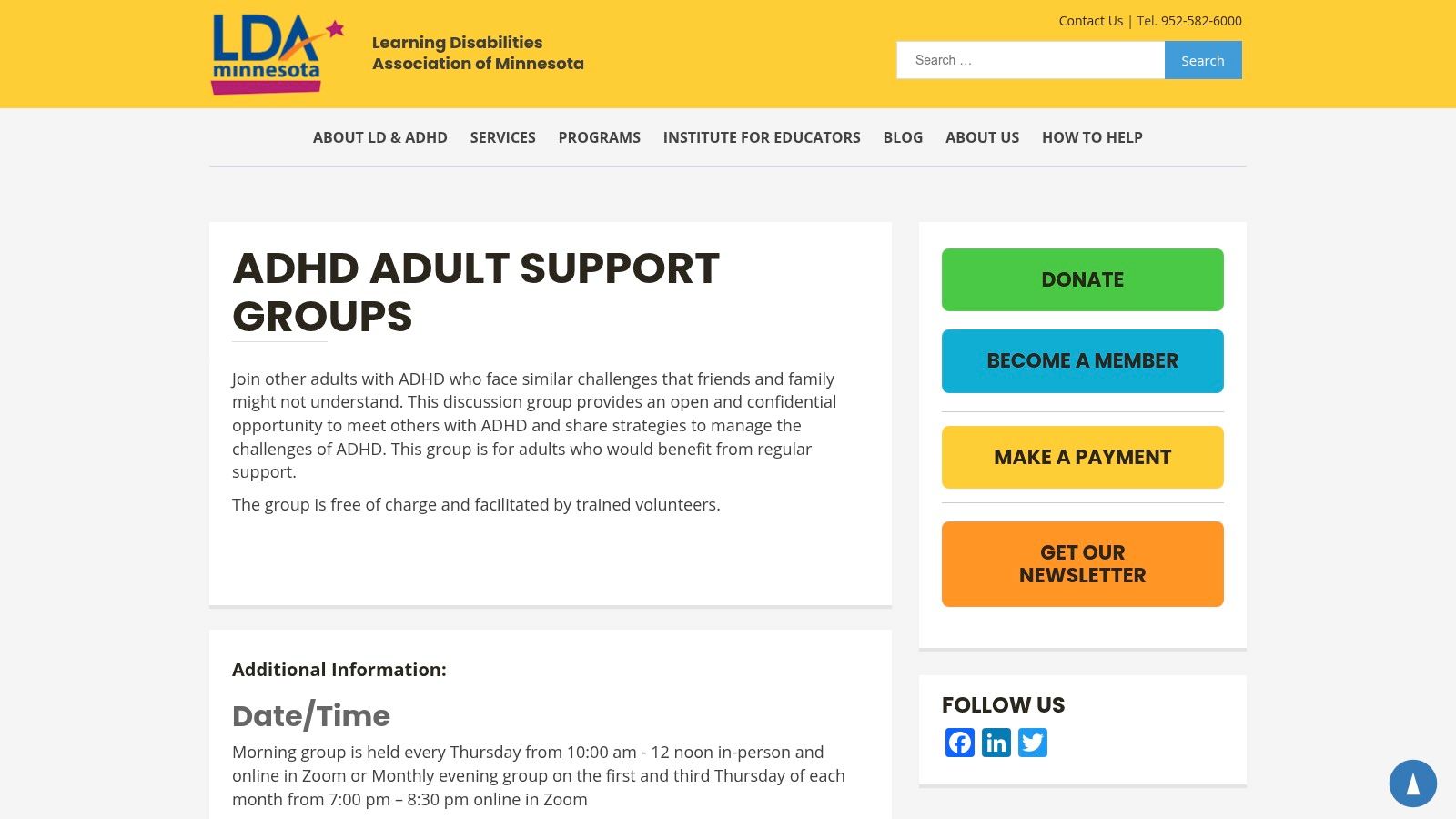
LDA Minnesota is worth considering if you want to compare online discussion with local, in-person options. Its adult ADHD groups primarily serve the Twin Cities, so readers elsewhere should confirm whether remote participation is welcome rather than assuming online means open nationwide.
The LDA Minnesota adult ADHD support-group page lists an online evening option on the first and third Thursdays. The groups are described as free in a Minnesota resource listing, but confirm fees directly with LDA Minnesota before attending.
The practical advantage is having both online and in-person formats associated with a local organization. The main limitation for D.C. and Virginia readers is geographic fit.
Questions for a new participant
Eligibility: Are adults outside Minnesota welcome, and is a diagnosis required?
Enrollment: Can you join the next meeting, or is an introductory conversation necessary?
Logistics: What are the current time, time zone, registration process, and attendance expectations?
Contact the organization before attending rather than relying only on a recurring calendar entry. That also gives you a chance to ask whether the group's focus matches what you need.
If you prefer to learn privately before joining a discussion, our guide to books on ADHD offers another starting point. Reading can help you find language for your experience, though it doesn't replace assessment or the back-and-forth of a supportive conversation.
10. CHADD of Greater Baltimore Women's Online Support Group
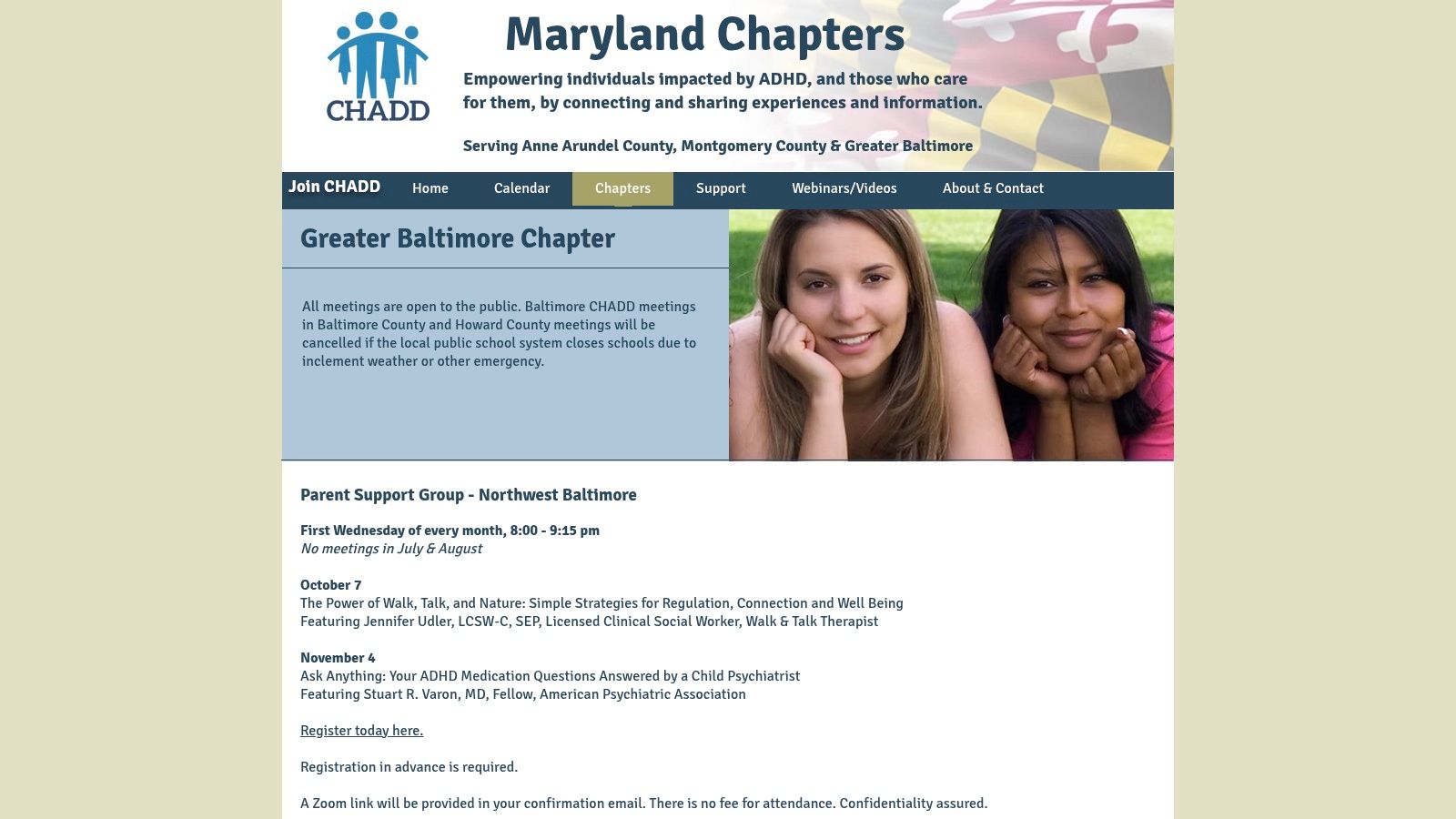
A women-focused group may feel more relevant than a general adult meeting. CHADD of Greater Baltimore lists an online support group for women with ADHD, with advance registration required and no attendance fee. Use the Greater Baltimore chapter page linked above to check current dates and eligibility details.
The chapter notes confidentiality, which is important, but a confidentiality expectation isn't a guarantee that another participant will protect everything you disclose. Start with what feels comfortable rather than sharing too much to establish that you belong.
The strengths are a dedicated community and peer sharing without an attendance charge. The limitations are required registration, uncertain session availability, and the need to confirm eligibility with the chapter.
Look for respectful facilitation
A useful group leaves room for differences in work, family responsibilities, identity, diagnosis history, and treatment choices. You shouldn't need to match someone else's experience of ADHD to participate meaningfully.
CHADD's discussion of the role of peer support emphasizes connection, shared strategies, and help navigating care, while distinguishing those functions from professional treatment. That distinction applies here as much as in a general adult group.
Ask whether you can listen during your first meeting and how facilitators respond to unsolicited advice. For parents seeking help for a teenager, this adult group isn't a substitute for an age-appropriate teen or parent resource.
How the 10 free ADHD support options compare on format, cost, eligibility, and schedule
These options differ in more than location. Some are peer meetings; others offer structured sessions, co-working, or education. The table separates listed costs and schedules from details that are not provided, so you can compare what is known without assuming every option is free or currently accepting members.
Item | Format | Cost | Who It Is For | Schedule Listed |
|---|---|---|---|---|
CHADD of Northern Virginia & Washington, D.C. | Regional events and online lectures | Cost not listed | People in the Washington, D.C., Maryland, and Virginia area seeking ADHD resources | Quarterly online lectures; support groups being revitalized |
New Hope Counseling Group, Adult Neurodivergent Support Group | Structured virtual group; eight sessions | Free | Neurodivergent adults living in D.C. or Maryland | Future cohort dates not listed; current group is closed |
CHADD of Maryland, Greater Baltimore Adult Support Group | Informal Zoom peer group | No fee listed | Adults with ADHD | Third Wednesday of each month |
Rockingham Memorial Hospital, ADHD Advocacy Group | In-person group in Harrisonburg, Virginia | Cost not listed | People interested in an ADHD advocacy group, especially in the Harrisonburg area | Second Tuesday of each month, 6:30–8:00 p.m. |
AHA! ADHD Peer Support | Peer meetings, virtual co-working, and online community | Free | Adults with ADHD | Meeting times not listed |
ADDNashville | Online Zoom peer group | Free | Adults with an ADHD diagnosis | First and third Mondays, 6:30–8:00 p.m. Central |
Atlanta Adult ADD Support Group | Online Zoom peer group | Free | Adults affected by ADHD, Tourette syndrome, and/or OCD | Second and fourth Wednesdays, 7:00–9:00 p.m. Eastern |
ADHD Adults Support Group, Summers ADHD Coaching | Virtual peer-support group | Free | Adults 18 and older who have or suspect they have ADHD | Next meeting date not listed |
LDA Minnesota, Adult ADHD Support Groups | Online and in-person groups | Listed as free | Adults with ADHD, primarily in the Twin Cities | Online evening group listed for the first and third Thursdays |
CHADD of Greater Baltimore, Women's Online Support Group | Online peer-support group | No attendance fee | Women with ADHD | Meeting dates not listed |
Choosing a Group You Can Return To
Choose for fit before proximity. A nearby meeting won't help much if you aren't eligible, can't attend consistently, or need a different kind of support. Start by deciding whether your immediate priority is conversation, practical co-working, structured learning, or individualized clinical care.
Narrow your options by diagnosis requirements, age, geography, format, and schedule. If a local listing isn't active, the CHADD chapter locator recommends checking neighboring chapters and notes that almost all chapters offer virtual meetings. Confirm each group's costs and enrollment directly rather than assuming a chapter affiliation guarantees free access.
A practical first-meeting checklist
Confirm access: Ask whether new members are welcome, whether a diagnosis is required, and how to register.
Clarify the role: Find out whether the facilitator is a peer or professional, and whether the meeting is support, education, coaching, or therapy.
Check privacy: Ask about recording, screenshots, confidentiality expectations, and how disruptive behavior is handled.
Plan your participation: Confirm whether you can listen, keep your camera off, or step away if overwhelmed.
Protect clinical decisions: Don't change medication or treatment because another participant recommends it.
Try an initial meeting and, if it feels reasonably safe but unfamiliar, consider returning before deciding. Notice whether you leave feeling heard, pressured, overloaded, or interested in coming back. A group can be respectful and still not be right for you.
Be cautious if participants diagnose each other, pressure people to disclose, promote treatment as universally effective, or discourage professional care. Free doesn't automatically mean accessible or safe. Peer meetings also aren't crisis services; urgent safety concerns need appropriate emergency or crisis support.
Peer support can reduce isolation and offer practical ideas. Individual therapy provides a more private setting to explore shame, anxiety, relationship patterns, avoidance, and emotional regulation in greater depth. You might know how to make a task list while still needing help with the self-criticism that follows an unfinished task.
In our practice, we work with teens and adults in person in Washington, D.C., and virtually throughout D.C. and Virginia. We combine practical ADHD strategies with attention to emotional and relationship patterns, and you don't need a diagnosis to begin. If you'd like to explore one-on-one support, Nick Donahue, LICSW, offers a free 15–20 minute phone or video consultation to discuss what's bringing you to therapy and whether working together feels like a fit, without pressure to commit.
Peer support can offer community, while individual therapy gives you space to work through the difficulties you'd rather explore privately. Visit Nick Donahue LICSW to learn about ADHD therapy in Washington, D.C., and virtual therapy across D.C. and Virginia, or schedule a free consultation to talk about what support would be useful now.
Comments