
10 Best Books on ADHD for Adults, Teens, and Parents

The best books on ADHD depend on what you want help with: understanding ADHD, building executive-function skills, managing emotions, navigating relationships, or supporting a teen or family member. A systematic review of adult ADHD psychoeducation identified 2,121 records and included 10 peer-reviewed studies, but found the evidence too varied to estimate overall effectiveness, so choose a book for how well its content fits your needs, not its popularity alone.
(Click here to read the review of adult ADHD psychoeducation)
You might be staring at a work task you can't start, replaying an argument, or wondering why ordinary routines take so much effort. ADHD can affect attention and organization, but it can also shape emotional regulation, relationships, self-esteem, and daily functioning. A book may offer language for what's happening or a practical skill to try, but no single title will fit every reader.
The recommendations below are organized around real-life needs, from a broad introduction to more focused guides for mindfulness, relationships, organizing, and identity. Some are easiest to dip into; others ask you to complete exercises and return to them. Think of a book as a resource to use alongside your life, not another assignment you have to finish perfectly.
Table of Contents
1. ADHD 2.0 by Edward M. Hallowell, MD and John J. Ratey, MD - A starting point, not a workbook
2. Taking Charge of Adult ADHD, Second Edition by Russell A. Barkley, PhD - A detailed reference for different needs
3. Your Brain's Not Broken by Tamara Rosier, PhD - For motivation and difficult feelings
4. The Mindfulness Prescription for Adult ADHD by Lidia Zylowska, MD - Repetition is part of the work
5. Mastering Your Adult ADHD by Steven A. Safren, Susan Sprich, Carol A. Perlman, and Michael W. Otto - Make the exercises fit your actual week
6. The ADHD Effect on Marriage, Second Edition by Melissa Orlov - A relationship guide for both partners
7. The Smart but Scattered Guide to Success by Peg Dawson, EdD and Richard Guare, PhD - Useful tools, broader focus
8. A Radical Guide for Women with ADHD by Sari Solden, MS and Michelle Frank, PsyD - Reflection, identity, and self-acceptance
9. Organizing Solutions for People with ADHD, Third Edition by Susan C. Pinsky - Change the setup, not your expectations
10. ADHD After Dark by Ari Tuckman, PsyD, CST - A focused resource for intimacy
1. ADHD 2.0 by Edward M. Hallowell, MD and John J. Ratey, MD
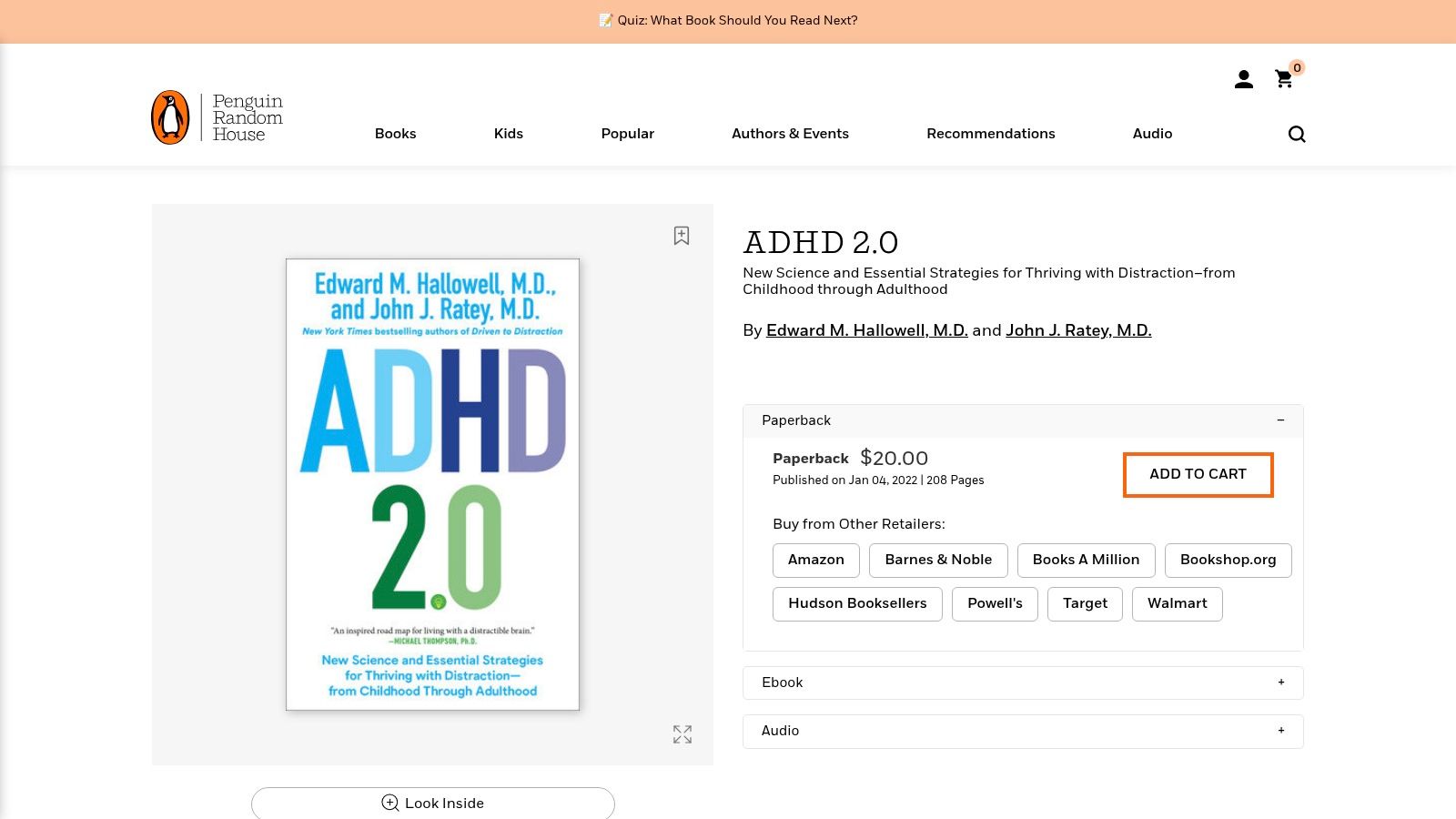
If you're looking for an approachable introduction, ADHD 2.0 offers an optimistic overview with ideas for making daily life more supportive. Hallowell and Ratey discuss neuroscience alongside practical topics such as shaping your environment and finding challenges that engage you without overwhelming you. The chapters are brief, which can make the book easier to pick up when long stretches of reading are difficult.
The authors also discuss the default mode network and cerebellum. Those topics may interest readers who want an accessible account of how researchers think about ADHD, though a general guide shouldn't be treated as a substitute for an individualized clinical explanation.
A starting point, not a workbook
The book's validating tone can help readers reconsider the idea that ADHD traits are moral failings. Its broad recommendations may also give you language for a conversation about why a particular work setup is difficult. If concentrating at work is the immediate concern, you might pair the book with this discussion of why it can be hard to concentrate at work.
The trade-off is that ADHD 2.0 offers a roadmap rather than a step-by-step skills program. It's available in paperback, ebook, and audiobook formats, but readers who want worksheets, a defined sequence, or focused practice may prefer a workbook. Choose it when you want perspective and practical ideas you can adapt, rather than a plan that tells you exactly what to do each day. See the publisher's page for ADHD 2.0.
2. Taking Charge of Adult ADHD, Second Edition by Russell A. Barkley, PhD
Some readers want a reference they can return to as questions change. Russell A. Barkley's Taking Charge of Adult ADHD covers seeking professional help, treatment choices, and strategies for daily life at home, work, and in relationships. Its range can be useful when you're trying to understand how assessment, medication, and practical adjustments fit together.
The book also addresses time management and emotional self-control. Rather than treating organization as the whole story, it provides material for considering how ADHD affects different parts of adult life. Downloadable tools from the publisher can help readers turn some ideas into actions.
A detailed reference for different needs
Barkley's direct, evidence-grounded style suits readers who appreciate a clear, well-rounded guide. It's available in hardcover, paperback, and ebook formats, and its breadth means you can revisit topics when a new challenge comes up instead of reading it as a one-time course.
That same breadth can feel like a lot if you're looking for a short guide to one immediate concern. Some readers may also find the tone more clinical than conversational. Use it as a reference, selecting the chapter that matches your current question, rather than assuming you need to adopt every strategy. Explore Taking Charge of Adult ADHD, Second Edition.
3. Your Brain's Not Broken by Tamara Rosier, PhD
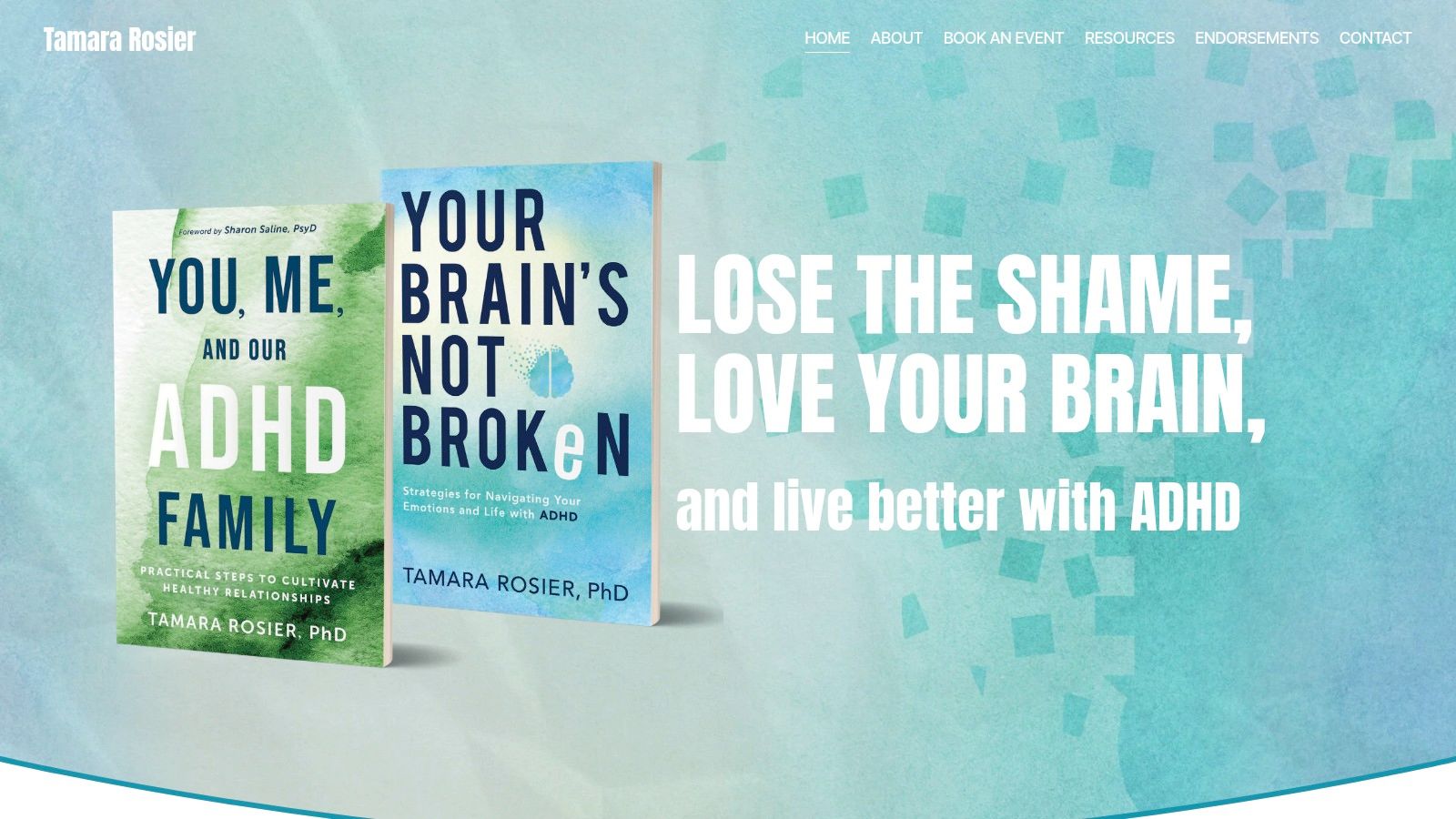
ADHD can make a task feel difficult before you've even begun it. Tamara Rosier's Your Brain's Not Broken speaks to motivation, emotions, and everyday problem-solving in plain language, with an approachable, humorous tone. Readers who are tired of translating every struggle into self-criticism may appreciate its effort to pair validation with concrete steps.
For motivation and difficult feelings
The guide offers plain-language tools for task initiation and navigating difficult feelings. That focus matters because emotional struggles can sit alongside procrastination: a person may delay a task not because they don't care, but because overwhelm, uncertainty, or fear of getting it wrong makes starting feel harder. A tool is most useful when you test it in a specific situation, rather than treating the book's advice as a judgment about your character.
A companion workbook is available, as are versions for teens and young adults, so readers can choose a format that fits their age and preference. The book may also support therapy homework by giving you a concrete idea to discuss or practice between sessions. It isn't a complete treatment plan, and its guidance won't explain every person's experience. For details about the author's resources, visit Tamara Rosier's ADHD books and resources.
4. The Mindfulness Prescription for Adult ADHD by Lidia Zylowska, MD
Mindfulness can sound like an unlikely fit if sitting still is already a challenge. Lidia Zylowska's The Mindfulness Prescription for Adult ADHD takes a structured approach, with an eight-step program and guided practices for attention and emotion regulation. It also introduces mindful self-coaching, a way to notice what's happening and respond with more intention.
The book includes audio exercises and is designed to sit alongside medication or other treatments. Its attention to common ADHD barriers can make the practices feel more relevant than a generic instruction to meditate. Readers interested in mindful approaches to therapy may find ideas to explore with a clinician.
Practice before perfection: Try a brief exercise in an everyday moment, then notice what made it easier or harder to return your attention.
Repetition is part of the work
The main trade-off is that the book asks for time and regular practice. If longer exercises feel frustrating, adapt the pace and discuss that experience with a therapist rather than concluding that mindfulness isn't for you. Some readers may prefer shorter exercises, and the book's structured program won't appeal to everyone.
Mindfulness isn't a replacement for assessment, treatment, or practical changes in your environment. It can be one way to build awareness of attention and emotional responses while you work on other supports. The publisher provides information about the book, its audio exercises, and other formats on The Mindfulness Prescription for Adult ADHD.
5. Mastering Your Adult ADHD by Steven A. Safren, Susan Sprich, Carol A. Perlman, and Michael W. Otto
If you want to work through skills rather than read a general overview, Mastering Your Adult ADHD is a cognitive-behavioral therapy workbook. Its modular sessions and worksheets address distractibility, procrastination, planning, calendars, and task management. The structured format gives you something observable to practice, such as writing down a task plan and checking whether it helped.
The workbook is designed for use with or without medication, and a companion Therapist Guide is available. A systematic review of CBT for adults with ADHD included 14 randomized trials involving 700 adults and found possible short-term benefits for core symptoms, while rating the overall evidence as low quality. CBT may be a useful treatment to discuss with a clinician, but those findings don't show that a workbook alone will suit everyone. Read the Cochrane review of CBT for adult ADHD.
Make the exercises fit your actual week
This workbook's strength is its structure. It can suit readers who like clear exercises and want to track what they've tried. If homework itself is hard to start, choose one exercise and make it small enough to complete, rather than treating every worksheet as another obligation. You can also bring an exercise into therapy or ask an accountability partner to help you follow through.
The trade-off is that the workbook may feel too procedural if you're looking for a personal narrative or a broad introduction to ADHD. It may be most useful with a therapist who can help tailor the exercises, especially when anxiety, low mood, shame, or relationship stress complicate task management. For an accessible explanation of what can make homework hard to begin, see this guide to researching the barriers to homework. View Mastering Your Adult ADHD.
6. The ADHD Effect on Marriage, Second Edition by Melissa Orlov
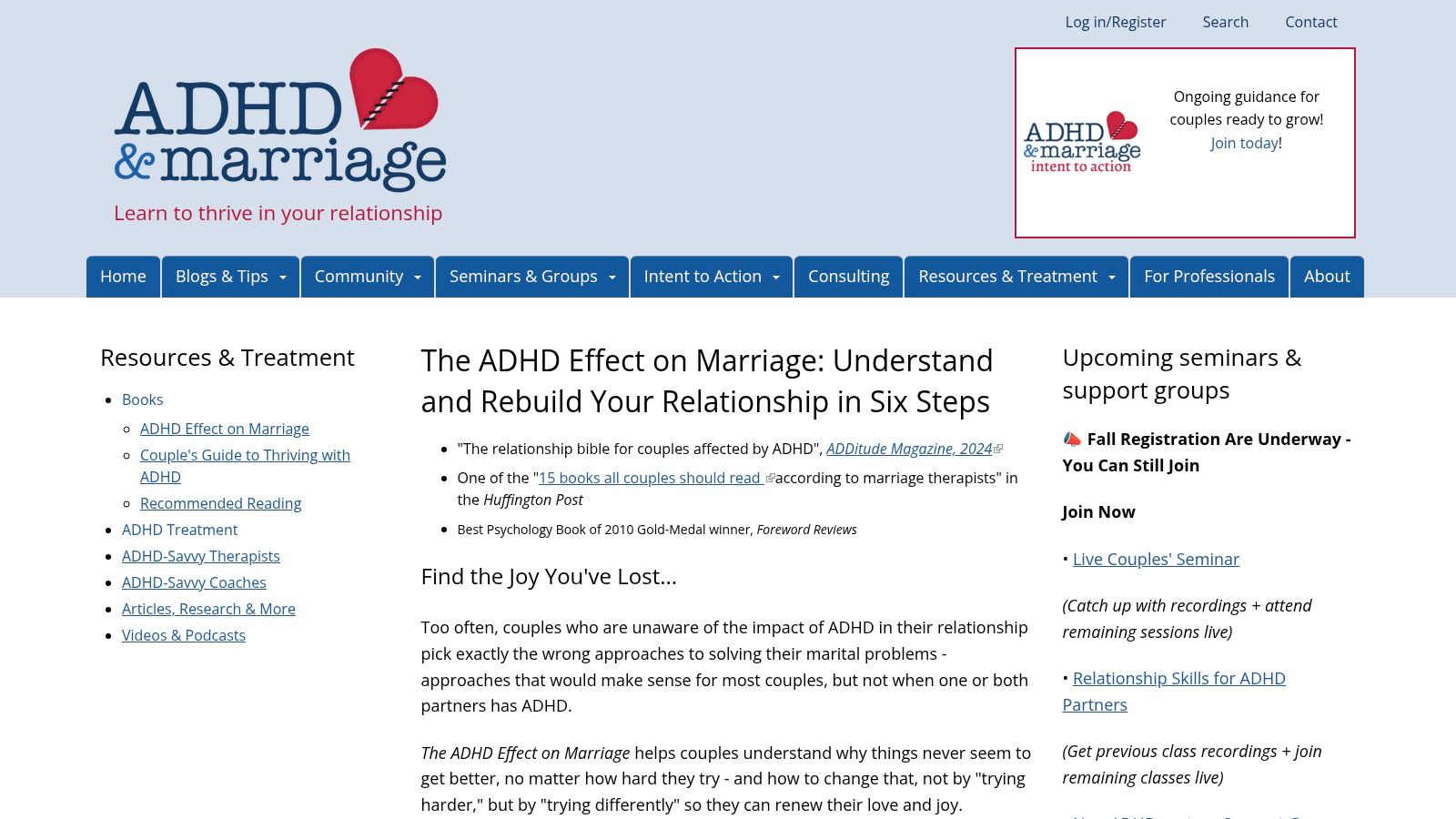
When ADHD affects a relationship, both partners may end up stuck in familiar roles: one feels they're carrying too much, while the other feels criticized or misunderstood. Melissa Orlov's The ADHD Effect on Marriage focuses on those relationship dynamics and how couples might rebuild connection. Its six-step framework addresses empathy, emotions, treatment, communication, boundaries, and romance.
A relationship guide for both partners
The book's non-blaming language may help couples describe a cycle without reducing either person to a problem. Supplemental worksheets and seminars offer ways to discuss the material, and the book can complement couples therapy or coaching. A useful conversation might focus not only on who forgot what, but on what each partner experienced and what they need to repair the moment.
Some readers may want more practical strategies for the ADHD partner earlier in the book. Its focus is relationship repair, not general ADHD management, so it won't address every challenge at work or with daily organization. If the main concern is how ADHD shapes connection and recurring conflict, it may be a better match than a broad handbook. The discussion of ADHD and relationship problems can help you think about what you'd like to address. Find details about The ADHD Effect on Marriage.
7. The Smart but Scattered Guide to Success by Peg Dawson, EdD and Richard Guare, PhD
Not every strategy needs to be designed specifically for ADHD to be useful. The Smart but Scattered Guide to Success focuses on executive skills, including organization, time management, and emotional control. It offers a self-assessment, action planning, and practical examples for home and work.
You can use its executive-skills profile to identify where a particular routine breaks down, then select a strategy to test. That behavior-first approach can complement therapy or executive-function coaching, especially when general advice has felt too vague to apply.
Useful tools, broader focus
The book's practical tools and printable materials may appeal to readers who want to make one change at a time. For example, you might use the planning prompts to clarify what the next step of a work task is, instead of writing an intimidating list of everything that needs doing. Treat the assessment as a guide for choosing a focus, not as a diagnosis.
Its main limitation is that it addresses executive skills broadly, rather than ADHD alone. It may be less specific if you want detailed discussion of diagnosis, medication, identity, or the emotional impact of living with ADHD. If a targeted strategy is what you need, its broader scope may be an advantage. See The Smart but Scattered Guide to Success.
8. A Radical Guide for Women with ADHD by Sari Solden, MS and Michelle Frank, PsyD
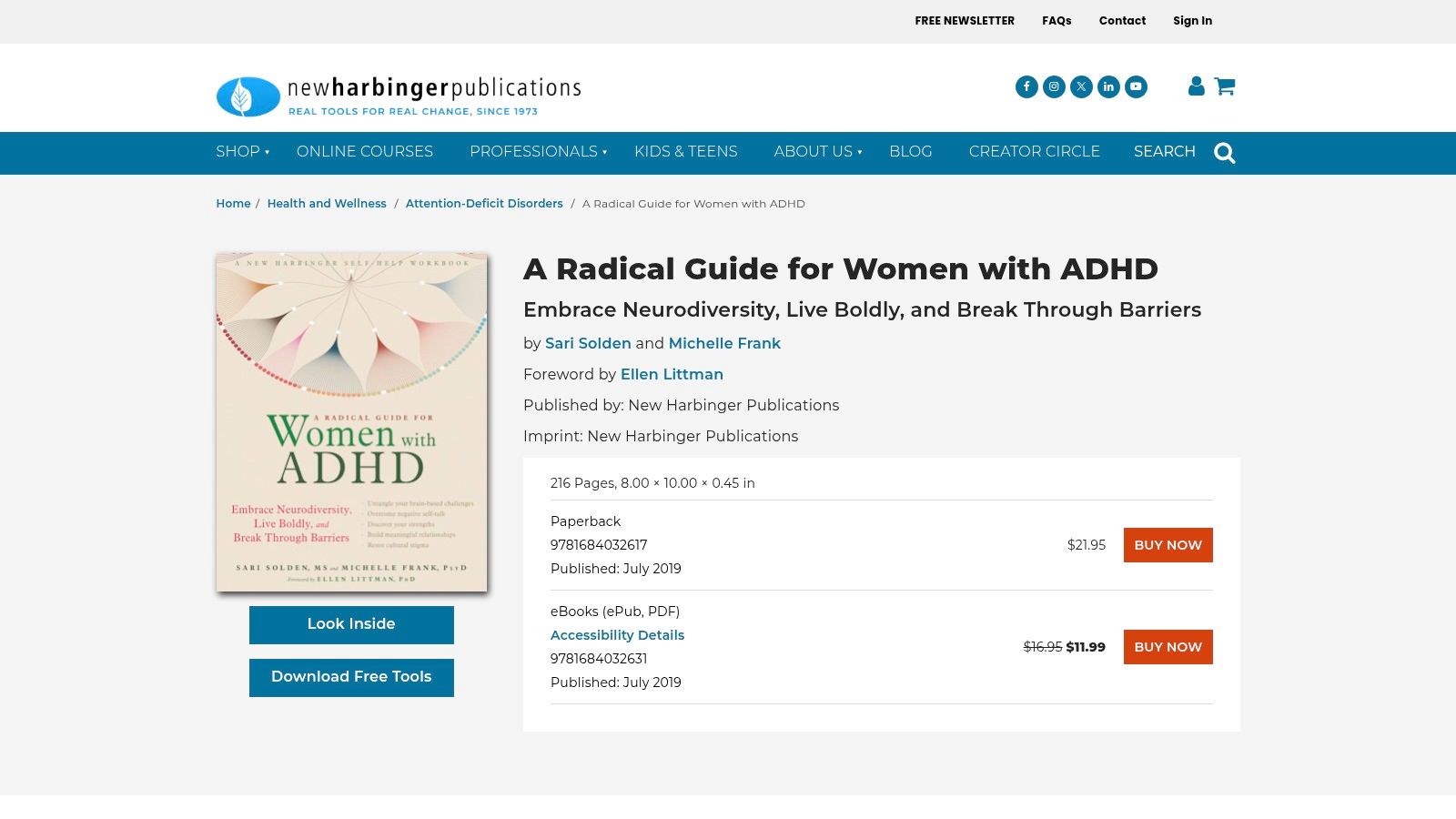
A late ADHD diagnosis can prompt questions that organization advice doesn't answer: How much of my effort has gone into masking? Why have I blamed myself for struggles I couldn't explain? A Radical Guide for Women with ADHD explores identity, shame, communication, and values through write-in exercises and reflection prompts.
Reflection, identity, and self-acceptance
The book's neurodiversity-affirming approach may resonate with late-identified women and AFAB readers, including those who recognize inattentive traits or have spent years trying to hide difficulties. Its prompts can help you connect everyday challenges with your own experience, without assuming that ADHD defines your identity or explains every problem.
This is a workbook for self-reflection and agency, not a guide to diagnosis or medication. Readers who want more information about clinical assessment and treatment choices may need a different resource or a conversation with a clinician. It also assumes some basic familiarity with ADHD, so it may not be the easiest first book if you're just beginning to explore the topic. Explore A Radical Guide for Women with ADHD.
9. Organizing Solutions for People with ADHD, Third Edition by Susan C. Pinsky
When clutter makes it difficult to find what you need, a change to the environment can be more useful than another reminder to try harder. Susan C. Pinsky's Organizing Solutions for People with ADHD focuses on home and work spaces, with room-by-room guidance, photos, and checklists. Its practical approach emphasizes low-maintenance systems and reducing the friction involved in everyday tasks.
Change the setup, not your expectations
This book may help readers who want to make visible changes to a specific space. Checklists and photos can make the suggestions easier to apply, especially if open-ended organizing projects tend to stall. You might choose one area that regularly causes stress and adapt a system to how you use that space.
The book's strength is also its limit. It concentrates on organizing the environment, so it offers less on emotion, identity, relationships, or treatment choices. A tidy room won't by itself address overwhelm or self-criticism, and a system that needs constant maintenance may not last. Look for adjustments that make the next action easier, rather than aiming for an idealized home. See Organizing Solutions for People with ADHD, Third Edition.
10. ADHD After Dark by Ari Tuckman, PsyD, CST
ADHD can affect intimacy and communication as well as the visible routines of daily life. Ari Tuckman's ADHD After Dark focuses on sex, libido, relationship satisfaction, and connection. It draws on a survey of mixed-ADHD couples and offers communication and planning tools for partners who want to talk about intimacy more openly.
A focused resource for intimacy
The book addresses a concern that may be difficult to bring up, even with someone you trust. Its practical suggestions can give partners a starting point for discussing what gets in the way of closeness and what helps them feel connected. It can complement individual or couples therapy, where partners can explore how their own patterns and needs shape the conversation.
This isn't a general guide to ADHD. Readers looking for help with treatment decisions, work, or organization will need a broader book as well. It's a more focused choice when intimacy is the challenge you want to understand, rather than a resource everyone with ADHD needs. Learn about ADHD After Dark and Ari Tuckman's other books.
10 ADHD Books Compared: Key Features and Focus
Book | Main Focus | Format and Approach | Best For | Standout Value | Consideration |
|---|---|---|---|---|---|
ADHD 2.0, Hallowell & Ratey | ADHD overview and everyday strategies | Accessible, brief chapters; neuroscience-informed | Readers seeking an affirming starting point | Validating tone and environment-design ideas | Less structured than a workbook |
Taking Charge of Adult ADHD, Barkley | Treatment choices and daily-life strategies | Comprehensive, evidence-based handbook with downloadable tools | Adults wanting an authoritative reference | Concrete guidance across work, home, and relationships | Broad scope and clinical tone |
Your Brain's Not Broken, Rosier | Emotions, motivation, and problem-solving | Relatable guide with practical tools | Adults feeling stuck or self-critical | Humorous, validating approach; workbook available | Current price varies by retailer |
The Mindfulness Prescription for Adult ADHD, Zylowska | Attention and emotion regulation | Eight-step mindfulness program with audio exercises | Readers seeking structured mindfulness practice | ADHD-aware practices that can complement therapy | Requires regular practice |
Mastering Your Adult ADHD, Safren et al. | Planning, task management, and procrastination | Structured CBT workbook with worksheets | Readers who want trackable exercises | Modular skills program with a research base | May work best with support or accountability |
The ADHD Effect on Marriage, Orlov | ADHD-related relationship dynamics | Six-step framework, worksheets, and seminars | Couples addressing communication and connection | Non-blaming guidance for both partners | Focuses on relationships, not general ADHD management |
The Smart but Scattered Guide to Success, Dawson & Guare | Executive skills and organization | Self-assessment, action plans, and practical tools | Adults improving organization and time management | Strategies can be personalized for home and work | Covers executive skills broadly, not ADHD alone |
A Radical Guide for Women with ADHD, Solden & Frank | Identity, shame, communication, and values | Neurodiversity-affirming workbook with prompts | Women and AFAB readers, including late-identified adults | Compassionate focus on masking and self-acceptance | Limited coverage of diagnosis and medication |
Organizing Solutions for People with ADHD, Pinsky | Organizing home and work spaces | Room-by-room guidance, checklists, and photos | Readers seeking practical environmental changes | Low-maintenance systems designed for ADHD needs | Less focus on emotions and identity |
ADHD After Dark, Tuckman | ADHD, intimacy, and relationships | Research-informed guide with communication tools | Individuals or couples addressing intimacy | Covers an often-overlooked relationship topic | Narrower focus than a general ADHD guide |
Choose One Book and Make It Work for You
You don't need to read every ADHD book on this list. Start with the area that is causing the most strain right now: understanding the diagnosis, getting through tasks, managing emotional reactions, improving communication, or changing a difficult setup at home. Choose a book that speaks to that need, and give yourself permission to set it aside if its tone or format doesn't work for you.
Reading can help you make sense of ADHD, but insight doesn't always turn into a new routine on its own. Select one idea from a chapter and try it in a specific situation. For instance, if task initiation is the problem, write down the first visible action, then note whether it made starting easier. If conflict is the focus, use a prompt to prepare for a calmer conversation rather than trying to solve every part of the relationship at once.
A systematic review of bibliotherapy found a small moderating effect on externalizing, internalizing, and prosocial behavioral challenges in children and adults. That evidence isn't specific to ADHD and doesn't establish reading as a treatment substitute. It supports treating books as a low-intensity resource for psychoeducation or reflection, especially when you pair reading with a concrete experiment and review how it goes. Read the bibliotherapy review.
Books also vary in what they explain. A guide centered on calendars or organizing may not help you make sense of intense frustration, shame, or the recovery after an argument. Emotional dysregulation is not one of the formal core symptom domains used to diagnose ADHD, but a systematic review reported it in approximately 34% to 70% of adults with ADHD. The wide range reflects differences in how studies define and measure it, and it's one reason emotional experience may deserve attention alongside focus and planning. Read the systematic review of emotion regulation in adult ADHD.
A book can offer useful language and a skill to practice, but it can't provide individualized assessment or medical care. Therapy may help you understand how ADHD interacts with anxiety, depression, shame, relationships, or avoidance, and adapt strategies to your actual circumstances. Adults and teens in Washington, DC, and adults in Virginia may explore individual therapy with Nick Donahue LICSW PLLC, including in-person sessions in DC and virtual therapy across DC and Virginia. A low-pressure first step is to learn about ADHD therapy and schedule an initial consultation.
Comments