
Couples Therapy vs Individual Therapy: How to Choose

If the same argument keeps happening, does that mean you need couples therapy, or do you need help with what happens inside you before the argument even starts? The answer isn't always obvious. Two people can argue about the same household task for very different reasons, and those reasons matter more than which therapy format sounds appealing.
Couples therapy vs individual therapy is primarily a question of treatment target and safety. Joint work makes sense when the problem is a repeating exchange between partners who can participate freely. Individual work may be the better starting point when you need privacy, symptom support, clarity about the relationship, or protection from harm.
Table of Contents
Couples Therapy and Individual Therapy at a Glance - Match the format to the problem
What Each Format Targets in Practice - Private sessions within couples treatment
Individual Therapy When a Partner Will Not Attend - What you can change without your partner
What the Research Shows About Outcomes - Depression relief looks similar across formats - Relationship outcomes show a different advantage
When Individual Therapy Should Come First - What a responsible safety assessment includes - Violence requires specialized judgment
Adult ADHD Patterns That Shape the Choice - Separate the practical difficulty from the response to it - Accountability without moral judgment
Choose the Format That Fits and Take the First Step - Prepare for a first conversation
Couples Therapy and Individual Therapy at a Glance
Couples therapy works on the relationship as a system, usually with both partners present. Individual therapy works on one person's symptoms, beliefs, coping, and behavior in a private setting. Neither format is better by default, and choosing individual therapy doesn't mean you're ignoring your relationship.
Couples therapy and individual therapy compared on key criteria
Criterion | Couples therapy | Individual therapy |
|---|---|---|
Primary target | The pattern between partners, including communication, conflict cycles, and shared routines | One person's symptoms, thoughts, coping, and emotional regulation |
Who attends | Both partners, ideally both willing | The client; a partner doesn't need to attend |
Typical session focus | Observing responses during disagreement and practicing different responses together | Understanding triggers and working on skills, shame, anxiety, or motivation |
Best fit | Recurring arguments, withdrawal, failed repair attempts, or mismatched expectations | Personal symptoms, ambivalence, identity questions, or an unavailable or unwilling partner |
Confidentiality | Therapist-specific rules for private disclosures, explained before sensitive information is shared | Individual confidentiality, subject to applicable legal exceptions |
Safety screening | Private assessment of each partner; joint work is inappropriate when fear or coercive control prevents safe participation | Safety concerns can be explored privately |
Common limitation | Progress requires both partners' willingness and ability to speak openly | The partner's contribution is described secondhand |
Match the format to the problem
Read the table by asking where the problem happens, not who deserves the blame. If the difficulty occurs in a repeating exchange between you, the couples column is a closer match. If it primarily involves your own reactions, uncertainty, or symptoms, the individual column may offer a better starting point.
A common relationship pattern is a couple arguing every Sunday about household tasks. The practical issue is chores, but the treatment target might be a sequence in which reminders become criticism, criticism prompts defensiveness, and neither person reaches an agreement.
A common individual pattern is someone avoiding disagreement because expressing a need feels intolerably uncomfortable. They stay quiet, agree to plans they don't want, and become resentful afterward.
Starting question: Which row describes what you most want to change, rather than what you wish your partner would change?
Choose that row as a tentative starting point. You don't need to commit to a format before a clinician has helped assess the situation.
What Each Format Targets in Practice
The clearest difference is what the therapist can work with directly. This illustration shows the basic distinction between a shared session and private work.
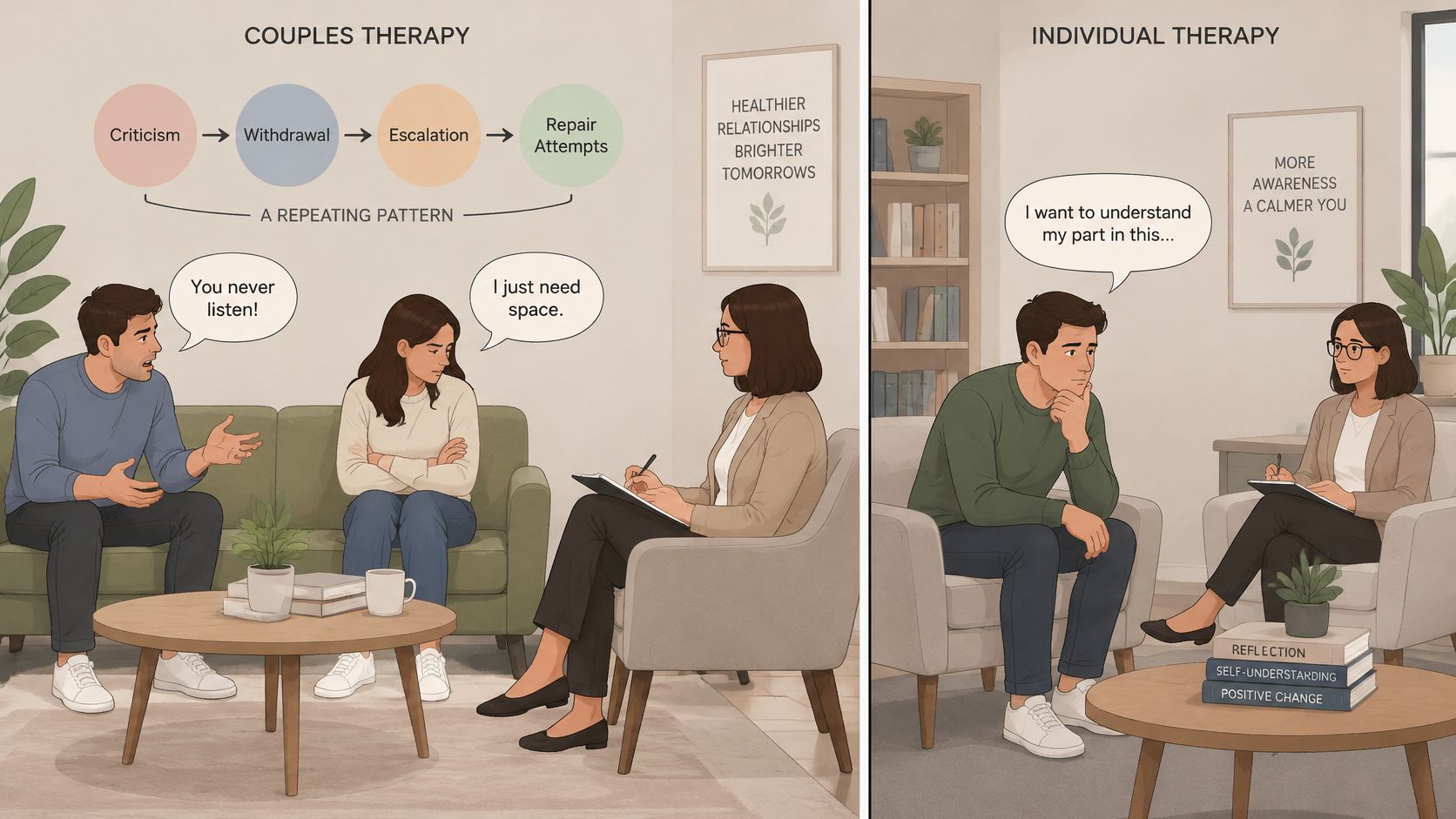
In couples therapy, the therapist can notice criticism, withdrawal, escalation, and unsuccessful attempts to reconnect as they happen. Rather than letting an argument run its familiar course, the therapist may slow it down, ask each person what they heard, and coach a more direct request or less defensive response.
Individual therapy offers privacy and depth. You might explore why criticism feels threatening, practice tolerating discomfort without shutting down, or work on self-criticism that makes an ordinary mistake feel like evidence of personal failure.
Individual therapy works on what you bring into the exchange. Couples therapy also works on what happens between you.
Understanding the sequence is central to breaking relationship patterns. Insight matters, but the practical question is what you'll do differently at the moment the familiar reaction begins.
The accompanying video offers another way to consider these formats.
Private sessions within couples treatment
Meeting alone with a couples therapist isn't automatically the same as starting individual therapy. A private meeting may support assessment, safety planning, or shared treatment goals.
A Psychology Today discussion of individual sessions in couples therapy describes American Association for Marriage and Family Therapy guidance requiring prior written permission before revealing an individual's confidences to others in the client unit. It also discusses clearly explained no-secrets policies, which can affect whether joint treatment continues when important information remains undisclosed.
Before sharing sensitive information, ask:
Who is the client? Clarify whether the clinician is treating you, the couple, or another defined client unit.
What stays private? Ask specifically about separate meetings, messages, and intake forms.
How are secrets handled? Find out what happens when information affects the shared work.
What if someone refuses disclosure? Ask whether treatment would pause, change, or require referral.
The format should follow the work you need, with privacy rules understood before you begin.
Individual Therapy When a Partner Will Not Attend
Yes, individual therapy can help when your partner won't come. You can work on anxiety, shame, trauma responses, ADHD-related planning difficulties, or emotional regulation without waiting for another person's agreement. You can also clarify your boundaries and decide what you're willing to accept.
A review of systemic interventions for adult-focused problems supports choosing treatment according to the problem being maintained, rather than assuming either individual or couple work is always preferable. That distinction matters when personal symptoms and relationship patterns overlap.
What you can change without your partner
You can practice making a clear request instead of hinting, taking a pause instead of retaliating, or stating a limit without defending it endlessly. Those changes may affect the relationship, but they don't guarantee your partner will respond constructively.
Individual therapy shouldn't become a project of finding the perfect words that will finally make someone else behave differently. It can help you distinguish your responsibility from theirs, including when your efforts aren't being reciprocated.
A common pattern is someone who knows they go silent during arguments but still freezes whenever money comes up. Individual work might involve noticing physical tension, grounding attention, and rehearsing a sentence such as, “I need a moment, and I want to return to this conversation.” A joint session, if safe and mutually wanted, can test whether the partner makes room for that response.
Fear of closeness can also complicate a refusal to attend. Exploring men's fears around intimacy can help distinguish discomfort with vulnerability from a settled decision not to participate.
Before a consultation:
Name the pattern in a sentence, using actions rather than labels.
Identify your part that you can realistically practice changing alone.
Consider the interaction, including whether both people need to be present to understand it.
Bring your notes so the clinician can help identify an appropriate starting point.
What the Research Shows About Outcomes
Depression relief looks similar across formats
A 2008 meta-analysis of eight controlled trials involving 567 participants found no statistically significant difference between couples therapy and individual psychotherapy in reducing depressive symptoms, while couples therapy significantly reduced relationship distress. That finding doesn't establish that the formats are interchangeable for every person. It suggests that involving a partner doesn't automatically produce better mood improvement.
A Cochrane review of couple therapy for depression likewise found no clear difference in depressive symptom outcomes; its continuous-outcome comparison included nine studies and 304 participants, while the comparison of participants remaining depressed included six studies and 237 participants, with estimates shown below.
For someone whose relationship is supportive, private treatment may be enough to address low mood, withdrawal from meaningful activities, and harsh self-evaluation. Requiring partner attendance can add a logistical burden without matching the main treatment need.
When depression occurs alongside recurrent conflict or disconnection, the goal changes. A clinician may need to address both the person's mood and the way partners respond to each other's distress.
Relationship outcomes show a different advantage
A 2020 meta-analysis of couple therapy outcomes reported a large pre-to-post improvement in relationship satisfaction, Hedges' g = 1.12, compared with a small, statistically nonsignificant change in wait-list conditions, g = 0.12, with confidence intervals listed below. This comparison is between treatment-related change and waiting, not a direct test against individual therapy.
For a direct comparison, a review by Bradbury and Bodenmann reported that across six comparative studies, couples therapy outperformed individual therapy for relationship distress by approximately Cohen's d = 0.50, increasing to about d = 1.10 among the most distressed couples.
Outcome effects reported in the research
Outcome | Measure | Result | Comparison |
|---|---|---|---|
Depressive symptoms, couples vs individual therapy | Standardized mean difference | −0.17 (95% CI −0.44 to 0.10) | Cochrane review, 9 studies, 304 participants |
Remaining depressed, couples vs individual therapy | Risk ratio | 0.94 (95% CI 0.72 to 1.22) | 6 studies, 237 participants |
Relationship satisfaction, couples therapy pre to post | Hedges' g | 1.12 (95% CI 0.92 to 1.31) | Wait-list control: 0.12 (95% CI −0.04 to 0.29) |
Relationship distress, couples vs individual therapy | Cohen's d | About 0.50 | About 1.10 among the most distressed couples |
The depression confidence intervals include the values that represent no difference: zero for the standardized mean difference and one for the risk ratio. In plain language, those comparisons didn't establish a clear advantage for either format.
Effect sizes aren't success rates, and group averages don't predict what will happen in your relationship. A pre-to-post improvement also answers a different question from a comparison between two active treatments.
The useful conclusion isn't that couples therapy wins. It's that relationship-focused treatment has an advantage when relationship distress is the outcome you're trying to change.
Personal preference still matters, alongside access, readiness, and safety. But the central clinical question remains specific: Is low mood the center of the problem, or is the relationship around it a major part of what needs treatment?
When Individual Therapy Should Come First
Conflict alone doesn't make couples therapy the right choice. A disagreement between people who can safely say no is different from a relationship in which one person controls what the other can say, do, or disclose.
A review addressing intimate partner violence and couple treatment distinguishes situational conflict from intimate terrorism, in which violence, intimidation, or coercive control is used to dominate a partner. Couples therapy isn't recommended in that situation because joint sessions can expose someone to retaliation, inhibit honest disclosure, or imply shared responsibility for abuse.
What a responsible safety assessment includes
A clinician should speak privately with each partner rather than relying only on what they say together. The assessment should cover:
Fear and control, including whether either person monitors, restricts, or intimidates the other.
Threats and access to weapons, along with stalking or escalating behavior.
Substance use, including its relationship to aggression or impaired judgment.
Freedom to speak, including what might happen after a difficult session.
If you're afraid of what your partner will do after you speak, that's not a communication obstacle. Private support and safety planning should precede or replace joint treatment. Responsibility for abusive behavior belongs to the person choosing it.
Violence requires specialized judgment
Couples treatment isn't categorically inappropriate whenever violence has occurred. Selected couples experiencing mild-to-moderate, situational or reciprocal violence may be candidates when both voluntarily want it to stop, the person using violence accepts safeguards, and a qualified clinician continuously assesses safety.
That distinction isn't something to determine from a checklist at home. An apparent agreement to attend doesn't establish that participation is voluntary, and individual therapy alone isn't a substitute for specialized domestic violence support.
Without abuse, individual treatment may still need to lead when a partner declines, the main concern is personal, or substance use or severe emotional dysregulation requires stabilization. Anxiety, ADHD, and substance use can complicate assessment, but none excuses intimidation or makes someone responsible for another person's violence.
If anyone is in immediate danger, contact local emergency services. A domestic violence hotline can also help with confidential safety planning before arranging relationship treatment.
Adult ADHD Patterns That Shape the Choice
Adult ADHD can be both a personal treatment issue and a relationship issue. It's a neurodevelopmental condition, not a character flaw, and its effects on attention, executive functioning, and emotional regulation differ substantially from person to person.
A review of adult ADHD and romantic relationships links ADHD with lower relationship satisfaction, greater relationship maladjustment, fewer and shorter romantic relationships, and higher divorce rates than among adults without ADHD. These are group-level associations, not a forecast for any individual partnership.
Separate the practical difficulty from the response to it
There can be distinct treatment targets: difficulty following through, and the conflict that develops around it. A forgotten bill may require an external reminder system; the argument afterward may require work on accusation, defensiveness, and repair.
The ADHD Evidence project's summary of relationship studies describes more negative and fewer positive conflict-resolution behaviors in couples where one partner had ADHD, and reports a study in which 24 out of 25 spouses said symptoms interfered with at least one area of functioning, such as household organization, time management, child-rearing, or communication. That small spouse sample shouldn't be treated as an estimate for all couples.
Individual work can address planning, attention management, distress tolerance, and the shame attached to mistakes.
Couples work can address how both partners interpret missed commitments and negotiate workable expectations.
Practical support might mean putting a commitment into a shared calendar while discussing it, defining who owns a task from start to finish, or agreeing on a repair when something is missed. These tools need to fit the person's actual difficulties, not an idealized version of how an organized adult should function.
Accountability without moral judgment
Someone may need help separating “I forgot” from “I don't care,” while still acknowledging the impact of forgetting. Exploring ADHD and relationship problems can also reveal when shame leads to hiding mistakes or avoiding conversations.
Therapy can include practicing willingness to feel embarrassment while taking a values-guided action, such as acknowledging a missed commitment promptly. It involves more than productivity tips, and it doesn't mean ADHD explains every relationship problem.
ADHD assessment and medication decisions should involve appropriately qualified providers, including a qualified medical prescriber for medication. Therapy doesn't replace those services. Which is most present in your life: difficulty managing your own symptoms, difficulty responding to each other, or both?
Choose the Format That Fits and Take the First Step
Situation | Better starting format | Why |
|---|---|---|
Depression with a stable relationship | Individual therapy | Depression outcomes are similar, and partner attendance isn't necessary |
Depression tangled up with recurring conflict | Couples therapy, or a combined plan | The relationship pattern may help maintain symptoms |
Recurring argument cycle, both partners willing | Couples therapy | The cycle can be observed and addressed directly |
Individual therapy | Joint work requires both people | |
Fear, threats, or coercive control | Individual therapy with safety planning first | Joint sessions can raise risk and restrict disclosure |
Substance use or severe dysregulation | Individual stabilization first, then couples work if appropriate | Stabilization may be necessary before joint sessions |
Personal shame or ADHD-related planning difficulties | Individual therapy first | Private work can build skills and self-understanding |
Your starting point doesn't have to be permanent. This decision guide offers a way to organize the choice.
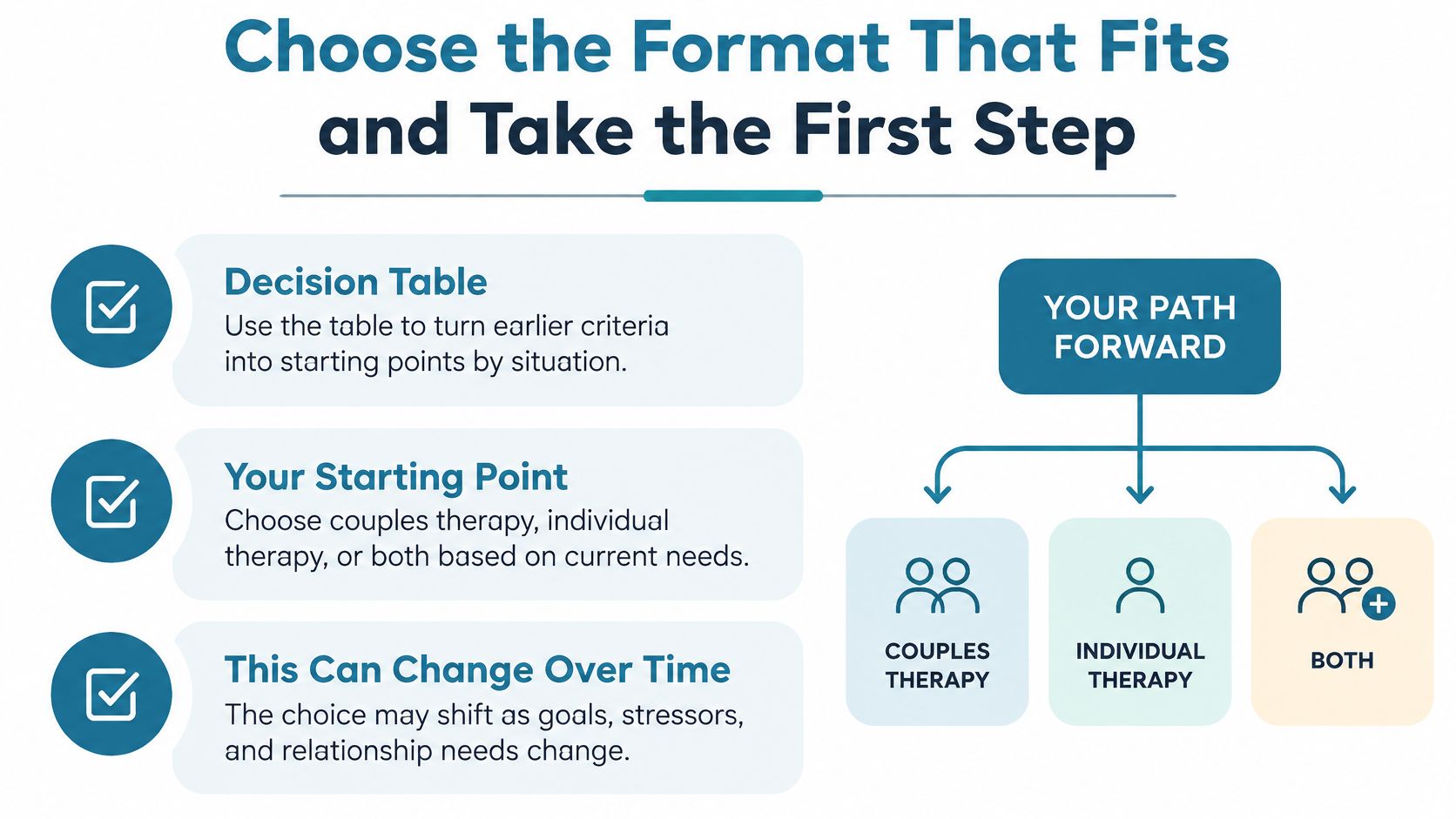
An ethical model of integrated individual and couple treatment describes involving the partner early, preferably at the first session, then using individual and joint meetings as clinically appropriate. It calls for informed consent about confidentiality and disclosure, including exceptions involving danger to self or others.
This is one model, not a universal rule. Combining formats requires clear roles and boundaries, not just adding your partner to an established individual session.
Prepare for a first conversation
Write down the two or three problems you most want to change. Note whether each primarily involves your internal experience or an exchange with your partner, and whether your partner is willing to participate.
For a prospective couples clinician, ask:
Treatment scope: Do they provide individual therapy, couples therapy, or coordinated treatment?
Privacy rules: How do they handle separate meetings and sensitive disclosures?
Safety assessment: How do they determine whether joint work is appropriate?
At our practice, we provide individual therapy for teens and adults, in person in Washington, DC, and virtually throughout DC and Virginia. Couples treatment would require a different provider.
You don't need a diagnosis or a perfectly clear reason to begin. Therapy length follows your goals: some people benefit from short-term work, while others continue as new challenges and opportunities for growth arise.
Nick Donahue LICSW offers individual therapy for ADHD, anxiety, relationship difficulties, and emotional regulation, including help deciding what kind of support fits your situation. Visit Nick Donahue LICSW to arrange a free 15–20 minute phone or video consultation, ask questions, discuss what brings you to therapy, and explore whether individual work is the right first step.
Comments