
Barkley Deficits in Executive Functioning Scale Explained

The Barkley Deficits in Executive Functioning Scale (BDEFS) is a self-report questionnaire by Russell A. Barkley, published by Guilford Press in 2011, that measures everyday executive-function problems across five domains. The full adult form has 89 items and is intended for ages 18 to 81.
If your results show difficulties with time, motivation, and emotions, does that mean you have separate problems, or could those scores describe different parts of the same struggle?
That distinction matters. You might know how to organize a project but still struggle to begin it, then feel overwhelmed when the deadline gets close. A useful assessment helps you understand that sequence rather than turning each score into another label.
Table of Contents
What the BDEFS Measures and How It Is Built - Adult and child BDEFS specifications - What the ADHD-EF Index adds
The Five Domains and What High Scores May Suggest - Recognizing the everyday patterns - Domain patterns and the support directions they may suggest
How Scores Are Calculated from Items to Total - From responses to interpretation - Why the profile needs context
Short Form and Adolescent Version Explained - Choosing the form for the person - Making room for the teen's perspective
Reliability Evidence Across Studies - What the coefficients mean - What the symptom associations add
Limits, Overlap and Common Misreadings - Separate labels don't mean separate problems - Context can change the meaning
How Clinicians Use the Scale in Practice - Moving from a profile to a workable goal - Therapy beyond productivity advice
Decide Whether a Full Evaluation Makes Sense - Prepare for the conversation - Start with the person, not the score
What the BDEFS Measures and How It Is Built
Executive functioning refers to the abilities you use to direct your behavior toward what you intend to do. That includes keeping track of time, organizing a task, pausing before responding, sustaining effort, and managing emotions while you act.
The BDEFS focuses on how those abilities show up in ordinary life, not just how someone performs during a structured cognitive task. Guilford Press's description of the adult BDEFS documents its publication in 2011, adult age range of 18 to 81, and ratings covering the previous six months.
Adult and child BDEFS specifications
The adult questionnaire and the child and adolescent instrument aren't interchangeable. The table distinguishes their formats; the parent form should be completed using its own administration instructions.
Feature | Adult BDEFS | BDEFS-CA |
|---|---|---|
Age range | Ages 18 to 81 | Norms for ages 6 to 11 and 12 to 17 |
Items | 89 items, full form; 20-item short form | 70-item parent long form; 20-item short form |
Response scale | 1, Never or Rarely, to 4, Very Often | Four-point frequency scale |
Time frame rated | Previous six months | Use the reference period specified on the parent form |
Who completes it | Adult, self-report | Parent report on the long or short form |
Scores produced | Five domain scores, total score, ADHD-EF Index | Age- and sex-based percentile profiles |
The domains are self-management to time, self-organization and problem solving, self-restraint, self-motivation, and self-regulation of emotion. They provide a vocabulary for describing daily difficulties more precisely than just saying that someone is disorganized.
What the ADHD-EF Index adds
The Florida State University document describing the BDEFS identifies the adult instrument as an 89-item questionnaire and describes an 11-item ADHD-EF Index intended to estimate whether the pattern of executive-function problems is associated with adult ADHD.
The index isn't a diagnosis. It doesn't establish why someone struggles, when those difficulties began, or whether another condition better explains them. Its value comes from giving a clinician focused questions to investigate within a broader evaluation.
A person can recognize themselves strongly in the questionnaire and still need a careful conversation about history, context, and impairment.
The Five Domains and What High Scores May Suggest
Each domain describes a recognizable part of daily functioning. A high score means that the person reports more difficulty in that area, not that a particular cause or treatment has been established.
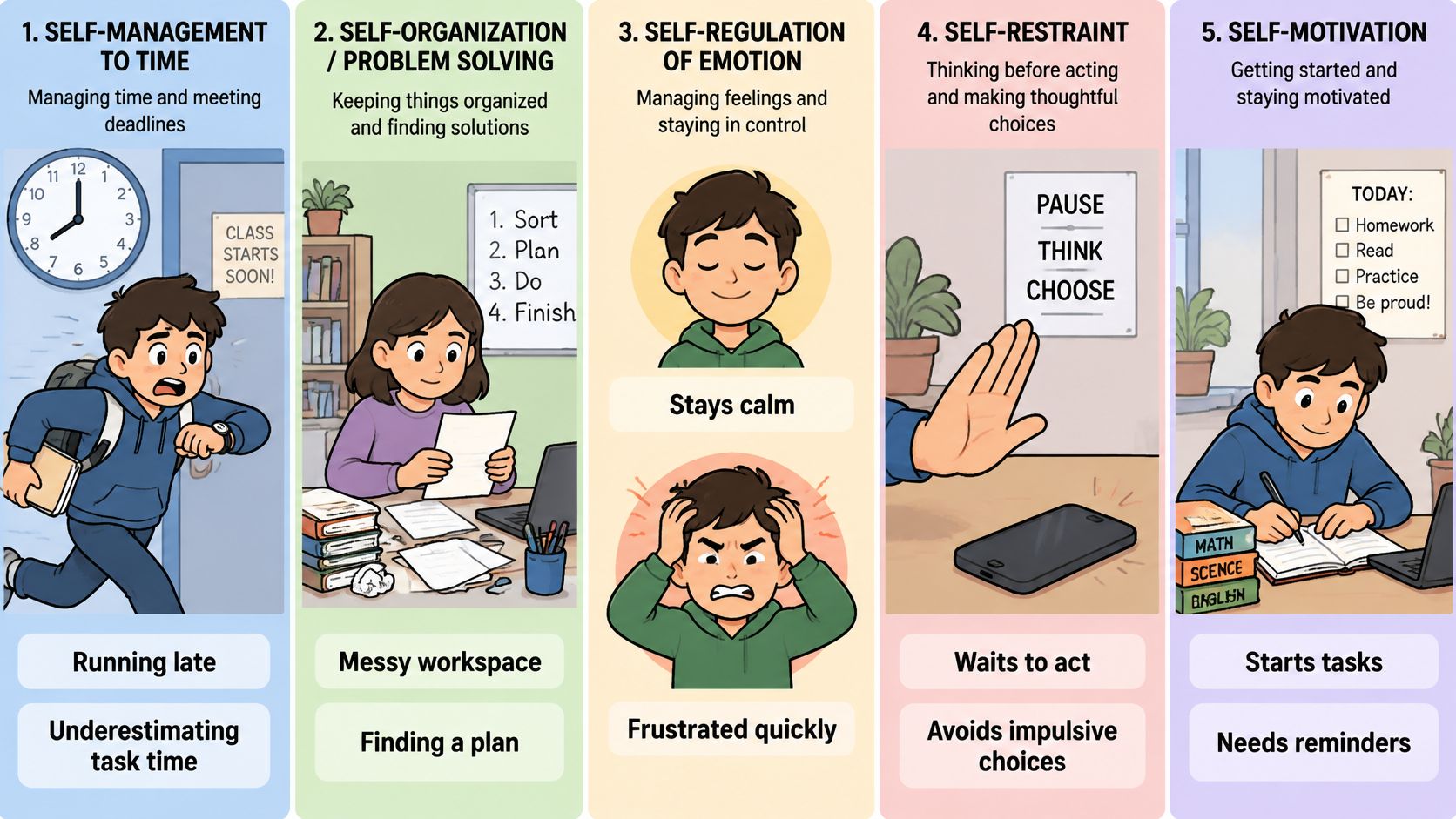
The illustration offers a visual overview of the domains.
Recognizing the everyday patterns
Self-management to time involves using time to guide action. You might run late because getting ready takes longer than expected, or leave work until the night before it's due. Poor sleep or a stressful transition can also interfere with timing, so lateness alone doesn't establish ADHD.
Self-organization and problem solving concerns arranging materials and figuring out a workable sequence. Examples include repeatedly losing paperwork or stalling because a project has several connected parts. Anxiety, including fear of choosing the wrong starting point, is another possibility to explore.
Self-restraint involves pausing or stopping a response. Someone might interrupt before another person finishes or send an angry reply before considering its consequences. Stress, substance use, and the circumstances of the interaction deserve attention alongside the behavior.
Self-motivation concerns starting and sustaining effort, especially when a task doesn't offer an immediate reward. You might delay routine paperwork despite wanting it finished, or lose momentum halfway through a long assignment. Depression, exhaustion, and overwhelm can produce similar experiences.
Self-regulation of emotion involves responding to feelings without letting them determine every next action. A person might take a long time to settle after frustration or carry that frustration into a later conversation. Anxiety, poor sleep, and recent life changes may also be relevant.
Domain patterns and the support directions they may suggest
The Guilford introductory chapter on the Barkley scales describes the domain framework and the separate BDEFS-CA, including its 70-item parent long form, 20-item short form, and norms for ages 6 to 11 and 12 to 17. Clinically, the useful next move is to connect a reported difficulty with what happens.
Domain | Everyday pattern that may stand out | Support direction it may suggest |
|---|---|---|
Self-Management to Time | Losing track of time or missing deadlines | External scheduling and deadline systems |
Self-Organization/Problem Solving | Difficulty sequencing tasks and organizing materials | Task breakdown and sequencing supports |
Self-Restraint | Acting before weighing consequences | Pause-and-plan strategies |
Self-Motivation | Difficulty starting or sustaining effort on low-reward tasks | Activation routines and reinforcement |
Self-Regulation of Emotion | Strong emotional reactions that are slow to settle | Emotion-regulation skills |
These are conversation starters, not treatment prescriptions. For an illustrative example, not a client story, consider someone who makes clear project plans but misses deadlines because they forget to return to them. Calendar prompts and visible reminders may be more useful to test than another planning system.
The following video provides an additional format for exploring executive functioning.
A useful question isn't just which domain is elevated. It's what happens before, during, and after the difficulty.
Patterns across domains often provide more useful information than a single high score.
How Scores Are Calculated from Items to Total
A completed questionnaire becomes a profile through structured scoring. Raw scores are the sums of item ratings; their meaning requires interpretation, not just arithmetic.
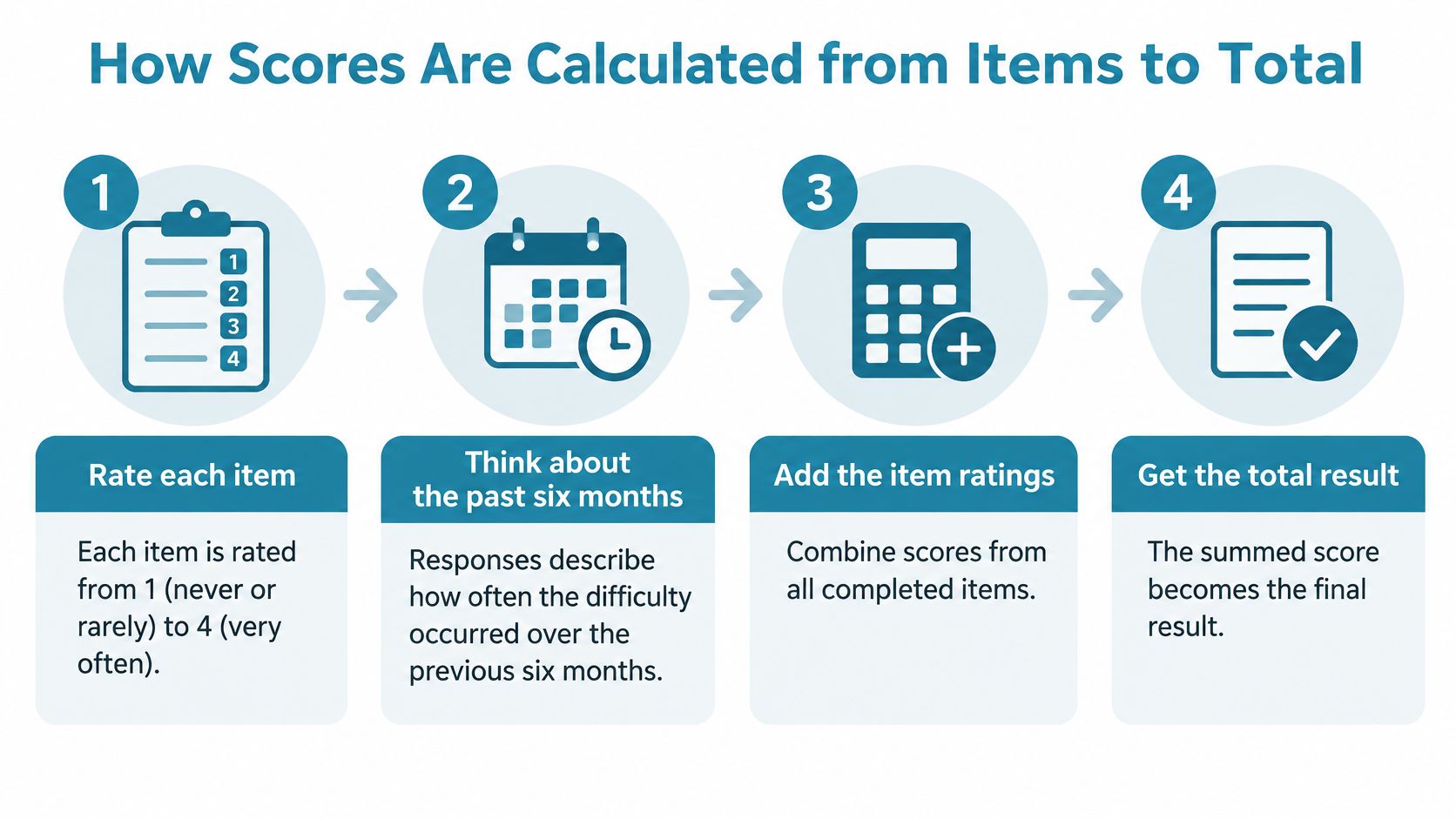
The BDEFS scoring description in the Egyptian Journal of Psychiatry explains the four-point response format, summing ratings within domains, and combining the five domain scores into an overall executive-function score.
From responses to interpretation
Rate each item. Responses range from 1, never or rarely, to 4, very often, using the adult form's reference period of the previous six months. Frequency matters because an occasional lapse isn't the same as a recurring difficulty.
Calculate raw domain scores. Ratings for items belonging to each domain are added together. A higher raw score represents more reported difficulty, but domains shouldn't be ranked by comparing their raw totals.
Calculate the overall score. The domain scores are combined into the total executive-function score. This gives a broad summary without showing, by itself, what caused the difficulties.
Score the ADHD-EF Index. The designated index items are scored according to the instrument's rules. The result contributes information about an ADHD-associated pattern rather than settling the diagnostic question.
Compare results with appropriate norms. The clinician interprets raw scores using the relevant normative information. This places the results in context rather than treating the questionnaire as a pass-or-fail test.
The infographic summarizes the basic arithmetic, while clinical interpretation requires the additional steps described above.
Why the profile needs context
A total score can summarize substantial difficulty while leaving important differences unexplained. Someone who misses deadlines because they can't sequence a task may need a different conversation from someone who understands the sequence but avoids beginning because they're afraid of making mistakes.
Scoring rule: Use the instructions and norms for the exact version administered. Don't interpret a child's results using adult norms.
After reviewing the profile, a clinician will want developmental history, examples of impairment across settings, and collateral information when available. That might include a partner's observations, school records, or a parent's account, with appropriate consent and attention to privacy.
The practical question is how the ratings connect with your life, including situations where things go better.
Short Form and Adolescent Version Explained
Which form will best capture the difficulties that matter in daily life? The answer depends on whose perspective is needed and how much detail the assessment calls for. A shorter questionnaire can reduce the time and effort required, while a longer one offers more opportunities to rate specific behaviors.
The adult short form retains the same conceptual domains with fewer questions. A study comparing the short and long BDEFS forms found that corresponding subscales were highly correlated and had similar associations with ADHD and cognitive-disengagement symptoms, even after statistically controlling for depression and anxiety. This supports treating the short form as a briefer view of related patterns, not as a separate set of domains.
Choosing the form for the person
The 20-item adult short form uses the same four-point frequency approach as the longer form. It takes less time to complete, but the longer questionnaire allows more detailed ratings of specific behaviors.
The BDEFS-CA is a separate parent-report instrument, not an adult questionnaire with adjusted wording. Its age- and sex-based percentile profiles compare a young person's ratings with those of an appropriate reference group. Parent forms, therefore, should be interpreted using the relevant child or adolescent norms rather than adult norms.
Making room for the teen's perspective
A parent can report visible behavior and its consequences. A teen may also describe internal effort, embarrassment, or anxiety that is harder to observe. These accounts can differ without either person being wrong. Together, they help show how executive-function difficulties overlap across situations, rather than turning each domain into a separate verdict.
Explore differences without assigning blame. Ask what happens at school, at home, and during independent work.
Include effort as well as outcomes. Homework may be completed after substantial prompting or distress, details a rating of the outcome alone can miss.
Use education to support conversation. Books on ADHD can offer a starting point for learning about ADHD together.
For parents, the profile is material to discuss with a clinician. It describes reported patterns, not a verdict on a teen's character, willingness, or future. The useful next step is to consider what the combined pattern suggests about support, while keeping both the parent's observations and the teen's experience in view.
Reliability Evidence Across Studies
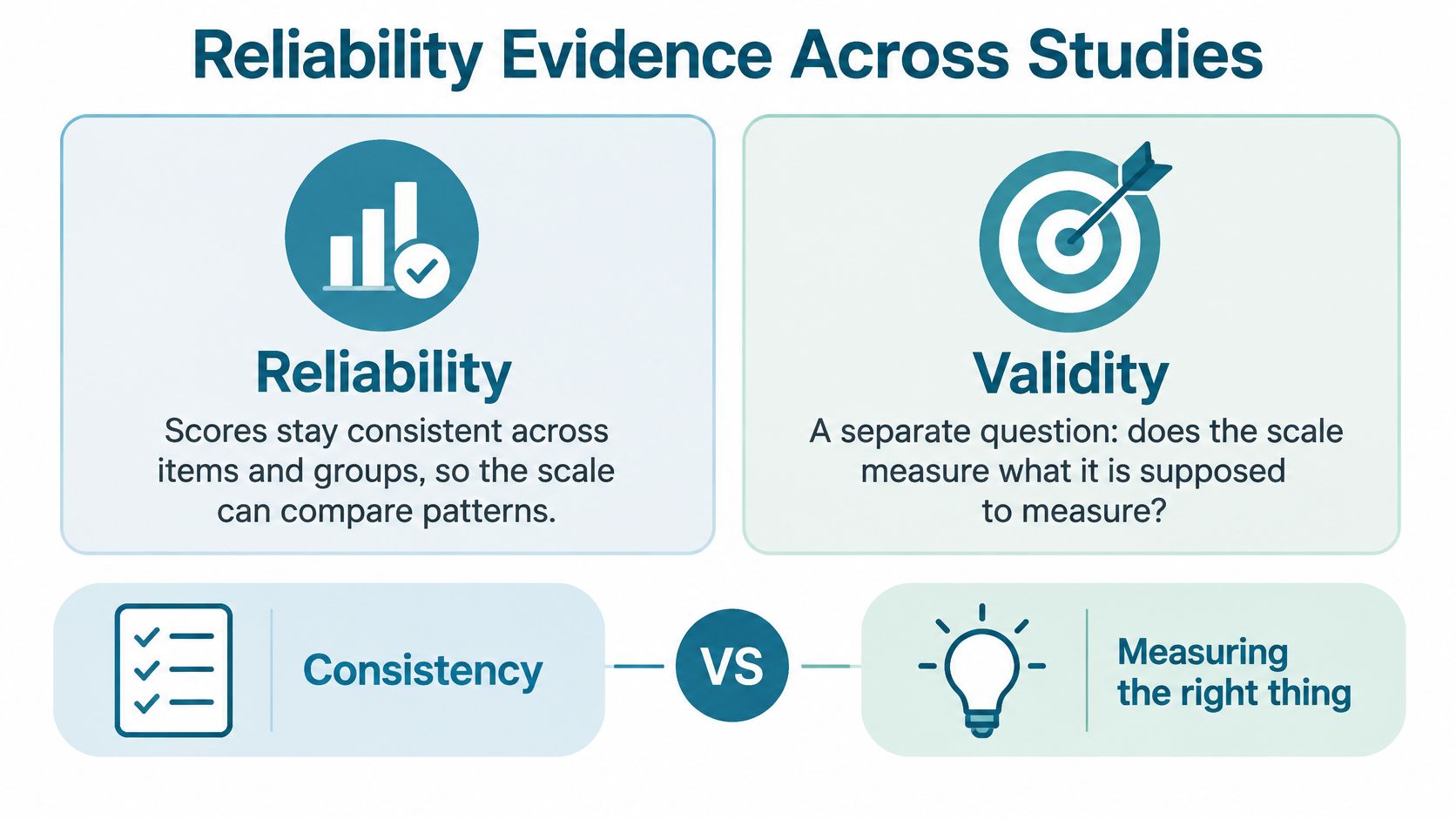
Reliability asks whether a measure produces consistent information. For the BDEFS, one important question is whether items within a domain tend to move together, which researchers call internal consistency.
Validity asks a different question: does the measure assess what it claims to assess, and does the evidence support a particular interpretation? Consistency helps, but a consistently high score doesn't establish a specific diagnosis.
What the coefficients mean
Internal-consistency coefficients near 0.9 generally indicate strong agreement among related items. The Spanish-language BDEFS validation study reports original English manual coefficients of approximately 0.91 to 0.96 and coefficients of 0.85 to 0.94 in its sample of 452 Latino community adults.
In that study, 78 of the 89 items loaded similarly to the original structure, broadly supporting the proposed domain organization. In plain language, most items related to the domains in a way that resembled the original English-language instrument.
The distinction between consistent measurement and measuring the intended thing is illustrated below.
What the symptom associations add
The investigators also found different patterns of association with ADHD symptoms. Inattention was most closely associated with disorganization, time-management, and motivational difficulties, while hyperactivity was more strongly related to self-restraint and emotional self-regulation.
That distinction can help a clinician ask better questions. If a person reports substantial difficulty sustaining effort, for example, the conversation might explore attentional symptoms alongside mood, task demands, and the circumstances in which persistence becomes easier.
Evidence | What it supports | What it doesn't establish |
|---|---|---|
Strong internal consistency | Related items provide coherent information | That ADHD caused an individual's responses |
Similar item structure across language versions | Broad support for the intended organization | Identical performance in every cultural setting |
Associations with ADHD symptoms | Relevance to ADHD assessment | A diagnosis without clinical evaluation |
These results describe performance in particular samples. They don't guarantee that every score will be equally informative for every adult, or that a translated questionnaire functions identically for everyone who speaks that language.
Reliability supports using the BDEFS thoughtfully. A full assessment determines what conclusions are justified for the person completing it.
Limits, Overlap and Common Misreadings
A BDEFS result isn't a diagnosis, and it isn't a verdict on character or effort. The most consequential misunderstanding is treating each domain as an independent finding about a separate part of the brain.
A bifactor analysis of the short-form BDEFS found that a general factor accounted for the overwhelming majority of score variance, while domain-specific factors showed weak construct replicability. The authors cautioned against interpreting the domains independently.
Separate labels don't mean separate problems
A bifactor analysis examines whether responses reflect both a broad underlying pattern and more specific domain patterns. Here, the broad pattern explained much more than the specific ones.
Does a high emotional-regulation score identify a distinct treatment target, or does it mainly reflect broader difficulty? The score alone can't settle that question. It provides a reason to inquire about emotional experiences, their consequences, and the situations in which they occur.
Consider someone who avoids an important email, becomes anxious about the delay, loses time checking other messages, and reacts sharply when a partner asks about it. Labeling that sequence as separate motivation, timing, and emotion deficits may obscure how closely the behaviors are connected.
Treat the domains as ways to organize questions, not as separate verdicts.
Context can change the meaning
Anxiety, depression, burnout, and substance-use concerns may overlap with the difficulties described on the questionnaire. Sleep disruption, unusual demands, or a recent life change also deserve attention before anyone attributes the whole profile to ADHD.
Measurement can be more complicated across symptom levels, too. A multisite validation study of college students found differences in factor loadings, thresholds, and latent means among participants with different ADHD symptom levels, suggesting that comparisons across very different symptom presentations require care.
Because the BDEFS captures perceived everyday functioning, a clinician needs examples rather than assuming every respondent interprets every item identically. Asking when a difficulty began, where it appears, and what makes it better can change the interpretation substantially.
Common misreadings include:
Treating the total as a diagnosis. A broad score identifies reported difficulty, not its cause.
Treating a domain as proof of a single deficit. A high domain score can reflect an overlapping pattern rather than an isolated missing skill.
Ignoring context. Sleep, stress, mood, substance use, and recent changes belong in the clinical conversation.
How Clinicians Use the Scale in Practice
Say an adult seeks help because unfinished work keeps leading to arguments at home. They describe detailed plans, missed follow-through, and feeling criticized whenever their partner asks for an update.
A clinician might use the questionnaire to identify topics worth exploring, then ask for a recent example. What happened when the person intended to start? What did they feel when they noticed they were behind? How did each partner respond?
Moving from a profile to a workable goal
A clinical discussion of the adult BDEFS describes its usefulness for identifying functional targets such as time management, sequencing, impulsive responding, task persistence, and emotional reactivity. It also emphasizes integrating ratings with developmental history, impairment across settings, collateral information, and differential assessment.
For the hypothetical adult, an initial goal might be making task status visible before either partner becomes frustrated. That could involve a shared check-in, a clear next action, and an agreement about reminders that doesn't place one partner in a supervisory role.
The clinician would also explore the emotional sequence. If opening a work document triggers self-criticism, installing another reminder may not address the avoidance that follows.
In evaluation, the profile helps identify daily functioning that needs closer examination.
In treatment planning, concrete examples help decide which difficulty to address first.
In research, investigators can compare executive-function patterns across groups without treating each participant's score as a diagnosis.
Therapy beyond productivity advice
Therapy can include practicing a pause before reacting, noticing an urge to avoid discomfort, or examining perfectionistic rules about what counts as acceptable work. An ACT-informed conversation might ask what action serves your values even while frustration or self-doubt is present.
Interpersonal work may focus on how missed commitments, criticism, withdrawal, and repair unfold between people. Mindfulness can offer a way to notice those reactions before responding, without requiring you to suppress them.
At our practice, Nick helps clients understand how ADHD shows up in their lives while building practical strategies that work with their brain, not against it. Depending on the difficulty, resources such as apps for executive functioning may support the work, but a tool doesn't replace understanding the pattern.
A full evaluation may also include medical review and discussion of medication when appropriate. Psychotherapy doesn't replace those services, and the questionnaire alone doesn't determine which treatments someone needs.
Decide Whether a Full Evaluation Makes Sense
You don't need to decide whether you have ADHD before asking for help. You can begin with what's getting in the way and seek guidance about whether formal assessment would be useful.
Prepare for the conversation
Write down concrete examples. Note which patterns stand out across your history, including observations a partner or family member has shared.
Bring the information you have. If you've completed a BDEFS with a clinician, bring the results and your notes rather than relying on a remembered score.
Discuss evaluation needs. A licensed clinician or medical provider can consider history, collateral information, and alternative explanations for you or your teen.
Clarify what support would involve. Explore both practical obstacles and the emotional or relationship patterns connected with them.
Our guide to ADHD screening for adults near you can help you prepare for that initial conversation.
Start with the person, not the score
Nick begins by getting to know your personality, relationships, values, and how you make sense of your life. He works with teens and adults in Washington, D.C. navigating ADHD, anxiety, emotional regulation, relationship challenges, life transitions, substance-use concerns, and everyday stress.
Write down a recent situation you want help understanding and bring it to an initial conversation.
Nick Donahue LICSW offers 60-minute individual therapy sessions in person in Washington, D.C., and virtually for clients in Washington, D.C. and Virginia. If executive-function difficulties are affecting your work, relationships, or daily life, visit Nick Donahue LICSW to arrange an initial consultation about your needs and whether working together feels like a good fit.
Comments