
Anxiety After Quitting Weed: Causes and How Long It Lasts

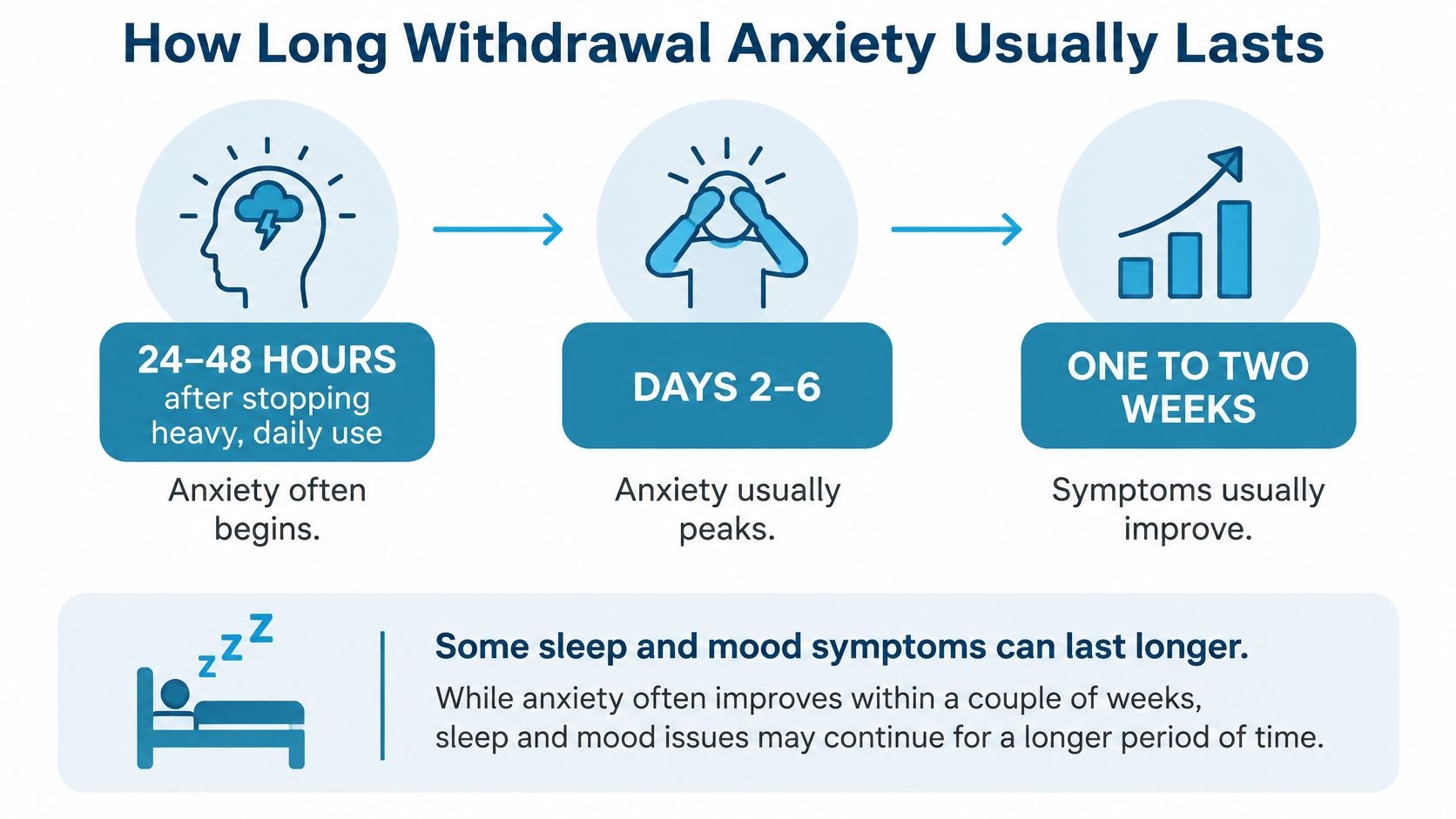
Anxiety after quitting weed often begins within 24-48 hours of stopping heavy use, peaks around days 2-6, and usually eases within 1-2 weeks, while some sleep trouble can last longer. But if cannabis used to help you feel calmer, how can you tell whether you're experiencing withdrawal or noticing anxiety that was already there?
That distinction matters more than finding an exact recovery date. A difficult evening doesn't necessarily mean quitting was a mistake, and persistent anxiety shouldn't automatically be dismissed as withdrawal. The useful clues are when symptoms started, what accompanies them, and whether your daily functioning is improving.
Table of Contents
Why Anxiety Shows Up After You Quit Weed - Why withdrawal estimates look so different
How Long Withdrawal Anxiety Usually Lasts - Why there isn't one universal peak day - Keep a brief daily record
Withdrawal Anxiety or Something Else? - Compare patterns, not just intensity - What to bring to an assessment
Breaking the Loop Between Sleep and Cravings - Build replacements before you need them - Make cravings easier to respond to
When Anxiety Needs Professional Help - Signs that shouldn't wait - Persistent symptoms deserve assessment too
Deciding Whether to Talk With a Therapist About Anxiety - When a conversation may be useful
Why Anxiety Shows Up After You Quit Weed
Yes, anxiety after stopping weed is a recognized withdrawal response, particularly after heavy or long-term use. The National Institute on Drug Abuse lists nervousness or anxiety among withdrawal symptoms and cites an estimate that 12.1% of people who use cannabis frequently experience withdrawal.
Consider an illustrative composite, not a real client: a man who uses cannabis every evening to unwind stops using and suddenly feels tense around his usual smoking time. He notices a tight chest, paces through the apartment, and wonders what he's anxious about. Nothing obvious happened that evening.
THC acts on the endocannabinoid system, which helps regulate stress, mood, appetite, and sleep. With repeated exposure, the nervous system adapts to THC's presence. Removing it can mean a period of readjustment, while the person is also losing a familiar way of transitioning out of the day.
Why withdrawal estimates look so different
A 2020 systematic review and meta-analysis involving 23,518 participants estimated cannabis withdrawal syndrome in 47% of regular or dependent users. Estimates were approximately 17% in population-based samples, 54% in outpatient samples, and 87% in inpatient samples.
Those differences likely reflect dependence severity and treatment needs, rather than proving that a treatment setting itself changes withdrawal risk. They also explain why the broader frequent-user estimate and the pooled estimate aren't interchangeable.
These are estimates of withdrawal syndrome, not the percentage of people who experience anxiety alone. Your own experience will depend on your pattern of use and circumstances, not the average from a study.
Withdrawal anxiety doesn't mean quitting was a mistake. It means your symptoms deserve attention without turning them into a verdict about whether you can cope without cannabis.
The evening discomfort in that composite example could involve physical adjustment, anticipation of the missing routine, or an existing worry that cannabis helped him avoid. The question isn't just whether quitting can cause anxiety. It's when this looks like withdrawal, and when something else needs attention.
How Long Withdrawal Anxiety Usually Lasts
The usual pattern is an early rise followed by gradual improvement, not a steady decline from the moment you stop. A clinical review of cannabis withdrawal management describes onset within 24-48 hours, a common peak around days 2-6, and improvement over 1-2 weeks, although some symptoms can continue for 3 weeks or longer among heavy users.
Typical withdrawal anxiety timeline after stopping regular cannabis use
Timeframe | What Typically Happens | Common Symptoms |
|---|---|---|
Day 1-2 | Anxiety and restlessness often begin 24-48 hours after last use | Irritability, poor sleep, appetite changes |
Day 2-6 | Symptoms commonly peak in intensity | Nervousness, insomnia, sweating, headache, low mood |
Week 1-2 | Anxiety gradually eases from its peak | Sleep and restlessness may still fluctuate |
Week 3 onward | Most symptoms return toward baseline, although recovery can take longer after heavy use | Occasional sleep disruption can linger longer |
These are typical ranges, not deadlines. The graphic offers a visual reference for that general course.
Why there isn't one universal peak day
The studies summarized in a review of withdrawal time courses don't all follow the same curve: a controlled study found anxiety and irritability greatest during the first three days, while 20%-56% met surrogate DSM-5 withdrawal criteria at different points during the first 30 days, with no more than 10% meeting criteria at moderate intensity. A separate clinical time-course study described in that review found overall withdrawal severity increasing through approximately day 10, then declining over the following 20 days.
That later peak belongs to that particular study. It isn't a prediction that everyone should expect to feel worse until that date. The studies also measured different things: anxiety intensity, overall withdrawal severity, and whether people crossed a symptom threshold aren't identical outcomes.
Use the calendar as context rather than a test you can pass or fail. A person can have a rough night while their overall course is improving.
Keep a brief daily record
A phone note or paper notebook is enough. Each morning, record:
Anxiety: Mild, moderate, or severe, plus when it was strongest.
Sleep: Approximate duration, awakenings, and disturbing dreams.
Other symptoms: Appetite, irritability, restlessness, sweating, or headaches.
Functioning: Whether you could attend school, work, eat, or connect with someone.
Context: Caffeine, alcohol, cravings, stressful events, and any cannabis use.
An entry might read: Anxiety moderate after dinner; slept poorly; appetite better; completed work; craving strongest when alone.
For a practical monitoring period, continue each morning for three weeks if symptoms remain manageable. You're looking for direction: shorter episodes, more settled periods, or a return to ordinary activities, not a perfectly smooth recovery.
Withdrawal Anxiety or Something Else?
Anxiety can be the symptom you notice most without being the only symptom that matters. The diagnostic criteria summarized in a systematic review in the British Journal of Psychiatry require at least three of seven symptom categories, emerging within approximately one week of stopping heavy, prolonged use: irritability or anger, anxiety, sleep difficulty, appetite or weight loss, restlessness, depressed mood, and physical discomfort.
That framework isn't a self-diagnosis checklist. A clinician also considers distress, impairment, other substances, and other explanations for the symptoms.
Compare patterns, not just intensity
The possibilities below are working hypotheses, not conclusions. Withdrawal and an underlying difficulty can coexist.
Anxiety patterns after quitting and what each usually points to
Pattern | Usually Points To | Next Step |
|---|---|---|
Onset within about two days of stopping, with other withdrawal symptoms, easing over two to three weeks | Cannabis withdrawal | Track symptoms daily and keep routines steady |
Anxiety present before any cannabis use or during long periods of abstinence | Possible independent anxiety disorder | Arrange a clinical assessment for anxiety |
Anxiety that worsens or stays severe after the expected withdrawal window | Possible co-occurring depression, trauma, ADHD-related dysregulation, or another cause | Seek a professional evaluation |
Anxiety that returns mainly in situations you used to manage with cannabis | Coping gap or stress that cannabis was masking | Build replacement strategies and consider therapy |
Panic that prevents functioning, paranoia, hallucinations, or no sleep for several nights | Possible urgent medical or psychiatric concern | Contact a doctor or emergency services promptly |
A clinical review of cannabis withdrawal supports looking at symptom clusters and functioning rather than assuming that all post-cessation anxiety has the same cause. Anxiety that predates use or remains severe deserves assessment beyond withdrawal alone.
Cannabis itself doesn't have a one-directional relationship with anxiety. A JAMA Psychiatry evidence review describes variation associated with dose, THC and CBD composition, and individual characteristics. Feeling calmer after using doesn't establish whether cannabis treated an independent condition, relieved withdrawal, or temporarily changed your experience of stress.
For someone with ADHD, it's also useful to separate longstanding trouble managing emotions or daily demands from changes that appeared after stopping. ADHD isn't a moral failing, but it shouldn't become the explanation for every uncomfortable feeling either.
What to bring to an assessment
Use history: When you first used, when you last used, typical frequency, and product potency if known.
Earlier anxiety: Whether worry, panic, or avoidance existed before cannabis.
Current course: Sleep, appetite, triggers, and changes in functioning.
Thinking patterns: Whether you're taking useful action or repeatedly revisiting the same question.
Our explanation of rumination versus problem-solving can help clarify that last distinction without requiring you to decide on a diagnosis.
Breaking the Loop Between Sleep and Cravings
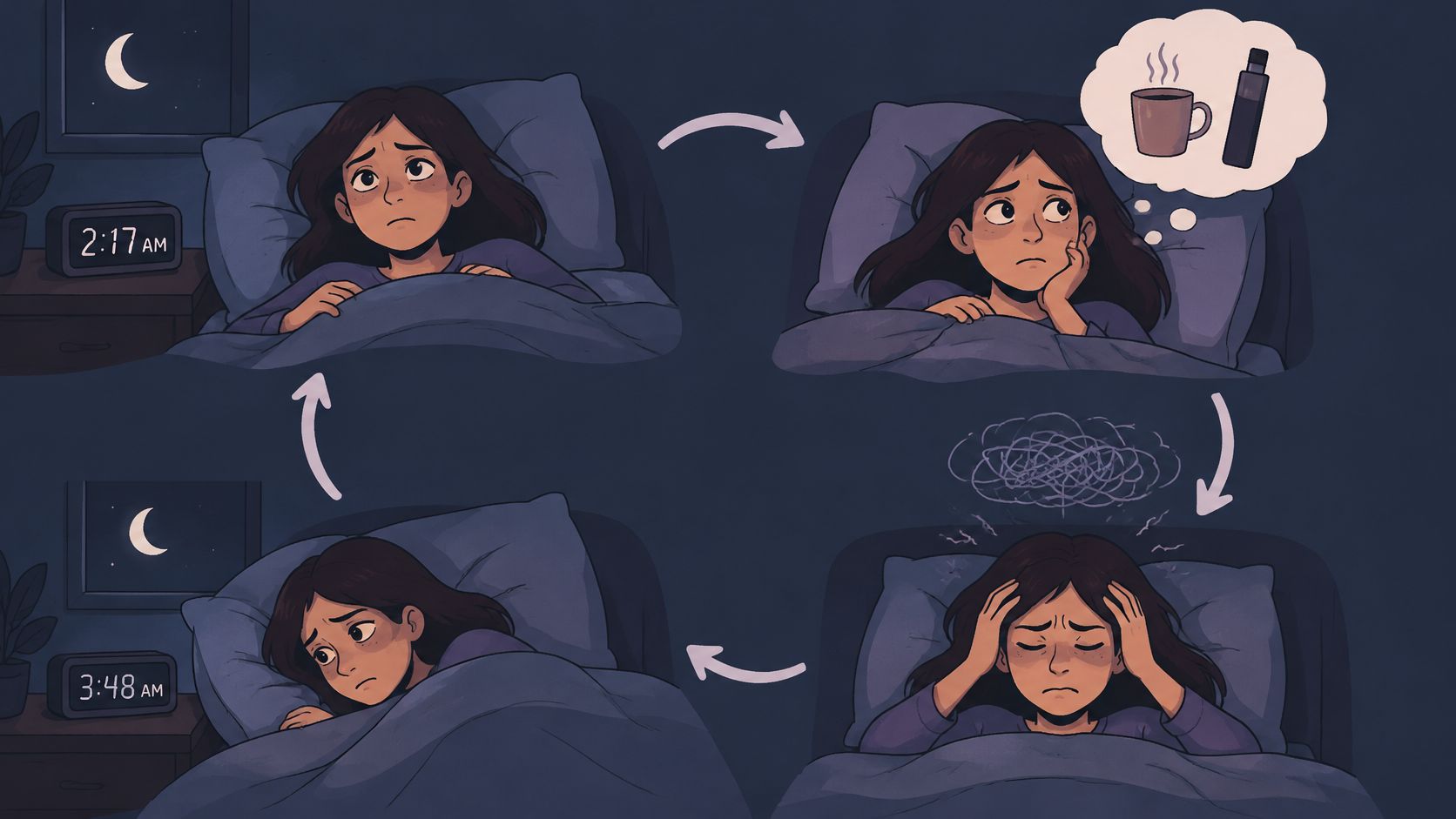
Stopping cannabis can remove both a substance and a familiar routine for calming down. Withdrawal may disrupt sleep; after poor sleep, you may feel more threatened by ordinary problems, spend longer replaying them, and want fast relief. A clinical review of cannabis withdrawal and treatment describes the importance of addressing sleep, coping, and relapse prevention together rather than treating anxiety in isolation.
A hypothetical example: a man who usually unwinds with a joint lies awake replaying work emails after stopping. He's irritable the next day, interprets a colleague's short message as criticism, and feels a strong pull to use that evening. The task is not to resist harder. It's to make that sequence less likely and less overwhelming.
Nighttime distress can feel especially consuming when you're exhausted and alone.
Build replacements before you need them
Name the situations cannabis covered. Write down the actual moments: arriving home, getting ready for bed, socializing, recovering from conflict, or facing an unfinished task. Each may require a different response. Common slip: calling everything general anxiety, which makes it harder to choose something useful.
Give each situation a specific alternative. After work, that might mean changing clothes and walking outside before opening your messages. After an argument, it might mean a shower followed by a conversation once you're less activated. Common slip: waiting until a craving arrives to invent a plan. Put the shoes by the door or arrange the call beforehand.
Make your sleep schedule more predictable. Choose a consistent wake time, get daylight and movement during the day, and reduce caffeine and alcohol. Don't try to repair every tired afternoon with a long nap, which can make bedtime harder. If you regularly wake up feeling anxious, note whether the distress changes after getting out of bed and beginning your routine, rather than assessing your entire day while still under the covers.
Respond to sensations without immediately fighting them. Try comfortable, paced breathing with an unforced exhale. In an Acceptance and Commitment Therapy, or ACT, approach, you might name tightness in your shoulders or a thought that you can't handle the evening, then choose your next action without waiting for complete calm. Common slip: treating every familiar anxiety sensation as an emergency. New or concerning physical symptoms still deserve medical attention.
These strategies aren't a test of how well you can relax. Their purpose is to give you options when your usual response isn't available.
The following video is an additional resource to consider alongside a personalized plan.
Make cravings easier to respond to
Delay the decision and observe the urge. When a craving appears, postpone acting while you complete a planned activity, such as washing dishes or walking around the block. Notice whether the urge changes in intensity, location, or urgency. You don't have to prove it will disappear. Common slip: beginning a long negotiation with yourself late at night, when you're tired and distressed.
Tell someone what support would help. A concrete request is easier to respond to than a vague announcement: ask a friend to check in after dinner or invite you for a walk. For a teen, that person might be a trusted adult who can help arrange care without turning the conversation into punishment. Common slip: withdrawing from everyone on the hardest days because you don't want to explain yourself.
Review your log weekly, not constantly. Look for changes in functioning and patterns you can act on. Perhaps social evenings are manageable but unstructured time alone remains difficult. If executive-functioning difficulties make tracking burdensome, keep the note short and attach it to an existing morning habit. Common slip: treating a bad evening as stronger evidence than a broader pattern of improvement.
Practical rule: Choose the next helpful action, not the action that guarantees you won't feel anxious.
Sleep may recover more slowly than daytime anxiety. That doesn't mean every sleepless night should be ignored, but it does mean you don't need to interpret imperfect sleep as evidence that your whole plan has failed.
Cannabis products also aren't a reliable substitute for an anxiety treatment plan. The 2025 Cannabis Evidence update on anxiety and mood disorders found mixed, very-low-certainty evidence that THC improves anxiety and described the risk of mistaking withdrawal relief for treatment of the underlying condition.
If you use again, a lapse isn't a verdict on your ability to change. Record what happened before it, what relief you wanted, and what support was missing. You can revise the plan without turning the event into a judgment about your character.
When Anxiety Needs Professional Help
Don't assume that every symptom after quitting is something you should endure. Hallucinations, severe agitation, paranoia, or thoughts of suicide require attention, regardless of whether withdrawal seems like a possible explanation.
A summary of a 2024 case series published in the British Journal of Psychiatry reports a median interval of 6 days between cannabis cessation and psychosis onset among the cases described. This uncommon but serious presentation is a reason to recognize warning signs, not a prediction that ordinary withdrawal anxiety will become psychosis. A case series cannot tell you the likelihood for everyone who stops using cannabis.
Signs that shouldn't wait
Seek same-day medical or psychiatric help for:
Suicidal thoughts or safety concerns: Especially if you might act on them or can't keep yourself safe.
Hallucinations or paranoia: Hearing or seeing things others don't, or feeling intensely threatened without a clear basis.
Severe agitation: Feeling unable to settle or behaving in ways that could put someone at risk.
Disabling panic: Anxiety that prevents eating, leaving home, attending school, or managing basic responsibilities.
Several nights without sleep: Particularly when accompanied by confusion, unusual behavior, or escalating distress.
Contact a doctor urgently for these symptoms. If there's immediate danger, contact emergency services; in the United States, you can also call or text 988 for crisis support. Don't wait for a routine therapy appointment when safety is uncertain.
Persistent symptoms deserve assessment too
Anxiety that keeps worsening after the expected withdrawal period deserves professional evaluation even without an emergency. So does anxiety that leaves you relying on other substances to get through the day.
A medical evaluation can consider other substances, medication effects, sleep problems, and physical or psychiatric conditions. Therapy supplements rather than replaces medical assessment or medication management when those are appropriate.
Bring your symptom log and an honest account of your cannabis use. You don't need to minimize it, exaggerate it, or arrive with the correct explanation.
The most useful question to bring is: What has changed since stopping, and what was going on before cannabis?
Deciding Whether to Talk With a Therapist About Anxiety
You don't have to settle the withdrawal-versus-anxiety question before talking with a therapist. Therapy can help you examine what you're experiencing while leaving room for uncertainty and medical input.
For anxiety, the aim isn't to eliminate every uncomfortable feeling. It's to develop a different relationship with anxiety so it no longer gets to make all the decisions. With cannabis, that can include exploring use without judgment and deciding what relationship you want with it moving forward.
When a conversation may be useful
Consider reaching out if:
Symptoms aren't settling: Anxiety continues beyond the typical recovery period or interferes with ordinary life.
Cannabis was your main coping strategy: You're unsure how to manage evenings, conflict, social stress, or sleep without it.
You're ambivalent: You don't know whether you want to reduce use, pause, or stop.
Other concerns may be involved: You suspect depression, ADHD, trauma, or longstanding anxiety needs attention.
Behavioral treatments including cognitive behavioral therapy, motivational enhancement, and contingency management have evidence for cannabis use disorder, according to NIDA. NIDA also reports that no FDA-approved medication exists specifically for cannabis use disorder or medically assisted cannabis withdrawal. That doesn't rule out medical care for associated symptoms or another condition.
At our practice, clients often begin with weekly sessions and transition to every other week or less frequently as therapy progresses. Our approach to anxiety therapy in Washington, DC involves slowing things down, understanding what's happening, and choosing responses that fit your life rather than applying a single formula.
A doctor is a sensible first stop when symptoms are severe or medical questions are present. Otherwise, an initial consultation can help you decide whether the therapeutic fit feels right, without needing a diagnosis or a fully formed goal beforehand.
Nick Donahue LICSW offers individual therapy for teens and adults navigating anxiety, ADHD, and questions about cannabis use, in person in Washington, DC and virtually across DC and Virginia. If you'd like support understanding what's changed since quitting and building other ways to cope, visit Nick Donahue LICSW to arrange an initial consultation.
Comments